Key takeaways
- A visibility percentage by itself is not a strategy. If your dashboard can't tell you which questions trigger mentions and which route buyers to competitors, it's a vanity metric with good production values.
- Single prompts and low run counts are mostly statistical noise. Peec AI's analysis of 120 million chats found that pinning a 50%-visibility prompt to within 5 percentage points takes close to 400 runs; confirming a real change takes roughly double that.
- Platform-wide shifts get mistaken for brand performance constantly. ChatGPT's citations per response dropped about 27% around the GPT-5.3 rollout in March 2026, which would show up as a "loss" on any dashboard that doesn't separate market-level noise from brand-specific movement.
- Good dashboards segment by prompt type (branded, organic, comparison) because citation behavior is wildly different across them, and they tie every tracked metric to a decision, not just an observation.
- Tools like Promptwatch are built around this distinction: they don't just report a score, they explain why it moved and queue up the fix.
The number everyone reports and nobody acts on
Here's a scene that's probably played out in your own marketing meetings. Someone pulls up a dashboard. It says brand visibility in AI answers is at 32%, up three points from last month. People nod. Someone says "good trend." Then someone else asks the only question that matters: okay, so what do we do about it? And the room goes quiet, because the dashboard gave everyone a number but no reason.
This isn't a new problem dressed up in AI terminology. Funnel's 2026 Marketing Intelligence Report found that 41% of in-house marketers report results without ever analyzing the why behind them. Prompt tracking dashboards for AI search visibility have inherited the exact same disease, just with a shinier UI and a scarier-sounding acronym.
The difference with AI visibility dashboards specifically is that the noise problem is worse. A share-of-voice number in Google Analytics is at least measuring something stable, a page either got a session or it didn't. A visibility score built from a handful of daily AI prompts is measuring something that behaves, as one analysis memorably put it, like flipping a biased coin. One flip tells you nothing.
Why most prompt dashboards are mostly noise
The statistics are worse than people realize
Peec AI ran the numbers across seven months and 120 million chats to figure out how much of the swing in visibility scores is real signal versus random variation. The conclusion is blunt: every prompt behaves like a biased coin, and a single run tells you almost nothing about a brand's true visibility rate. Only repeated runs over time reveal it.
The math backs this up. Using a standard confidence-interval formula, doubling the precision of a visibility score requires four times the number of runs. To pin a 50%-visibility prompt down to within 10 percentage points takes around 100 runs. To get that down to 5 points takes close to 400. And confirming that a score has genuinely changed, not just estimating where it currently sits, takes roughly double the runs again. Track a single prompt once a day and you're looking at three months to a year before you can trust the baseline number, and six months to two years before you can trust that a change actually happened.
That's the quiet failure mode of most prompt tracking setups: teams check a dashboard weekly and react to swings that are, statistically, just noise.
Platform updates get mistaken for brand wins and losses
The second failure mode is attribution. Promptwatch's own data shows ChatGPT's average citations per response dropped about 27% almost overnight around the GPT-5.3 rollout on March 4, 2026, from roughly 6.4 sources per response the week before down to 4.7-4.9 by late March, with no recovery a month later. That hit GPT-5.3, GPT-5.4, and GPT-5-Mini simultaneously. It had nothing to do with any individual brand's content.
A dashboard that just reports "your citation count dropped 27% this month" without flagging that the whole platform shrank its citation pool is going to send a marketing team chasing a ghost. Separating platform-level shifts from brand-specific ones is not optional, it's the baseline requirement for a dashboard to be trustworthy at all. Promptwatch's citation drop analysis is a good example of the kind of market-context data a dashboard needs behind it.
Prompt sets get built around vanity, not gaps
A third common failure: teams build their tracked prompt list around what looks impressive rather than what's useful. Peec AI flags the common mistake of agencies tracking only "best [category]" listicle-style prompts because they sound important, which produces a misleading view of actual visibility. Brand-versus-brand prompts are another trap, adding a prompt on a topic you already dominate inflates the aggregate score without reflecting anything new.
Siteimprove's take on this is sharp: your visibility score and your content strategy are not the same thing. Share of voice and citation rate are outcome metrics, they confirm visibility happened somewhere, to some degree, across prompts you may or may not have chosen carefully. They don't point toward a fix. Prompt-level data does, because it treats the question as the unit of analysis instead of the brand mention. A question triggers a response. That response either names you or it doesn't. Track that pattern across hundreds of real customer questions and you get something closer to a content roadmap than a scoreboard.
What separates a useful dashboard from a noisy one
It segments by prompt type, because they behave completely differently
Promptwatch's citation data shows this clearly. Branded prompts, where someone names your company directly, tend to cite far fewer domains. Only 21.3% of branded-prompt responses cite 10 or more domains, and the most common pattern is exactly 5 sources, with 40.7% citing 5 or fewer. Organic, category-level prompts are much more crowded, 52.5% cite 10+ domains, 71.8% cite 8+. Competitor-comparison prompts stay crowded too, almost never settling on a single source.
A dashboard that lumps all of this into one aggregate "visibility score" is hiding the most useful information it has. Branded prompts tell you whether your own content is winning its own search. Organic prompts tell you whether you can break into a crowded conversation. Those require completely different fixes, and a single blended number erases the distinction.
It flags market-wide noise before brand-specific signal
Any dashboard worth trusting should answer "did the market shrink, or did we lose share" before it lets a marketing team panic. That means tracking platform-level baselines, like average citations per response by engine, alongside brand numbers. For context: ChatGPT cites around 5 sources per web-search answer on average, Google AI Overviews cites roughly double that at around 10, and Perplexity sits at almost exactly 10 with unusual day-to-day stability. Microsoft Copilot, by contrast, has swung from under 2 sources per response to nearly 17 within weeks, which tells you Copilot's retrieval architecture is still being rebuilt. A dashboard that doesn't show these baselines will mislabel platform volatility as brand performance constantly.
It's built on a prompt set designed to find gaps, not confirm wins
Profound's framework for designing a prompt set is a reasonable template: start with existing SEO keyword clusters translated into conversational questions, mine actual sales calls and support tickets for real phrasing customers use, and deliberately balance the set across the buyer journey, awareness, evaluation, conversion, post-purchase, rather than stacking it with queries you already win.
SE Ranking's research arrives at a similar number from a different angle: track by topic cluster or persona rather than every individual phrasing, with something like 15 prompts per persona as a workable middle ground. As RicketyRoo's Melissa Popp put it, the goal is specific enough to see what's working, loose enough that you're not spending more time tracking than creating.
One underused filter worth applying: prioritize prompts where the AI is currently citing lower-authority domains, forums, or content you could realistically get featured on. Those are the prompts where effort actually moves the needle. Prompts dominated by unbeatable, high-authority sources are a waste of a team's limited optimization time, even if they're high-volume.
It connects every metric to a decision someone can actually make
This is the rule that kills vanity-metric creep before it starts. If a number on the dashboard can't be tied to a specific action, a specific piece of content, or a specific business outcome within a reasonable reporting window, it shouldn't be on the dashboard. New AI visibility tools make it tempting to track citation volume or "AI impressions" as if they were inherently meaningful. They're not, unless someone can point to the prompt, the competitor set, and the content gap behind the number.
A comparison of what dashboards get right and wrong
| Dashboard trait | Noise | Signal |
|---|---|---|
| Reporting style | Single blended visibility score | Visibility broken down by prompt type: branded, organic, comparison |
| Sample size | A handful of prompts run occasionally | Dozens to hundreds of prompts run daily, with statistical confidence noted |
| Context | Raw citation count with no baseline | Citation count alongside platform-wide baselines (engine, model version) |
| Prompt sourcing | Vanity "best of" listicle prompts | Prompts mined from sales calls, support tickets, and real buyer language |
| Output | A chart to glance at | A prioritized list of content gaps tied to specific prompts and competitors |
| Action loop | Report, discuss, forget | Report, diagnose, generate or fix content, re-measure |
Tools that actually try to close the loop
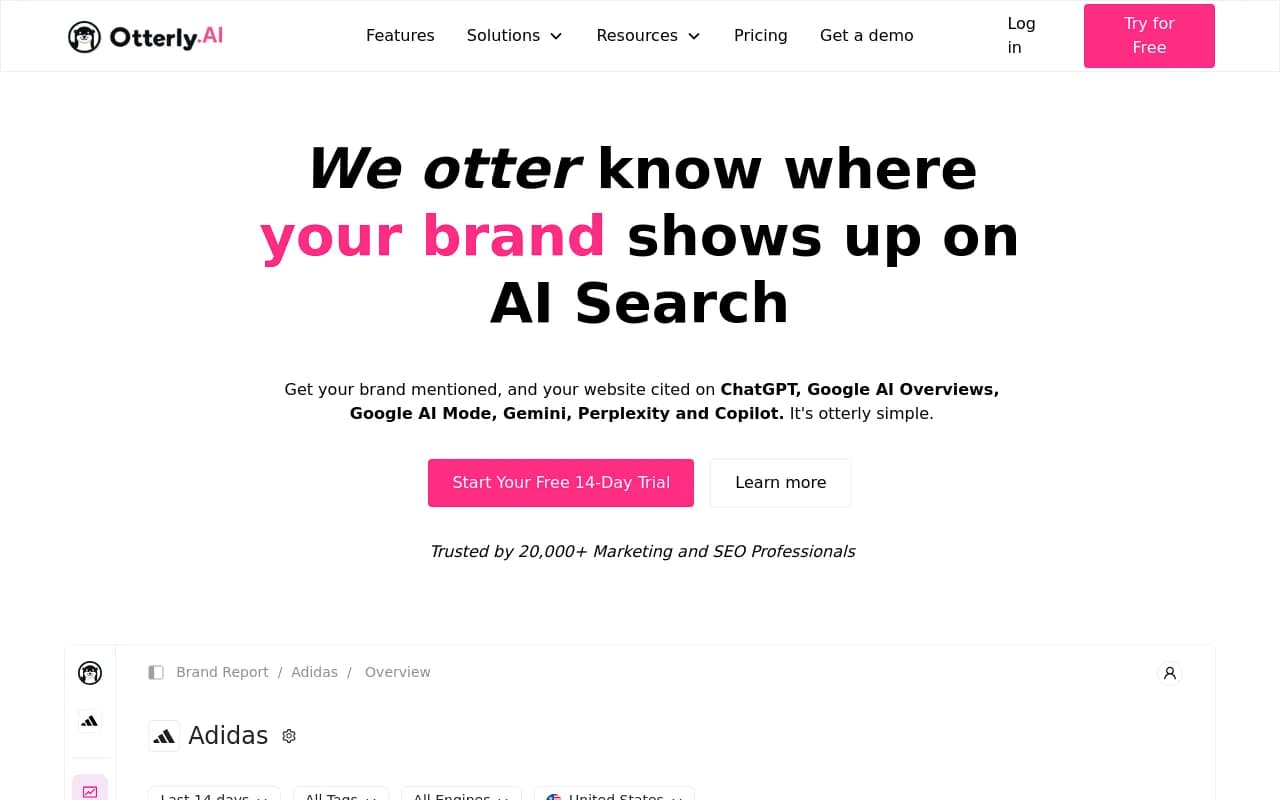
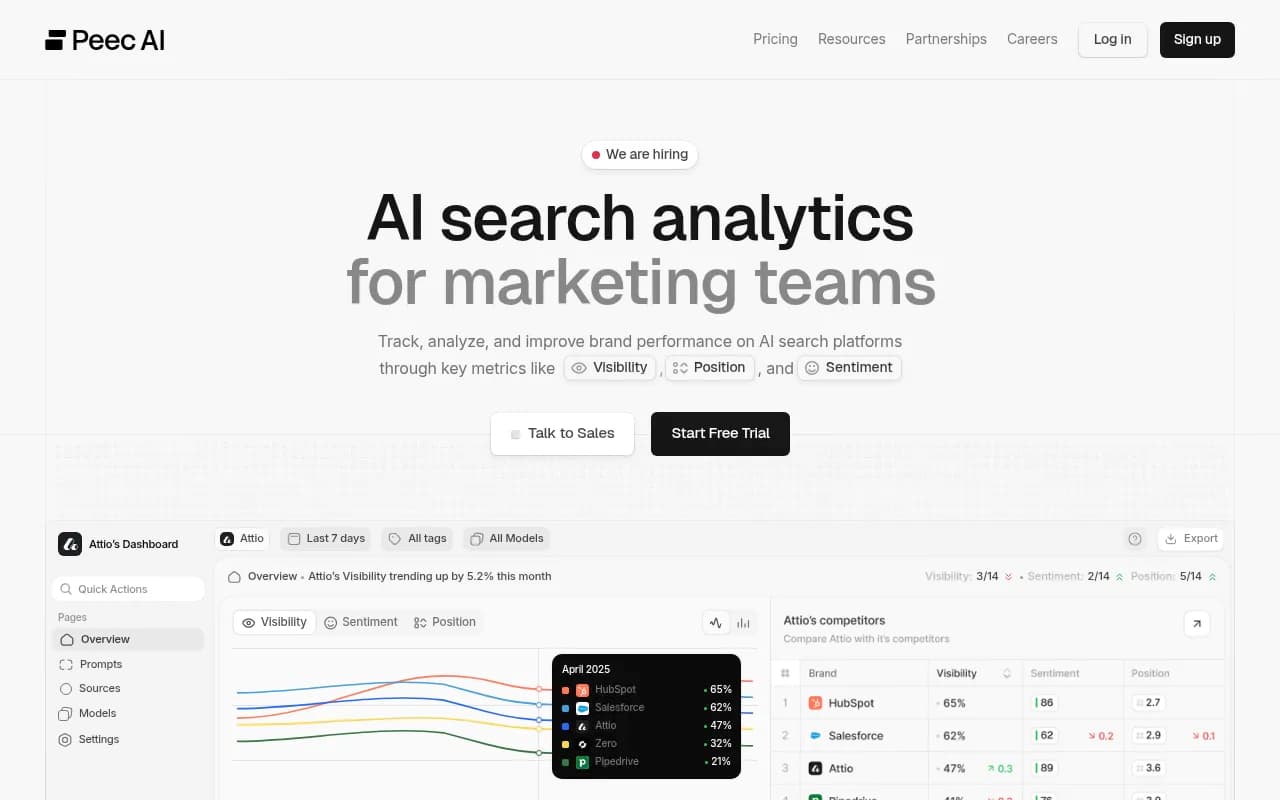
Most AI visibility tools stop at the "report" stage. Peec AI and Otterly.AI are solid, affordable prompt trackers, Otterly starts at $29/month for 15 prompts across a fixed engine set, Peec starts at $95/month and lets you pick which engines to track per project. Both do a competent job of logging mentions across models. Neither one does much to help a team act on what it finds; you still have to go build the content brief yourself.
Profound sits at the premium end, its enterprise tier covers up to 10 engines plus ChatGPT Shopping tracking, but its public starter pricing has reportedly been pulled from its own pricing page as of October 2026, leaving mostly a free trial and custom enterprise deals. Semrush's AI Visibility Toolkit, now under Adobe after the April 2026 acquisition, bundles tracking into a broader SEO suite at $99/month per domain for 25 custom prompts, which is fine if you already live in Semrush but shallow as a dedicated visibility tool.
Where this gets more interesting is agentic platforms that treat the dashboard as a starting point rather than the deliverable. Promptwatch tracks prompt volumes and difficulty scores, segments citation data the way described above, logs actual AI crawler visits to a site (so you can see which pages ChatGPTBot or PerplexityBot are reading, not just guess), and then runs Content Agents that draft and publish fixes for the gaps it finds. That loop, monitor, diagnose, generate, publish, re-measure, is the part most prompt trackers skip entirely.
Promptwatch also tracks Reddit and YouTube citations specifically, which matters more than it sounds. Promptwatch's own research shows reddit.com's share of ChatGPT Search citations collapsed from roughly 4% to 0.5% in a single day on August 14, 2026, a shift any dashboard relying on stale assumptions about Reddit's importance would have completely missed. That's the kind of platform-level context a good dashboard has to carry, not just brand-level numbers.
Building the habit, not just the dashboard
A dashboard is only as useful as the meeting built around it. If your team's AI visibility review is still "here's the number, any questions," the fanciest tool in the world won't fix that. The teams getting real value out of prompt tracking treat the weekly or monthly review as a triage session: which prompts moved for reasons we understand, which moved for reasons we don't yet, and which gaps are worth a content brief this week.
Start smaller than feels comfortable. A frozen set of 50-100 prompts, split roughly across branded, organic, and comparison queries, tracked daily, beats a sprawling 500-prompt list refreshed sporadically. Resist the urge to add prompts just because a competitor ranks well on them; that's how aggregate scores get inflated into meaninglessness. And whenever a number moves, check the platform-level baseline before assuming it's about you.
If you want to see more of the current field of AI visibility tools side by side, bestgeosoftware.com tracks the GEO software category in more depth, and ai-rank-tools.com is worth a look if rank tracking specifically is the gap you're trying to close.