Key takeaways
- "EU-based" and "EU-hosted" are different things. Check the vendor's headquarters, its data hosting and its sub-processors as three separate questions.
- ISO 27001 is often claimed on a website and not evidenced. Ask for the certificate, its scope and its date.
- Profound is a New York company with SOC 2 on its Enterprise tier. Its data hosting location was not stated on the pricing page when we looked, so ask for it in writing.
- Promptwatch is ISO/IEC 27001 certified and GDPR compliant, and combines tracking with content execution, which most monitoring-only tools do not.
- Cheaper EU-friendly trackers exist, but several are pure monitors. Decide whether you need monitoring only or monitoring plus action before you compare prices.
Why European teams look beyond Profound
Profound is a strong product, and I do not want to pretend otherwise. It covers many AI engines and is built for large enterprises. Profound is headquartered in New York.
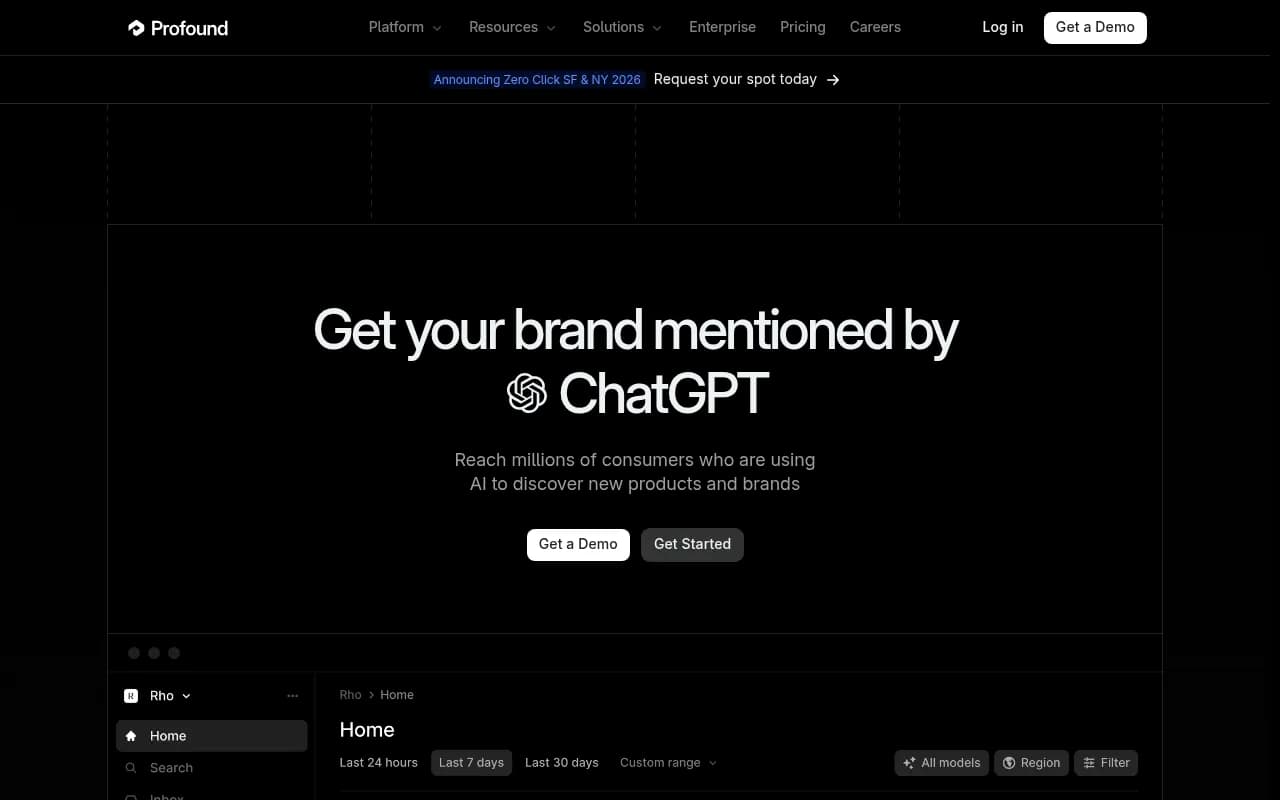
The friction for European buyers is rarely about features. It is about procurement. A DPO or security team asks three questions: where is the data processed, who are the sub-processors, and can you show me a certificate. If the answer to the first is "not stated", the deal stalls for weeks.
For context, one competitor comparison (get3rd) notes that Profound's data hosting is not stated on its pricing page, and that custom languages and regions sit on the Enterprise tier, with the trial limited to one language and one region. That is a competitor's reading, so verify it with Profound directly. I have not checked Profound's current DPA or EU hosting on its own site, and you should not rely on my summary for that.
To be fair to the other side: get3rd also says that if your security review requires SOC 2 today, a US tool like Profound is the right choice, because most European vendors do not have a SOC 2 report yet. That is honest advice and worth keeping in mind. SOC 2 and ISO 27001 are different frameworks, and some European security teams accept either.
What "European" should actually mean
Vendors use the word loosely. Before comparing any names, split the claim into parts.
| What to check | Why it matters | What to ask the vendor |
|---|---|---|
| Company HQ and legal entity | Determines which jurisdiction can compel access to data | "Which legal entity signs the contract?" |
| Data hosting region | GDPR transfer rules apply when data leaves the EEA | "Where are prompts, responses and customer data stored?" |
| DPA and sub-processors | GDPR requires a processing agreement and a list of who processes what | "Send me the DPA and the sub-processor list" |
| ISO 27001 | Independent evidence of an information security management system | "Send the certificate, scope statement and expiry date" |
| SOC 2 | Often required by US-linked enterprise buyers | "Type I or Type II, and what period?" |
| Language and market coverage | AI answers differ by country and language | "Can I track the same prompt in German, French and Dutch?" |
A European HQ does not guarantee EU hosting. A US HQ does not rule out EU data residency. The sub-processor list is where this usually gets resolved, because the AI models being queried may themselves be operated by US providers.
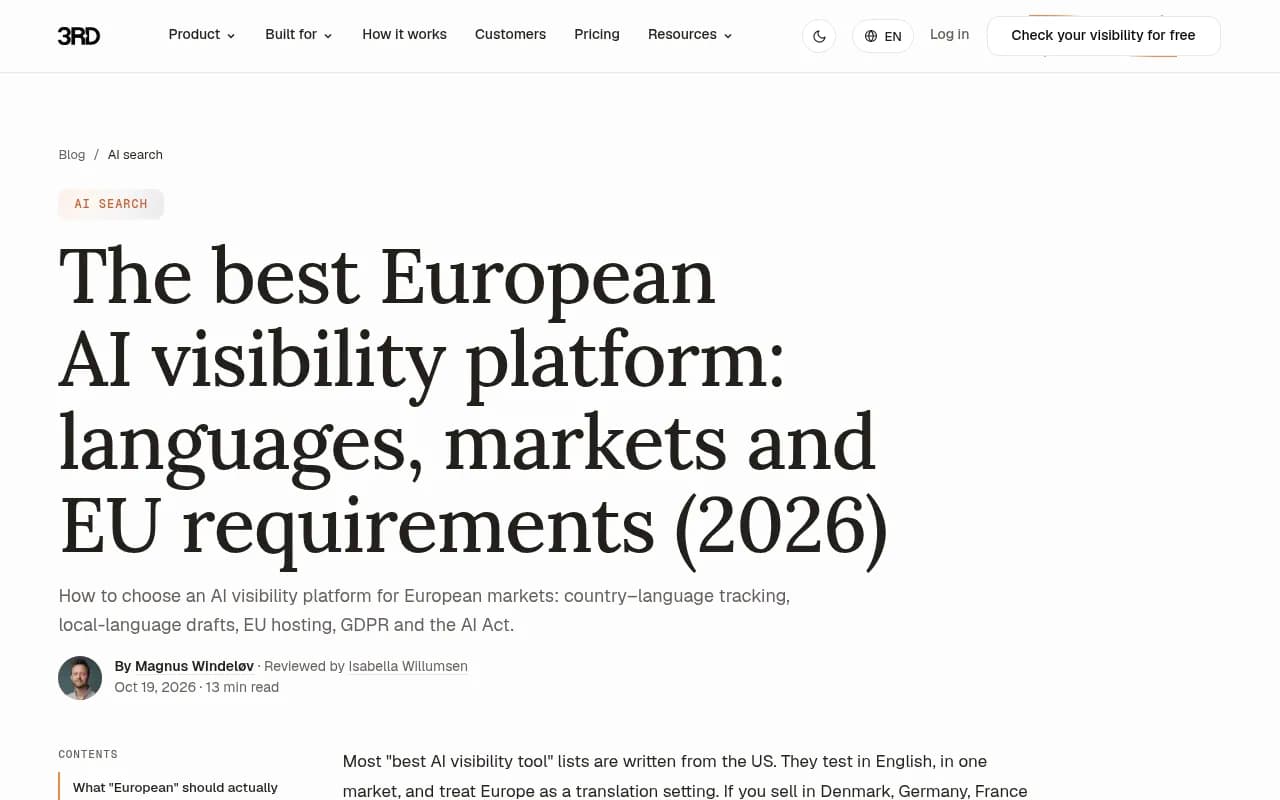
The get3rd guide above is a vendor-written piece, so read it with that in mind, but its comparison table (HQ, hosting, markets, security documents) is a good template for your own vendor scorecard.
A note on the CLOUD Act
Some European guides argue that US-headquartered providers can never fully escape the US CLOUD Act, regardless of where data is hosted. Craft AI makes this argument about LLM providers. It is a legitimate legal concern for regulated sectors, and your legal team may or may not weigh it heavily. For AI visibility tools, the personal data involved is usually limited (brand prompts, public AI answers, site analytics), so the practical risk is lower than for a tool that processes customer conversations. Still, your DPO decides, not the vendor.
Why each European market needs its own measurement
AI answers change by country and language. A prompt asked in German from Munich can produce different brands and different sources than the same prompt in English from London. If you sell across the EU, a tool that only tracks English prompts from one US location will mislead you.
There is a second reason to track per engine. Promptwatch Data's average sources per response report shows that ChatGPT cites about 5 sources per web-search answer, while Google AI Overviews and Perplexity cite about 10. Copilot swung from under 2 to nearly 17 within a few weeks before settling low. A tool that blends all engines into one score hides this. Look for per-engine reporting.
The shortlist
Promptwatch
This is the one I would put first for European teams that need both security paperwork and results. Promptwatch is ISO/IEC 27001 certified and GDPR compliant, is headquartered in Amsterdam (Promptwatch B.V., with a US office in New York), and offers SSO, audit logs and scoped API keys on the relevant plans. Customers include Rabobank, ABN AMRO, Achmea, KVK and DPG Media, which tells you it has already passed Dutch and European enterprise security reviews.

The difference from a pure tracker is what happens after the report. It monitors the real interfaces of ChatGPT, Google AI Overviews, AI Mode, Gemini, Perplexity, Copilot, Meta AI and others, per country and language. It then shows IP-verified AI crawler logs, AI-referred traffic and conversions, and a content gap analysis. The Content Agent can plan, write and publish to WordPress, Webflow or Framer. Local targeting down to exact coordinates is available on Business and above. It also tracks Reddit, YouTube and LinkedIn citations, which many monitors ignore.
Pricing starts free (Explore, ChatGPT only), then Essential at $95/month, Professional at $245, and Business at $579. Agencies pay from $199/month. Confirm current numbers at promptwatch.com/pricing. The free Agentic Readiness Check and AI Visibility Report are a quick way to see what you are dealing with before talking to anyone.
Honest caveat: the Content Agent and Agentic AI Search Optimization are on Business and Enterprise. If you only want a cheap dashboard, you will pay for more than you use.
Search Bridge
Search Bridge describes itself as GDPR-native, ISO 27001, "AI Act Ready" and a Benefit Corporation, with European data residency. Those are claims from its own comparison page against Profound, not independently verified. If it ticks your boxes, request the certificate and scope like you would with anyone else.
Neuroflash
Temso lists Neuroflash as strong for DACH and European data residency, with servers in Germany, GDPR compliance and ISO 27001 certification. It has a free plan of 2,000 words a month and paid plans from about 30 euros a month. Be careful here: it is more of a content-writing tool than an AI visibility tracker. It can be a sensible companion for German-language copy, but I would not buy it as a Profound replacement.
Peec AI and Otterly
Peec AI (Berlin) and Otterly (Austria) are the names European teams meet first when they want a cheaper, simpler tracker. I have not verified their certifications on their own sites, so treat that as an open item for your vendor call. Both are monitoring-focused. Per Frase's listicle, Otterly starts at $29/month for 15 prompts and Peec AI at about $80/month. Both are fine if you only need to know whether you are mentioned, but they stop short of crawler logs, AI traffic attribution and content production.


Qwairy, 3RD and Teun.ai
Qwairy is a GEO platform that covers monitoring and optimization.

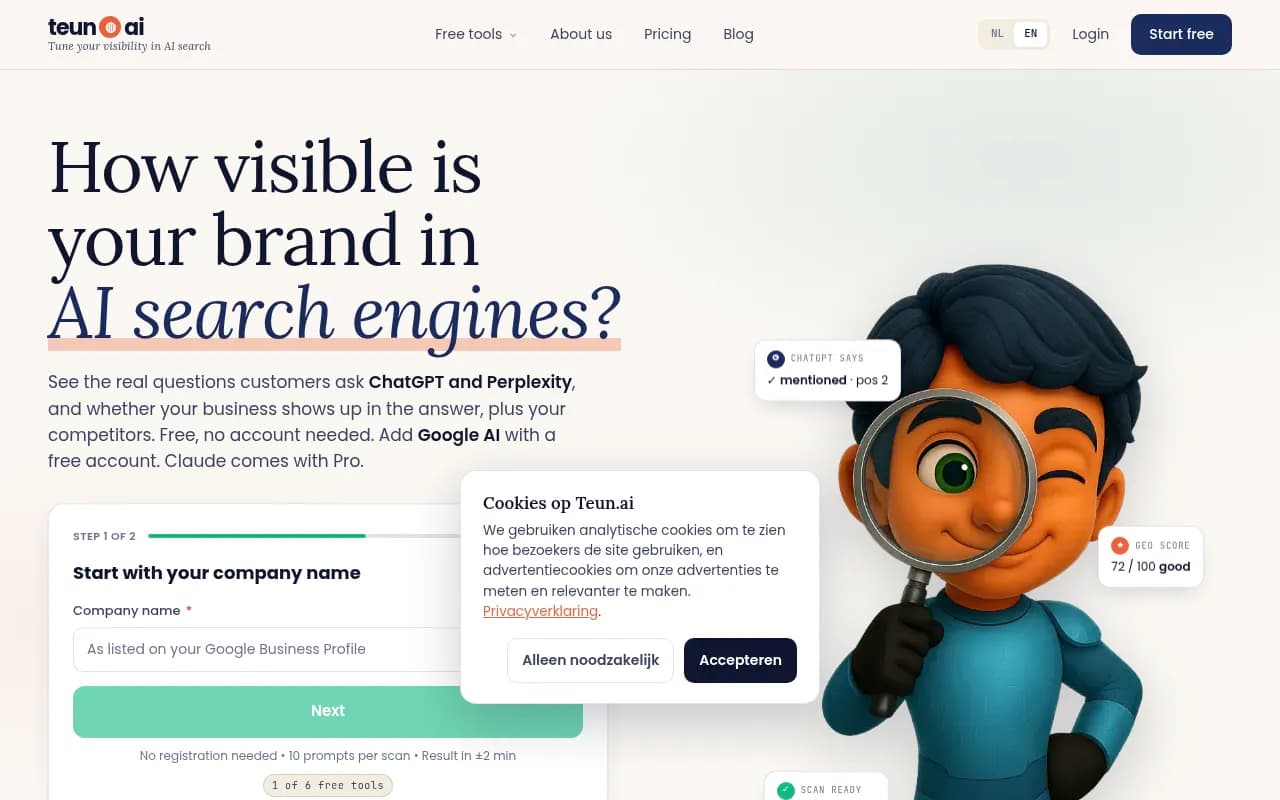
3RD (get3rd.com) is a European platform. It is candid that it has no SOC 2 or ISO 27001 report yet, says its controls follow both frameworks, and makes documentation available to Agency and Enterprise customers. That candour is useful, but it means a strict procurement team will want to see the paper first. Teun.ai is a Dutch toolkit with free rank checks, useful for a quick look at the Dutch market.
Other global options worth knowing
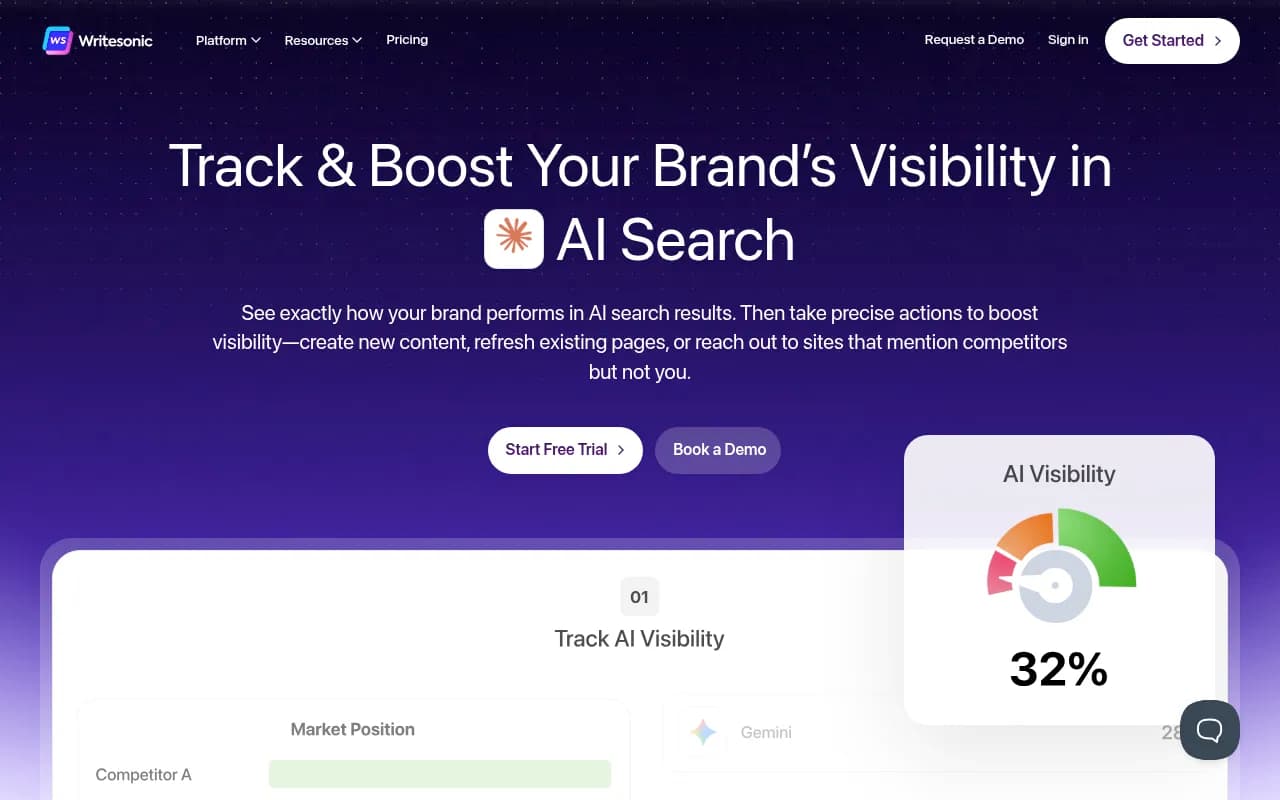
Semrush's AI Visibility Toolkit arrives with a higher plan, not the entry SEO plan (the entry plan was cited at $117.33/month billed annually in September 2026). Writesonic starts around $79/month billed annually. ZipTie is usage-priced from about $35.63. Frase warns that price per prompt "hides the real number", and I agree: compare cost per tracked response, number of engines and number of countries, not headline prompt counts.
Side-by-side comparison
| Platform | HQ | Security claims | Strength | Watch out for |
|---|---|---|---|---|
| Promptwatch | Amsterdam (US office in NYC) | ISO/IEC 27001, GDPR, SSO on Enterprise | Tracking plus crawler logs, traffic and content execution | Content Agent only on Business and up |
| Profound | New York | SOC 2 on Enterprise (per get3rd) | Enterprise coverage across many engines | Hosting region not stated on pricing page |
| Search Bridge | Vendor claims European | GDPR, ISO 27001 (vendor claim) | EU data residency positioning | Claims unverified |
| Neuroflash | Germany | GDPR, ISO 27001 (per Temso) | German-language content | More content tool than tracker |
| Peec AI | Berlin | Not verified | Simple tracking from about $80/month | Monitoring only |
| Otterly | Austria | Not verified | Entry price from $29/month | 15 prompts at the lowest tier |
| 3RD | Europe | Controls follow ISO 27001 and SOC 2, no report yet | Country-language tracking | No certificate yet |
Pricing figures come from third-party listicles (Frase, Temso) and vendor pages, so confirm them before budgeting.
EU requirements without the fog
GDPR
You need a signed DPA, a current sub-processor list, and clarity on where processing happens. Most AI visibility tools handle limited personal data, but analytics scripts and crawler logs can contain IP addresses. Ask how those are stored and for how long.
ISO 27001
A certificate has a scope. A company can be certified for one office or one product and still list the badge on every page. Ask which entity, which services and which date range. If a vendor says its controls "follow" ISO 27001, that is not certification.
The EU AI Act
Vendors love the phrase "AI Act ready". For a visibility tracker, which mostly reads public AI answers, the direct obligations are light. The more relevant impact is if you use generated content at scale: transparency requirements around AI-generated content may apply to what you publish. Ask your legal team, not the vendor's marketing page.
When a US tool is still the right call
If your parent company or key clients demand SOC 2 right now, Profound's SOC 2 on Enterprise may decide the matter. If you are mostly English-language and global, residency matters less. Choose on evidence, not on flag.
A buyer's checklist for European teams
- Ask for the DPA and the sub-processor list before any demo.
- Ask where prompts, responses, crawler logs and analytics are stored.
- Request the ISO 27001 certificate or SOC 2 report, with scope and date.
- Confirm you can track by country and language, not just English from one location.
- Check that each engine is reported separately.
- Compare cost per tracked response, not per prompt.
- Decide whether you need monitoring only or monitoring plus content and crawler data.
- Verify every claim from a competitor's comparison page independently. Several facts in this guide come from vendor-written sources.
If you are replacing other US tools in the same stack, heyData's list of European alternatives (OVHcloud, Scaleway, Matomo, Piwik PRO, DeepL and others) is a useful companion, though it notes that EU-based providers still need individual review.
Where to browse more
For a wider view of the category, the GEO software directory at bestgeosoftware.com lists many more platforms, and ai-rank-tools.com focuses on AI rank trackers.
Final recommendation
If your blocker is procurement and you also want results, start with Promptwatch: ISO 27001, GDPR, an Amsterdam base and an execution layer. If your blocker is budget and you only need monitoring, shortlist Peec AI or Otterly and get their security documents in writing. If your blocker is SOC 2, Profound stays on the list. Whichever you pick, send the DPA and certificate request on day one.