Key takeaways
- Peec AI covers more AI models (8+) and offers unlimited countries/languages, making it better suited for teams with international reach or competitive tracking needs.
- ZipTie covers fewer models (4) but has a cleaner onboarding flow and integrates with Google Search Console for prompt suggestions.
- Neither tool offers content creation, crawler logs, or traffic attribution -- they're both monitoring-only dashboards.
- If you need to act on what you find (not just see it), both tools hit a ceiling quickly. Platforms like Promptwatch are built for that next step.
- For most teams choosing between these two, the decision comes down to model coverage vs. simplicity of setup.
The AI visibility tracking space has gotten crowded fast. A year ago, most marketing teams hadn't heard of GEO. Now there are dozens of tools claiming to solve it, and the two most common questions I hear are: "Which one is easiest to set up?" and "Which one actually gives me useful data?"
Peec AI and ZipTie keep coming up in those conversations -- both positioned as focused, no-frills trackers that don't overwhelm you with features. That's a reasonable pitch. But "simple" can mean different things: simple to set up, simple to understand, or simple because there's not much there.
This guide breaks down both tools honestly, so you can figure out which one fits your situation -- or whether you need something different entirely.
What each tool actually does
Before comparing features, it helps to be clear about what both tools are trying to do.
Both Peec AI and ZipTie are AI visibility monitoring platforms. You give them a set of prompts (questions your customers might ask AI engines), they run those prompts against AI models on a schedule, and they report back on whether your brand appeared, how often, and in what context.
That's the core loop. Neither tool goes beyond it in a meaningful way -- no content generation, no crawler logs, no traffic attribution.

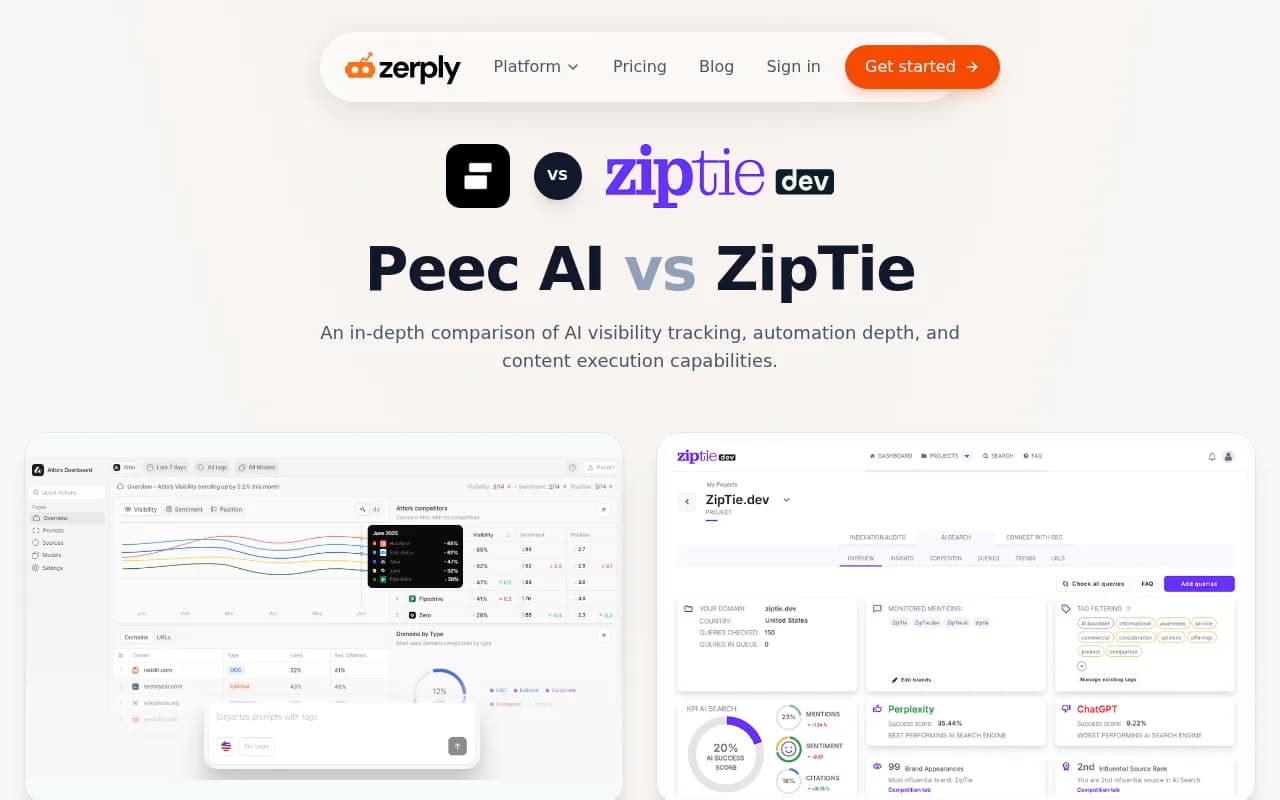
Model coverage: Peec AI wins here
This is the most concrete difference between the two.
Peec AI tracks 8 AI platforms: ChatGPT, Perplexity, Google AI Overviews, Claude, Gemini, Google AI Mode, DeepSeek, and Grok. That's solid coverage for a mid-market tool.
ZipTie covers 4: ChatGPT, Perplexity, Google AI Overviews, and Google AI Mode.
If Claude or Gemini matter to your audience -- and for B2B SaaS, they often do -- ZipTie just doesn't have the data. That's not a minor gap. Claude in particular has become a go-to research tool for technical buyers, and being invisible there is a real problem.
One caveat: Peec AI's Pro plan (€199/mo) covers four base engines. Claude, Gemini, and AI Mode are listed as Enterprise add-ons with custom pricing. So the full 8-model coverage may cost more than the headline plan suggests.
Prompt setup: both are decent, ZipTie is slightly smoother
Both tools let you import your URL and get AI-suggested prompts. ZipTie adds a Google Search Console integration, which is genuinely useful -- it means your prompt list is seeded from real queries your site already ranks for, not just guesses about what people might ask.
Peec AI scans your website to suggest prompts, which works fine but feels more generic. The prompt limits on Peec's Pro plan cap at 100 prompts and 9,000 AI answers per month. For a focused campaign that's workable, but teams running competitive tracking across multiple product lines will hit that ceiling.
ZipTie offers weekly tracking as standard, with daily available on higher plans. Peec AI runs prompts every 24 hours across all plans.
Metrics tracked: similar, with minor differences
Here's a side-by-side look at what each platform tracks:
| Metric | Peec AI | ZipTie |
|---|---|---|
| Mentions | Yes | Yes |
| Citations | Yes | Yes |
| Position/rank | Yes | No (sentiment instead) |
| Sentiment | Yes | Yes |
| Share of voice | Yes | Yes |
| Competitive benchmarks | Yes | Yes |
| Tracking cadence | Daily | Weekly (daily on higher plans) |
| Countries/languages | Unlimited | Not specified |
| Content creation | No | No |
| Crawler logs | No | No |
| Traffic attribution | No | No |
Peec AI's unlimited countries and languages at no extra cost is a real differentiator if you're tracking visibility across markets. Most tools charge extra for regional tracking or limit it to specific tiers.
Collaboration and team features
Peec AI supports unlimited team members with dedicated agency workspaces. That's a meaningful advantage for agencies managing multiple clients.
ZipTie's collaboration features aren't as clearly documented, which is itself a signal -- it's probably better suited to smaller, single-brand teams than agencies running 10+ client accounts.
Pricing comparison
| Plan | Peec AI | ZipTie |
|---|---|---|
| Entry-level | ~€99/mo (Starter) | Free trial available |
| Mid-tier | €199/mo (Pro) | Paid plans vary |
| Enterprise | Custom | Custom |
| Free tier | No | Trial only |
| Models covered | 4 base (8 with add-ons) | 4 |
| Prompt limit (mid-tier) | 100 prompts | Not publicly listed |
Peec AI's pricing is more transparent. ZipTie's paid plan details aren't prominently published, which makes direct comparison harder. Worth checking directly with their sales team if you're evaluating seriously.
What users are actually saying
One Reddit user who tested ZipTie noted: "They have a nice interface for tracking rankings on AI Overviews and the data seems accurate." That's a fair summary -- ZipTie's interface is clean and the data quality seems solid for the models it covers.
Peec AI gets credit for its international coverage and the breadth of models on the full plan. The complaint that comes up most often is the prompt and answer caps on mid-tier plans, and the fact that Claude and Gemini require an Enterprise upgrade.
The real limitation both tools share
Here's the thing neither tool's marketing will tell you directly: they both stop at monitoring.
You can see that your brand isn't showing up for "best project management software for remote teams." You can see that your competitor is. What you can't do -- in either tool -- is understand why, get guidance on what content to create, generate that content, or track whether publishing it actually moved the needle.
That's not a knock on either tool specifically. It's just the category they're in. Monitoring-only dashboards are useful for awareness, but they don't close the loop.
For teams that need to actually fix their AI visibility -- not just measure it -- the gap becomes frustrating quickly. You end up exporting data from Peec or ZipTie and then trying to figure out what to do with it in a separate workflow.
Platforms like Promptwatch are built around closing that loop: find the gaps, generate content that addresses them, track whether it gets cited. It's a different category of tool.

Which one should you pick?
The honest answer depends on what you're optimizing for.
Pick Peec AI if:
- You need Claude, Gemini, or DeepSeek coverage (and are willing to pay for the Enterprise add-ons)
- You're tracking across multiple countries or languages
- You're running an agency with multiple client accounts
- Daily tracking cadence matters to you
Pick ZipTie if:
- You want the simplest possible setup and a clean interface
- Google AI Overviews is your primary focus
- You already use Google Search Console and want prompt suggestions grounded in real search data
- You're a smaller team that doesn't need deep model coverage
Consider something else if:
- You need to understand why you're invisible, not just that you are
- You want content creation tools alongside tracking
- You need crawler logs to see how AI bots interact with your site
- You're running a serious GEO program and need traffic attribution
A few alternatives worth knowing about
If you're evaluating Peec AI and ZipTie, you're probably also looking at the broader market. A few tools that come up in the same conversations:
Otterly.AI -- similar monitoring focus, slightly different prompt management approach. Good for teams that want something lightweight.

SE Ranking -- broader SEO platform that added AI visibility tracking. Better if you want traditional SEO and AI monitoring in one place.
Athena HQ -- more enterprise-oriented, stronger on competitive benchmarking.
Promptwatch -- the option to consider if you want to move from monitoring to optimization. Content gap analysis, AI content generation, crawler logs, and traffic attribution in one platform. Used by 1,480+ brands including Booking.com and Center Parcs.
Bottom line
Peec AI and ZipTie are both reasonable choices for teams that want focused, low-complexity AI visibility tracking. Peec AI has broader model coverage and better international support. ZipTie has a cleaner interface and a useful GSC integration.
Neither will tell you what to do about what they find. If your goal is to understand your AI visibility and hand the data off to someone else to act on, either tool can work. If your goal is to actually improve your AI visibility, you'll outgrow both of them faster than you expect.
The AI search space is moving quickly -- Similarweb reported 1.1 billion AI referral visits in June 2025, up 357% year-over-year. Teams that can close the loop between monitoring and optimization are the ones that will build durable AI visibility. A tracker alone won't get you there.