Key takeaways
- Most AI visibility tools in 2026 are monitoring dashboards -- they show you data but leave the fixing entirely up to you.
- Scrunch has solid discoverability features but starts at $250/month and lacks content generation and crawler log access.
- Meteoria.ai is a lighter-weight option, useful for basic brand tracking but limited on actionability and depth.
- Promptwatch is the only platform in this comparison that closes the full loop: find gaps, generate content, and track whether it worked -- across 10 AI models.
- If you're serious about improving your AI search presence (not just watching it), the tool you pick needs to do more than monitor.
There's a pattern playing out across marketing teams right now. Someone signs up for an AI visibility tool, gets excited by the dashboard, watches their brand's "share of voice" number for a few weeks -- and then realizes they have no idea what to actually do with any of it.
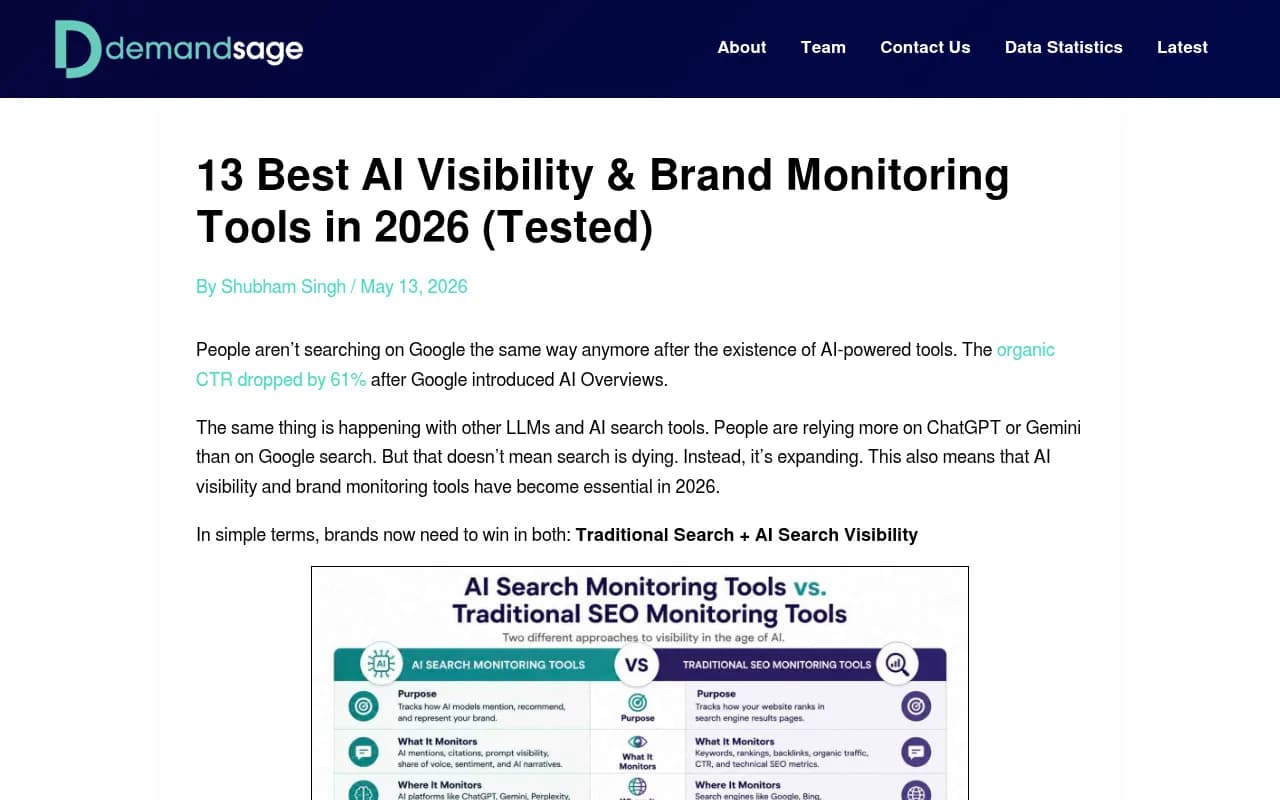
That's the monitoring-only problem. And in 2026, with AI search eating into traditional organic traffic at a pace that's hard to ignore (organic CTR dropped 61% after Google rolled out AI Overviews, according to DemandSage's analysis), sitting on data without acting on it is an expensive hobby.
This guide compares three platforms that come up regularly in this space: Meteoria.ai, Scrunch, and Promptwatch. They're not identical products. One is built for action, one is built for enterprise-scale monitoring, and one sits somewhere in the middle. Knowing the difference matters before you commit.
What "AI search visibility" actually means in 2026
Before the comparison, a quick grounding. AI search visibility refers to how often -- and how favorably -- your brand appears in responses from tools like ChatGPT, Perplexity, Claude, Gemini, Google AI Overviews, and similar platforms. When someone asks "what's the best project management tool for remote teams?" and ChatGPT answers, which brands get mentioned? Which get cited as sources?
That's the game. And unlike traditional SEO, where you can see your ranking for a keyword, AI search is probabilistic, prompt-dependent, and model-specific. A brand might appear in 80% of Perplexity responses for a given query but almost never in Claude's. The same content that gets cited by ChatGPT might be invisible to Gemini.
Tracking this requires a different kind of tool. And improving it requires more than a tracker.
Meteoria.ai: lightweight monitoring with limited depth
Meteoria.ai positions itself as an accessible entry point into AI visibility tracking. It covers the basics -- brand mention tracking across a handful of AI models, some competitor comparison, and prompt-level reporting.
For teams that are just starting to think about AI search and want a low-friction way to see where they stand, it's not a bad starting point. The interface is clean, setup is relatively quick, and the pricing is accessible.
Where it runs into trouble is depth and actionability. Meteoria.ai doesn't offer content gap analysis, meaning you can't see which prompts your competitors are winning that you're not. There's no built-in content generation, no crawler log access, and limited prompt intelligence (volume estimates, difficulty scores, query fan-outs). You get a picture of your current state, but not much guidance on what to do next.
For a team that needs to report on AI visibility to stakeholders but isn't yet in a position to act on it, Meteoria.ai might be enough. For anyone trying to actually move the needle, it's likely to feel like a starting point that doesn't go far enough.
Scrunch: stronger features, but still monitoring-first
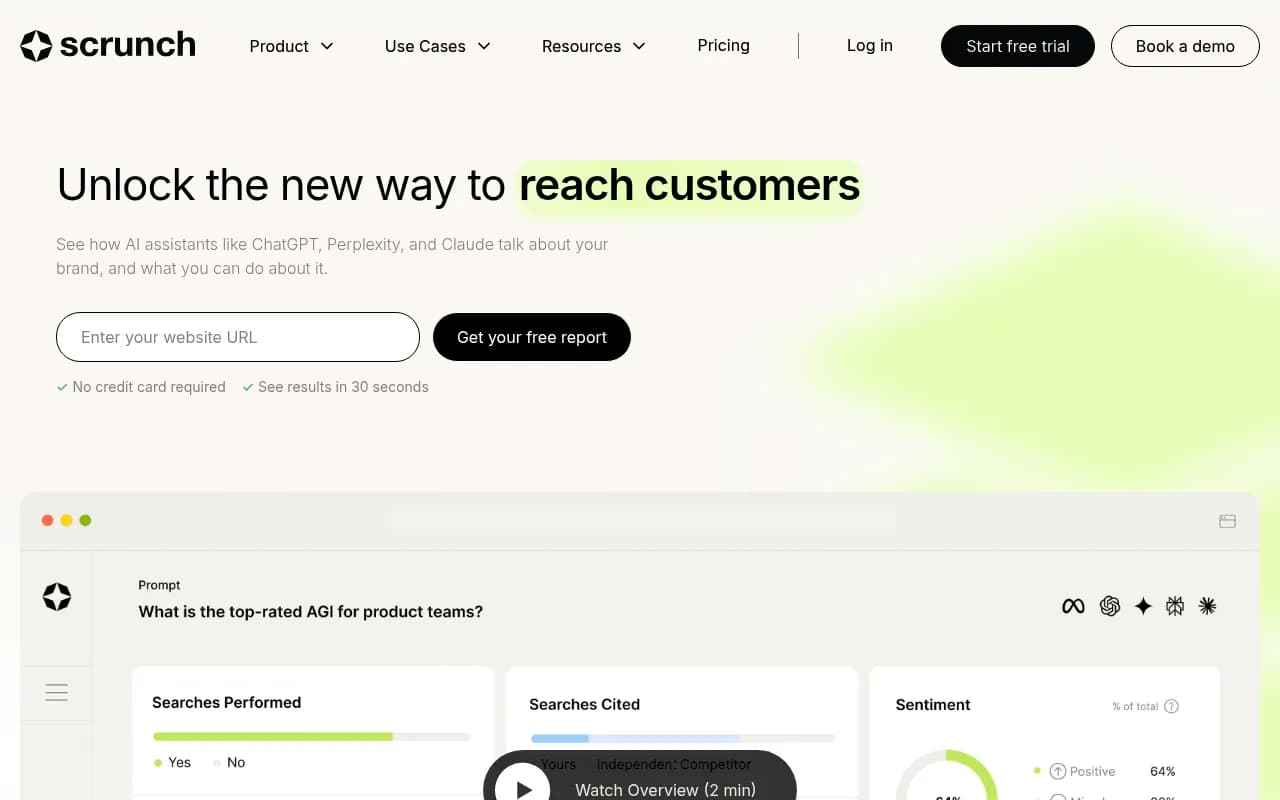
Scrunch is a more serious product. It's been around long enough to have built out a reasonably comprehensive monitoring suite, and it covers AI discoverability optimization with more depth than Meteoria.ai.
Key things Scrunch does well:
- Multi-LLM monitoring across major AI models
- Brand mention tracking with sentiment analysis
- Competitor visibility comparisons
- Some optimization recommendations based on what it finds
The pricing reflects the feature set: Scrunch starts at $250/month, which puts it in a tier where you'd expect a full optimization workflow, not just monitoring. That's where the friction shows up.
Scrunch's recommendations tend to be directional rather than executable. It might tell you that you're underperforming for a category of prompts, or that a competitor is getting cited more often in a particular context -- but it doesn't generate the content to fix that, and it doesn't have crawler logs to show you how AI engines are actually interacting with your site. You still have to figure out the "what to do" part yourself.
For enterprise teams with dedicated content and SEO resources who can take directional insights and run with them, Scrunch is a reasonable choice. For teams that need the full workflow in one place, the gap between "here's what's wrong" and "here's how to fix it" is a real cost.
Promptwatch: the full loop, not just the dashboard
Promptwatch takes a different approach. The core premise is that monitoring without optimization is only half the job -- and the less valuable half.

The platform is built around what it calls the action loop:
- Find the gaps (Answer Gap Analysis shows exactly which prompts competitors are winning that you're not)
- Create content to fill them (built-in AI writing agent generates articles, listicles, and comparisons grounded in citation data)
- Track whether it worked (page-level visibility tracking, traffic attribution, and model-by-model breakdowns)
That third step -- closing the loop with actual traffic attribution -- is something most tools in this space skip entirely. Promptwatch connects AI visibility to real business outcomes through a code snippet, Google Search Console integration, or server log analysis.
A few things worth calling out specifically:
- AI Crawler Logs: Real-time logs showing which AI crawlers (ChatGPT, Claude, Perplexity, etc.) are hitting your site, which pages they're reading, and what errors they're encountering. Most competitors don't have this at all.
- Prompt Intelligence: Volume estimates and difficulty scores for each prompt, plus query fan-outs that show how one prompt branches into sub-queries. This lets you prioritize prompts that are actually worth winning.
- Reddit and YouTube tracking: Surfaces discussions that directly influence AI recommendations -- a channel most tools ignore.
- ChatGPT Shopping tracking: Monitors when your brand appears in ChatGPT's product recommendations and shopping carousels.
- 10 AI models covered: ChatGPT, Perplexity, Claude, Gemini, Google AI Overviews, Google AI Mode, Grok, DeepSeek, Copilot, and Meta/Llama.
Pricing runs from $99/month (Essential: 1 site, 50 prompts, 5 articles) to $579/month (Business: 5 sites, 350 prompts, 30 articles), with agency and enterprise tiers available. A free trial is available.
Head-to-head comparison
| Feature | Meteoria.ai | Scrunch | Promptwatch |
|---|---|---|---|
| Multi-LLM monitoring | Yes (limited) | Yes | Yes (10 models) |
| Brand mention tracking | Yes | Yes | Yes |
| Competitor visibility | Basic | Yes | Yes + heatmaps |
| Answer gap analysis | No | Partial | Yes |
| Prompt volume/difficulty | No | No | Yes |
| Query fan-outs | No | No | Yes |
| AI crawler logs | No | No | Yes |
| Content generation | No | No | Yes (built-in agent) |
| Reddit/YouTube tracking | No | No | Yes |
| ChatGPT Shopping tracking | No | No | Yes |
| Traffic attribution | No | No | Yes |
| Page-level citation tracking | No | Partial | Yes |
| Multi-language/region | Limited | Yes | Yes |
| Starting price | Lower | $250/month | $99/month |
| Free trial | Varies | 7 days | Yes |
The table tells a clear story. Meteoria.ai and Scrunch are monitoring tools. Promptwatch is a monitoring-plus-optimization platform. Whether that distinction matters depends on what you're trying to accomplish.
When monitoring-only is (and isn't) enough
There are legitimate use cases for a monitoring-only tool. If you're:
- Running a brand audit to understand your current AI search baseline before investing in optimization
- Reporting AI visibility metrics to leadership without a mandate to act on them yet
- Working in a highly regulated industry where content creation has long approval cycles
...then a lighter tool might be appropriate for now.
But if you're trying to actually improve your AI search presence -- get cited more often, appear in more responses, drive traffic from AI platforms -- monitoring alone won't get you there. Knowing that ChatGPT mentions your competitor 3x more often than you is useful context. Knowing exactly which content gaps are causing that, and having a tool that helps you fill them, is what actually moves the number.
The research backs this up. Multiple 2026 roundups (DemandSage, Omnia, Lebesgue) consistently flag the gap between tools that show data and tools that help you act on it as the defining difference in the category.
Who each tool is actually for
Meteoria.ai
Best for: Small teams or individuals who want a basic read on their AI search presence without a significant budget commitment. Good as a starting point, not a long-term solution for teams that need to improve their visibility.
Scrunch
Best for: Mid-market and enterprise teams with dedicated SEO/content resources who can take directional insights and execute on them independently. The $250/month entry point makes more sense if you already have the internal capacity to act on what it finds.
Promptwatch
Best for: Marketing and SEO teams that want to understand their AI search visibility and do something about it without stitching together multiple tools. Particularly strong for teams that don't have the bandwidth to manually translate monitoring data into content strategy.
The agency and enterprise tiers also make it a strong fit for agencies managing multiple client brands, given the multi-site support and white-label reporting options.
A note on the broader market
The AI visibility tool space has gotten crowded fast. There are now 28+ platforms (per Omnia's 2026 comparison) claiming to solve this problem, ranging from lightweight trackers to enterprise suites.
Most of them are monitoring tools. That's not a criticism -- monitoring is necessary. But it's table stakes now, not a differentiator. The tools that will matter in 2026 and beyond are the ones that connect the data to action: content gap analysis, content generation grounded in real citation data, crawler log access, and traffic attribution that closes the loop back to revenue.
That's a short list. Promptwatch is on it. Most others aren't yet.
If you're evaluating tools in this space, the right question to ask isn't "does this tool show me my AI visibility?" -- they all do that. The question is: "after I see the data, what does this tool help me do about it?"
Bottom line
Meteoria.ai is fine for basic awareness. Scrunch is a more capable monitoring platform with a price tag that implies more than it delivers on the optimization side. Promptwatch is the only tool in this comparison that treats monitoring as step one of a workflow rather than the whole product.
If your goal is to understand where you stand in AI search, any of these will give you a starting point. If your goal is to actually rank better in AI search -- to get cited by ChatGPT, appear in Perplexity answers, show up in Google AI Overviews -- you need a tool that helps you create the content AI models want to cite, not just a dashboard that shows you they currently don't.
That's the distinction that matters in 2026.