Key takeaways
- The format of the coverage you land matters as much as the outlet. News is only 5.7% of ChatGPT citations, while product pages, landing pages and listicles dominate (Promptwatch Data, Sep 28 to Oct 4, 2026).
- News-hook coverage fades fast. Half of the news pages ChatGPT cited on July 6, 2026 were gone within 36 days, while comparisons, listicles and docs held up much longer.
- Journalists you pitch most are not necessarily the ones AI cites for your brand. 5WPR reports an average overlap of only 2% between the two groups, so check the research behind that figure and build your list from citation data.
- Social posts are a minor route to ChatGPT but a real one into Google AI Overviews, where YouTube alone is 6.71% of citations.
- Pitch with original data, explain how you collected it, and offer a spokesperson. Angle quality beats volume.
Why pitching changed
For years the goal of a media pitch was simple: get a link from a high-authority site. That still has value. But a second goal now sits next to it. When someone asks ChatGPT or Google AI Mode "what is the best tool for X", the answer is built from a handful of cited pages, and you want your brand named on those pages.
That changes which placements are worth chasing. A big-name outlet running a one-day news item may do less for your AI visibility than a mid-tier trade site publishing an evergreen comparison that features you. I think a lot of PR teams are still scoring coverage the old way, by outlet prestige and syndication reach, and missing this.
The good news is that you do not have to guess. Citation data tells you which formats, outlets and topics AI engines actually pull from. You can work backwards from that to the angles worth pitching.
What citation data says about coverage formats
Start with what ChatGPT cites. In Promptwatch Data's report on content types (Sep 28 to Oct 4, 2026), the split of ChatGPT citations looked like this:
| Content type | Share of ChatGPT citations |
|---|---|
| Product pages | 22.4% |
| Landing pages | 16.8% |
| Listicles | 13.6% |
| How-to guides | 8.7% |
| Documentation | 7.5% |
| General articles | 6.1% |
| Comparisons | 5.9% |
| News | 5.7% |
| FAQ | 3.3% |
| Reviews | 1.7% |
Two things stand out for anyone pitching. First, news is a small slice. A press-driven news hit is not the main way brands get cited. Second, the formats that journalists and editors produce on the editorial side, listicles, comparisons, how-tos and reviews, add up to a meaningful share, and they cluster around the prompts that matter commercially.
For commercial prompts, the top types were product pages (26.0%), landing pages (20.6%), listicles (15.0%) and comparisons (7.9%). For branded prompts, reviews rose to 5.6% and press releases to 2.1%. Press releases are a weak citation surface. If your plan is "issue a release and hope AI picks it up", the numbers do not support it.
What this means for the ask
When you write to a journalist, you are implicitly asking for a format. Be deliberate about it:
- Pitch a roundup writer a reason to include you in a "best of" list, with data that justifies the placement.
- Pitch a comparison or review writer access, a demo, or benchmark data so they can evaluate you fairly.
- Pitch a how-to editor an expert and a tested method, not a product plug.
- Pitch news reporters only when you have a real news hook, and treat the citation value as short-term.
Match the angle to the decay curve
Citation lifespan should shape your campaign calendar. In Promptwatch's content half-life data, pages ChatGPT cited on July 6, 2026 were tracked for 90 days.
| Content type | Still cited at 30 days | Still cited at 60 days |
|---|---|---|
| Landing pages | 78% | 69% |
| Docs | 76% | 67% |
| Comparisons | 72% | 63% |
| Listicles | n/a | 60% |
| Product pages, reviews, how-tos | n/a | 55% |
| News | n/a | 41% |
About a quarter of news pages were never cited again after day zero. Half were gone after 36 days. Product pages, reviews and how-tos had half-lives of 74 to 77 days.
So there are two different jobs. A news-hook pitch buys a short burst of visibility, which can still be worth it for a launch or a funding announcement. An evergreen placement in a comparison or listicle keeps working for months. A healthy plan mixes both, and does not judge the news hit by the standard of the evergreen one.
Choose outlets by who AI actually cites
The usual way to build a media list is to pull journalists from a database by beat and reach. That is fine for relevance. The problem is that it tells you who is read, not who is cited.
5WPR cites a release finding that the journalists most pitched on one platform and the journalists most cited by AI for a given brand overlapped by only 2% on average. I have not verified the original source, so treat the exact number as indicative. The direction still makes sense: the people everyone pitches are not the same people AI quotes.
Muck Rack makes a related point: journalism citations alone span more than 20,000 outlets, and the sources cited by ChatGPT, Claude and Gemini can look quite different from one another. A list built for one engine may miss another.
A practical process
- Define 20 to 50 prompts your buyers would actually ask, split into commercial ("best X for Y"), comparison and branded.
- Run them across ChatGPT, Google AI Overviews, Perplexity and Gemini and record every cited URL.
- Group the cited pages by domain and by content type.
- Mark which pages are editorial (a journalist or editor wrote them) and which are owned (vendor sites, docs).
- For each editorial page, find the author and check whether you are already in it, and whether competitors are.
- Build your pitch list from that, starting with pages where competitors appear and you do not.
This turns a vague media list into a list of specific pages that AI already trusts. Many of those pages are updated regularly, which means a pitch to the author can get you added to an existing citation source rather than creating a new one from scratch.
Do not ignore domain authority tiers
Promptwatch's ChatGPT citation share by domain rank data for August 2026 found that sites with domain rank 46 to 75 earned almost half of ChatGPT citations, while DR 91 to 100 fell to about 3%. The very largest publications are hard to pitch and, per this data, are not where most citations come from. Mid-authority trade and niche outlets are often the better target. They are also easier to reach and more likely to reply.
And one number worth remembering: almost half of ChatGPT responses cite 10 or more unique domains, per Promptwatch's unique domains report. There is room for many sources in one answer. You do not need to win the single top spot, you need to appear in several of the pages it pulls.
Pick tools for the research step
The citation research above is tedious by hand. Tools like Promptwatch can track prompts across ChatGPT, Google AI Overviews, Perplexity and others, show which pages get cited, and flag content gaps against competitors. Its Citation Trends view classifies each citation by content type and source type, which maps neatly to the format-based pitching described here.

If you want a lighter option for seeing which sources AI cites in your category, MentionBird is aimed at exactly that.
For browsing more options, the GEO software directory at bestgeosoftware.com lists dozens of trackers.
Where social and video fit
Journalists increasingly share their work on social platforms, and some pitches end up as a video or a post rather than an article. Does that help AI visibility?
It depends on the engine. In Promptwatch Data's social media citations report for November 2026 (Oct 11 to Nov 9, 2026), social platforms made up 13.16% of Google AI Overviews citations, 1.94% of Perplexity's and 0.64% of ChatGPT's. In AI Overviews, YouTube was 6.71% (up from 4.28% in the earlier October window), Facebook 2.34% and Reddit 2.10%. LinkedIn fell from 1.55% to 0.78%. The two windows differ in length (7 days against 30), so treat the shifts as directional.
The practical read: if your priority engine is ChatGPT, earned coverage on third-party sites matters far more than a creator's post. If you care about AI Overviews, a video segment or a YouTube feature is a real path. Reddit is its own story. Promptwatch's report on Reddit citations shows reddit.com's share of ChatGPT citations collapsing from about 4% to 0.5% on August 14, 2026, so do not build a ChatGPT plan around seeding threads.
Pitch angles that earn replies
Citation data tells you where to aim. The angle decides whether anyone answers. Nico Digital ran a six-week experiment on this: 30 hand-picked journalists, five angle families, six journalists per family, one pitch plus at most one follow-up each. Ten of the 30 replied overall, and four placements ran. The interesting part was the spread between angles. One family replied at 67% and another at zero, with the same sender, beats and personalization standard.
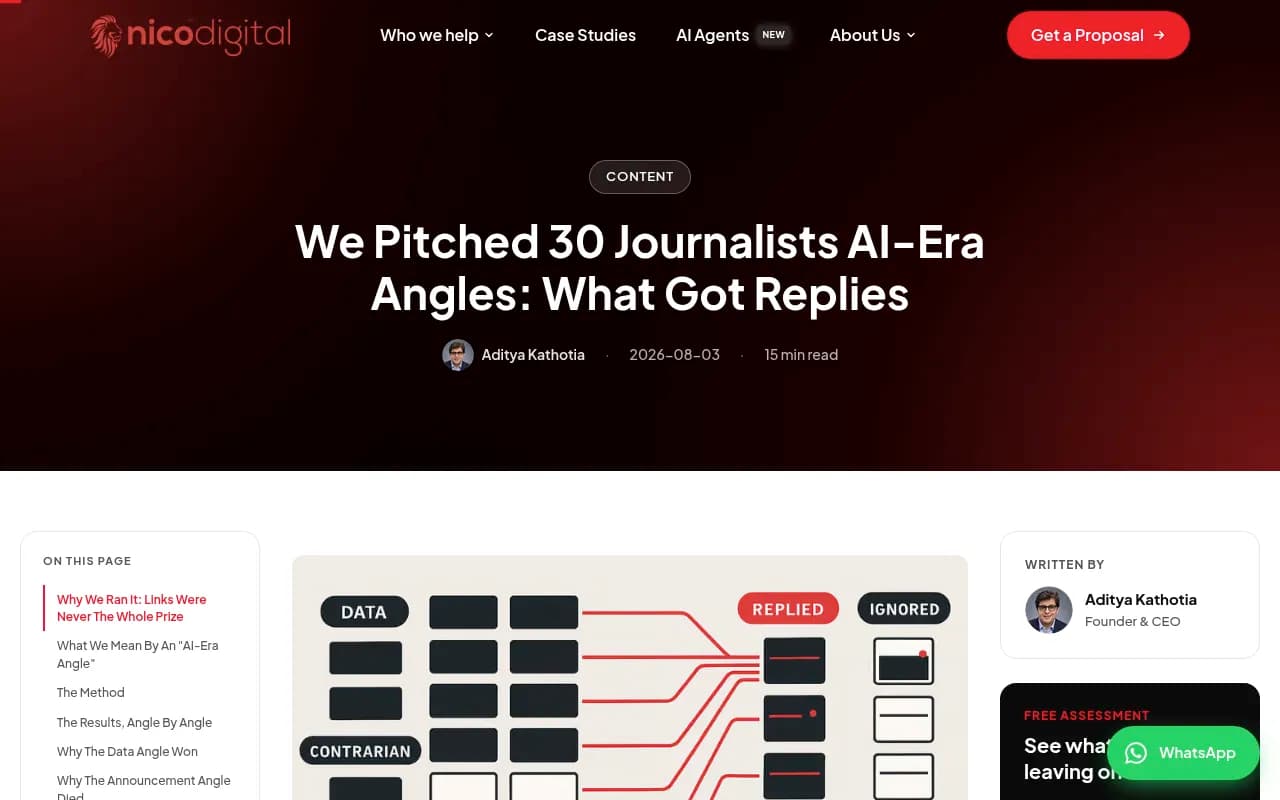
The angle families they tested included data, contrarian, timely commentary and announcements. I could not retrieve the per-angle breakdown, so read the full write-up before relying on which one won. What is clear from the setup is that the angle, not the volume, was the variable that moved results.
Lead with your own data
5WPR's advice on how pitches should change is concrete: lead with a finding from your own data, say how the data was collected, offer a spokesperson who can explain it, and give the journalist a primary source to link. That last point matters for citations. A journalist who links your original research gives AI a primary source to trace, rather than a paraphrase.
Another pitching write-up from Criminally Prolific makes the same case: work out an interesting data point first and let the data be the pitch, instead of bolting data onto a product announcement.
Good proprietary data tends to look like:
- Aggregated, anonymized usage trends from your product
- A survey with a stated sample size and dates
- A benchmark that compares real options in your category
- A time series that shows something changing
Use citation data as the story itself
Here is a neat loop. The citation reports above are themselves pitchable. A finding like "Reddit nearly vanished from ChatGPT citations overnight" is news to marketing reporters. If you have your own data on how AI treats your industry, you can offer it as a data-led angle. Promptwatch Data covers sector breakdowns for healthcare, travel and software, and a team in one of those verticals could pitch from that kind of evidence.
Write for a journalist who may be using AI to filter
Some journalists now run pitches through AI filters. One LinkedIn post describes a filter that screens for relevance and traffic alignment, and generates an SEO-conscious headline angle for top pitches. That is one anecdote, not a trend line. But it supports an old rule: be clearly relevant in the first two lines, and make the story obviously worth a reader's click.
A pitch anatomy that works
Keep it short. A workable structure:
- One line that proves you read their recent work, specific to a piece they wrote.
- The finding, stated with a number.
- How you got the data, in one sentence.
- What you can offer: the full dataset, a chart, an expert on call.
- A suggested format if it fits their style, such as a line for their next roundup.
Avoid long company backstories. Avoid attaching a press release. And do not send the same email to 200 people. Nico Digital's one-pitch-per-journalist method got a 33% reply rate on a small, carefully built list, which is mostly a statement about list quality. OnePitch, a tool vendor, argues for the same shift away from spray-and-pray toward relationship-based pitching, though that is a vendor talking about its own category.
Tools for the outreach layer
You need a media database and a way to track relationships. Meltwater covers media monitoring and journalist data.
For finding what content already earns links and shares in your topic area, BuzzSumo is useful for sizing up angles before you pitch.
And a CRM keeps follow-ups from slipping. Anything that tracks journalist conversations works, and Affinity is one relationship-focused option.
Measure placements by what AI does with them
Counting links and impressions is not enough anymore. Muck Rack's own framing is to measure placements by authority and alignment. In practice I would add four checks after every placement:
- Is the page being cited by AI engines for any of your tracked prompts?
- Which content type is it, and what is its likely half-life?
- Does the text name your brand and describe it accurately?
- Did AI-referred traffic or branded query volume move afterward?
A page-tracking feature in an AI visibility platform handles the first check. You can watch a specific URL and see which prompts and responses cite it. Offsite mention tracking helps with the third, since AI can name your brand from a third-party page without a link back. For traffic, attributing AI traffic takes some setup, and note that ChatGPT stopped sending a referrer on October 8, 2026, so tagged links with utm_source=chatgpt.com become useful.
If you want to run this as a managed program rather than in-house, an SEO and digital PR agency such as 1001 SEO Media combines digital PR with GEO measurement, which is the combination this approach needs.
A simple four-week plan
Week 1: research
Build your prompt set and collect cited URLs. Sort them by content type and outlet. Identify 15 to 30 editorial pages where competitors appear and you do not.
Week 2: prepare the asset
Pick one proprietary data point and package it: a short summary, a chart, a methodology note, and a named spokesperson. Decide which of the pitch targets are news, which are evergreen.
Week 3: pitch
Send one tailored pitch per journalist. Send news-hook pitches to reporters and evergreen offers (updated data, a tested benchmark, expert quotes) to roundup and comparison authors. One follow-up at most.
Week 4: measure and adjust
Check new placements against your tracked prompts. Log which angle each reply came from. Next cycle, double down on what replied and drop what did not.
Where this approach falls short
Citation shares move around. The ChatGPT content-type numbers above cover a single week, and the Reddit collapse shows how fast a source can fall out of favor. Re-check the data before every campaign rather than treating any figure as permanent. The Nico Digital sample is also tiny, 30 journalists, so treat its reply rates as a sign of direction, not a benchmark. And a placement on a cited page does not guarantee a mention in a given answer. It raises your odds, which is all any of this can do.
Still, the shift in thinking is the useful part. Stop asking "which outlets are biggest" and start asking "which pages does AI already trust for my buyers' questions, and what would make an author add me." That question has an answer you can look up.
For more tools to run the research step, browse the AI rank tracking tools directory or the free AI visibility report from Promptwatch to see where your brand stands today.