Affinity Review 2026
CRM tool featuring automated data entry, relationship insights, and workflow optimization to save hundreds of hours annually.
Key Takeaways:
- Built specifically for private capital: Unlike generic CRMs, Affinity is purpose-built for PE, VC, and investment banking workflows -- deal sourcing, relationship mapping, and portfolio management
- Automatic data capture: Syncs with email and calendar to populate contact records, track interactions, and update pipeline stages without manual entry
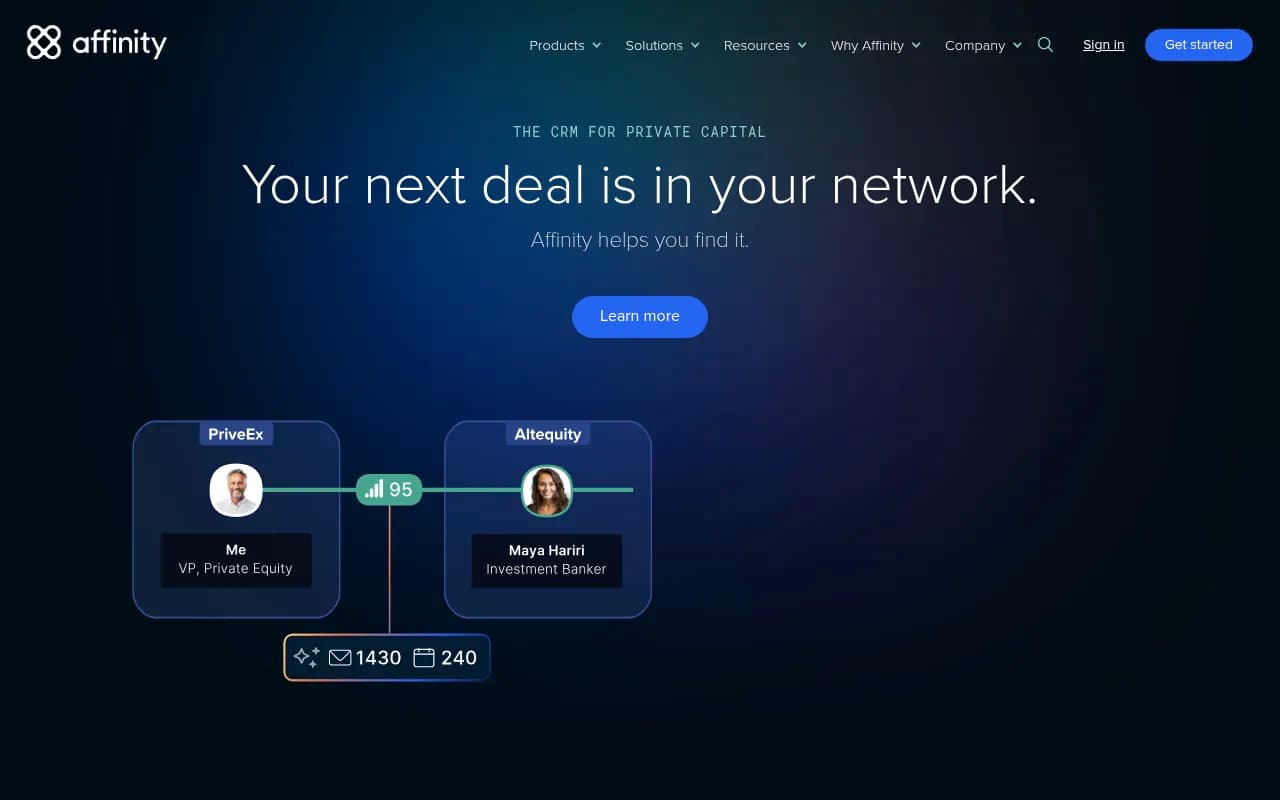
- Relationship intelligence: Shows who on your team knows decision-makers at target companies, surfaces warm introduction paths, and quantifies relationship strength
- Premium pricing: Starts at $2,000/user/year (Essential), scaling to $2,300 (Scale) and $2,700 (Advanced) -- significantly higher than general-purpose CRMs
- Enterprise focus: Best for established firms with 6+ team members managing active dealflow; overkill for solo investors or early-stage funds
Affinity is a relationship intelligence CRM designed exclusively for private capital markets -- private equity, venture capital, investment banking, and asset management. Founded in 2014 by former Palantir engineers, the platform is used by over 3,000 firms managing more than $3 trillion in assets, including BlackRock, Bain Capital, OMERS, Kleiner Perkins, and Generation Investment Management. The core premise: in private markets, every deal traces back to relationships, and Affinity automates the work of tracking, maintaining, and leveraging those connections.
The platform addresses a specific pain point in dealmaking -- relationship data lives scattered across individual team members' inboxes and calendars, making it nearly impossible to know who knows whom, which relationships are warm, or when someone last touched base with a key contact. Affinity solves this by automatically ingesting communication data and surfacing actionable relationship intelligence.
Automated Data Capture
Affinity's foundational feature is passive data collection. Once connected to your email (Gmail, Outlook) and calendar, the platform continuously monitors communications and automatically creates or updates contact records, logs interactions, and tracks relationship strength. When you email a founder, Affinity logs the interaction, updates the last contact date, and adjusts the relationship score based on frequency and recency of communication. When you attend a meeting, it captures attendees and associates them with relevant deals or companies.
This eliminates the manual CRM hygiene work that kills adoption in most firms. No one has to remember to log calls, update contact info, or record meeting notes -- it happens in the background. The Pathfinder browser extension extends this to LinkedIn, AngelList, and Crunchbase, automatically enriching profiles with funding data, board members, and employment history as you browse.
Data capture includes email signatures (phone numbers, titles, social profiles), calendar invites (meeting attendees, locations), and even Zoom/Google Meet participants. The system is smart enough to distinguish between internal team discussions and external relationship-building conversations, focusing enrichment on the latter.
Relationship Intelligence
This is where Affinity differentiates from Salesforce or HubSpot. The platform builds a relationship graph across your entire firm, showing not just who you know, but who your colleagues know, how well they know them, and when they last connected. When evaluating a potential investment in Company X, you can instantly see that your partner met the CEO twice last year, your associate went to business school with the CFO, and your advisor sits on the board of a portfolio company where the CTO previously worked.
Relationship strength is quantified with a proprietary score (0-100) based on communication frequency, recency, and depth (email vs. meeting vs. phone call). You can filter contacts by relationship strength to prioritize warm outreach over cold emails. The "Team Sync" feature surfaces these connections in real-time -- when researching a target company, Affinity highlights which team members have existing relationships and suggests the best person to make an introduction.
The platform also tracks "relationship decay" -- contacts you haven't touched in 90+ days get flagged for re-engagement. Automated reminders ensure high-value relationships don't go cold due to busy schedules.
Deal Pipeline Management
Affinity structures dealflow around customizable pipelines with stages like Sourced, First Meeting, Due Diligence, Investment Committee, Closed Won/Lost. Deals move through stages automatically based on activity (e.g., scheduling a second meeting advances from First Meeting to Due Diligence) or manually via drag-and-drop. Each deal card displays associated contacts, companies, recent activity, next steps, and custom fields like check size, sector, or lead investor.
The platform supports multiple pipeline types -- one for direct investments, another for LP fundraising, a third for portfolio company exits. Each pipeline has its own stages, fields, and workflows. Deal records link to contact records, so you see the full relationship history with everyone involved in a transaction.
Affinity's "Smart Lists" feature creates dynamic contact segments based on criteria like industry, location, relationship strength, or recent activity. A list of "SaaS founders in Series A stage with strong relationships" updates automatically as new contacts match the criteria. These lists feed into outreach campaigns and reporting dashboards.
AI-Powered Enrichment and Automation
Affinity's AI layer (launched 2023, expanded in 2024-2025) automates research and data enrichment tasks. The system automatically pulls company data from Crunchbase, PitchBook, and public sources -- funding rounds, revenue estimates, employee count, tech stack, recent news. Contact profiles get enriched with LinkedIn data, Twitter handles, and employment history without manual lookups.
The AI assistant surfaces relevant opportunities based on your firm's investment thesis. If you typically invest in B2B SaaS companies at Series A in the US, Affinity will flag new companies matching that profile and highlight any existing relationships your team has with the founders or investors. This "proactive dealflow" feature has helped firms like 8VC reduce time spent on deal sourcing by 50%.
Workflow automation handles repetitive tasks like sending follow-up emails after meetings, updating deal stages based on activity, or notifying team members when a high-priority contact re-engages. Zapier integration extends automation to external tools.
Analytics and Reporting
Affinity provides real-time visibility into pipeline health, team performance, and relationship coverage. Dashboards show metrics like deals by stage, average time in each stage, conversion rates, and velocity (how quickly deals move through the pipeline). You can drill down to see which team members are driving the most activity, which sources generate the highest-quality dealflow, or which sectors have the strongest relationship coverage.
The "Relationship Coverage" report maps your firm's network against target markets, showing gaps where you lack warm introductions. If you're targeting fintech companies but have weak relationships in that sector, the report makes it obvious and suggests contacts to cultivate.
Custom reports can track LP engagement (for fundraising), portfolio company performance, or competitive intelligence (which other firms are active in your sectors). Data exports to CSV or integrates with Looker Studio for custom visualizations.
Integrations and Ecosystem
Affinity integrates natively with Gmail, Outlook, Google Calendar, Outlook Calendar, Zoom, and Slack. The Pathfinder browser extension works on LinkedIn, AngelList, Crunchbase, and PitchBook, allowing one-click data capture while researching companies. Zapier integration connects to 5,000+ apps for custom workflows.
The platform offers a REST API for firms building custom integrations or syncing data with internal tools. Mobile apps (iOS/Android) provide on-the-go access to contacts, deals, and activity feeds, though the mobile experience is more limited than desktop.
Affinity does NOT integrate with traditional sales tools like Gong, Outreach, or Salesloft -- it's not built for high-volume outbound sales. It also lacks native accounting or fund administration integrations, focusing purely on relationship and deal management.
Who Is It For
Affinity is purpose-built for private capital firms -- venture capital funds, private equity shops, growth equity investors, investment banks, family offices, and corporate development teams. The ideal customer is a firm with 6-50 investment professionals managing active dealflow and needing to coordinate relationship intelligence across the team.
Specific personas include:
- VC partners sourcing 200+ deals annually and needing to track which associates have relationships with promising founders
- PE deal teams managing 50-100 active opportunities across multiple sectors and requiring pipeline visibility for weekly partner meetings
- Investment bankers maintaining relationships with 500+ corporate executives and needing automated follow-up to stay top-of-mind
- Family office principals evaluating direct investments and co-investment opportunities, relying on their network for deal access
- Corporate development teams at tech companies tracking M&A targets and partnership opportunities
Firms typically have $50M+ in AUM and are past the stage of managing dealflow in spreadsheets. Seaside Equity Partners (mid-market PE) closed 15+ deals after implementing Affinity. Motive Partners (fintech-focused PE/VC) increased deals reviewed annually by 66%. 8VC (early-stage VC) cut deal sourcing time in half.
Affinity is overkill for solo angel investors, pre-seed funds with <3 people, or firms doing <10 deals per year. The pricing and feature set assume a team environment where relationship intelligence across multiple people creates compounding value. If you're a solo GP managing a small fund, a simpler CRM like Streak or Airtable will suffice.
The platform is also NOT suitable for traditional B2B sales teams, agencies, or consultants. It lacks features like email sequences, call recording, or lead scoring that sales-focused CRMs provide. Affinity is relationship-first, not pipeline-first.
Pricing and Value
Affinity uses annual subscription pricing with three tiers:
- Essential: $2,000 per user/year -- core CRM, automated data capture, relationship intelligence, basic reporting, email/calendar sync, Pathfinder extension
- Scale: $2,300 per user/year -- adds advanced automation, custom fields, API access, Zapier integration, priority support
- Advanced: $2,700 per user/year -- adds AI-powered enrichment, proactive dealflow, advanced analytics, dedicated customer success manager
All plans require annual contracts with a minimum of 5 users, putting the entry point around $10,000/year. Enterprise pricing (for 50+ users) is custom and includes white-glove onboarding, custom integrations, and SLA guarantees.
Compared to general-purpose CRMs, Affinity is expensive. Salesforce Professional is $100/user/month ($1,200/year), HubSpot Professional is $90/user/month ($1,080/year). But those platforms require heavy customization to support private capital workflows and don't include relationship intelligence or automated data capture. Firms switching from Salesforce to Affinity report saving 10-15 hours per week on CRM maintenance.
Compared to competing relationship intelligence CRMs like 4Degrees ($1,800-2,400/user/year) or Sourcescrub ($2,000+/user/year), Affinity is competitively priced and offers broader feature coverage. DealCloud (now part of Intapp) is the main enterprise competitor, with pricing starting around $3,000/user/year but offering deeper portfolio management and fund administration features.
Affinity does NOT offer a free trial or freemium tier. Prospective customers get a customized demo and typically a 30-day pilot with a small team before committing to an annual contract.
Strengths
- Automatic data capture eliminates manual CRM work: Email and calendar sync means contact records stay current without anyone lifting a finger. Firms report 80-90% reduction in time spent on data entry.
- Relationship intelligence is genuinely useful: Seeing who on your team knows a target company's CEO and how well they know them turns abstract networks into actionable dealflow. The relationship graph is the killer feature.
- Purpose-built for private capital workflows: Deal stages, relationship tracking, and reporting are designed around how PE/VC firms actually work, not generic sales processes. No need to customize Salesforce for six months.
- Strong data enrichment: Automatic pulls from Crunchbase, PitchBook, LinkedIn, and public sources save hours of manual research per deal.
- Excellent customer support: Dedicated customer success managers (on Advanced plan) and responsive support team. Onboarding includes workflow consulting and best practices from other firms.
Limitations
- Expensive for small teams: $10,000+/year minimum makes it inaccessible for solo GPs, emerging managers, or funds with <$25M AUM. Competitors like Streak ($49/user/month) or Airtable ($20/user/month) are more budget-friendly.
- Limited customization vs. Salesforce: While Affinity's opinionated design is a strength (less setup required), it's also a constraint. Firms with highly specific workflows may hit limitations. No custom objects, limited formula fields, no process automation beyond basic triggers.
- Weak portfolio management features: Affinity focuses on pre-investment dealflow. Post-investment portfolio tracking (board meetings, KPIs, exit planning) is basic compared to DealCloud or Chronograph. Many firms use Affinity for sourcing and a separate tool for portfolio management.
- Mobile app is limited: The iOS/Android apps are fine for viewing contacts and deals but lack full editing capabilities and advanced features. You'll still need desktop for serious work.
- No native email sequences or outreach tools: If you need to send 100 cold emails with automated follow-ups, Affinity isn't built for that. It's relationship-first, not outbound-first.
- Data privacy concerns: Automatic email/calendar sync means Affinity sees all your communications, including sensitive deal terms, personal emails, and confidential information. The platform is SOC 2 Type II certified and GDPR compliant, but some firms are uncomfortable with the access level.
Bottom Line
Affinity is the best relationship intelligence CRM for established private capital firms (PE, VC, investment banking) with 6+ investment professionals managing active dealflow. If your firm closes 10+ deals per year, has $50M+ in AUM, and struggles with relationship coordination across the team, Affinity will pay for itself in time saved and deals sourced. The automatic data capture and relationship graph are genuinely differentiated features that generic CRMs can't replicate.
It's not for solo investors, emerging managers with tight budgets, or firms needing deep portfolio management features. And if you're a traditional B2B sales team, look elsewhere -- this is built for relationship-driven dealmaking, not high-volume outbound.
Best use case in one sentence: Mid-market PE or VC firms with 10-30 investment professionals who need to turn their collective network into proprietary dealflow without drowning in CRM busywork.
Tags:
Similar and alternative tools to Affinity