Key takeaways
- A local prompt list should mix branded and unbranded prompts, and keep them in separate groups so one doesn't skew the other.
- Cover the intents that lead to a visit (hours, availability, price, "open now"), not just "best X in city" discovery prompts.
- In an Uberall study across 16 local intents, 5 industries and 4 US cities, 7 intents captured only 46% of the businesses AI recommended. It took about 11 to reach 80%.
- Put the neighborhood or city inside the prompt text, and pin tracking to a real location where your tool allows it.
- The 60 prompts below are templates. Swap in your services, neighborhoods and competitors, then trim to what your customers actually ask.
Why local prompt lists need their own method
Keyword research gives you volume, rankings and a stable target. Prompt tracking gives you none of that. There is no reliable volume, no fixed position, and the same question can return different businesses depending on location, session and which model you ask.
Local makes it messier. "Best dentist" means nothing without a place. "Near me" means nothing without coordinates. And a lot of what people ask is situational: open Sunday, takes walk-ins, has parking, speaks Spanish.
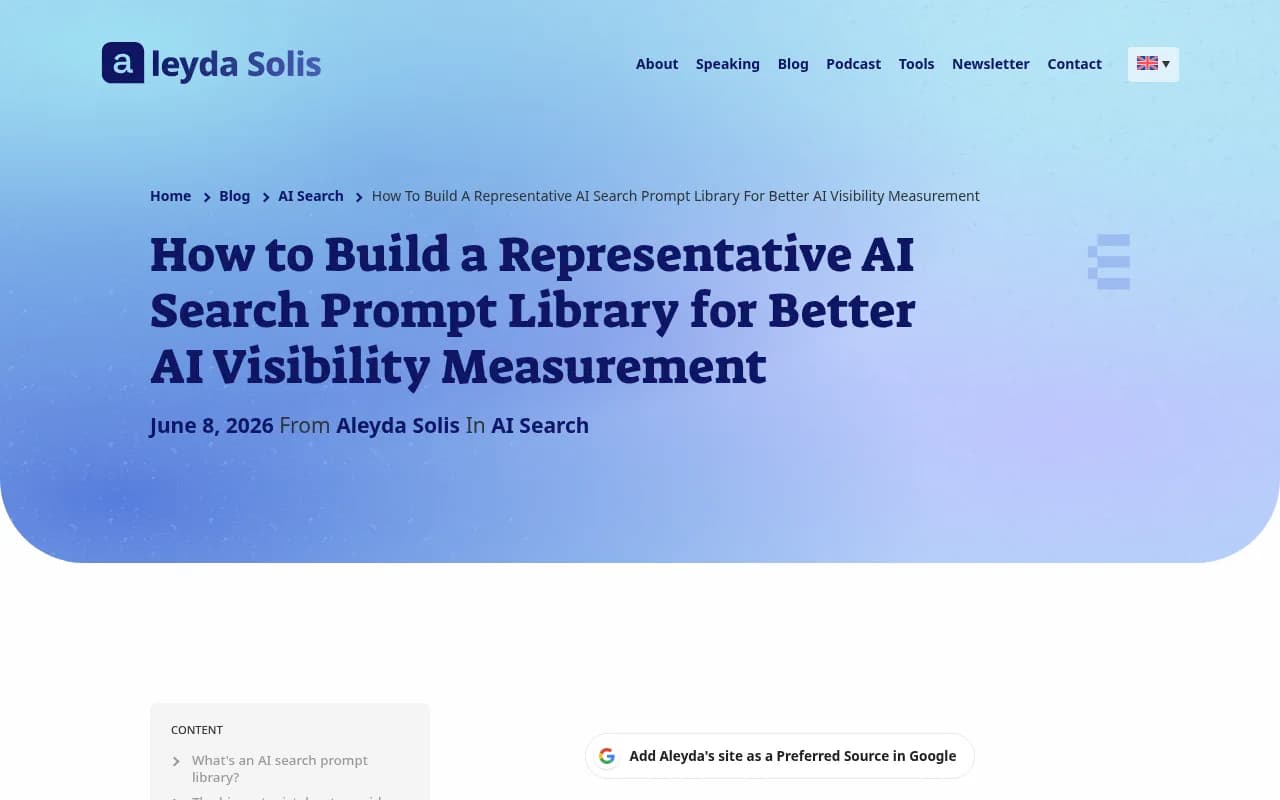
Most teams I see default to "best [service] in [city]" and call it done. That is one thin slice. Aleyda Solis makes the same point: a prompt set that over-represents generic discovery, ignores local competitors or only tracks branded questions can make a dashboard look useful while pointing you at the wrong priorities. Her goal is a representative sample of the journeys that matter, not an exhaustive list.
How many prompts you actually need
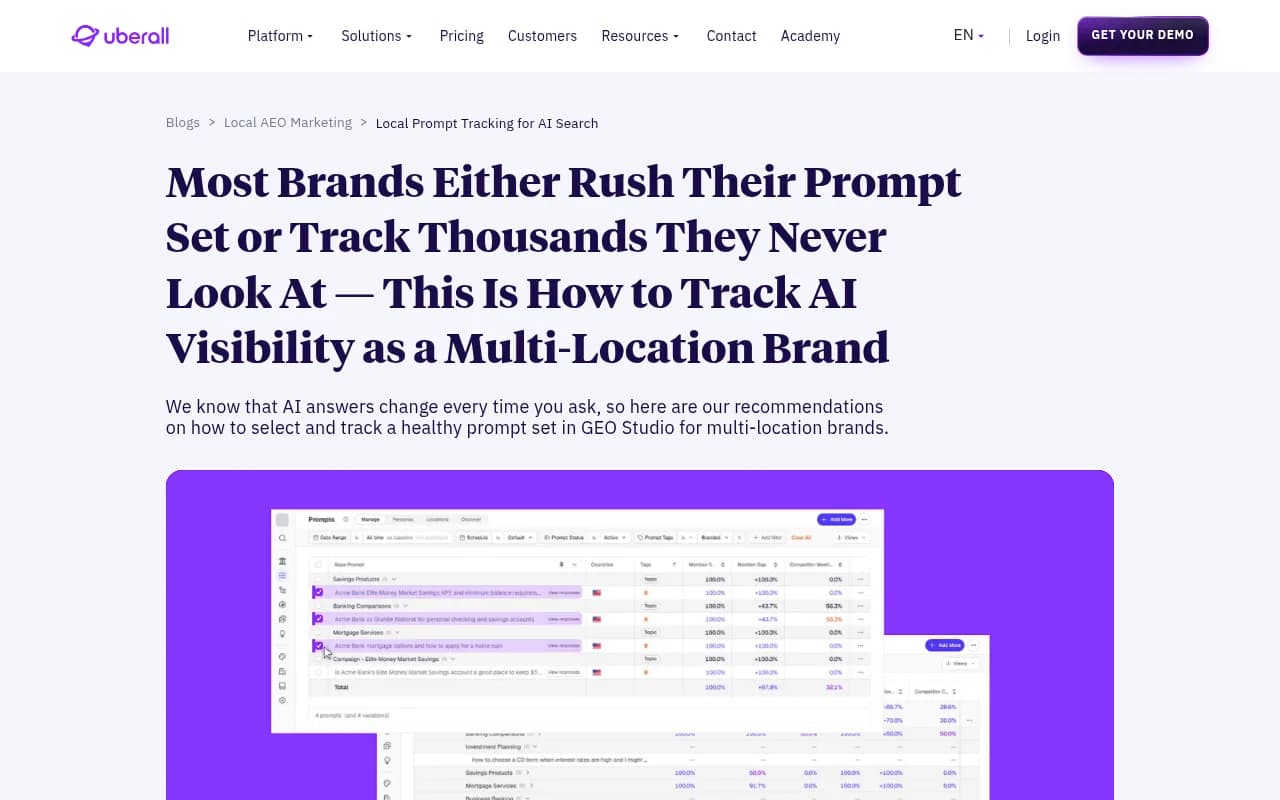
More than feels comfortable. The Uberall research above is the best local-specific number I found: 7 intents caught 46% of the businesses AI recommended, and roughly 11 got you to 80%. The same piece reports that nearly 2 in 3 businesses cited by any AI tool show up in only one model's recommendations, so a single-model check will mislead you.
A workable starting point for one location:
- 10 to 15 core intents per service line
- 2 to 4 neighborhood variants of each
- A small branded group (5 to 8 prompts) tracked separately
- Every major AI model, not one
That adds up quickly, which is why the 60 prompts below are grouped by business type. Pick the group that fits, then expand.
Branded vs unbranded: keep them apart
Promptwatch Data's content type report (Sep 28 to Oct 4, 2026) shows why. On branded prompts, reviews rise to 5.6% of ChatGPT citations, more than 3x their overall share, and social posts and FAQ pages also climb. On commercial "best X" prompts, product and landing pages plus listicles and comparisons make up almost 70% of citations. Different prompts pull different sources, so blending them hides what is going on.
So: unbranded prompts tell you whether you get recommended. Branded prompts tell you whether AI describes you correctly. Report them as two numbers.
The prompt structure to reuse
Every local prompt is some mix of four parts:
[intent] + [service or product] + [place] + [constraint]
"Emergency plumber in Lakeview Chicago open on a Sunday"
Intent is what the person wants to do. Place is a city, neighborhood or landmark. Constraint is the thing that makes the answer narrow: price, hours, specialty, language, urgency. Constraints are where small local businesses win, because AI models can't pick a generic leader for a very specific need.
60 local prompts by business type
Replace the brackets. Where a prompt says "near me", track it from a pinned location if your tool supports that, since the model has to infer where "me" is.
Restaurants and cafes (10)
- Best [cuisine] restaurant in [neighborhood]
- Where do locals eat in [city]
- Affordable [cuisine] near me open now
- Restaurants with vegan options in [neighborhood]
- Best place for a birthday dinner for 10 people in [city]
- Dog-friendly patio restaurant near [landmark]
- Best brunch in [neighborhood] without a long wait
- Restaurants in [city] that take walk-ins on Friday night
- Best late-night food near [venue or station]
- Compare [your restaurant] and [competitor] for date night
Home services: plumbers, electricians, HVAC (10)
- Best plumber in [city]
- Emergency plumber near me open on Sunday
- Licensed electrician in [neighborhood] for a panel upgrade
- How much does a water heater replacement cost in [city]
- HVAC repair near [zip code] same day
- Who is the most trusted roofer in [city]
- I need a plumber near [neighborhood] and I'm not sure who to use
- Best HVAC company in [city] for older homes
- Affordable drain cleaning near me with good reviews
- Is [your company] reliable for [service] in [city]
Legal and professional services (8)
- Best personal injury lawyer in [city]
- Divorce attorney near me with free consultation
- Immigration lawyer in [city] who speaks [language]
- How much does a DUI lawyer cost in [state]
- Small business accountant near [neighborhood]
- Estate planning attorney in [city] for a blended family
- Which [city] law firm handles [niche case type]
- Compare [your firm] and [competitor] for [practice area]
Healthcare and wellness (9)
- Best dentist in [neighborhood] accepting new patients
- Emergency dentist near me open today
- Family doctor in [city] that takes [insurance]
- Urgent care near me with short wait
- Pediatric dentist in [city] good with anxious kids
- Cosmetic dentistry specialist in [city]
- Physical therapist near [zip code] for a knee injury
- Therapist in [city] offering evening or weekend sessions
- What do patients say about [your clinic] in [city]
Healthcare is its own case. Promptwatch Data's healthcare report (Sep 9 to Oct 8, 2026) found ChatGPT leaning on NIH, the FDA and the NHS, with government and public health sites earning almost half of citations. For informational health prompts, you are competing with institutions. For "near me" provider prompts, you are not, and that is where to focus.
Auto repair and dealerships (7)
- Best auto repair shop in [city]
- Honest mechanic near me for a brake job
- Where to get an oil change near [neighborhood] without an appointment
- Used car dealership in [city] with good reviews
- Mechanic who works on [make] in [city]
- How much does a transmission repair cost in [city]
- Compare [your shop] and [competitor] for [service]
For dealerships, expect marketplaces to crowd the answer. Promptwatch's automotive data from August 2026 shows Autotrader and Cars.com outranking every car brand in ChatGPT citations, with Chevrolet the top manufacturer site. Your listings there matter as much as your own pages.
Salons, spas and personal services (8)
- Best hair salon in [neighborhood]
- Hair stylist near me who specializes in curly hair
- Wedding hair and makeup in [city]
- Barber near [landmark] open Sunday
- Best nail salon in [city] for gel manicures
- Massage therapist near me with same-day booking
- Affordable hair salon in [city] with good reviews
- Which salon in [neighborhood] takes online bookings
Retail and local shopping (8)
- Where to buy [product] near me today
- Best [store type] in [city]
- Local bike shop in [neighborhood] that does repairs
- Where can I buy organic coffee beans in [city]
- Stores near [zip code] with [brand] in stock
- Best gift shop in [neighborhood] for a [occasion]
- [Product] under $100 near me
- Is [your store] worth visiting for [product category]
Prompts to add for every business type
The 60 above lean on discovery and comparison. Add a handful from this accuracy set, adapted from the checks in Insites' ChatGPT local visibility prompts:
- Tell me about [business] in [city]
- What are the hours and address of [business]
- What do customers say about [business]
- Why wouldn't you recommend [business] for [service]
The last one is the most useful. When the model explains why it left you out, it tends to name the missing thing: thin reviews, vague service descriptions, outdated hours.
Where the answers come from
Two findings shape how you read results.
First, Promptwatch Data on ChatGPT query fanouts shows that behind a response, ChatGPT runs its own web searches, and those queries got short and keyword-like, around 53 characters by April 2026. Then on August 8, 2026, site:-scoped fanouts jumped from 0.37% to 16.8% of all fanouts. For a local business, that means your own indexed pages are a direct lookup surface. Service pages that state the service, the place and the constraint in plain words are more likely to match.
Second, ChatGPT often cites many domains: almost half of responses cite 10 or more unique domains. A local answer is assembled from directories, review sites, your site and others. Being strong on one of them is not enough.
Social is a smaller piece than people assume in ChatGPT. Promptwatch's October 2026 social citation data found ChatGPT drew just 0.46% of citations from social platforms, while Google AI Overviews drew 12.2%. If Google's surfaces matter for your market, track them separately.
Interpreting what you find
A few patterns, and what they usually mean:
| Pattern | Likely problem | Fix |
|---|---|---|
| Shown for "affordable" or "where locals go" but not "best" | Known but not seen as a leader | More and better reviews, richer Google Business Profile |
| Shown for generic prompts, missing on specialty ones | Service depth is thin | Dedicated service pages per specialty |
| Right name, wrong hours or address | Inconsistent listings | Clean up citations and listings |
| Appears in one model only | Narrow source footprint | Broaden presence across directories and review sites |
| Mentioned, never cited | Content or crawlability gap | Check crawler access and page content |
The Uberall piece gives a good example: an Italian franchise that appears for "affordable" and "where do locals go" but not "best" or "vegan options" reads to the model as a known local option, not a quality leader or specialist.
Tools for tracking local prompts
You can run these by hand in ChatGPT, Gemini and Perplexity to start. That works for a first audit and falls apart at 60 prompts across several models and locations.
Promptwatch is the one I'd look at first for this job. It can pin a monitor to exact coordinates so ChatGPT, AI Overviews and AI Mode answer as if asked from that spot, and it tracks by country, state and city. Local targeting is on the Business plan and above, so check promptwatch.com/pricing for current details. It also reports branded and unbranded prompts by topic, which matches the separation described above, and its crawler logs help you tell an access problem from a content problem.

For multi-location brands, Uberall ties prompt tracking to listings and location data.
Tibly is built specifically for local businesses' AI visibility.

For the listings and reviews side that feeds these answers, BrightLocal and Yext are established options.
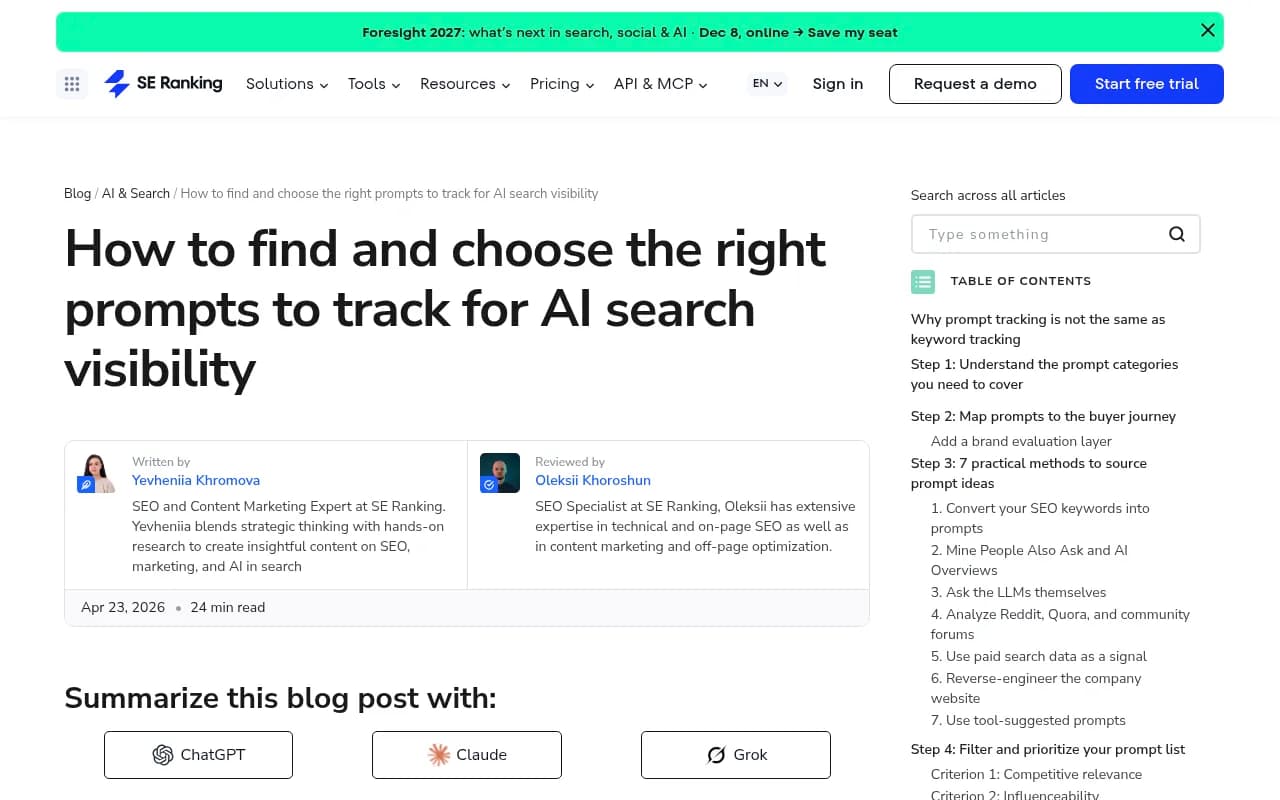
SE Ranking also publishes a useful framework for choosing prompts, including adding city or neighborhood modifiers to base prompts for local businesses.
| Tool | Local angle | Best for |
|---|---|---|
| Promptwatch | Exact-coordinate targeting, city and state tracking, content and crawler follow-through | Teams that want to fix gaps, not just see them |
| Uberall | Listings plus prompt tracking for many locations | Franchises and multi-location brands |
| Tibly | Local business focus | Single-location owners |
| BrightLocal | Local SEO and listings | Agencies running local SEO |
If you want to compare more options, the GEO software directory lists them side by side.
A simple process to build your list
- Pick your business type group above and copy it into a spreadsheet.
- Replace placeholders with your real services, three to five neighborhoods and two or three named competitors.
- Delete anything your customers would never ask. Add what they do ask, taken from call logs, review text and Search Console queries.
- Tag each prompt as branded or unbranded, and by intent: discovery, comparison, urgent, price.
- Run across multiple models, from the right location, on a fixed schedule.
- Review monthly. Add prompts where you see gaps. Retire ones that never produce signal.
Answers vary from run to run, so judge by trends over several weeks, not a single check.
What to do first
Start with 12 unbranded intents from the group that matches your business, add 5 branded ones, and run them across at least three models. That alone will tell you more than any generic score. Fix the biggest gap it shows, usually reviews, a thin service page, or inconsistent listings, then re-run and see whether the answer moves.