Key takeaways
- Most AI visibility platforms query LLMs on a fixed schedule (daily to weekly), but crawl frequency varies significantly and isn't always disclosed
- Data latency -- the gap between when an AI model changes its behavior and when your dashboard reflects it -- can range from hours to weeks depending on the platform
- Accuracy depends heavily on methodology: platforms that query live AI interfaces capture real-world responses; those using cached or synthetic data often miss model updates
- Crawler logs (tracking when AI bots actually visit your site) are a separate and underused freshness signal that most platforms ignore
- Platforms built around action -- not just monitoring -- tend to invest more in data infrastructure because stale data makes optimization impossible
Data freshness is one of those topics that sounds like a technical footnote until it isn't. Then it's the reason your team spent three weeks optimizing for a prompt that ChatGPT stopped responding to the way you thought it did.
The AI visibility monitoring space has grown fast. There are now dozens of platforms claiming to track how your brand appears in ChatGPT, Perplexity, Claude, Gemini, and other models. But under the hood, they differ enormously in how often they collect data, how quickly that data reaches your dashboard, and how accurately it reflects what users actually see.
This guide gets into the specifics.
Why data freshness matters in AI search
Traditional SEO rank tracking could afford to be a bit slow. Google's index is relatively stable -- a page that ranked #3 yesterday probably ranks #3 today. You could pull weekly data and make reasonable decisions.
AI search doesn't work that way. LLMs update their behavior constantly. Model versions change. Retrieval-augmented generation (RAG) systems pull from different sources depending on when they're queried. A prompt that returned your brand prominently last Tuesday might return a competitor today because the underlying model was fine-tuned, the retrieval index was refreshed, or the response format changed entirely.
Kevin Indig noted in his State of AI Search Optimization 2026 report that faster infrastructure helps not just with rendering but with freshness and compound query fan-outs -- where one prompt branches into multiple sub-queries, each potentially pulling from different sources. If your monitoring tool is running weekly batch queries, you're seeing a blurry snapshot of a moving target.
The practical consequence: stale visibility data leads to bad prioritization. You optimize for prompts where you're already visible, miss the ones where a competitor just overtook you, and can't tell whether your content changes are working.
The three dimensions of data freshness
Before comparing platforms, it helps to separate three things that often get conflated.
Crawl frequency
This is how often a platform actually queries the AI models it monitors. Some platforms run queries daily. Others run them weekly or even less frequently for lower-tier plans. A few run continuous or near-real-time queries for high-priority prompts.
Crawl frequency determines how quickly you'd notice a change in AI behavior. If a model starts recommending a competitor for your core category prompt, a platform with daily crawls catches it within 24 hours. A weekly crawler might leave you in the dark for six days.
Data latency
Crawl frequency and latency are different things. A platform might query models every day but only process and surface that data in your dashboard every 72 hours. Latency is the pipeline delay between data collection and data availability.
For most use cases, 24-48 hours of latency is acceptable. But if you're running a campaign, responding to a PR situation, or testing whether a content change improved your visibility, you want to know fast.
Response accuracy
This one is trickier. There are two main methodologies for querying AI models:
- Live API queries: The platform calls the model's API directly and records the actual response. Fast, scalable, but API responses sometimes differ from what users see in the chat interface.
- Interface-level crawling: The platform simulates a real user session in the actual chat UI. Slower and more resource-intensive, but captures exactly what a real user would see -- including UI-level features like citations, shopping carousels, and follow-up suggestions.
As the ZipTie.dev comparison of LLMO tools noted: "Tools that crawl actual user interfaces, or capture screenshots, provide more accurate real-world visibility data." The tradeoff is that interface-level crawling is harder to scale, so platforms doing it tend to cover fewer prompts or update less frequently.
There's also the question of methodology transparency. Many platforms don't disclose how they query models, how often, or what they do when a model returns inconsistent results across multiple runs. That opacity makes it hard to trust the numbers.
How leading platforms approach freshness
Here's a practical breakdown of how the main categories of AI visibility platforms handle these three dimensions.
Enterprise-grade platforms
Platforms like Profound and BrightEdge serve Fortune 500 clients and invest heavily in data infrastructure. Profound runs queries across multiple AI models and surfaces data with relatively low latency. BrightEdge has been building web crawling infrastructure for years and applies similar rigor to AI response tracking.
The tradeoff: enterprise pricing. Profound starts at $499/month with no free trial. BrightEdge is enterprise-only with custom pricing. If you're a mid-market brand, these may be overkill.
Mid-market monitoring tools
Otterly.AI, Peec AI, and similar tools run scheduled queries -- typically daily for active prompts -- and surface data within 24-48 hours. They're solid for basic monitoring but tend to lack transparency about their methodology. You get a visibility score, but you don't always know exactly how it was calculated or whether it reflects live model behavior.
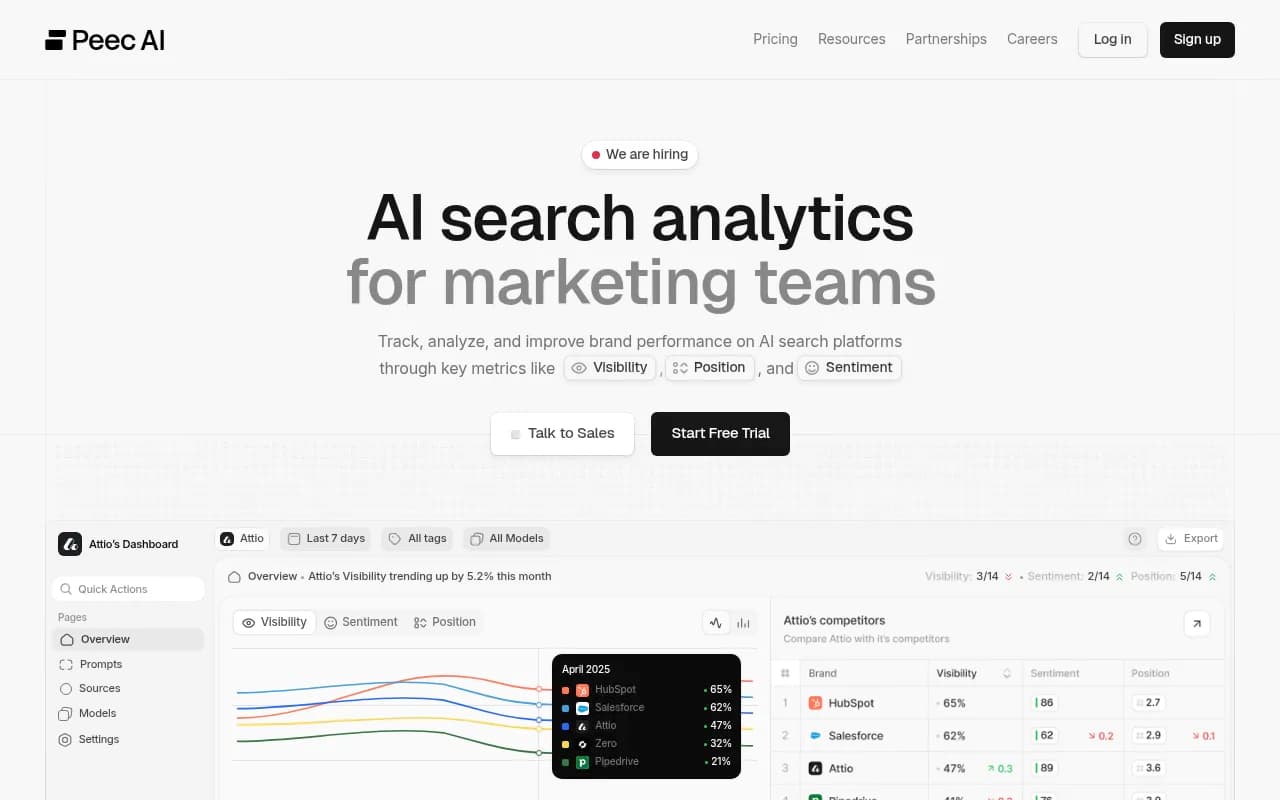
These platforms are also monitoring-only. They'll tell you your visibility dropped, but they won't help you figure out why or what to do about it.
Traditional SEO tools with AI add-ons
Semrush and Ahrefs have both added AI visibility features, but with a significant limitation: they use fixed prompt sets. You can't customize the prompts to match how your actual customers search. Ahrefs Brand Radar has no AI traffic attribution, meaning you can't connect visibility data to actual website visits or revenue.
The freshness story here is mixed. Both platforms have robust data infrastructure from their SEO roots, but AI visibility is still a secondary feature. Update frequency for AI-specific data tends to lag behind their core rank tracking products.
Action-oriented platforms
Promptwatch takes a different approach. Rather than treating freshness as a pure monitoring problem, it connects data freshness to the optimization loop: find gaps, create content, track results. The platform monitors 10 AI models -- including ChatGPT, Claude, Perplexity, Gemini, Grok, DeepSeek, and Google AI Overviews -- and provides page-level tracking that shows exactly which pages are being cited, how often, and by which model.

What makes the freshness story interesting here is the AI Crawler Logs feature. Most platforms tell you what AI models are saying about you. Promptwatch also tells you what AI crawlers are doing on your site -- which pages ChatGPT's crawler read, which pages returned errors, how frequently different models are crawling. That's a different kind of freshness signal: not "what did the model say today" but "what did the model's crawler see when it last visited."
This matters because there's often a lag between when you publish new content and when AI models incorporate it into their responses. Crawler logs let you see whether the model has even visited your new page yet -- which is the first step in diagnosing why a content change hasn't moved the needle.
The methodology transparency problem
Here's something that doesn't get discussed enough: most AI visibility platforms don't tell you how they collect data.
Do they query the API or the interface? How many times do they run each prompt? Do they average results across runs, or report the most recent? How do they handle cases where the model returns different answers to the same prompt on consecutive queries (which happens more than you'd think)?
Without answers to these questions, a visibility score is just a number. You can't tell whether a drop in your score reflects a real change in model behavior or a sampling artifact.
The more rigorous platforms publish methodology documentation or at least disclose the basics. When evaluating any AI visibility tool, it's worth asking directly: "How do you query the models, and how often?" If the answer is vague, that's a signal.
Comparing platforms on data freshness
| Platform | Crawl frequency | Latency | Methodology transparency | Crawler logs | Models covered |
|---|---|---|---|---|---|
| Promptwatch | Daily (continuous for high-priority) | Low | Good | Yes | 10+ |
| Profound | Daily | Low-medium | Good | No | 6+ |
| BrightEdge | Daily | Medium | Good | No | 5+ |
| Otterly.AI | Daily | Medium | Limited | No | 5+ |
| Peec AI | Daily | Medium | Limited | No | 4+ |
| Semrush AI | Weekly (fixed prompts) | Medium | Limited | No | 3+ |
| Ahrefs Brand Radar | Weekly (fixed prompts) | Medium | Limited | No | 3+ |
| AthenaHQ | Daily | Medium | Limited | No | 5+ |
Note: Exact crawl frequencies and latency figures are based on publicly available documentation and platform disclosures as of March 2026. Some platforms do not disclose this information.
What to actually look for when evaluating freshness
A few practical questions to ask any AI visibility vendor before buying:
How often do you query each model? Daily is the baseline. Anything less than daily for your core prompts is a problem if you're actively optimizing.
What's the lag between data collection and dashboard availability? 24 hours is fine. 72+ hours starts to hurt if you're running experiments.
Do you query the API or the interface? Both have legitimate uses, but you should know which one you're getting. Interface-level data is more accurate for understanding what users see; API data scales better.
How do you handle response variability? LLMs don't return identical responses every time. A good platform runs multiple queries per prompt and has a principled way of aggregating results.
Do you provide crawler logs? This is a differentiator. Knowing that GPTBot visited your site three times last week but kept hitting a 404 on your most important page is actionable information you can't get from response monitoring alone.
Can I track specific pages, not just my domain? Page-level tracking tells you which content is actually getting cited. Domain-level visibility scores are useful for benchmarking but too coarse for optimization.
The freshness-action connection
There's a reason the platforms with the best data freshness tend to be the ones built around optimization rather than pure monitoring. Stale data is fine if you're just reporting to a CMO once a month. It's not fine if you're trying to understand whether a content change you made last Tuesday is working.
The monitoring-to-action gap -- the phrase used in the ZipTie.dev comparison -- is partly a data freshness problem. If your platform updates weekly, you can't run meaningful experiments. You publish content, wait a week, get a data point, wait another week, get another data point. That's not optimization; it's guessing with extra steps.
Platforms that invest in faster, more accurate data collection do so because their users are trying to do something with the data. That's a useful signal when evaluating vendors: ask whether their customers are primarily reporting on AI visibility or actively improving it. The answer will tell you a lot about how seriously they take freshness.
Practical recommendations
If you're primarily reporting AI visibility to stakeholders and don't need to act on the data quickly, weekly data from a tool like Semrush or Ahrefs Brand Radar is probably sufficient. The fixed prompt sets are a limitation, but the data is good enough for trend reporting.
If you're actively optimizing -- publishing content, testing changes, running campaigns -- you need daily data with low latency. Promptwatch, Profound, and BrightEdge are the strongest options here, with Promptwatch being the only one that also surfaces crawler logs and connects visibility data to actual traffic.
If you're an agency managing multiple clients, look hard at methodology transparency and prompt customization. Fixed prompt sets won't match your clients' actual competitive landscapes. You need a platform that lets you define the prompts that matter for each client and tracks them with enough frequency to show progress between reporting cycles.
The bottom line: data freshness isn't a nice-to-have. In a space where model behavior changes weekly and content that worked last month might be invisible today, the quality of your data determines the quality of your decisions.