Key takeaways
- There is no public, verified figure for how often Meta AI cites sources. Anyone quoting a precise percentage is guessing.
- Meta AI is included in Tinuiti and Profound's 2026 citation testbed, but the Meta AI numbers are behind a gated report.
- Meta-WebIndexer, a Meta crawler, went from roughly 2% to nearly 38% of tracked AI crawler requests between mid-July and August 9, 2026. That suggests Meta is investing in web retrieval, though Meta hasn't confirmed why.
- For comparison, other assistants cite about 5 (ChatGPT) to 10 (AI Overviews, Perplexity) sources per web-search answer, based on Promptwatch's older data.
- The practical move: let Meta's crawlers in, watch your logs, and don't build a strategy around a citation rate nobody can measure.
The honest answer: nobody has published the number
I went looking for a clean statistic on Meta AI citations. Something like "Meta AI cites X sources per response" or "Y% of answers include links." It does not exist in any public source I could find.
That gap is the story. ChatGPT, Google AI Overviews, and Perplexity have been measured to death. Meta AI sits in a blind spot, even though it is built into WhatsApp, Instagram, Facebook, and Messenger, and reaches a huge audience.
Why the gap? A few reasons I can see:
- Most citation studies track assistants with web UIs that are easy to query at scale. Meta AI lives largely inside messaging and social apps.
- Meta AI's source display is less prominent than in Perplexity, where citations are the product.
- The studies that do include Meta AI tend to be gated, so the Meta-specific numbers don't reach the open web.
So this guide won't give you a made-up rate. It will tell you what is known, what is inferred, and what to do about it.
What the data covers, and what it misses
Promptwatch Data
Promptwatch publishes an average sources per response report built from the real user interfaces of AI platforms. It covers ChatGPT, Google AI Overviews, Perplexity, and Microsoft Copilot. It does not cover Meta AI. The page copy dates from September 2025 and doesn't state a date range, so treat the figures as approximate.

What it shows for the assistants it does cover:
| Assistant | Approx. sources per web-search answer | Pattern |
|---|---|---|
| ChatGPT | About 5 | Only counts messages where web search triggered |
| Google AI Overviews | About 10 | Steady over time |
| Perplexity | Almost exactly 10 | Very stable day to day |
| Microsoft Copilot | Under 2 to nearly 17, then settled low | Fewest citation slots of the four |
| Meta AI | Not publicly quantified | No data in this report |
The Copilot line is a good warning. An assistant's citation count can swing wildly in a few weeks. Even if someone did measure Meta AI today, the number could be stale by next month.
Tinuiti and Profound
The closest thing to an outside look at Meta AI is the Tinuiti and Profound citation research. Their Q1 2026 testbed ran mid- to lower-funnel commercial prompts across seven platforms (ChatGPT, Perplexity, Google AI Mode, AI Overviews, Gemini, Copilot, and Meta AI) in nine verticals.
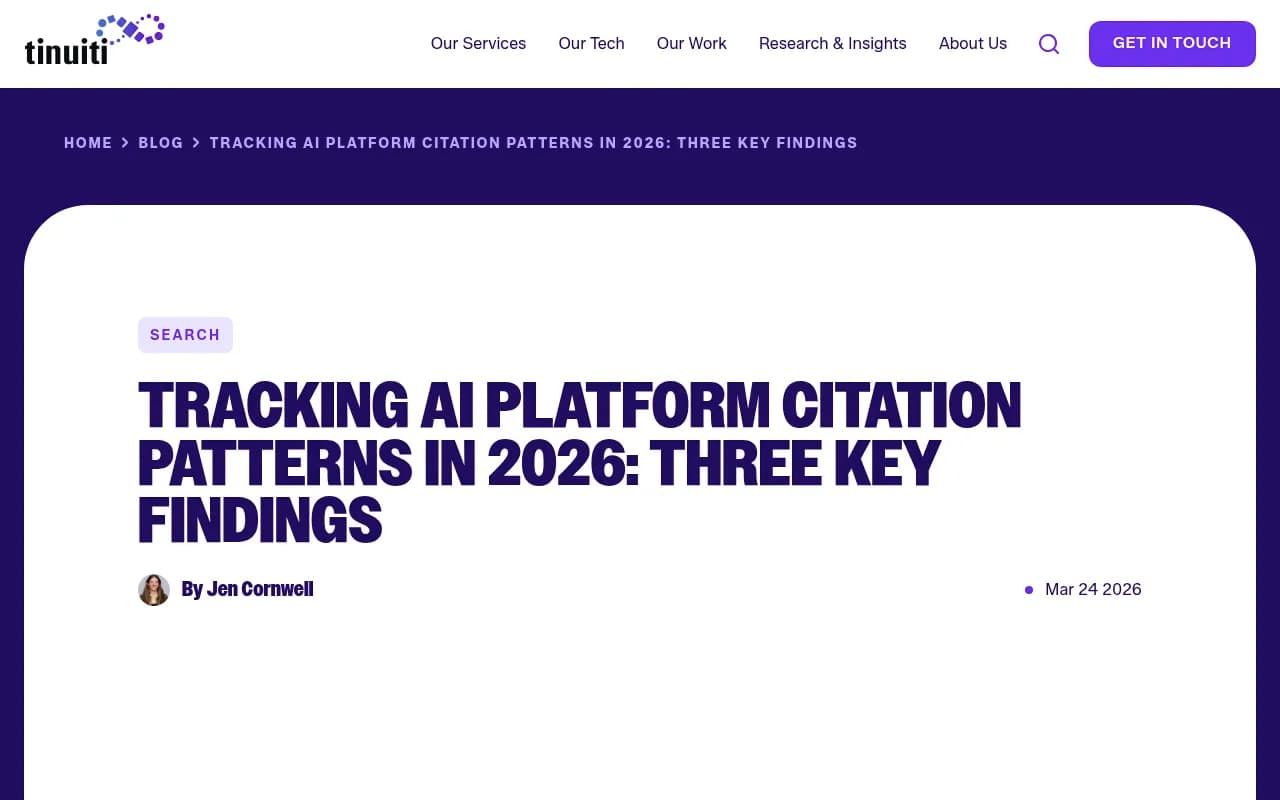
The public findings are cross-platform. Social media's share of citations across all platforms rose from 6% in October to 9% in January. The page I could reach did not break out a Meta AI-specific citation figure.
The Q2 2026 follow-up covers the same seven platforms and nine categories. Its headline numbers are about others: YouTube's share of AI Mode citations grew more than 3x, Amazon holds 19% of Copilot citations, and social media is 13% of AI citations for apparel prompts. The full report is gated, and no Meta AI figures were publicly visible.
If you need Meta AI specifics, it may be worth requesting the full report from Tinuiti. Just don't pretend the public summary says something it doesn't.
What Meta's crawler surge tells us
Here is where it gets interesting. Promptwatch Data tracked a Meta-WebIndexer crawling surge in summer 2026. Its share of tracked AI crawler requests rose from about 2.2% in mid-July 2026 to 37.8% on August 9, 2026. That is roughly 17x in under a month, and it made Meta-WebIndexer the heaviest AI crawler in Promptwatch's logs.
The timeline was lumpy. The share sat around 2% until July 17, spiked to about 23% between July 20 and 22, then climbed again from August 5 to the August 9 peak. The surge comes from the indexing crawler specifically, not Meta's AI-training or link-fetching bots.
Why would Meta do this? Promptwatch's reading is that Meta-WebIndexer exists to improve Meta AI search results and cite sources. That is an interpretation, not a Meta statement. On August 6, 2026, @levelsio posted that Meta staff told him Meta is "allegedly" building its own web index so Meta AI's web searches don't have to go through Google. He also reported heavy scraping that triggered server load alerts. All of this is unconfirmed.
My take: a company doesn't pour that much crawl budget into a web index to then ignore the sources. If Meta AI is moving toward its own retrieval layer, citation behavior could change quickly. But that is speculation, and I'd rather label it as such than build a forecast on it.
Why assistants that barely link out are hard to measure
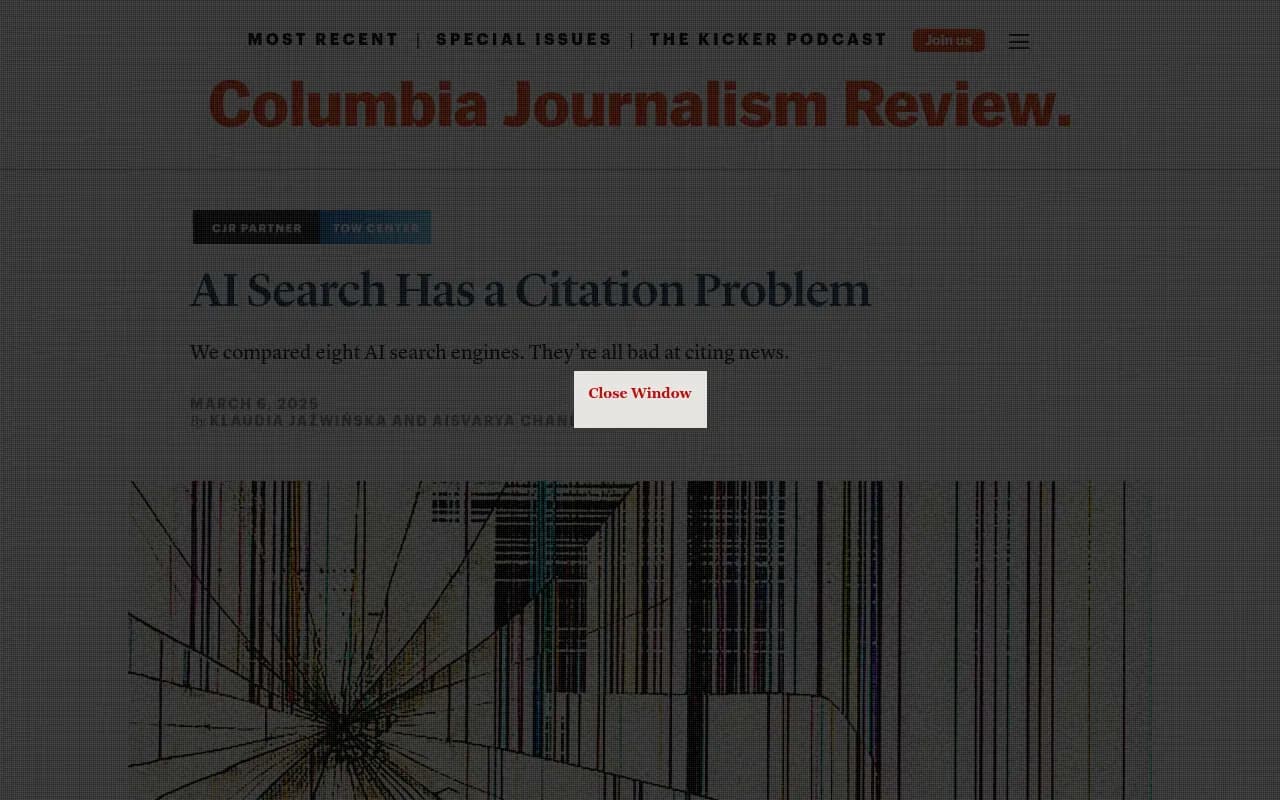
The broader citation problem is worse than low link counts. The Columbia Journalism Review's Tow Center tested eight generative search tools and found they often fail to link back to the original source. Of 200 prompts tested on Grok 3, 154 citations led to error pages. That study dates from 2025 and does not cover Meta AI, but it makes a useful point: a citation existing and a citation being useful are different things.
For assistants that rarely show links, three things get tangled together:
- Mentions. The brand is named in the answer with no link.
- Citations. A source URL is attached to the answer.
- Clicks. A user actually follows it.
A low-link assistant can still shape what people buy. If Meta AI tells a WhatsApp user which running shoe to buy and never links anywhere, you got influence and zero traffic. Your analytics will never show it.
How to prepare your site for Meta AI
Since you can't optimize against a metric that isn't published, focus on what is observable.
Check your logs for Meta's crawlers
The user agents to look for in server logs and robots.txt are:
meta-webindexer
meta-externalagent
meta-externalfetcher
FacebookBot
They do different jobs. Per Promptwatch's data, the surge was meta-webindexer. If you block everything with a Meta-looking name, you may be opting out of Meta AI's retrieval entirely. Decide deliberately.
Budget for the load
Promptwatch advises planning for sustained Meta crawler load, since request-billed infrastructure (serverless functions, metered CDNs) can get expensive. Check your hosting bill after any crawler spike. Rate limiting is a reasonable middle ground if you want to be indexed but not drained.
Write content that survives without a link
If an assistant rarely links out, your brand name and key facts have to carry the weight inside the answer text. Practical steps:
- State who you are, what you sell, and who it is for in plain sentences near the top of key pages.
- Keep pricing, specs, and definitions consistent across your site and third-party profiles.
- Get named on pages assistants already pull from, such as review sites and directories, since a mention elsewhere can feed an answer even if your own page is not cited.
Monitor what you can
Most AI visibility tools focus on ChatGPT, Perplexity, Gemini, and AI Overviews, and Meta AI coverage varies. Check any vendor's model list before you pay for it. Promptwatch tracks Meta AI among the interfaces it monitors, alongside crawler logs that show whether Meta's bots are reading your pages. For a wider shortlist, the GEO software directory at bestgeosoftware.com lets you filter by platform coverage.
Other trackers in this space worth checking for Meta AI support include:



I haven't verified Meta AI coverage for each of these, so confirm before buying.
How to cite Meta AI when you use it
There is a second reading of this question: how do you cite Meta AI as a source in your own writing? Meta publishes APA guidance for its own tool.
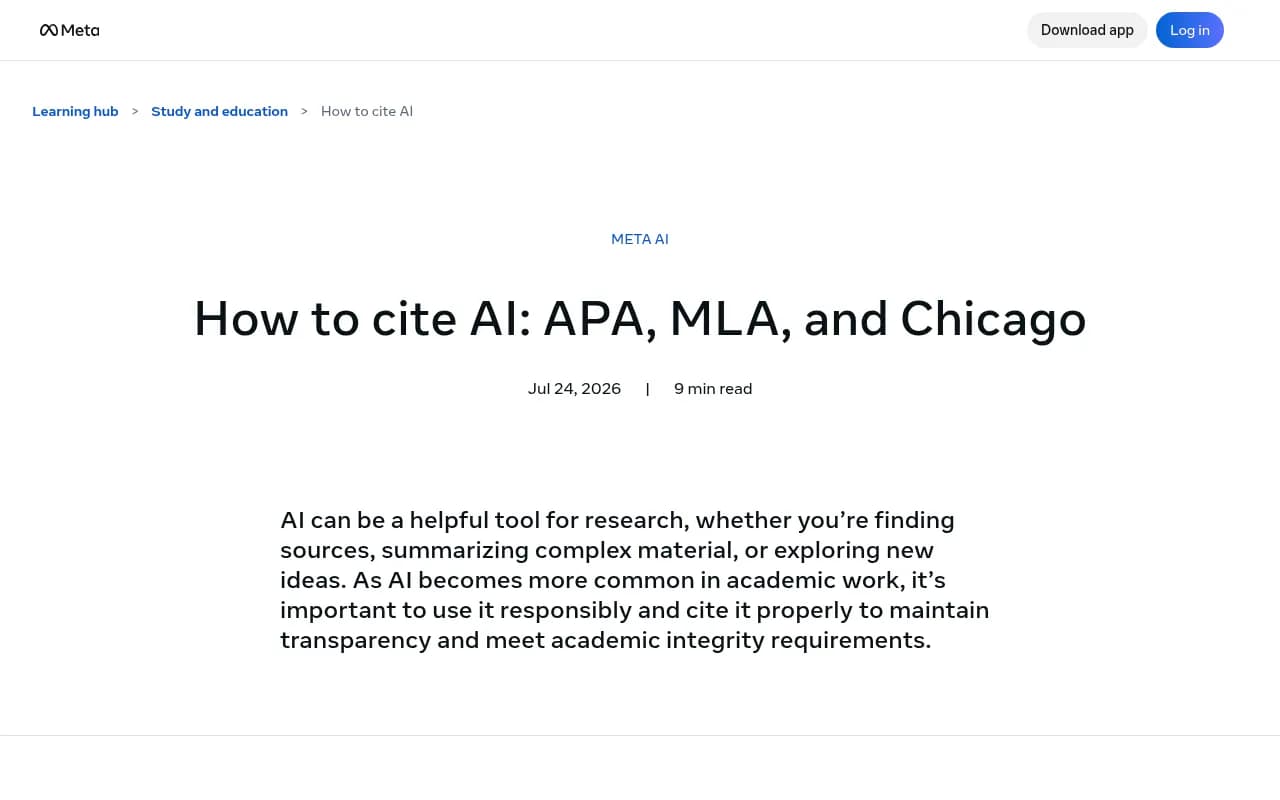
The APA format Meta gives is:
Meta. (2026). Meta AI (May 5 version) [Large language model]. https://ai.meta.com/learn/ai-for-students/how-to-cite-ai/
Library guides at Purdue and the University of Maryland add a caveat worth remembering. Many style guides and publishers don't recommend listing AI as an author. They recommend naming the tool and keeping human responsibility for the content front and center. If you are citing Meta AI for a claim, verify it against a primary source and cite that instead.
What to watch next
| Signal | Where to look | What it would mean |
|---|---|---|
| Meta confirms a Meta AI search index | Meta announcements | Citation behavior could change quickly |
| Meta-WebIndexer share stays high | Promptwatch Data crawler reports | Sustained investment in retrieval |
| Meta AI figures appear in Tinuiti's full report | Tinuiti Q2 2026 report | The first real citation benchmark |
| Meta changes how sources display in apps | Meta AI in WhatsApp and Instagram | More or fewer clickable links |
Bottom line
Meta AI's citation rate is unquantified in public data. The strongest signal is indirect: Meta's indexing crawler grew from about 2% to nearly 38% of tracked AI crawler requests in under a month, which hints at a retrieval push but proves nothing about linking behavior. Until someone publishes a real measurement, treat Meta AI as an influence channel you monitor through crawler logs and brand mentions, not a traffic source you can attribute.