Key takeaways
- Almost half of ChatGPT responses with citations (47.6%) cite 10 or more unique domains, and 66.1% cite at least 8 (Promptwatch Data, Sep 28 to Oct 4, 2026).
- Answers built on a few sites are rare: 6% cite three domains or fewer, and just 1% cite a single domain.
- Prompt type matters. Organic prompts hit 10+ domains 52.5% of the time, competitor comparisons 49.1%, and brand-specific prompts only 21.3%.
- You will almost never be the only brand in an answer. Position, description, and third-party mentions matter as much as being cited at all.
- Be careful comparing this stat with "average citations per response" figures. They measure different things.
The headline numbers
Promptwatch Data looked at ChatGPT responses with at least one citation between September 28 and October 4, 2026, and counted unique domains per response. Several URLs from the same domain count once. The result is more crowded than most people assume.
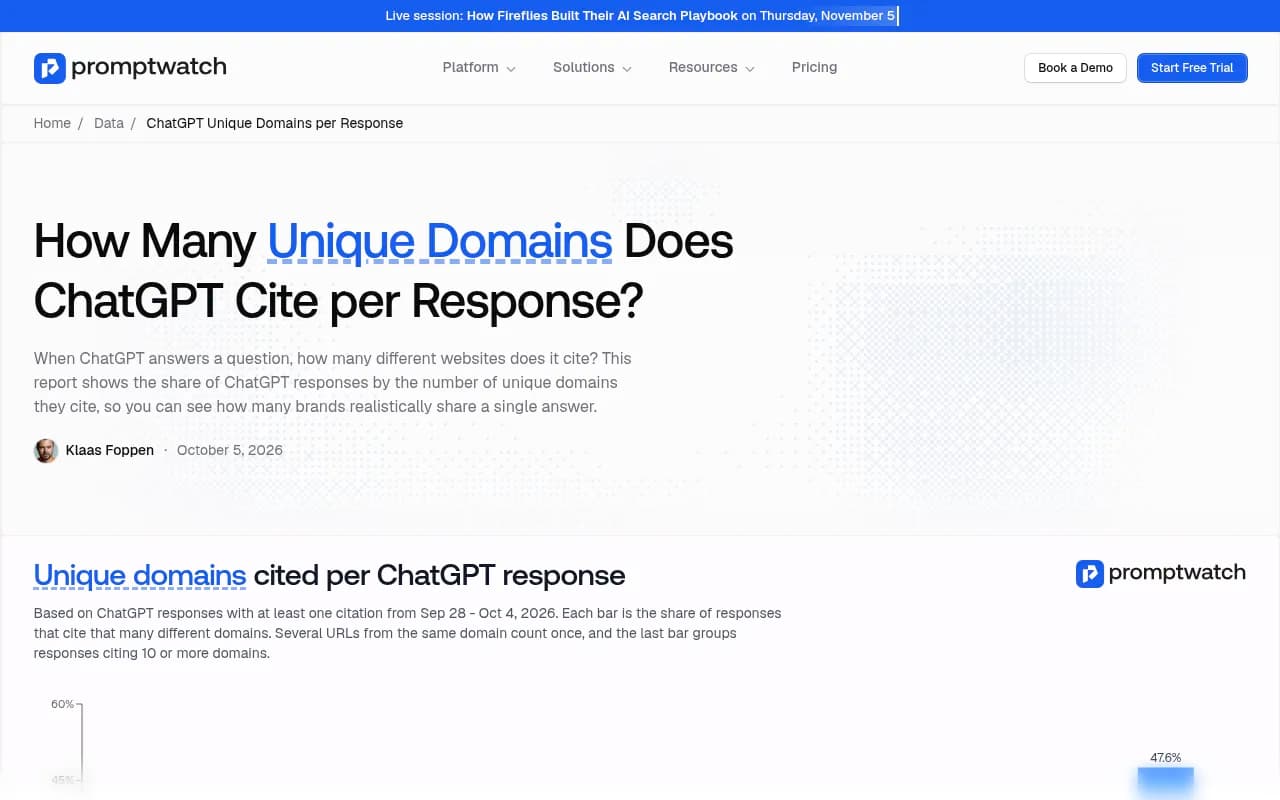
The full distribution is in Promptwatch's report on unique domains per ChatGPT response. The main figures:
| Measure | Share of responses |
|---|---|
| Cite 10 or more unique domains | 47.6% |
| Cite at least 8 domains | 66.1% |
| Cite three domains or fewer | 6% |
| Cite exactly one domain | 1% |
The share climbs with every extra domain from 1 to 9, and then the last bar, 10 or more, is the biggest single bucket. The old mental model of ChatGPT picking one or two authoritative sources and summarizing them is mostly wrong. The typical answer is a pile of sources.
Why prompt type changes the picture
The overall number hides a big split. Promptwatch breaks prompts into three types, and they behave differently.
| Prompt type | Example | 10+ domains | 8+ domains | 3 or fewer |
|---|---|---|---|---|
| Organic | "best project management software for small teams" | 52.5% | 71.8% | about 4-5% (brand prompts are roughly 3x this) |
| Competitor comparison | "Tool A vs Tool B" | 49.1% | 66.5% | not reported |
| Brand-specific | A question naming one brand | 21.3% | not reported | 13.8% |
A few observations.
Organic prompts are the most crowded. These are the category-level questions where buyers discover options, so this is also where most of the competition for new customers happens. Over half of those answers pull from ten or more sites.
Comparison prompts look nearly identical to organic ones. Even when a user names two products, ChatGPT still goes wide, pulling reviews, forums, docs, and listicles around both.
Brand-specific prompts are the exception. Only 21.3% cite 10+ domains, and 13.8% cite three or fewer, about three times the organic share. When someone asks about you by name, ChatGPT leans on a tighter set of sources: your site, a few reviews, maybe a profile page. That is good news if you control those sources, and a risk if one of them is outdated or wrong.
What this means for your brand
You are sharing every answer
If a typical organic answer cites ten or more domains, being one of them is the starting line, not the finish. Promptwatch's own advice from the report is to track where you appear in the response and how ChatGPT describes you, not just whether you were cited. A mention buried in the ninth source with a lukewarm description is a different outcome from a first-position recommendation.
Third-party pages do a lot of the work
With that many domains per answer, ChatGPT is clearly leaning on listicles, reviews, comparison pages, and forums. For organic prompts, those are often how a brand gets in at all. Promptwatch's data on which content types ChatGPT cites most shows product pages at 22.4% of citations (Sep 28 to Oct 4, 2026), followed by landing pages and listicles. So both your own pages and other people's pages matter.
Other studies point the same way. OtterlyAI's analysis of 1M+ citations across ChatGPT, Perplexity, and Google AI Overviews (January to February 2026) found community platforms and other non-brand sources taking a large slice, and that crawler access problems affected 73% of the sites they checked.
Your competitors are in the same answer
With ten sources, the reader sees a field of options. Check which competitors are cited alongside you, and on which pages. If the same three review sites keep appearing next to your rivals and never next to you, that is your outreach list.
Authority is not the only lever
Promptwatch's data on citation share by domain rank found that sites with domain rank 46-75 earned almost half of ChatGPT citations in August 2026, while DR 91-100 sites fell to about 3%. A crowded answer has room for mid-authority sites that are specific and useful.
Why the answers got so wide
I can't pin this on one cause, but a few things in the data are relevant.
Query fanout is the obvious suspect. ChatGPT runs several web searches per response, and each search pulls its own set of results. Promptwatch reported that on August 8, 2026 ChatGPT started using the site: operator at scale, going from roughly 0.4% to about 17% of fanout queries overnight, with searches per response nearly doubling (report here). More searches per response plausibly means more distinct domains per response, though the unique-domains report doesn't test that link directly.
Social sources have also shrunk in ChatGPT. Promptwatch measured reddit.com's share of ChatGPT citations falling from about 4% to 0.5% on August 14, 2026 (details), and ChatGPT drew only 0.46% of citations from social platforms in the week of Sep 28 to Oct 4, versus 12.2% for Google AI Overviews (social citations report). Fewer slots going to a few big forums leaves more for the long tail.
A caution about "average citations per response"
You may have seen figures like "ChatGPT cites about 5 sources per answer." Promptwatch's earlier average sources per response report (September 2025) found about 5 citations per ChatGPT web-search answer, versus about 10 for Google AI Overviews and Perplexity. And its ChatGPT citation drop report found citations per search-enabled response falling from about 6.4 to roughly 4.7-4.9 (about 27%) after the GPT-5.3 rollout on March 4, 2026.
Those numbers sit awkwardly next to 47.6% of responses citing 10+ domains. They shouldn't be treated as directly comparable. The reports cover different periods and response sets, and may count different things (for example, displayed citations versus all sources consulted). If you quote both, state the period and the definition each time. The safe reading of the new report is relative: most answers have many domains, and prompt type shifts that a lot.
How to compete in a 10-domain answer
- Map the prompts that matter. Split them into organic, comparison, and brand-specific. Your odds and your tactics differ for each.
- Find who appears next to you. For each prompt, list the other cited domains. Group them into your own pages, review sites, listicles, forums, and publishers.
- Close third-party gaps. Pitch the listicles and comparison pages that already get cited. Fix inaccurate reviews and profile pages.
- Tighten your own pages. Product pages, landing pages, and docs earn the most citations and stay cited longest. Promptwatch's content half-life report found landing pages and docs lasting longest, while news lost half its pages within 36 days.
- Write headings that read like short search queries and build focused pages for sub-questions like pricing, alternatives, and how-tos, since fanout searches tend to be short.
- Check crawler access. Blocked AI crawlers mean you can't be one of the ten. Server logs and robots.txt are the first place to look.
- Watch the details of how you are described, not only whether you are present.
Tools for tracking this
You can spot-check by hand, but a crowded answer is hard to monitor without a tracker. Promptwatch monitors the real ChatGPT interface, shows which domains are cited next to yours, and logs AI crawler visits so you can see if your pages are even being read.

Other trackers in the same space include Profound and Otterly.AI, which are mostly monitoring-focused.


For a wider list, the GEO software directory at bestgeosoftware.com compares options. Pick one that shows cited domains per response and your position within them, not just a mention count.
What to remember
If 47.6% of ChatGPT answers cite ten or more domains, visibility is a shared outcome. Organic and comparison prompts are the crowded ones; brand-specific prompts are tighter. Treat the numbers as a snapshot of one week (Sep 28 to Oct 4, 2026), expect them to move, and check Promptwatch Data for updates.