Key takeaways
- Product results in Google AI Mode and Gemini are drawn from the Shopping Graph, which is built largely from Merchant Center data. AI Overview text answers come mostly from the web index, so feed work and page work are separate jobs.
- Fix in this order: identifiers and core required fields, price and availability accuracy, feed-to-page consistency, then titles, images, and the new conversational attributes.
- Conversational attributes (Q&A, related products, variant options, document links) are optional, but they give AI systems literal facts to quote. Verify exact names in Google's spec before building.
- ChatGPT is a different surface. Its most-cited content type is the product page, so the page your feed points to matters as much as the feed.
- Measure the result. Merchant Center's AI performance insights cover Google surfaces; other AI platforms need a separate tracker.
Why the feed matters more than it used to
Shopping ads never had a keyword list. Google reads your feed and decides which searches your product gets matched to. AI shopping takes that logic further. When someone asks AI Mode for "polarized sunglasses under 100", the products that can appear are the ones whose data Google can read, verify, and trust.
Shopify's explainer describes the mechanism plainly: product data in Merchant Center feeds the Shopping Graph, a dataset of more than 50 billion listings interpreted with Gemini models. Price, availability, and product data updates can then show up across AI Mode, virtual try-on, and agentic checkout.
So the feed is no longer just a way to run Shopping ads. It is the source record AI uses to decide whether your product fits a detailed request.
What the feed controls, and what it doesn't
This is where a lot of advice gets sloppy. Different AI surfaces pull from different places.
| Surface | Main source of product info | What you can influence |
|---|---|---|
| Google AI Mode shopping results | Shopping Graph (built largely from Merchant Center) | Feed attributes, price, availability, images |
| Gemini app shopping | Same Shopping Graph | Same as above |
| AI Overviews text answers | Google's web index | Page content, structured data, authority |
| Shopping carousels and free listings | Merchant Center feed | Feed quality, diagnostics |
| ChatGPT product cards and citations | Open web, product pages, merchant data | Product pages, schema, accurate pricing |
ZenoX Media makes the same split: feed work can affect AI Mode, while page content can affect the answer box. I think that is the right mental model. Don't expect a feed tweak to change what an AI Overview says, and don't expect page copy alone to win a Shopping Graph slot.
One caveat. I could not find a published number showing how much feed quality changes AI Mode or ChatGPT shopping visibility. Anyone quoting a precise lift is guessing. What exists is mechanism and practitioner evidence, which is enough to prioritize, not enough to promise results.
The new pieces in Google's stack
A few 2026 developments change what "feed optimization" means.
Universal Commerce Protocol and agentic checkout
On January 11, 2026, Google announced the Universal Commerce Protocol (UCP), an open standard for agentic commerce co-developed with Shopify, Etsy, Wayfair, Target, and Walmart. It powers a checkout feature on eligible listings in AI Mode and the Gemini app, starting with eligible US retailers. The retailer stays seller of record.
Per Google's UCP help page, only listings carrying the native_commerce(checkout_eligibility) attribute show the Buy button, Merchant Center remains the hub, and Google's advice is to keep feeds and brand assets as robust and up to date as possible. It is early access for select merchants in the US, Canada, and Australia. A community note says the attribute currently has to go in via a supplemental feed or a primary feed with custom attributes, and that feed rules were not yet supported. Check the current state before you plan around it.
Conversational attributes
Announced at Google Marketing Live in May 2026, these are optional attributes meant for natural-language shopping. Google's own Ads Decoded episode on holiday readiness names six: Q&A, variant options, item group title, related products, popularity rank, and document link. Third-party write-ups use slightly different field names (question_and_answer, related_product, variant_option, document_link), so confirm exact names in Google's attribute spec before you build anything.
Reported limits, from Limelight Marketing and worth double-checking:
- Up to 30 Q&A pairs per product, each question and answer capped at 1,000 characters
- Every related product needs all three sub-attributes
- Within an item group, every variant must use the same set of variant option names
Channable and Lily AI both say empty fields don't cause disapprovals. That makes these low risk to add and easy to defer, but they are exactly the kind of data an AI assistant can lift into an answer.
AI performance insights in Merchant Center
The change log lists AI performance insights, announced for May 27, 2026, designed to show how your products are discovered in AI Mode, AI Overviews, and the Gemini app. Performance reporting definitions were also updated starting August 24, 2026, and the Popular products reports were enhanced in late June 2026. Compare your numbers carefully across those dates, because some shifts will be definitional rather than real.
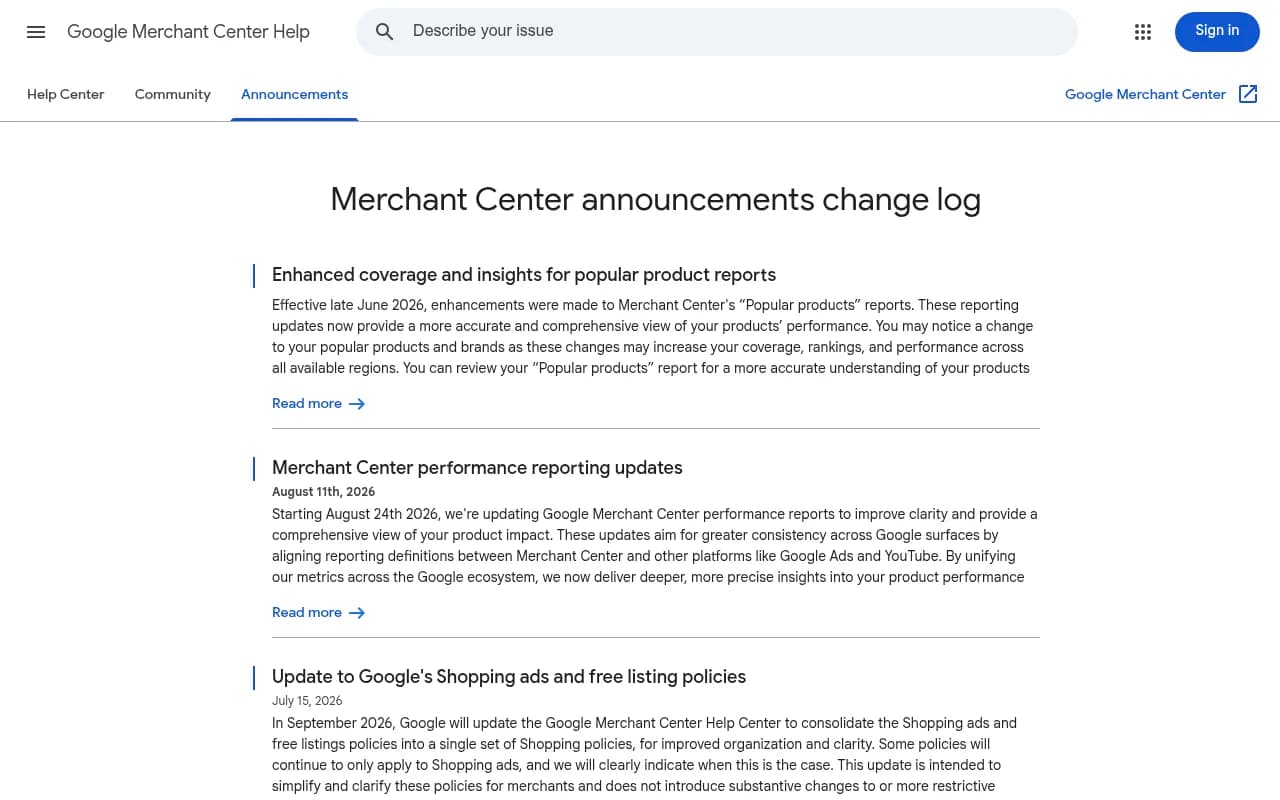
The change log is worth bookmarking. Merchant Center dropped the "Next" branding in July 2026, shopping ad and free listing policies are being consolidated into one set of Shopping policies in September 2026, and Google says the consolidation brings no new restrictions.
What to fix first
Here is the order I'd work in. It follows the logic from ZenoX Media: don't polish copy on a product Google cannot identify.
1. Product identifiers
In ZenoX Media's sample of 12,375 products (measured July 28, 2026), 81.3% had no GTIN or MPN. That is a single-vendor sample, not an industry census, but it matches what Google's Bhaskar said on the Ads Decoded episode: identifiers are basic housekeeping, and without them matching gets hard.
- If the product has a real barcode, send the GTIN.
- If not, send brand plus MPN.
- Never invent a GTIN to fill the column. Inaccurate data is a policy violation and a fast route to a suspension.
2. Required fields, price, and availability
Check ID, price, availability, link, image, and brand. Then check sale price and item_group_id for variants. Google's team also pointed merchants to automatic price corrections and crawled offers, which sync price and availability from your landing pages.
The reason this ranks so high: agents and AI Mode surface products people may buy. A wrong price or stock status is the fastest way to lose trust, and it can get you disapproved.
3. Feed and page must match
seoClarity describes two things Google is guarding against: fake listings, and bait-and-switch pricing where the feed says $100 and the page says $600. Strict matching is the defense. Practically:
- Same price, availability, and GTIN in feed and in page schema
- Product schema markup on the page, since AI shopping assistants also parse structured data from the page itself
- No UTM parameters in product URLs. Tiptop Search Marketing notes the Google & YouTube Shopify app appends them, which can muddy GA4 attribution
A mismatch can trigger a Merchant Center flag and keep AI tools from recommending the product.
4. Diagnostics and disapprovals
Disapproved products drop out of shopping ads and free listings, which can keep them out of AI-powered results. Open the Diagnostics tab weekly, not quarterly. Small issues compound.
5. Titles and descriptions
Now the copy. Merchant Center allows 150 characters in a title, but displays truncate. seoClarity suggests including brand, product or model name, and product type, and avoiding option strings at the end. ZenoX recommends putting buyer words in the first 70 characters, since Shopping ads show roughly that much; 68% of titles in their sample ran past 80.
A caution: seoClarity's 30-35 character tip is about SERP truncation. I found nothing official tying title length to AI Mode ranking, so treat it as display advice.
For descriptions (limit 5,000 characters), write feature plus proof, like "100% organic cotton, so it stays cool all day", not "made of cotton". If you draft with AI, read every line. Models guess at fabric blends and sizes, and a wrong claim can trigger a misrepresentation flag. Ship approved copy through a supplemental feed so the storefront stays untouched.
6. Images and video
Google's team was direct about this: AI can pick up textures and stitching, so one hero image isn't enough. Their guidance:
- Minimum 500 by 500 pixels, ideally above 1500 by 1500
- Up to 10 additional images with close-ups and alternate angles
- Fill the lifestyle image link too; there is no penalty for using both
- Use the video link attribute (up to 10 videos), starting with the product front and center
- No overlays or promotional text
ZenoX found only 41% of sampled products carried two or more extra images. That is an easy gap to close.
7. Shipping, returns, ratings, and promotions
Shipping speed and return policy are confidence drivers. Merchants can now set order cutoff times and carriers at offer level. Product ratings need at least 50 reviews across the catalog per Channable, and Google matches reviews using GTIN, MPN, and brand, so those identifiers matter again. Review feeds also need a review ID.
8. Conversational attributes
Only after the basics. Start with Q&A on best sellers, and use literal, quotable values. Lily AI's example: "Requires a 1/4-inch felt rug pad on hard floors" beats marketing language every time.
A practical prioritization table
| Priority | Fix | Effort | Why it comes first |
|---|---|---|---|
| 1 | GTIN or brand plus MPN | Medium | Google can't match what it can't identify |
| 2 | Price, availability accuracy | Low to medium | Wrong data costs trust and approval |
| 3 | Feed-to-page and schema match | Medium | Mismatch triggers flags |
| 4 | Clear diagnostics errors | Low | Disapproved items vanish from results |
| 5 | Titles and descriptions | Medium | Better matching on detailed queries |
| 6 | Extra images and video | Medium | Multimodal queries need visual context |
| 7 | Shipping, returns, ratings | Medium | Confidence and conversion |
| 8 | Conversational attributes | Medium | Optional, but quotable by AI |
Rank products by revenue and start with the top slice. You are not going to hand-edit 5,000 SKUs.
Managing the work at scale
Supplemental feeds and feed rules in Merchant Center handle most overrides without touching your store. For larger catalogs, a feed tool applies the same template across everything. WebAppick's example is a rule that converts a color value like Crimson into Red so it matches Google's expectations. If you manage SEO for a large catalog, enterprise platforms such as seoClarity also cover Shopping feed analysis.
Schema markup on the product page is the other half of the match. A structured data platform can help if you can't hand-maintain it.
ChatGPT is a different game
Google's Shopping Graph doesn't govern ChatGPT. According to Promptwatch's ChatGPT shopping data, shopping features such as product cards and price comparisons attach to only a low single-digit percentage of ChatGPT web-search responses, and they concentrate on commercial and transactional prompts. The rate moves in steps, which Promptwatch reads as OpenAI tuning when cards appear.
The citation side matters more for most merchants. In Promptwatch's content-type report (Sep 28 to Oct 4, 2026), product pages were the most cited type in ChatGPT at 22.4%, with landing pages at 16.8%. For commercial prompts, product pages hit 26.0%. The page your feed links to is the surface ChatGPT cites most, so full specs, price, and positioning belong on the page, not just in the feed.
The half-life report adds that landing pages and docs stay cited longest, while news loses half its pages within about five weeks. Evergreen product pages are the safe bet.
Ads are in the mix too. Promptwatch Data on ChatGPT ads shows ads in an average of 20.1% of web-search responses from May 20 to August 17, 2026, with a 7-day average of 32.4%. Shopping prompts are competitive real estate.
Measuring whether it worked
Merchant Center's AI performance insights tell you about Google surfaces. For everything else, you need to see which prompts name your products and which pages get cited. Tools like Promptwatch track product visibility in ChatGPT shopping carousels and Amazon Alexa results, and let you upload your catalog to follow your own products.

If you want to compare options, the directory at bestgeosoftware.com lists GEO tools by category. Also pair Merchant Center with Google Search Console and GA4, which groups free listing traffic under Organic Shopping.
A simple monitoring loop:
- Record a baseline: disapproval count, impressions, and clicks in Merchant Center.
- Run your buyers' commercial prompts in AI Mode, Gemini, and ChatGPT. Note which brands fill product cards.
- Ship one change batch to your top-revenue products.
- Re-check in two to four weeks. Account for the August 24 reporting definition changes when comparing older data.
What I'd skip
- Chasing a title length target for AI ranking. There's no evidence for one.
- Inventing GTINs or padding descriptions with claims you can't prove.
- Building a separate "AI feed". ZenoX is right that there's no second upload for AI Mode. Complete attributes, parseable titles, and matching page schema are the job.
- Waiting for UCP. Fix the basics now; they are prerequisites anyway.
Bottom line
The feed decides whether Google's AI can identify, trust, and match your product. Fix identifiers, price accuracy, and feed-to-page consistency before anything exciting. Then add images, ratings, and conversational attributes, and measure across Google and ChatGPT separately, because they don't share a source.