Key takeaways
- ChatGPT and Google AI Mode behave like separate shelves. In a GrowByData running-shoe sample (Sept 15 to 21, 2026), they never put the same product first on the same day.
- AI Mode draws on Google's Shopping Graph (50+ billion listings). ChatGPT leans on merchant feeds plus third-party review and retail pages it cites.
- Track at the product level: which SKU appeared, in what slot, at what price, and who showed up instead. Brand mentions alone won't tell you that.
- Shopping cards show up in only a small share of ChatGPT responses, and the rate moves in steps, so measure over weeks, not a single day.
- Use a shopping-specific tracker for cards and a GEO platform for citations, crawlers and content gaps.
Why these two surfaces need separate tracking
A year ago most ecommerce teams treated "AI shopping" as one thing. It isn't. ChatGPT's product carousel and Google AI Mode's product panels are built from different data, shown differently, and clicked through to different destinations.
GrowByData tracked running-shoe prompts for a week and found the two surfaces never agreed on the top product on the same day. That is a small sample (21 answers per surface, one category, one market), so don't treat it as a law. But it matches what many teams see: strong on one, missing on the other.
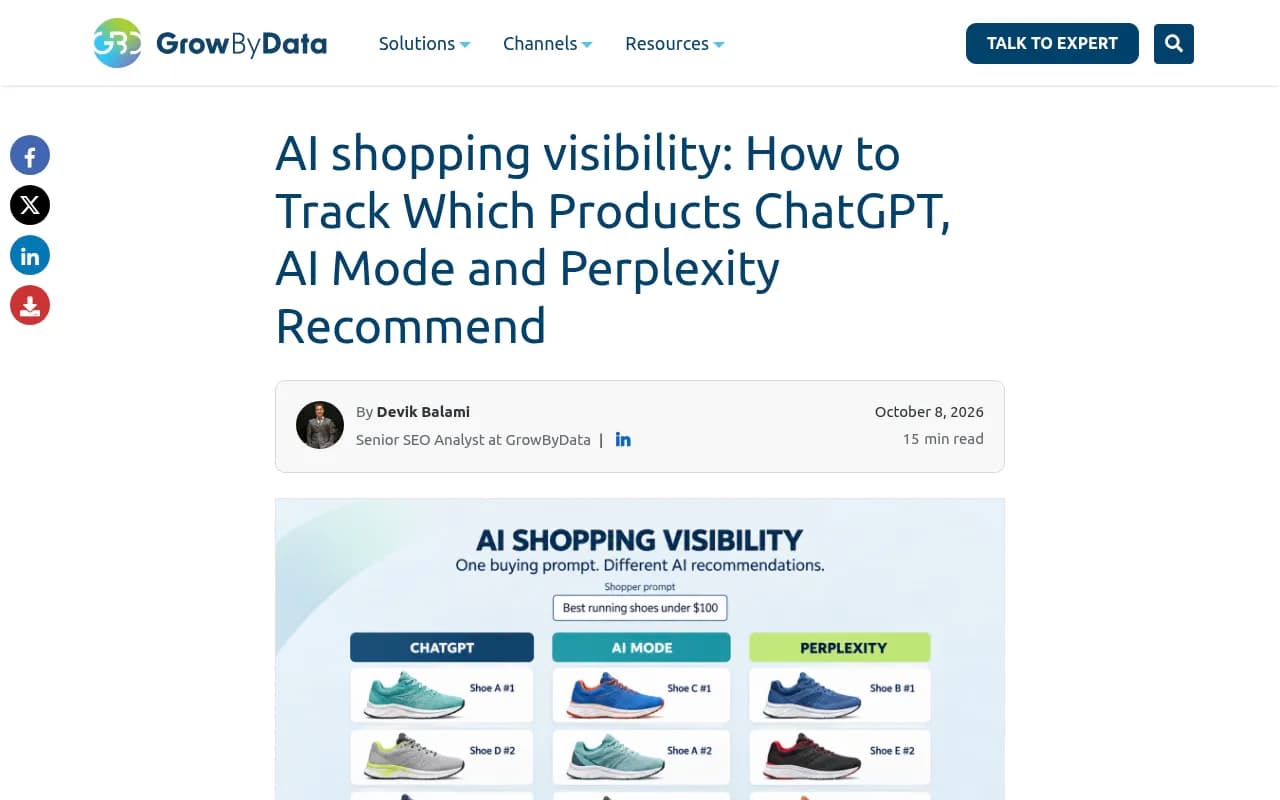
So the practical question isn't "are we visible in AI shopping?" It's "which of our products show up on which surface, and why?"
How each platform sources products
Google AI Mode
AI Mode builds on Google's Shopping Graph, which Google describes as more than 50 billion product listings, with over 2 billion refreshed every hour. Shoppers get a panel of products and images that updates as they refine the question. Google has also added agentic checkout for eligible US merchants and virtual try-on for apparel.
The implication is simple. If your Merchant Center feed is thin, wrong or stale, AI Mode has little to work with. In the GrowByData sample, 71 of 130 AI Mode product placements linked to a Google Shopping product page.
ChatGPT
ChatGPT's shopping results come from merchant feeds (via the Agentic Commerce Protocol, Shopify Catalog or direct feed applications), and OpenAI says the picks are chosen independently and are not ads. ChatGPT may rewrite product titles and add labels like "Budget-friendly".
Here is the twist. In the same GrowByData sample, 118 of 159 ChatGPT product placements pointed to a third-party review or retail page, and none to a brand's own site. So a clean feed gets you considered, but coverage in the pages ChatGPT reads is what moves you up the list.
Promptwatch Data's content-type report (Sep 28 to Oct 4, 2026) adds nuance: product pages were the most cited content type in ChatGPT at 22.4%, followed by landing pages (16.8%) and listicles (13.6%). For commercial prompts, product pages hit 26.0% and comparisons 7.9%. So brand product pages matter. The small GrowByData sample just shows how often review sites sit alongside them.
Side-by-side comparison
| Google AI Mode | ChatGPT Shopping | |
|---|---|---|
| Core data source | Google Shopping Graph | Merchant feeds, Shopify Catalog, cited web pages |
| What you can influence | Merchant Center feed, listings, structured data | Feed access, product pages, third-party reviews and roundups |
| Presentation | Product panel that updates with refinements | Product carousel with simplified titles and labels |
| Checkout | Agentic checkout for eligible US merchants | Merchants can use their own checkout |
| Avg. products per answer (GrowByData sample) | 6.2 | 7.6 |
| Typical link target (same sample) | Google Shopping page (71 of 130) | Third-party review or retail page (118 of 159) |
| Trigger frequency | Part of the AI Mode experience | Low single-digit % of web-search responses, in steps |
The trigger row comes from Promptwatch Data's ChatGPT shopping usage report: ChatGPT attaches shopping features to only a small share of responses where it searches the web, and the rate roughly doubled overnight at one point in late May before falling back. That looks like OpenAI tuning when cards appear, so a sudden change in your numbers may not be your doing.
What the pricing and overlap studies tell you
Productrise tracked over 2 million product listings across 100,000+ SERPs and AI Mode responses from August 9 to 31, 2026, running the same query on both sides on the same day. A few results worth knowing if you sell through Google:
- On matched products, AI Mode's lead price was 21.6% higher than in traditional search.
- Only 1.28% of products in traditional search also appeared in AI Mode for the same query on the same day.
- AI Mode showed far fewer products: an average of 3.9 versus 27.8 in traditional search.
- The main seller differed on 49.6% of matched products.
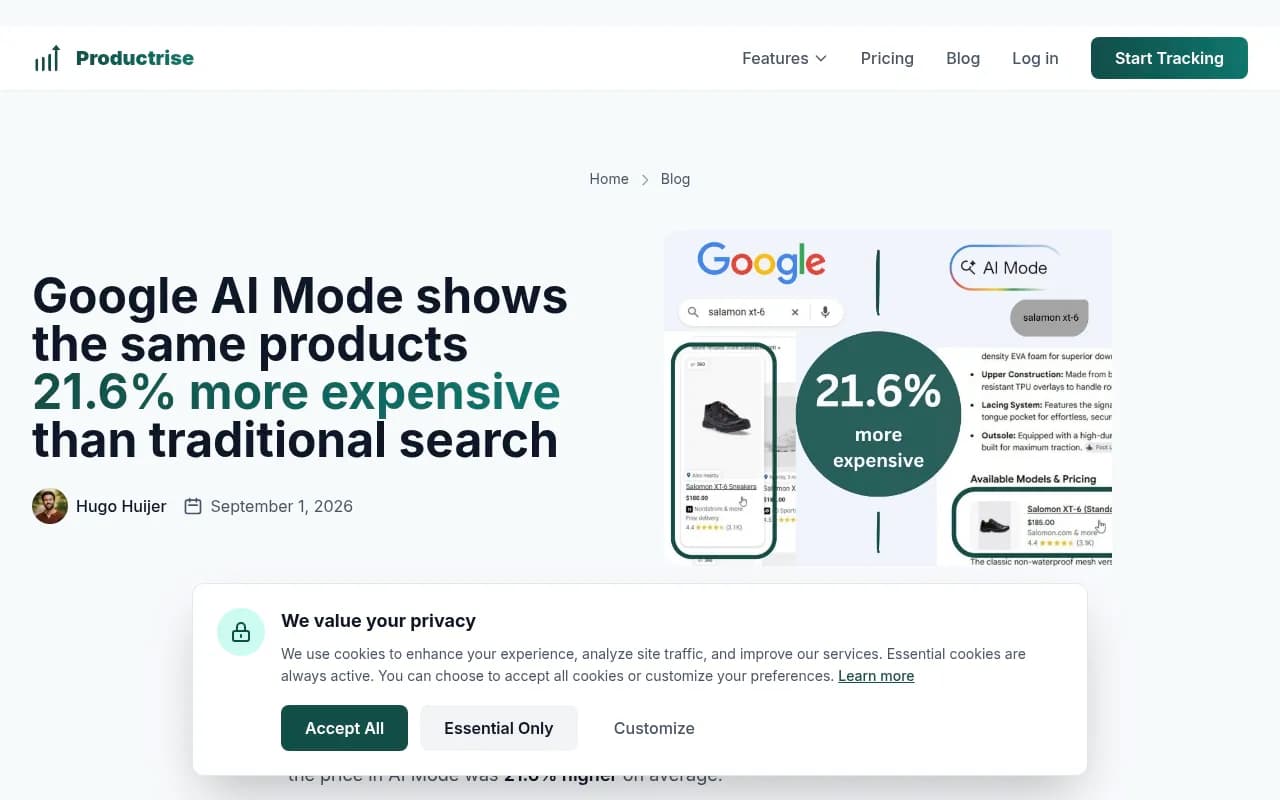
Take this seriously for one reason: ranking well in classic Shopping doesn't carry over. With roughly 1% overlap, your organic Shopping position tells you almost nothing about AI Mode. You have to measure it directly. (Independent SEO consultant Brodie Clark noted that the lowest-priced retailer tends to win the click in the end, so a higher lead price in the grid isn't necessarily a loss.)
What to track in each surface
Ignore vanity metrics like "were we mentioned." These are the fields that change decisions:
- Product-level presence: which SKUs appeared, which never did.
- Position or slot in the carousel or panel.
- Price and seller shown, since both can differ from your own site.
- Competitors in the cards when you're absent.
- Source pages behind each pick (feed listing, review site, your own page).
- Sponsored flags on ChatGPT, so you don't read an ad as an organic win.
- Rate over time, not a single run. RankX AI reports that the same ChatGPT question returned a different carousel verdict 24% of the time, so use a 28-day window.
Also keep AI Overviews in the frame. They sit on a normal results page and, in the GrowByData sample, named fewer products (4.7 per answer), with a cited page on 58 of 66 placements. Measure them with the same fields so you can compare all three.
Step-by-step: build your tracking setup
1. Write the prompts shoppers actually use
Start with category and comparison questions: "best waterproof hiking boots under $150," "trail running shoes for wide feet," "X vs Y." Tools such as AnswerThePublic and AlsoAsked help surface the phrasing. Aim for a mix of generic, comparison and branded prompts.
2. Load your catalogue
Product-level tracking needs a list of your SKUs to match against. Upload or connect it so the tool can say "your Model X appeared in slot 3" rather than "a card appeared."
3. Run both surfaces, separately
Report ChatGPT and AI Mode as two lines, never an average. If you pool them, a win on one hides a gap on the other.
4. Read results over weeks
Because ChatGPT's trigger rate shifts in steps, treat a sudden jump or drop as a possible platform change before you credit or blame your own work.
5. Connect visibility to the source
When a product is missing, check why. On AI Mode, look at your feed and listing data. On ChatGPT, look at whether the review pages and roundups it cites mention you.
Tools for tracking AI shopping visibility
There are two kinds of tools here, and you probably want both.
Shopping-card trackers
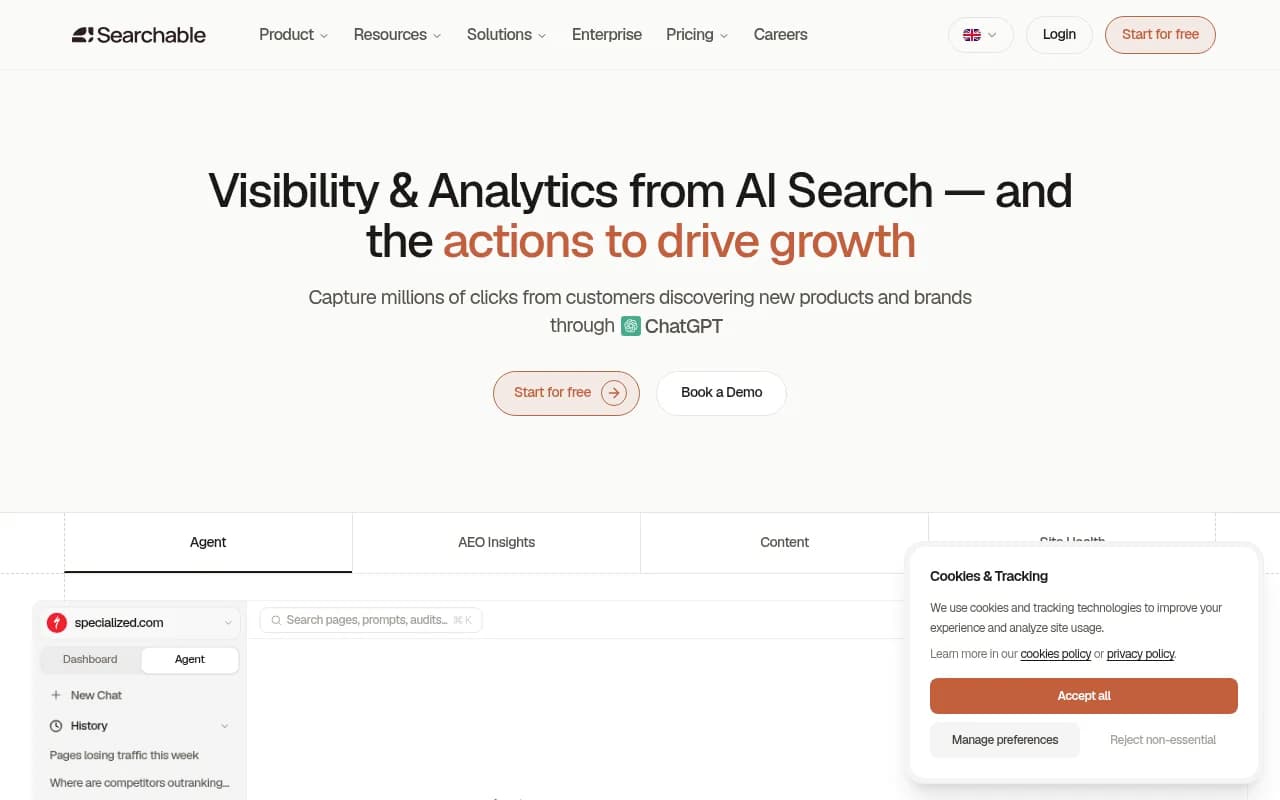
Some tools read the product cards directly. Searchable tracks product share, merchants and shopping prompts across AI platforms and shows how your products appear over time after feed or content changes.
GrowByData and RankX AI also offer AI shopping tracking that covers ChatGPT Shopping and Google AI Mode. RankX AI notes these are the two surfaces a provider can observe at industrial quality today, and reports which products appeared, in which slot and at what price. Goodie covers AI Mode and Gemini shopping panels; the Goodie AI listing is below.
GEO platforms for the "why"
Card tracking tells you what happened. To understand why, you need citation and crawler data. Promptwatch tracks ChatGPT shopping carousels and Amazon Alexa product results (you upload your catalogue to track your own products), and pairs that with citation analytics, IP-verified AI crawler logs and a content gap analysis. That lets you see which third-party pages ChatGPT cites for your category, and then use the Content Agent and Action Board to close the gaps. It also tracks AI Overviews and AI Mode answers and citations by country and language.

Other monitoring-focused options in the directory include Profound, Otterly.AI and Peec AI. They mostly answer "were we mentioned?" rather than "how do we fix it?" If you want a wider list, the GEO software directory at bestgeosoftware.com is a good place to compare.



| Need | Type of tool | Examples |
|---|---|---|
| See which products appear in cards | Shopping tracker | Searchable, RankX AI, GrowByData |
| Know why you're cited or missing | GEO platform with citations and crawler logs | Promptwatch |
| Basic mention monitoring | Prompt tracker | Otterly.AI, Peec AI |
| Feed and listing health in Google | Google's own tools | Merchant Center, Google Search Console |
How to improve visibility on each surface
No platform has published a ranking formula, so treat the following as evidence-backed starting points, not guarantees.
For Google AI Mode
- Fix your Merchant Center feed: accurate titles, prices, availability, GTINs, images and attributes.
- Add complete Product schema on product pages.
- Write conversational product copy that answers the long-tail questions shoppers type, such as use case, fit, and who the product is for.
- Monitor price consistency. With the lead price differing so often between AI Mode and classic search, make sure your listed price is the one you want shown.
For ChatGPT
- Apply for feed access via Shopify Catalog or a direct feed application.
- Make product pages easy to compare: clear pricing, specs and who each product suits. Product pages are ChatGPT's most cited content type at 22.4%.
- Get included in the "best of" roundups and comparisons that ChatGPT cites. Listicles and comparisons together are about 19.5% of citations, and higher for commercial prompts.
- Check crawler access. If AI bots can't read your product pages, nothing else matters. Crawler logs show whether they can.
- Don't lean on Reddit. Promptwatch Data shows reddit.com's share of ChatGPT citations fell from about 4% to 0.5% on August 14, 2026.
Content that holds its place
Not all pages stay cited. Promptwatch's content half-life report found landing pages and docs stayed cited longest among pages ChatGPT cited on July 6, 2026, while news lost half its pages within 36 days. Evergreen product and landing pages are a safer bet than news-style posts.
Common mistakes
- Averaging the two platforms into one score.
- Checking once. One run tells you little when the same question can flip carousel verdicts 24% of the time.
- Treating a feed fix as the whole job on ChatGPT.
- Reading a sponsored card as an organic win.
- Assuming classic Shopping rankings predict AI Mode. They barely overlap.
- Over-trusting small studies. The GrowByData sample is useful but narrow: one category, three prompts, one market, one week.
A simple weekly routine
- Run your tracked prompt set on both surfaces.
- Log products shown, slot, price and seller.
- List the competitors who beat you and the source pages behind their placements.
- Pick two fixes: one feed or schema issue, one content or coverage gap.
- Re-check in 28 days before drawing conclusions.
For a more specialised view of tooling beyond shopping, the AI rank tools directory at ai-rank-tools.com lists trackers by category.
Bottom line
Google AI Mode rewards clean listing data in the Shopping Graph. ChatGPT rewards feed access plus presence in the pages it reads. Track both at the product level, report them separately, and give each at least a month of data before changing course.