Key takeaways
- All three platforms track brand visibility in AI search engines like ChatGPT, Perplexity, and Google AI Overviews -- but they're built for very different use cases.
- Otterly.AI is the simplest and cheapest option, suited for small teams that just want to know if they're being mentioned.
- GetMint.ai sits in the middle: more features than Otterly, but still primarily a monitoring tool.
- Promptwatch is the only one of the three that closes the full loop -- from identifying gaps to generating AI-optimized content to tracking the results. It's the better fit for teams that want to actually improve their visibility, not just measure it.
AI search is no longer a side experiment. ChatGPT, Perplexity, Claude, and Google's AI Mode are now real traffic sources -- and for a growing number of brands, they're becoming the primary discovery channel. The question isn't whether to track your AI visibility anymore. It's which tool to use.
Three names come up constantly in this space: GetMint.ai, Promptwatch, and Otterly.AI. They all sit in the same category on paper, but they're quite different in practice. This guide breaks down exactly how they compare -- features, pricing, and which type of marketing team each one actually serves.
What these platforms are trying to solve
Before getting into the specifics, it helps to understand what problem this category of tool exists to solve.
When someone asks ChatGPT "what's the best project management tool for remote teams?" or "which CRM should I use for a 10-person sales team?", the AI generates an answer. It cites sources. It recommends brands. And if your brand isn't in that answer, you're invisible to that potential customer -- even if you rank #1 on Google.
AI visibility platforms track those answers. They run prompts relevant to your industry, record what the AI says, and tell you whether your brand is being mentioned, cited, or recommended. The better platforms go further and help you understand why you're not showing up and what to do about it.
That's the core problem. Now let's look at how each tool approaches it.
Otterly.AI: the lightweight starting point
Otterly.AI is the most accessible entry point in this comparison. It's designed for teams that are new to AI visibility tracking and want something they can set up quickly without a steep learning curve.

The platform monitors your brand mentions across a handful of AI models -- ChatGPT, Perplexity, and a few others -- and gives you a dashboard showing how often you appear, what sentiment the AI expresses, and how you compare to a few competitors. For a team that's never tracked AI visibility before, that's genuinely useful.
Where Otterly runs into limits is when you want to do something with the data. It shows you the monitoring output but doesn't offer much guidance on what to change. There's no content gap analysis, no built-in writing tools, no crawler log access, and no way to connect visibility data to actual traffic or conversions. It's a read-only dashboard.
That's not a criticism exactly -- it's a design choice. Otterly is priced accordingly (entry plans are significantly cheaper than the other two), and for a solo marketer or a small brand that just wants a pulse check, it does the job.
The problem is that most marketing teams don't just want to know they're invisible. They want to fix it. And Otterly doesn't help with that part.
GetMint.ai: more depth, still monitoring-first
GetMint.ai positions itself as a more comprehensive AI visibility platform. It covers more AI models than Otterly, offers prompt tracking, and has a cleaner interface for managing multiple brands or competitors.
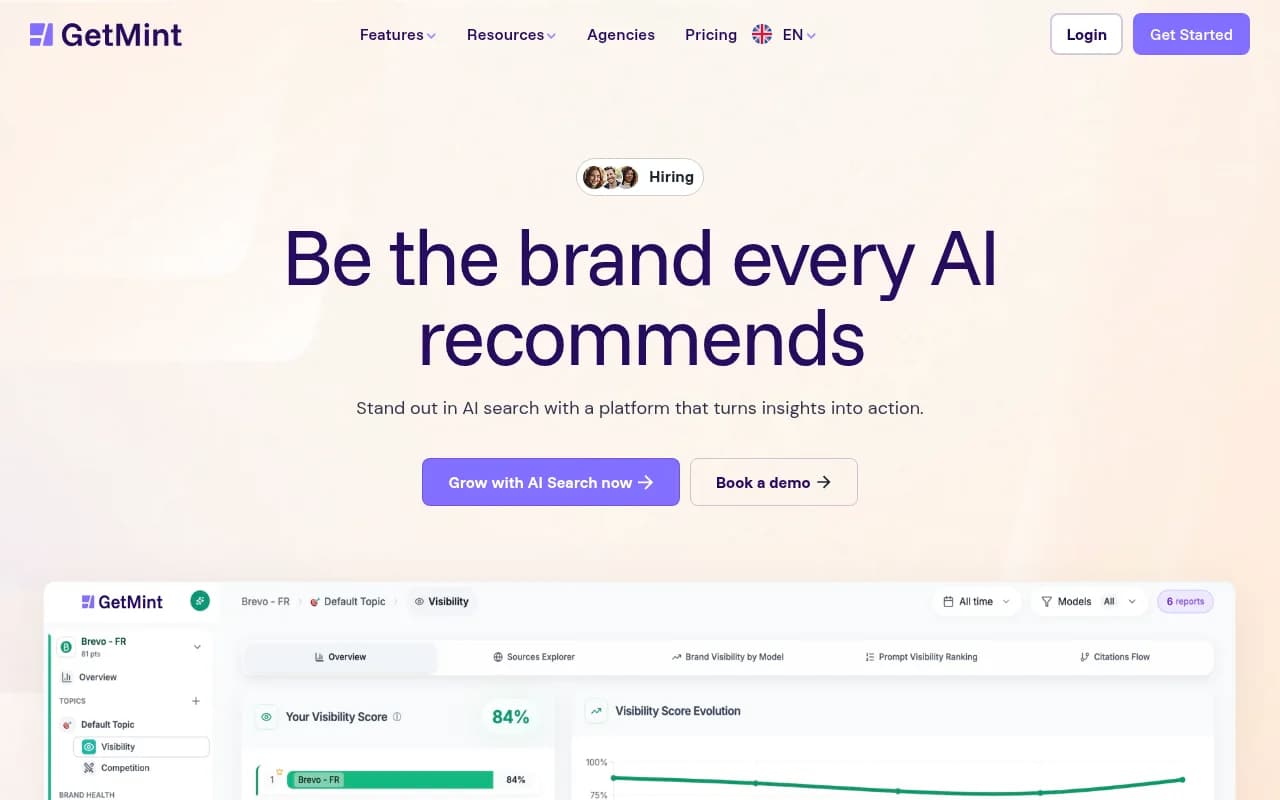
The feature set is genuinely broader. You can track more prompts, get more granular visibility scores, and run some basic competitor comparisons. For agencies managing multiple clients, the multi-brand support is a practical advantage over Otterly's simpler setup.
But GetMint is still fundamentally a monitoring platform. It tells you where you stand. It doesn't tell you what content to create, which pages AI crawlers are actually reading, or how to connect your AI visibility to revenue. The data is richer than Otterly's, but the workflow stops at the same place: you get a report, then you're on your own to figure out what to do next.
That gap matters more than it sounds. Knowing you have a visibility problem is step one. The hard part is knowing which specific topics you're missing, what content format would work, and whether the content you create is actually getting picked up by AI models. GetMint doesn't bridge that gap.
Promptwatch: monitoring plus the full optimization loop
Promptwatch is the most fully-featured of the three, and it's built around a fundamentally different premise: tracking your visibility is only useful if it leads to action.

The platform monitors 10 AI models -- ChatGPT, Perplexity, Claude, Gemini, Google AI Overviews, Google AI Mode, Grok, DeepSeek, Copilot, and Mistral -- and gives you visibility scores, share of voice, and sentiment tracking. That's table stakes at this point. What makes Promptwatch different is what happens after the monitoring.
Answer gap analysis
This is the feature that separates Promptwatch from both GetMint and Otterly. Answer Gap Analysis shows you the specific prompts where your competitors are being cited but you're not. Not just "you're less visible than Competitor X" -- but "here are the 23 specific questions AI models are answering where your competitor shows up and you don't, and here's what content you're missing."
That's actionable in a way that a visibility score isn't.
AI content generation grounded in citation data
Once you know the gaps, Promptwatch has a built-in writing agent that generates content designed to fill them. The key word is "designed" -- this isn't generic AI content. It's built on analysis of 880M+ real citations from AI responses, so it knows what types of content, what formats, and what topics AI models actually cite. The output is articles, listicles, and comparisons engineered to get picked up by ChatGPT, Perplexity, and others.
Neither GetMint nor Otterly has anything like this.
Crawler logs
Promptwatch shows you real-time logs of AI crawlers (from ChatGPT, Claude, Perplexity, and others) hitting your website -- which pages they read, how often they return, and any errors they encounter. This is genuinely rare in the market. Most platforms, including GetMint and Otterly, have no visibility into how AI engines discover and index your content. Knowing that Perplexity's crawler hasn't visited your most important product page in three months is the kind of insight that changes what you prioritize.
Traffic attribution
Promptwatch connects AI visibility to actual traffic through a code snippet, Google Search Console integration, or server log analysis. You can see which AI-driven visits are converting, not just which prompts mention your brand. That's the link most marketing teams need to justify investment in GEO to leadership.
Feature comparison
Here's how the three platforms stack up across the dimensions that matter most to marketing teams:
| Feature | Otterly.AI | GetMint.ai | Promptwatch |
|---|---|---|---|
| AI model coverage | 3-5 models | 5-7 models | 10 models |
| Prompt tracking | Basic | Moderate | Advanced (volume + difficulty scores) |
| Competitor analysis | Basic | Moderate | Detailed (heatmaps, share of voice) |
| Answer gap analysis | No | No | Yes |
| AI content generation | No | No | Yes (citation-grounded) |
| Crawler log access | No | No | Yes |
| Traffic attribution | No | No | Yes (snippet, GSC, server logs) |
| Reddit/YouTube tracking | No | No | Yes |
| ChatGPT Shopping tracking | No | No | Yes |
| Multi-language/region | Limited | Limited | Yes |
| Page-level citation tracking | No | No | Yes |
| Prompt volume & difficulty | No | No | Yes |
| Query fan-out analysis | No | No | Yes |
| Looker Studio / API | No | No | Yes |
| Entry-level pricing | ~$49/mo | ~$79/mo | $99/mo |
The pricing difference between Otterly and Promptwatch is real but not dramatic at the entry level. The feature gap, though, is significant.
Which platform fits which team
These aren't interchangeable tools. They serve genuinely different needs.
Otterly.AI is a good fit if:
- You're just starting to think about AI visibility and want a low-commitment way to check if your brand is showing up
- Your budget is tight and monitoring is all you need right now
- You're a solo marketer or a very small team without bandwidth for a more complex platform
GetMint.ai is a good fit if:
- You want more prompt coverage and cleaner multi-brand management than Otterly offers
- You're an agency that needs to report AI visibility to clients but doesn't need to optimize it yet
- You want a middle-ground option before committing to a full optimization platform
Promptwatch is a good fit if:
- Your team needs to actually improve AI visibility, not just measure it
- You want to know which content to create and have tools to create it
- You need to connect AI visibility to traffic and revenue for internal reporting
- You're running SEO or content operations and want AI search to be part of the workflow, not a separate dashboard
For most marketing teams with real growth targets, Promptwatch is the practical choice. The monitoring-only platforms are useful for awareness, but they don't move the needle.
A note on the broader market
GetMint, Otterly, and Promptwatch are three of many platforms in this space right now. The market has exploded in the past 18 months, and there are now dozens of tools claiming to solve AI visibility.
Most of them are monitoring dashboards. They show you a number, maybe a competitor comparison, and leave you to figure out the rest. That's fine as a starting point, but it's not a strategy.
The platforms worth paying attention to in 2026 are the ones that complete the loop: find the gap, create the content, track the result. That's a much shorter list.
Pricing summary
| Platform | Entry plan | Mid-tier | Notes |
|---|---|---|---|
| Otterly.AI | ~$49/mo | ~$99/mo | Limited prompts, basic features |
| GetMint.ai | ~$79/mo | ~$149/mo | More prompts, multi-brand |
| Promptwatch | $99/mo (Essential) | $249/mo (Professional) | Includes content generation, crawler logs at Professional tier |
Promptwatch's Essential plan ($99/mo) covers 1 site, 50 prompts, and 5 articles per month. The Professional plan ($249/mo) adds crawler logs, city/state tracking, and 15 articles across 2 sites. For agencies, custom pricing is available.
The free trial on Promptwatch (10 prompts tracked with ChatGPT) is worth running before committing -- it gives you a real sense of what the gap analysis surfaces for your specific brand.
Bottom line
If you're trying to decide between these three platforms, the honest answer is: it depends on what you want to do with the data.
Otterly.AI is fine for a quick pulse check. GetMint.ai gives you more data to look at. But if you're a marketing team with actual targets -- traffic, leads, revenue -- you need a platform that helps you act on what you find. That's what Promptwatch is built for, and it's why it's the strongest option in this comparison for teams serious about AI search in 2026.
The monitoring-only approach made sense when AI search was a novelty. It's not a novelty anymore.