Key takeaways
- SEO rank trackers (AccuRanker, Nightwatch, SE Ranking, Keyword.com) still matter because Google blue links haven't disappeared, but they can't see what ChatGPT, Perplexity, or AI Overviews cite, which is a separate monitoring problem now.
- GEO monitoring tools (Peec AI, Otterly, Profound, Scrunch) range from $29/month self-serve plans to $500+/month agency tiers, and pricing has shifted fast: Profound dropped its self-serve brand plans in September 2026 and now pushes most buyers to custom quotes.
- Most GEO platforms stop at monitoring. They tell you where you're invisible and hand you a priority list, but someone on your team still has to write, publish, and ship the fix.
- Engines don't play by the same rules: ChatGPT cites roughly 5 sources per web-search response while Perplexity and Google AI Overviews cite closer to 10, so the same content can look "invisible" on one engine and fine on another.
- If you want monitoring plus execution (content gap analysis, automated drafting, CMS publishing), that's a narrower list than the monitoring-only crowd, and it's worth separating the two categories before you buy.
Why this buying decision got more complicated
Two years ago, picking a rank tracker was simple: check keyword coverage, check update frequency, check price per keyword, done. Now you're shopping in two markets at once. There's the old-school SEO rank tracking category, still useful, still necessary, and there's the newer generative engine optimization (GEO) category tracking whether your brand shows up inside ChatGPT, Gemini, Claude, Perplexity, and Google's AI Overviews and AI Mode.
The annoying part is that these aren't interchangeable. A tool that tracks your position for "best project management software" on Google doesn't tell you whether ChatGPT recommends you when someone asks the same question conversationally. And the GEO side itself splits further into tools that just monitor and tools that try to fix what they find.
I'll walk through both categories, give you real pricing (a lot of it changed mid-2026), and point out where the monitoring-only trap tends to bite buyers.
The shortlist at a glance
| Platform | Category | Starting price | Engines tracked | Fixes it, or just reports it? |
|---|---|---|---|---|
| Promptwatch | GEO + execution | $95/mo | ChatGPT, Gemini, Claude, Perplexity, Grok, AI Overviews, AI Mode, Copilot, and more | Monitors and ships content via Content Agents |
| Peec AI | GEO monitoring | ChatGPT, AI Mode, AI Overviews, Copilot, Perplexity, Gemini, Grok | Reports only | |
| Otterly.AI | GEO monitoring | $29/mo | ChatGPT, AI Overviews, Perplexity, Copilot (AI Mode/Gemini as add-ons) | Reports only |
| Profound | GEO monitoring, enterprise | Custom (self-serve brand tiers discontinued Sept 2026) | Up to 9 engines on Enterprise | Reports only, workflow automation layer added |
| Scrunch AI | GEO + site intelligence | $250/mo (Core) | ChatGPT, Perplexity, AI Overviews, Copilot | Limited content generation via AXP agent |
| SE Ranking / SE Visible | Hybrid SEO + GEO | ~$52-$71/mo (AI add-on), $189/mo (SE Visible standalone) | Google AI Overviews, AI Mode, limited ChatGPT | Reports only |
| Semrush AI Toolkit | Hybrid add-on | $99/mo add-on (plus base Semrush plan) | ChatGPT, Gemini, Perplexity | Content generation assistant |
| AccuRanker / Nightwatch / Keyword.com | Traditional rank tracking | $20-$100/mo range | Google (and Bing) only | Reports only |
Prices move fast in this category, so treat the table as a starting point for a sales conversation, not a final invoice.
Category one: traditional SEO rank trackers
If your business still lives or dies by Google's ten blue links (and for most businesses, it still does, at least partially), you need a conventional rank tracker. These tools are mature, cheap relative to GEO platforms, and good at exactly one job: telling you your position for a keyword, in a location, on a device, every day.
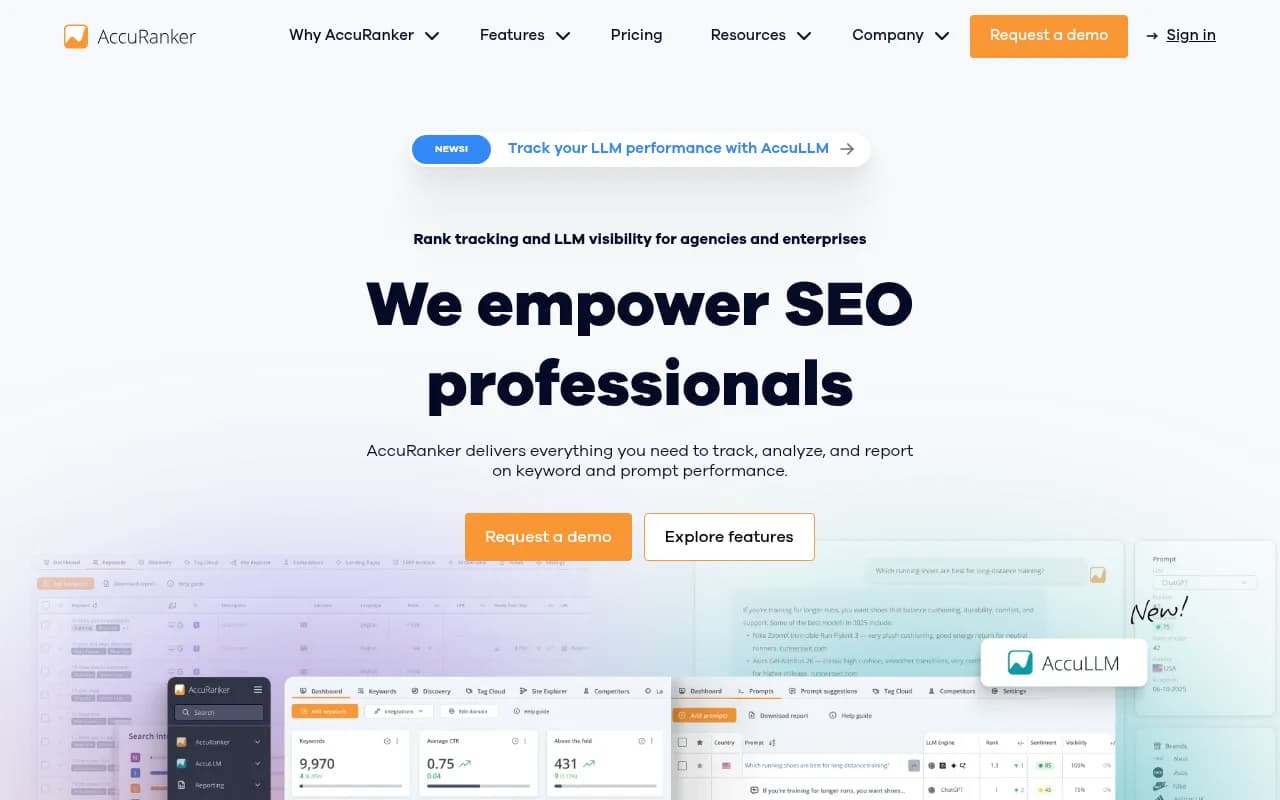
AccuRanker is built for speed and scale, which matters if you're tracking thousands of keywords across multiple markets.
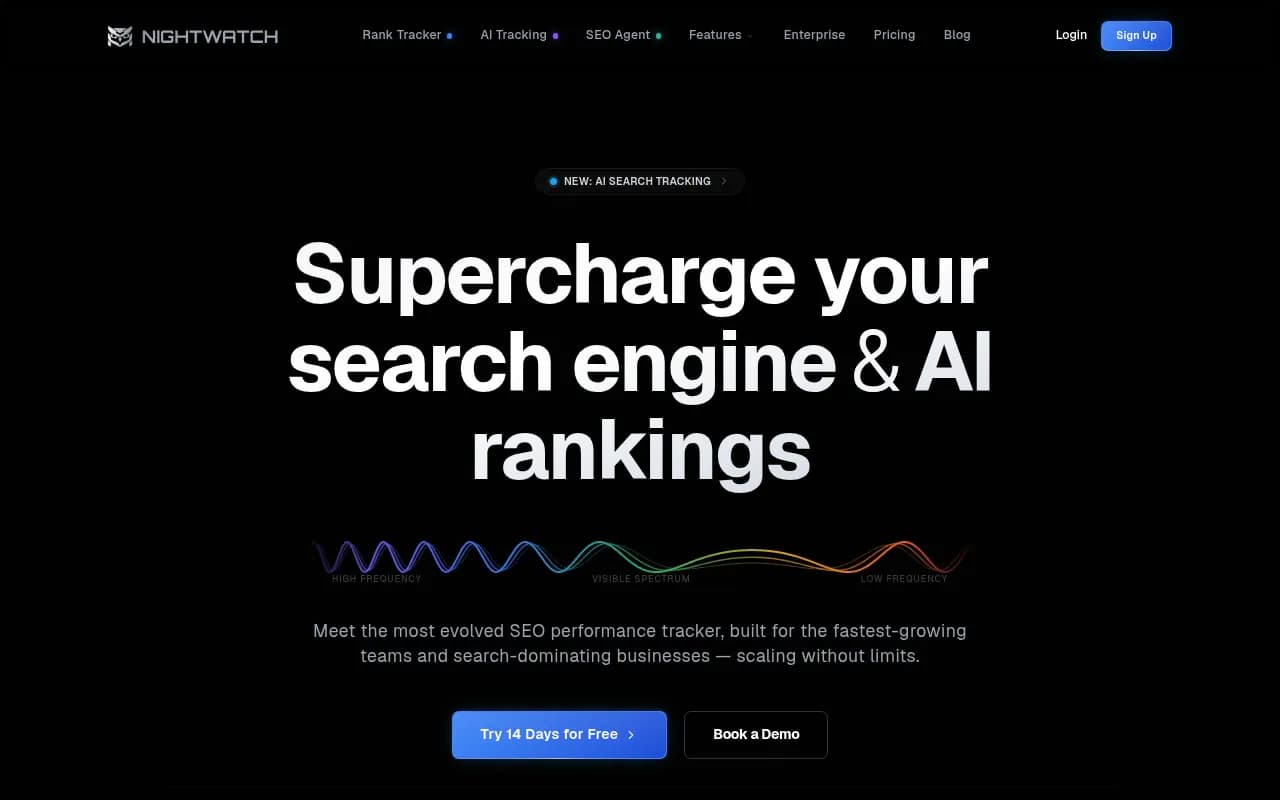
Nightwatch leans into local and multi-location tracking, which is the right call if you're managing rankings across dozens of store or branch locations.
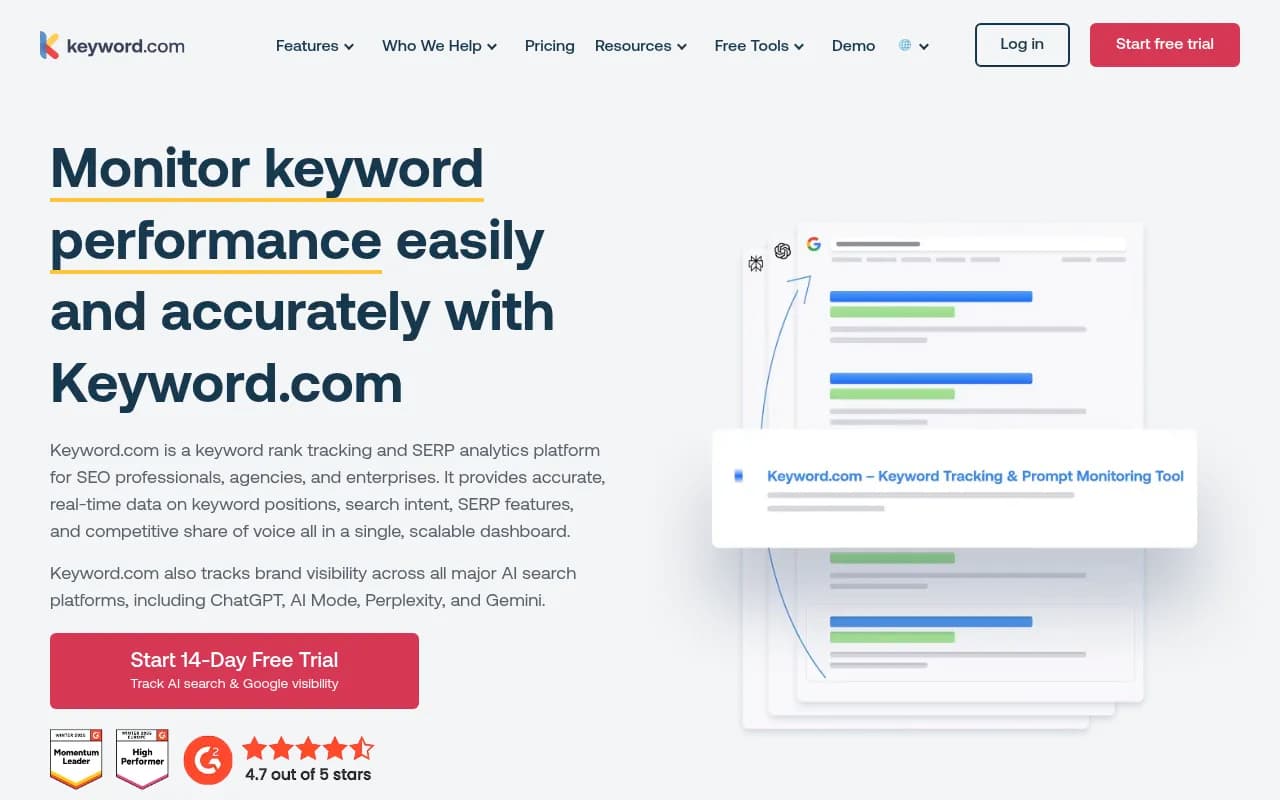
Keyword.com is the budget option for agencies that need routine client reporting without a lot of extra bells.
None of these tools have any idea what happens inside a chatbot. That's not a knock on them, it's just not their job. Which brings us to category two.
Category two: GEO monitoring platforms
This is the fastest-growing segment, and also the most confusing to shop in, because every vendor's landing page claims roughly the same thing: "see where your brand appears in AI answers." The differences show up in engine coverage, prompt volume limits, and whether you get real content execution or just a dashboard.
Peec AI
Peec AI sits in the mid-market lane. Starter is about €85/month (€70 on annual billing), scaling to €425/month for Advanced, with Enterprise custom. It covers ChatGPT, AI Mode, AI Overviews, Copilot, Perplexity, Gemini, and Grok, which is genuinely broad coverage for the price.

Otterly.AI
Otterly is still the cheapest credible entry point at $29/month for the Lite tier, with Standard at $189 and Premium at $489. Good for testing the category before committing budget, though AI Mode and Gemini are add-ons rather than core coverage.

Profound
Profound restructured its pricing in September 2026, around a reported $180M Series D. The old $99/month Starter and $399/month Growth self-serve tiers for brands are gone; brands now get a 7-day free trial (50 prompts/day, 3 engines) and then move to a custom Enterprise quote covering up to 9 engines, SOC 2, SSO, and dedicated support. Agencies retain a defined structure: $99/month base plus $399/month per client workspace. If you were planning around the old $399/month figure, check current pricing before you budget.
Scrunch AI
Scrunch leans into site-level operational context rather than pure monitoring. Core is $250/month for brands (5,000 responses, 125 prompts, 4 engines), with a separate Agency Core at $500/month. It includes limited query fan-out tracking and basic content generation, plus an Agent Experience Platform add-on for deeper site work. Independent pricing trackers put Scrunch roughly double the category median of $85.50/month, so you're paying for the extra operational layer, not just monitoring.
Other names worth knowing
AthenaHQ, Rankscale, Goodie AI, and Ahrefs Brand Radar round out the monitoring field at different price points and depths. Ahrefs Brand Radar is attractive if you already pay for Ahrefs, since the AI tracking rides on top of a subscription you have anyway, though its depth centers more on Google AI Overviews than the full spread of engines.
If you want a wider view of this category before narrowing down, the GEO software directory at bestgeosoftware.com is a reasonable place to browse more options side by side.
Category three: monitoring plus execution
Here's the question that actually separates these tools, and it's not engine count or price per prompt: after the platform tells you what's wrong, who fixes it?
Most of the names above are monitoring-first. They query AI systems, show where you're cited versus competitors, and generate a prioritized list of gaps. That list is usually accurate. The problem is operational: if your content team can ship 5 pieces a month and the tool surfaces 50 opportunities, you've bought a very expensive to-do list.
Promptwatch is built around closing that loop rather than stopping at the report. It monitors ChatGPT, Gemini, Claude, Perplexity, Grok, Meta Llama, DeepSeek, Mistral, Copilot, Google AI Overviews, and AI Mode, but it also runs AI crawler logs showing exactly when ChatGPTBot, ClaudeBot, PerplexityBot, and 400+ other bots hit your pages, which pages they read, and whether they error out. That's the "why" behind a visibility score that most pure trackers can't explain.

On top of that, it has Content Agents that plan, write, and publish GEO-optimized content directly to Webflow, Framer, or WordPress on a schedule, a Unified Actions list that prioritizes what to fix, and Agent Chat for querying your own visibility data conversationally (including from Slack). Crisp, one of Promptwatch's customers, used this to scale from a handful of articles to 5-10 per day and saw twice the conversion rate from AI traffic compared to traditional channels. That's the kind of result monitoring alone can't produce.
Promptwatch pricing starts at $95/month (Essential: 1 site, 50 prompts, 6,000 responses, 5 AEO articles, all LLM tracking), scaling to $245/month for Professional (most popular, 150 prompts, automated content generation, shopping insights) and $579/month for Business. Agency plans start at $199/month with unlimited projects and prompts. It's rated 4.7/5 on G2 across 1,840+ customers, which puts it in a similar price range to Peec AI or Scrunch but with a content execution layer most competitors don't have.
The engine-coverage problem nobody talks about enough
A lot of buyers assume "we track ChatGPT" means roughly the same thing across tools. It doesn't, because the engines themselves behave differently, and vendor coverage claims hide that.
ChatGPT's web-search responses cite around 5 sources on average, which is about half of Google's old ten blue links. That makes every citation slot in ChatGPT more contested than the equivalent slot in Perplexity or Google AI Overviews, both of which hover closer to 10 sources per answer, according to Promptwatch's data on average sources per response. Microsoft Copilot is the wild card in that same dataset, swinging from under 2 to nearly 17 sources per response within weeks as Microsoft keeps re-architecting its retrieval system.
That matters for buying decisions because a tool that only tracks ChatGPT is watching the tightest, most competitive engine, while a tool that adds AI Overviews or Perplexity coverage is watching a more forgiving one. If a vendor's pricing page lists "7 engines" as a headline feature, ask what share of your actual prompt volume each engine represents before assuming the coverage is evenly useful.
Domain authority patterns add another wrinkle. In August 2026, mid-authority domains (DR 46-75) took nearly half of all ChatGPT citations, while top-tier DR 91-100 domains fell from about 7% to roughly 3% mid-month, per Promptwatch's ChatGPT citation share by domain rank data. That's good news if you're not a massive incumbent domain, bad news if you were relying on sheer domain authority to win citations.
Reddit's role is also shifting fast. Reddit held a steady 3.8% share of ChatGPT citations through early August 2026, then collapsed to under 1% in a single day on August 14, an 86% relative drop, according to Promptwatch's reporting on Reddit citations dropping in ChatGPT. Google's AI Overviews and AI Mode showed only gradual Reddit declines over the same window, no cliff. If your GEO strategy leaned heavily on Reddit presence, that's worth revisiting engine by engine rather than assuming a single Reddit strategy covers all of them.
And query behavior itself keeps changing. ChatGPT's average fanout, how many separate web searches it runs per prompt, eased from roughly 2.15 to 1.84 queries per response between December 2025 and March 2026, per Promptwatch's query fanout data, then ChatGPT started using the site: operator at scale on August 8, 2026, jumping from 0.4% to 17% of fanout queries overnight. If your tool's "query fanout" feature is based on an old snapshot, it may already be stale.
Pricing reality check
Industry-wide pricing data from mid-2026 puts the category median around $85.50/month and the average around $118/month across roughly 38 compared tools, but the range is enormous: Rankscale starts at $20/month, Evertune runs $800/month, and enterprise quotes from BrightEdge or seoClarity ArcAI go well beyond that with no public number at all.
A few things to watch for when a sales rep quotes you a number:
- Add-ons stack. Semrush's AI Visibility Toolkit is not standalone, it sits on top of a paid Semrush plan ($139.95-$499.95/month), and extra domains or prompt packs can tack on another $250+/month.
- "AI visibility" sometimes means two different products from the same vendor. SE Ranking's AI Results Tracker add-on starts around $52-71/month inside the core SEO suite, but its separate SE Visible product starts at $189/month with different coverage. Don't assume they're the same thing just because the vendor name matches.
- Self-serve pricing can disappear. Profound pulled its public brand tiers in September 2026. If a comparison article (including this one, eventually) quotes a number, verify it against the live pricing page before you commit.
How to actually choose
Start with what you're trying to answer, not which tool has the longest feature list.
If you need daily, precise Google keyword positions across thousands of terms, buy a traditional rank tracker and don't overthink it. AccuRanker or Nightwatch will do the job.
If you need to know whether your brand shows up when people ask ChatGPT or Perplexity buying-intent questions, that's GEO monitoring territory. Otterly if you're testing the waters cheaply, Peec AI if you want broader engine coverage at a mid-market price, Profound or Scrunch if you need enterprise depth and have budget for custom quotes.
If you need both monitoring and someone (or something) to actually close the gaps it finds, that's a shorter list, and it's where Promptwatch is designed to sit, with crawler logs explaining the why, citation and traffic data explaining the where and how much, and Content Agents plus Unified Actions handling the what-to-do-about-it part.
Whichever direction you go, the AI rank tracking directory at ai-rank-tools.com is worth a browse if you want to compare more options before narrowing your shortlist further.
One honest caveat worth repeating: buying any of these tools doesn't improve your visibility by itself. Someone still has to review the reports weekly, decide what to prioritize, and ship the changes. If your content team can only ship 5 pieces a month, a platform surfacing 50 opportunities a month is just generating a backlog you'll never clear. Size the tool to your actual execution capacity, not the other way around.