Key takeaways
- An agency and a platform do different jobs. Agencies produce pages, links, and strategy. Platforms measure, monitor, and show you what to fix.
- Promptwatch Data shows product pages and landing pages take about 39% of ChatGPT citations, which is work for people who build and write.
- A reasonable starting split for most Dutch B2B and e-commerce firms is roughly 70 to 85% on people and content, 15 to 30% on tooling. Adjust it by team size.
- Small teams with no in-house SEO should lean toward an agency. Teams with strong content staff should lean toward a platform.
- I could not verify Dutch agency retainer prices for this guide, so treat every figure below as a planning range, and get real quotes.
The question behind the budget
Most Dutch marketing leaders I'd talk to frame this as a choice. Hire a bureau, or buy software. That framing is the first mistake.
An agency sells hours and judgement. A platform sells data and repeatable checks. You can't replace one with the other, but you can overspend on either. I've seen companies pay a retainer for monthly reports that a dashboard would give them for free, and I've seen others buy a tracking tool, stare at it, and never publish a single new page.
The 2026 twist is AI search. Your buyers in Amsterdam, Utrecht, or Eindhoven now ask ChatGPT, Gemini, and Google AI Overviews for recommendations before they ever visit your site. Classic Google rankings still matter, but a second layer of visibility now needs measuring, and measuring it needs tooling that most agencies don't own.
What each side is actually good at
What an agency does well
Agencies earn their fee on work that needs people:
- Strategy and prioritisation across your market and language mix (Dutch, English, sometimes German or French)
- Writing and editing content that sounds like your brand
- Digital PR and link building, including getting named in roundups and comparison articles
- Technical SEO fixes that touch your CMS and developers
- Reading the data and telling you what to do next
The Dutch market is crowded and strong. A 2026 shortlist from Customer Impact, which is a Belgian agency serving the Benelux and openly ranks itself first on its own list, names Follo (formerly OrangeValley), Netprofiler, Yonego, Fingerspitz, and Traffic Builders alongside itself. A Web Tonic roundup quotes starting prices of $1,600 a month for Adpepper and $3,200 a month for Social Brothers. Those are unverified vendor-published figures, so use them only as a sanity check on order of magnitude.
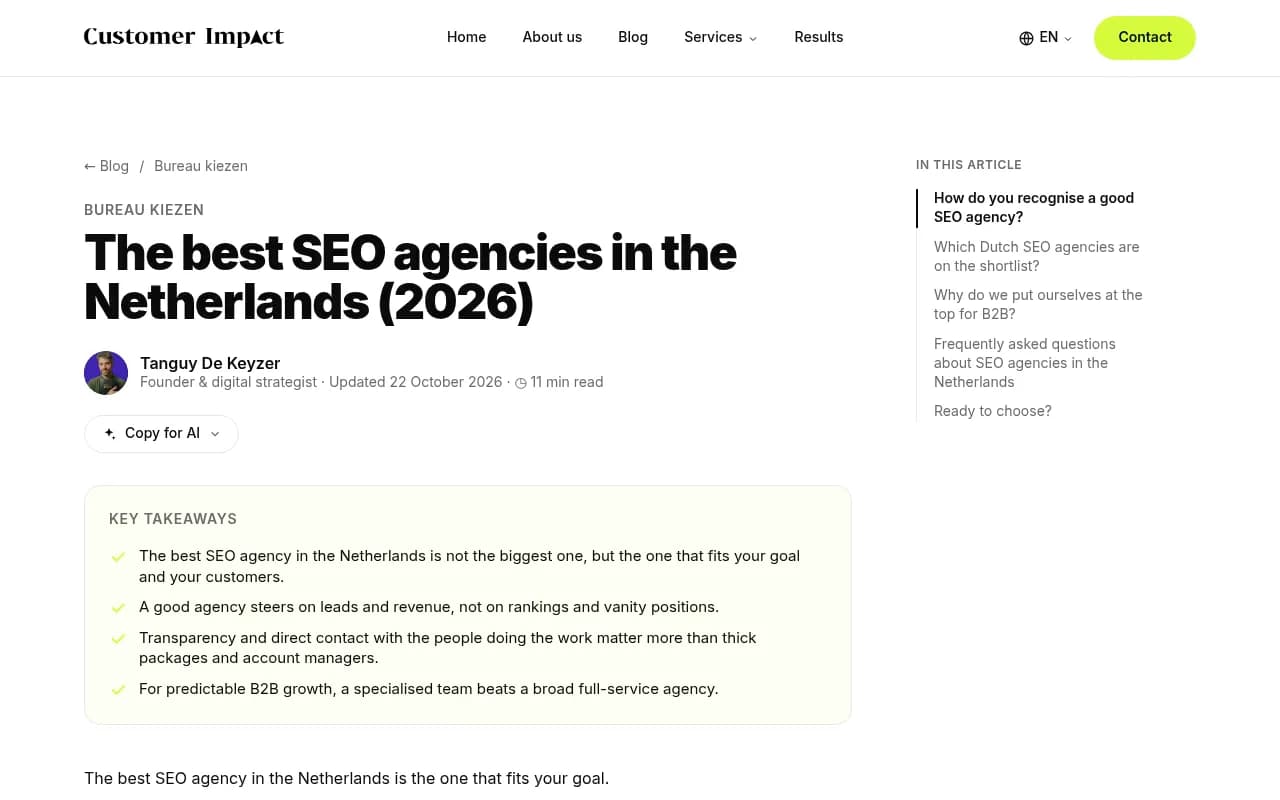
Two cautions from that same source are worth keeping. Ask who does the daily work, because at bigger agencies a junior often does it while a senior fronts the pitch. And decide whether you want a specialist or a full-service shop, because both can work but they behave differently.
What a platform does well
Platforms are better at things that are tedious, continuous, or impossible by hand:
- Running the same prompts every day across ChatGPT, Gemini, Perplexity, and Google AI Overviews, by country and language
- Showing which of your pages AI crawlers actually read, and where they hit errors
- Tracking which third-party pages get cited instead of yours
- Tying AI-referred visits to conversions
- Producing reports without a human assembling slides
No agency analyst is going to check 150 prompts across five models every morning. Software does that for the price of a modest monthly subscription.
What AI search actually rewards
This is where the budget logic gets concrete. In Promptwatch Data for ChatGPT citation share by content type, covering Sep 28 to Oct 4, 2026, product pages were the most cited type at 22.4% of classified citations. Landing pages followed at 16.8%. Together that is about 39% of citations going to pages describing what a company sells.
Listicles took 13.6%, how-tos 8.7%, comparisons 5.9%, and news 5.7%. For commercial prompts, product pages, landing pages, listicles, and comparisons made up almost 70% of citations.
Read that as a to-do list. Most of what gets cited is stuff you build and earn:
- Strong product and landing pages on your own domain
- Inclusion in third-party "best of" roundups
- Comparison pages
- Public, crawlable documentation
- Reviews on trusted sites
That is agency and content-team work. A tracker can tell you that you are missing from a roundup. It can't talk the editor into adding you.
The flip side is also in the data. According to Promptwatch's AI crawler traffic report (verified requests, June 8 to Sep 6, 2026), OpenAI accounted for 79.8% of verified AI crawler requests in the week of Aug 31 to Sep 6, down from 94.8% in early June. The advice there is to compare your own server logs with that mix. If a big provider is near zero in your logs, you may be blocking it through robots.txt, your CDN, or a WAF rule. That is a checking job, and platforms with crawler logs do it better than a quarterly audit.
One more data point matters for channel planning. In Promptwatch's social citation data for Sep 28 to Oct 4, 2026, social platforms made up only 0.46% of ChatGPT citations but 12.2% of Google AI Overviews citations, with YouTube leading there at 4.28%. If an agency pitches you a Reddit-heavy plan to win ChatGPT visibility, that report is worth showing them. Reddit's share of ChatGPT citations collapsed on August 14, 2026, as covered in Promptwatch's Reddit citation report.
Caveat: none of this data is specific to the Netherlands. It is global. Dutch-language prompts may behave differently, and that is a reason to test your own prompts rather than assume.
A starting budget split
There is no universal ratio, and anyone who gives you one without asking about your team is guessing. Here is the logic I'd use as a starting point, with the percentages as planning ranges rather than benchmarks.
| Your situation | Agency / people | Platform / tooling | Reasoning |
|---|---|---|---|
| No in-house SEO or content staff | 80 to 85% | 15 to 20% | You need hands first. Buy the minimum tooling to verify the agency's claims. |
| One SEO lead, thin content capacity | 65 to 75% | 25 to 35% | Agency fills the content gap. Platform gives your lead real data. |
| Established in-house SEO and content team | 40 to 55% | 45 to 60% | You need data, automation, and specialist help for gaps such as digital PR. |
| Multi-market or multi-brand enterprise | 50 to 60% | 40 to 50% | Governance and reporting justify serious tooling, and agencies handle local nuance. |
| Agency reselling to clients | 30 to 40% | 60 to 70% | Your labour is the agency. Spend on data and white-label reporting. |
The percentages refer to your total search-visibility budget, not your total marketing spend. And remember a cheap platform with no one to act on it is wasted money, which is why the people side stays dominant for most small and mid-size Dutch firms.
A worked example
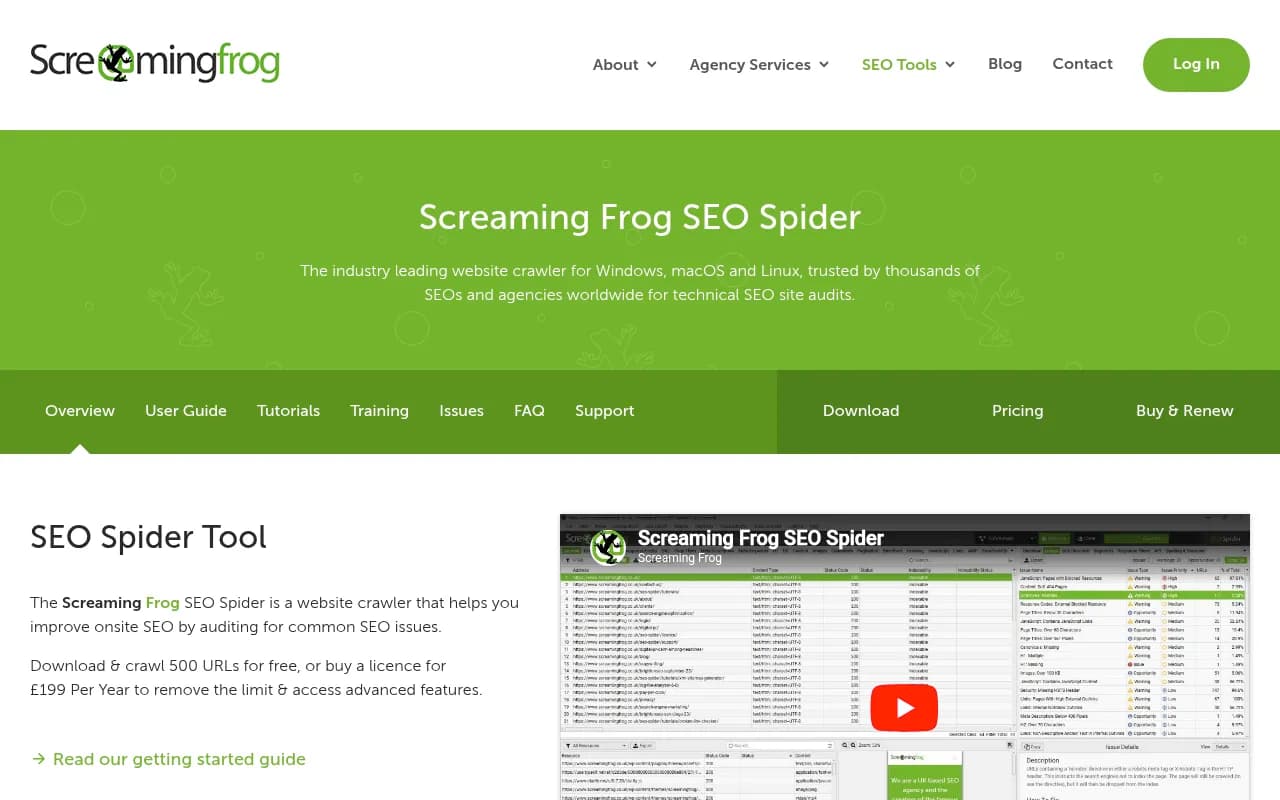
Take a Dutch B2B SaaS company with a EUR 6,000 monthly search budget and one marketer who owns SEO part-time. Under the second row, you'd put around EUR 4,000 to 4,500 into an agency retainer for content and links, and EUR 1,500 to 2,000 into tools. That tooling line could cover an AI visibility platform, a crawler such as Screaming Frog, and reporting. Not all of it needs to go to one vendor.
Choosing the platform side
The AI visibility market is crowded, and the catalog on this site lists dozens of trackers. The useful split is between tools that only answer "was I mentioned?" and tools that help you do something about it.
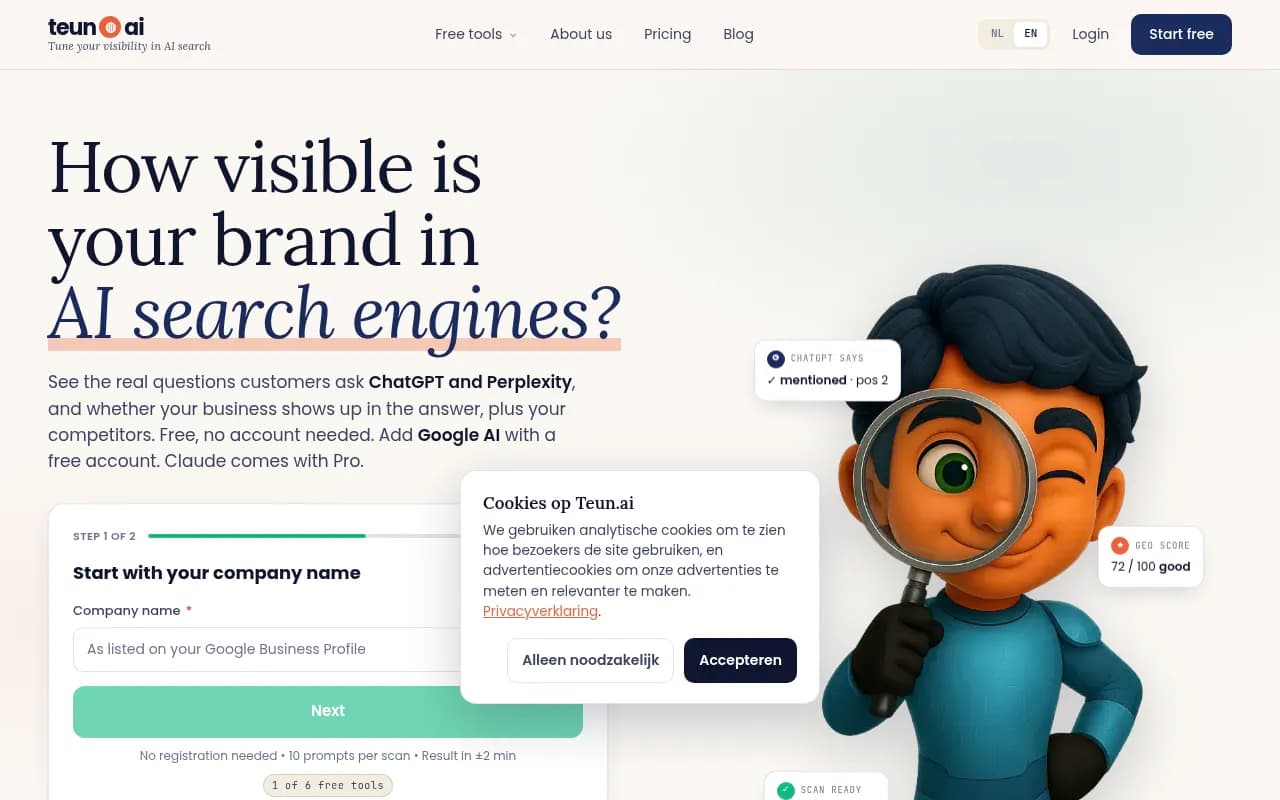
Promptwatch sits on the second side. Beyond tracking prompts in the real interfaces of ChatGPT, Google AI Overviews, Gemini, Perplexity, and others by country and language, it has IP-verified AI crawler logs, visitor analytics for AI-referred traffic, content gap analysis, and a Content Agent that can draft and publish to WordPress, Webflow, or Framer. It is ISO/IEC 27001 certified and GDPR compliant, which tends to matter in Dutch procurement and security reviews. Plans start with a free Explore tier (ChatGPT only) and paid plans from $95 a month, so check promptwatch.com/pricing before budgeting.

If you are comparing options, a few others in the catalog are worth a look depending on your needs:
| Tool | Type | Best fit |
|---|---|---|
| Promptwatch | Tracking plus optimization, crawler logs, content agent | Teams that want to act on the data, not only watch it |
| Otterly.AI | Prompt tracking | Small budgets that only need monitoring |
| Peec AI | Prompt tracking | Monitoring without the optimization layer |
| Profound | Enterprise monitoring | Large brands with larger budgets |
| Teun.ai | Dutch AI visibility toolkit with free rank checks | Quick Dutch-market spot checks |
| Screaming Frog SEO Spider | Technical crawler | Technical audits you can run in-house |
| Google Search Console | Free search data | Everyone, as the baseline |


For a wider browse, the GEO software directory at bestgeosoftware.com lists many more.
Choosing the agency side
Use the six signs from the Customer Impact guide as a filter, since they apply regardless of who wrote the list:
- It starts with your goals and customers, not keywords
- It talks about leads and revenue, not positions alone
- You know what happens, what it costs, and what it delivers
- You speak with the people doing the work
- It shows cases with a growth number and a time period
- You know which senior person runs your project
Then add questions specific to 2026:
- Which AI search engines do you measure, and with what tool?
- Can you show me crawler access for AI bots on a past client?
- How do you get clients into third-party roundups and comparison pages?
- Will you work in my platform, or send me PDFs?
The last one is practical. If you already pay for a platform, a good agency should read from it. Ask for access sharing, and some platforms offer read-only client seats and white-label reports for exactly this.
If you want an agency that works in both traditional SEO and AI search, 1001 SEO Media covers technical SEO, content, digital PR, and generative engine optimization, and uses Promptwatch for AI visibility. Like any agency, it should be tested against the questions above. Dutch-local teams, Belgian cross-border teams, and international specialists all have a case depending on your markets.
Does the Dutch tax backdrop change anything?
A little, and not as much as you might hope. The 2027 Tax Package published on Budget Day, September 15, 2026, is described by Stibbe as containing fewer policy-driven proposals than in previous years, because the government is a minority cabinet. Items that touch marketing budgets directly are thin. Eversheds Sutherland lists changes in areas such as the Energy Investment Allowance, the Innovation Box, and the work-related costs scheme (WKR), none of which turns SEO spend into a special category.
All proposals are subject to parliamentary approval and enter into force on 1 January 2027 if adopted. My practical read: don't restructure your search budget around Budget Day. If you do want to know whether any software or services costs have special treatment in your situation, ask your accountant. I haven't verified any marketing-specific deduction here, and I won't pretend otherwise.
A 90-day plan to test your split
Don't commit to a ratio on faith. Run it for a quarter.
- Weeks 1 to 2: baseline. Connect Google Search Console. Pick 30 to 50 prompts your buyers would ask an AI assistant, in Dutch and English. Record where you appear.
- Weeks 2 to 4: access check. Review robots.txt, CDN, and WAF rules for AI crawlers, and compare your logs to the provider mix in the Promptwatch crawler report.
- Weeks 4 to 8: build. Have the agency or content team fix product and landing pages first, then publish comparison pages and pursue roundup inclusion.
- Weeks 8 to 12: measure. Look at citations, AI-referred visits, and leads. Move budget toward whichever side produced evidence, not whichever has a nicer deck.
If the platform shows problems your agency ignores, that is useful information. If the agency delivers pages but you can't measure the effect, you under-bought tooling. Either way, the data picks the next quarter's split.
Common mistakes
- Buying a tracker and expecting visibility to appear. Tracking is a thermometer, not medicine.
- Paying a retainer for reports. If the main deliverable is a monthly PDF, you are overpaying.
- Ignoring content decay. Promptwatch's content half-life report found news loses half its cited pages within about 36 days, while landing pages and docs stay cited for months. Put your durable budget into the latter.
- Treating Dutch and English as one market. Test both.
- Signing long contracts before you have a baseline.
Bottom line
Spend most of your money on the people and content that earn citations, and a smaller, steady slice on the platform that proves whether it worked. For a small Dutch firm that is roughly three parts agency to one part tooling. For a team that already writes well, flip it toward the platform. Start with a free baseline, run the 90-day test, and let your own numbers move the split. For more tools in the category, the AI rank tracking directory at ai-rank-tools.com is a good next stop.