Key takeaways
- I did not run this experiment for you, and I won't invent results. This guide gives you the protocol, the scoring sheet, and the reasoning so you can run it in a week and trust what you find.
- Run-to-run noise in AI answers is large enough that two identical trackers can disagree. Test for that before you blame a cheap tool.
- Price buys different things: prompt count, engine coverage, refresh frequency, and whether the tool helps you fix anything. Raw mention detection is the least likely place for a gap.
- Cost per tracked prompt is a better comparison than the monthly sticker price.
- The deciding question is not "which tool is accurate" but "what will I do with the data on Monday morning".
Why this question keeps coming up
The pricing gap is real. A Reddit thread on r/seogrowth complained that Profound and Ahrefs charge $499 and $699 per month for their AI visibility features, while entry plans from other vendors sit around $20 to $30. Otterly is listed at $29 per month for 20 prompts, and Rankscale advertises entry pricing from $20. Those figures come from third-party roundups and forum posts, so check each vendor's pricing page before you budget.
Digiday reported that marketers are skeptical of expensive tools because results are inconsistent and there are no shared benchmarks. That skepticism is fair. But it cuts both ways. If results are inconsistent, a cheap tool can look wrong simply because AI answers moved, and an expensive one can look precise while measuring the same noise.
So here is the experiment: take 20 prompts, run them through a cheap tracker and a pricier one on the same dates, and compare. The trick is doing it in a way that separates tool differences from engine randomness.
Why a 20-prompt test is noisy by default
Twenty prompts is small. One prompt flipping from "mentioned" to "not mentioned" moves your visibility rate by 5 points. That is bigger than most differences you will see between tools. Before comparing anything, understand where the movement comes from.
Engines cite different numbers of sources
According to Promptwatch Data on average sources per response, ChatGPT cites about 5 sources per web-search answer, while Google AI Overviews cites about 10. Perplexity sits almost exactly at 10 every day. Microsoft Copilot swung from under 2 to nearly 17 sources per response within a few weeks before settling low.
The practical read: a tracker reporting Perplexity citations will look stable, and one reporting Copilot or ChatGPT will look jumpy. If your cheap tool covers Perplexity and your expensive tool covers ChatGPT, you are not comparing like with like.
ChatGPT changes what it searches for
Promptwatch's ChatGPT query fanouts data shows one prompt can trigger 3 to 8+ separate web searches. The average fanout count per response fell from about 2.15 in early December to about 1.84 by early March, and average query length dropped from roughly 117 characters to the high 80s by February and March. Separately, ChatGPT began using the site: operator at scale on August 8, 2026, according to Promptwatch's site: operator report, jumping from about 0.4% to about 17% of fanout queries overnight.
Same prompt, different week, different searches, different citations. If you run tool A on Monday and tool B on Friday, you are partly measuring ChatGPT's behavior drift. Run both on the same dates.
The experiment design
Pick the tools
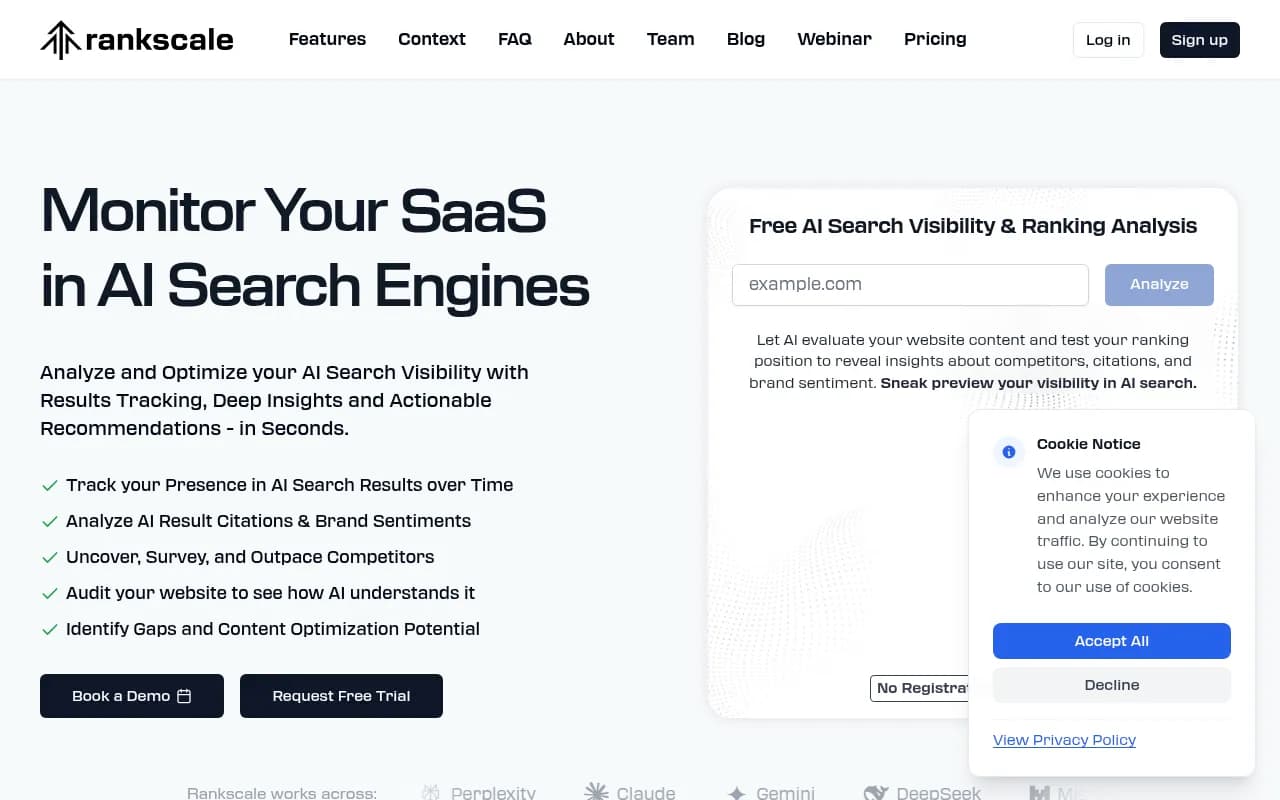
Choose one cheap tool and one or two expensive ones. For the budget end, candidates from our catalog include Otterly.AI, Rankscale, and PromptRush. For the upper end, Profound, Semrush, and Ahrefs Brand Radar come up most often in roundups.


I would also include a mid-priced platform that goes beyond monitoring, so you can see whether the extra spend changes what you can do. Promptwatch is the one I would use here. The Essential plan is listed at $95 per month for 50 prompts, so it covers a 20-prompt test with room to spare, and there is a 7-day free trial on monthly billing. Confirm current numbers at promptwatch.com/pricing.

Most vendors offer trials of 7 to 14 days, which is enough for a 20-prompt test if you start all trials on the same day.
Write the 20 prompts
Do not let a vendor suggest them. Write them yourself so every tool gets identical input. A split that works:
- 6 branded prompts ("Is [brand] good for X?", "[brand] pricing")
- 6 competitor comparison prompts ("[brand] vs [competitor]")
- 8 non-branded category prompts ("best [category] tool for [use case]")
The non-branded ones matter most. Branded prompts almost always return your brand, so every tool will look fine on them. The gaps show up where your brand is borderline.
A Writesonic webinar on AI visibility makes a related point: the useful work is finding prompts your buyers actually use, then tracking a small set of metrics rather than dozens. Twenty well-chosen prompts beat 200 guessed ones.
Hold everything else constant
| Variable | Rule |
|---|---|
| Dates | Start all tools the same day, compare the same 7-day window |
| Engines | Compare only engines every tool covers (ChatGPT, Perplexity, AI Overviews is a common overlap) |
| Country and language | Same for every tool |
| Brand aliases | Configure the same name variants everywhere |
| Competitor list | Identical |
| Refresh rate | Note it. Daily vs weekly changes the sample size |
Add a manual baseline
This is the part people skip. Before the tools report anything, run the 20 prompts yourself in a clean browser session on each engine, and log whether your brand appears, in what position, and which URLs are cited. It takes about an hour. Now you have ground truth to compare against, imperfect but independent.
If you want a free first pass, tools like Amplitude AI Visibility and RightChoice.Ai offer no-cost checks, but treat them as a sanity check, not a benchmark.
What to measure
Do not compare dashboard "scores". Every vendor defines them differently, so a 62 in one tool and a 71 in another mean nothing. Compare raw observations instead.
| Metric | How to score it |
|---|---|
| Mention agreement | For each prompt and engine, did the tool say the brand was mentioned? Compare with your manual baseline |
| Citation agreement | Did the tool list the same cited URLs you saw? |
| Position | Does the tool's brand order match what you saw in the answer? |
| Run-to-run stability | Run the same prompts twice in one day (if the tool allows). How much does it move? |
| Competitor detection | Did it find the competitors that actually appeared? |
| Time to data | How long until first results? |
Calculate agreement as matches divided by total prompt-engine pairs. With 20 prompts across 3 engines you have 60 pairs, which is a more forgiving sample than 20 alone.
A simple scoring sheet
One row per prompt and engine. Columns: manual result, tool A result, tool B result, tool C result, match flags. Total the match flags at the bottom. Then add a second tab for citations, because mention detection and citation capture are different skills. A tool can spot your brand name in text fine and still mangle source URLs.
What I expect you will find
These are predictions from how the tools work, not measured outcomes. Treat them as hypotheses your test can confirm or break.
- Mention detection will agree closely across tools on branded prompts and diverge on non-branded ones, mostly because of sampling noise and slightly different phrasing of how prompts are sent.
- Cheap tools will cover fewer engines at entry. According to Searchable's roundup, most entry plans include three or four engines and charge extra for more. Otterly's entry plan lets you pick any three of seven.
- Differences in citation capture and real-interface data will be larger than differences in mention detection. Some tools query APIs, others scrape the actual user interface. User-facing answers and citations can differ from API output, which is why Promptwatch collects from the real interfaces of ChatGPT, AI Overviews, Gemini, Perplexity and others.
- The biggest gap will not be accuracy. It will be what happens after the dashboard.
Where the extra money actually goes
Searchable's comparison puts cost per tracked prompt on entry plans between $1.19 and $3.96, which is a more honest yardstick than monthly price. A $29 plan with 20 prompts is $1.45 per prompt. A $125 plan with 100 prompts is $1.25. The "cheap" tool is not always cheaper per unit.
Beyond that, higher price typically buys some mix of:
- More prompts and more frequent refreshes (Promptwatch runs daily on every plan, and Business plans can run every 12, 6 or 1 hours)
- More engines, including Copilot, Meta AI, Alexa and AI coding agents
- Crawler logs that show whether AI bots can even read your pages
- AI traffic attribution, so you can tie visibility to visits and conversions
- Content tooling that acts on gaps
- Team features, audit logs and security certifications
| Need | Budget tracker enough? | Look at |
|---|---|---|
| Quick check on 20 to 50 prompts | Usually yes | Otterly.AI, Rankscale, PromptRush |
| Weekly reporting for a small team | Often | Peec AI, Otterly.AI |
| Crawler logs and traffic attribution | No | Promptwatch, Profound |
| Fixing gaps with content | No | Promptwatch, AirOps |
| Agency with many clients | Depends on seats and projects | Promptwatch agency plans, Scrunch |
| Already paying for an SEO suite | Maybe use its add-on | Semrush, Ahrefs Brand Radar |
If you want to browse more options by category, the directories at bestgeosoftware.com and ai-rank-tools.com list far more trackers than this guide covers.
The part a 20-prompt test cannot tell you
Accuracy of mention detection is table stakes. What a short test cannot show is the cost of living with a tool for a year.
One question: when the dashboard says you are invisible for "best [category] software", what happens next? With a monitoring-only tracker you export a CSV and open a doc. With a platform that closes the loop, the gap becomes a task. Promptwatch, for example, turns gaps into a prioritized Action Board, drafts content with its Content Agent on Business plans, publishes to WordPress, Webflow or Framer, and then checks through crawler logs and citation tracking whether the page got read and cited. If you only need numbers for a monthly slide, you may not care. If you need to move them, you will.
The second question is stability over time. Three of the nine tools in Searchable's roundup were acquired by larger companies since April 2026, which may matter if you plan to commit for years. That list is from a competitor's blog, so verify independently, but the point stands: check ownership and roadmap.
Running the test, step by step
- Write 20 prompts, split branded, comparison and non-branded.
- Log your manual baseline on ChatGPT, Perplexity and AI Overviews in clean sessions.
- Start trials for every tool on the same day. Set country, language, aliases and competitors identically.
- Let them run 7 days. Do not edit prompts mid-test.
- Export raw responses, not scores.
- Fill the scoring sheet. Compute agreement per tool and per engine.
- Repeat for a second week if you can. Two weeks separates tool behavior from a one-off engine wobble.
- Add price per prompt, engine coverage and what each tool does after detection.
Reading the results
If the cheap tool matches your baseline within a few points of the expensive one on mentions, buy the cheap one for monitoring and stop worrying. If it misses citations or covers engines your buyers use, that is your reason to pay more. If all tools disagree with your manual baseline equally, the problem is your baseline or engine noise, and you should widen the sample before deciding anything.
For context on how to interpret visibility numbers once you have them, the Promptwatch Academy metrics overview explains the difference between share of voice, position and citation share, which helps you compare tools that name things differently.
A fair verdict
I would be suspicious of anyone who says expensive tools are a ripoff, and equally of anyone who says cheap ones are toys. Mention tracking on a short prompt list is close to a commodity. The price differences mostly pay for coverage, data collection method, history, attribution and action. Run the experiment above, score raw agreement, and spend money only on the capabilities you will use. If you want a no-risk start, the free AI visibility report at promptwatch.com/ai-visibility-report gives you a quick external reference point to add to your baseline.