Key takeaways
- Promptwatch Data followed every page ChatGPT cited on July 6, 2026 for 90 days. Landing pages (78% still cited after 30 days) and docs (76%) hold up best; news is the weakest, with half of its pages gone after 36 days.
- Product pages, reviews and how-to guides reach their half-life after 74 to 77 days. Comparisons and listicles keep more than 60% of their citations after two months.
- Profound's separate study puts the median half-life of an AI citation at 11 days. That figure and Promptwatch's measure different things, so do not compare them directly.
- Write for longevity by putting durable effort into landing, docs, comparison and listicle pages, keeping facts current, and using news for short bursts only.
- Track which of your pages ChatGPT keeps citing, so you can refresh the ones that start to slip before they drop out.
What content half-life means
In classic SEO a page that ranks tends to keep ranking. You earn links over months, and a ranking, once won, is something you hold. AI search does not behave that way, at least not reliably. A page ChatGPT cites today may be gone from its answers in five weeks, or it may stay for a year. Which one happens depends heavily on what kind of page it is.
Content half-life is the time it takes for a page to lose half of whatever citation presence it had at the start. Simple idea. The catch is that two studies published within a week of each other in autumn 2026 define "half" differently and reach very different headline numbers. I'll cover both, and then explain why the apparent contradiction is not one.
The Promptwatch study: how long ChatGPT keeps citing a page
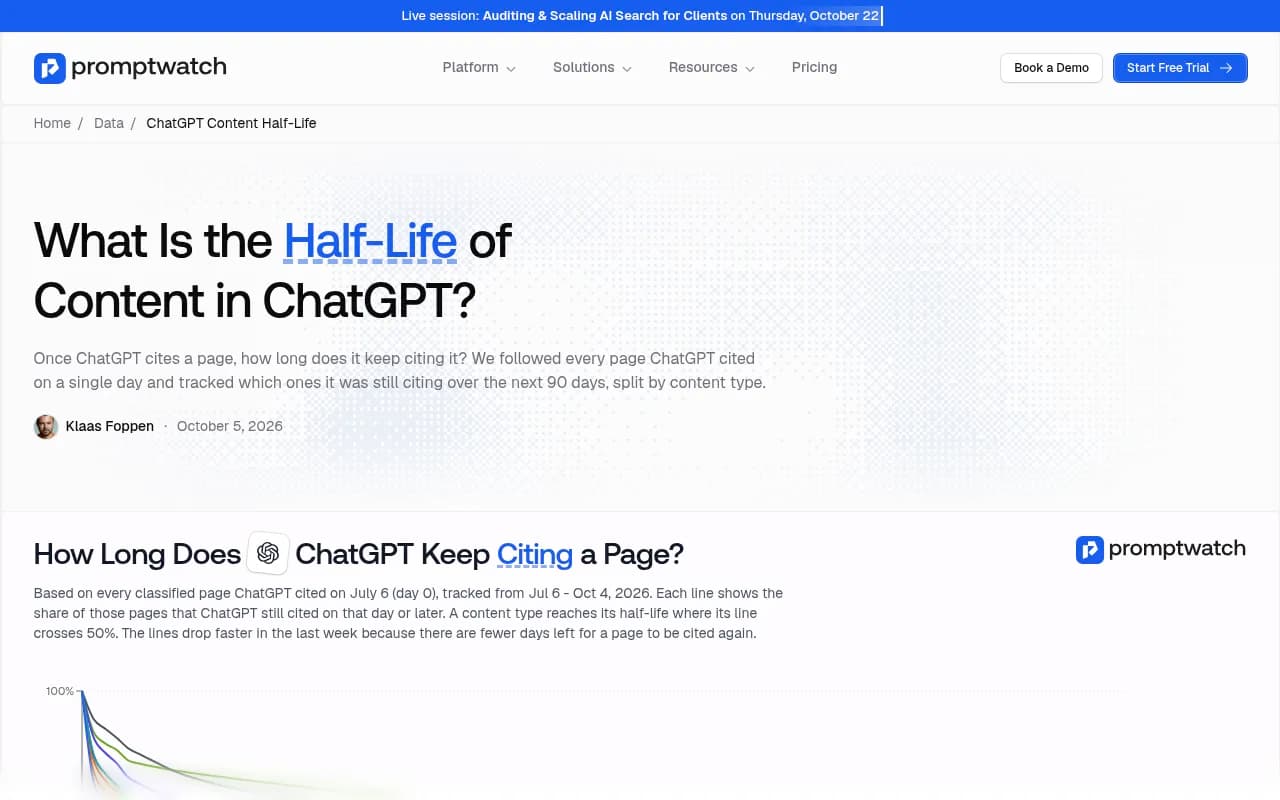
Promptwatch took every classified page ChatGPT cited on July 6, 2026 (day 0) and tracked each through October 4, 2026, a 90-day window. Each line on the chart is the share of those day-0 pages that ChatGPT still cited on that day or later. A content type reaches its half-life where its line crosses 50%. The full write-up is in Promptwatch's ChatGPT content half-life report.

Results by page type
| Page type | Still cited after 30 days | Still cited after 60 days | Half-life |
|---|---|---|---|
| Landing pages | 78% | 69% | Likely near or beyond 90 days |
| Documentation | 76% | 67% | Likely near or beyond 90 days |
| Comparisons | 72% | 63% | Likely near or beyond 90 days |
| Listicles | n/a | 60% | Likely near or beyond 90 days |
| Product pages | n/a | about 55% | 74 to 77 days |
| Reviews | n/a | about 55% | 74 to 77 days |
| How-to guides | n/a | about 55% | 74 to 77 days |
| News | n/a | 41% | 36 days |
A few details are worth pulling out.
Docs have the smallest drop right after day 0. ChatGPT cited 93% of them again later, against 77% of news pages. Almost a quarter of news pages are never cited again after the first day. That is a brutal number if news coverage is your main plan for AI visibility.
Landing, docs, comparison and listicle lines only cross 50% in the last week of the window. That is an artifact: every line drops at the end because there are fewer days left for a page to be cited again. So their true half-life is probably close to or beyond 90 days, but this dataset cannot say how far beyond.
Pricing pages are classified as landing or product pages, which matters if you are wondering where yours land. It is a split worth knowing about: a pricing page is not automatically a durable asset just because it sounds like one.
Product pages surprised me. They are the most cited content type in ChatGPT overall, but they decay about as fast as how-to guides. Being cited a lot and staying cited are different properties.
What ChatGPT cites in the first place
Half-life only matters for pages that get cited. Promptwatch's citation share by content type data covers September 28 to October 4, 2026:
| Content type | Share of ChatGPT citations |
|---|---|
| Product pages | 22.4% |
| Landing pages | 16.8% |
| Listicles | 13.6% |
| How-to guides | 8.7% |
| Documentation | 7.5% |
| General articles | 6.1% |
| Comparisons | 5.9% |
| News | 5.7% |
| FAQ pages | 3.3% |
| Reviews | 1.7% |
Product and landing pages together make up 39% of citations. Put that next to the half-life data and a pattern emerges. Landing pages are both the second most cited type and the longest lasting. Docs are mid-volume but very sticky. News gets a decent 5.7% of citations but burns out fastest.
Intent changes the mix too. For commercial prompts, product pages (26.0%), landing pages (20.6%), listicles (15.0%) and comparisons (7.9%) add up to almost 70% of citations. For branded prompts, reviews climb to 5.6%, more than three times their overall share. If your category is commercial, the durable types and the most cited types overlap heavily, which is convenient.
The Profound study: an 11-day half-life
On September 30, 2026 Profound published research with a much scarier headline: the half-life of an AI citation is 11 days. It measured 883,000 pages across ChatGPT, Perplexity, Claude, Google AI Overviews, Google AI Mode, Gemini and Microsoft Copilot over twelve months, producing 1.19 million page and engine lifecycles.
Its main findings:
- The median page loses half its citation share within 11 days of peaking.
- 78% of cited pages fall to half their peak share within two weeks. The remaining 22% have a median half-life of 27 to 29 days.
- Among pages that last beyond two weeks, a Claude citation is 2.8 times as likely as a ChatGPT citation to still be relevant eight weeks later.
- Decay on one engine tells you almost nothing about decay on another. Cross-engine correlations run between 0.03 and 0.09.
- Pages tied to a date or event fade first.
- Being cited by many engines helps. Of pages cited by five or more engines, 6.8% were still above half their peak share at day 56, against 1.2% for pages cited by a single engine.
Why the two numbers do not conflict
It is tempting to say one study is right and the other wrong. They are measuring different things.
| Promptwatch | Profound | |
|---|---|---|
| Question asked | Is the page cited again at all after day 0? | Does the page keep half its peak citation share? |
| Engines | ChatGPT | Seven engines, each page measured per engine |
| Population | Every classified page cited on July 6, 2026 | Only pages that reach a minimum citation volume (at least 5 citations in a 14-day window at peak) |
| Start point | A single day | Each page's own peak |
A page can keep getting cited once in a while, which counts as alive for Promptwatch, and still have lost most of its peak share, which counts as decayed for Profound. Neither is wrong. The practical reading: staying in the answer pool is fairly easy for the right page types, but holding a strong share of attention is hard for everyone.
One takeaway is shared. Date- and event-driven pages fade first, and Promptwatch's news numbers say the same thing in a different way.
Anecdotes and other signals worth a sanity check
A few other sources circulate on this topic. Treat them as hints, not data. One Medium analysis of four weeks of tracking by DecaGEO found that pages ChatGPT cited every single week were first published a median of 23 months ago, which fits the idea that old, stable pages can anchor citations. A ziptie.ai post claims 76.4% of ChatGPT's top-cited pages were updated within the last 30 days. Those two are not contradictory either: an old page that gets regularly touched is exactly what the durable types look like. I have not verified either methodology, so I would not build a strategy on the exact figures.
How to write for longevity
Here is the practical part, built from the Promptwatch half-life data plus the overlap with Profound's findings.
Match the page type to the job
Before writing, decide what citation lifespan you need.
- Need steady, months-long presence: landing pages, docs, comparisons, listicles.
- Need a short burst around a launch or announcement: news and press coverage. Plan on it being gone in about five weeks.
- Need both: do the news piece, then fold the facts into a durable page that you keep updated.
Keep facts on durable pages accurate
Landing, docs and pricing pages get cited for months, which means a stale price or a removed feature can be quoted for months too. Set a review cadence. Monthly is reasonable for pricing and feature pages; quarterly for docs. Product pages need the most attention since they decay about as fast as how-tos: specs, availability and prices should be current.
Invest in comparisons and listicles
Both keep more than 60% of their citations after two months, and listicles are the third most cited type at 13.6%. A caveat: a LinkedIn post circulating in the industry claims ChatGPT's citations to "best [category]" listicles dropped by half in a single day at one point. I could not verify it, but it is a reminder that a durable type is not a guaranteed one. Do not put every egg in the listicle basket.
Avoid tying evergreen pages to a date
Profound found date- and event-bound pages fade first. If a how-to or comparison does not need a year in the slug or a launch-week hook, leave it out of the URL and the opening paragraph. Update the visible year inside the content when you refresh it, rather than creating a new page every January.
Get cited in more than one place
Profound's data shows that pages cited by more engines are far more likely to last. In its table, the median rise time grows from 19 days for single-engine pages to 46 days for pages cited by five or more. Cross-engine correlations are tiny, so do not assume ChatGPT performance predicts Claude or Gemini performance. Measure each separately.
Refresh before the drop, not after
Watch citation trends per page. When a page that used to get cited stops showing up, refresh it with new data, better structure and updated facts. Doing this early is much cheaper than rebuilding a page that has been out of the answers for two months.
A simple refresh workflow
- List your pages by type: landing, docs, comparison, listicle, product, how-to, news.
- Pull citation data for each page over the last 90 days.
- Flag pages whose citations are falling, and pages that never got cited.
- Check the facts on each flagged page: prices, specs, dates, screenshots.
- Update, republish, and watch whether citations return in the next two to four weeks.
- Repeat monthly for durable pages and weekly for anything revenue-critical.
Tools that help you track citation longevity
You need page-level citation history to do this, not just a brand mention count. Tools like Promptwatch track which of your pages get cited, flag pages that have dropped out, and tie those back to AI crawler activity and traffic. Its Content Refresh feature suggests git-diff-style updates for existing pages, which fits the refresh workflow above.
Other options in the monitoring space include:



Most of these focus on whether you were mentioned rather than on page-level decay. If longevity is your concern, check that a tool shows per-page citation history before you buy. For more options, the GEO software directory at bestgeosoftware.com lists a wide range of trackers.
For content creation and updates, general optimization tools such as [tool:surfer-seo] and [tool:clearscope] can help you improve a page's coverage when you refresh it, though they do not measure AI citations themselves.
What this research cannot tell you
A few honest limits.
- Promptwatch's window is a single start date, July 6, 2026, and covers ChatGPT only. Behavior around model updates may shift things. Promptwatch Data has also recorded a drop in average citations per ChatGPT response around the GPT-5.3 rollout on March 4, 2026, so product changes matter.
- The end-of-window artifact means the longest-lasting types have no precise half-life. We only know it is likely 90 days or more.
- I found no per-engine half-life data from Promptwatch for Claude, Perplexity or Gemini, so Profound's cross-engine findings are the only numbers here on that front.
- ChatGPT's behavior moves. For example, it began using the site: operator at scale on August 8, 2026, which changes which pages get fetched. Re-check your data regularly.
Bottom line
The lesson from Promptwatch's 90-day data is not that AI citations are fleeting. It is that lifespan depends on page type. Landing pages and docs last the longest, comparisons and listicles are close behind, product pages, reviews and how-tos sit around 74 to 77 days, and news is gone in about five weeks. Profound's 11-day figure is a tougher test, share of peak attention, and the news there is that holding prominence takes ongoing work. Build your durable pages first, keep their facts accurate, and use news for the bursts.