Key takeaways
- A flat citation count hides the story. Four timing measures (first cited, ramp-up days, peak rate, decay half-life) show whether a page is climbing, holding or fading.
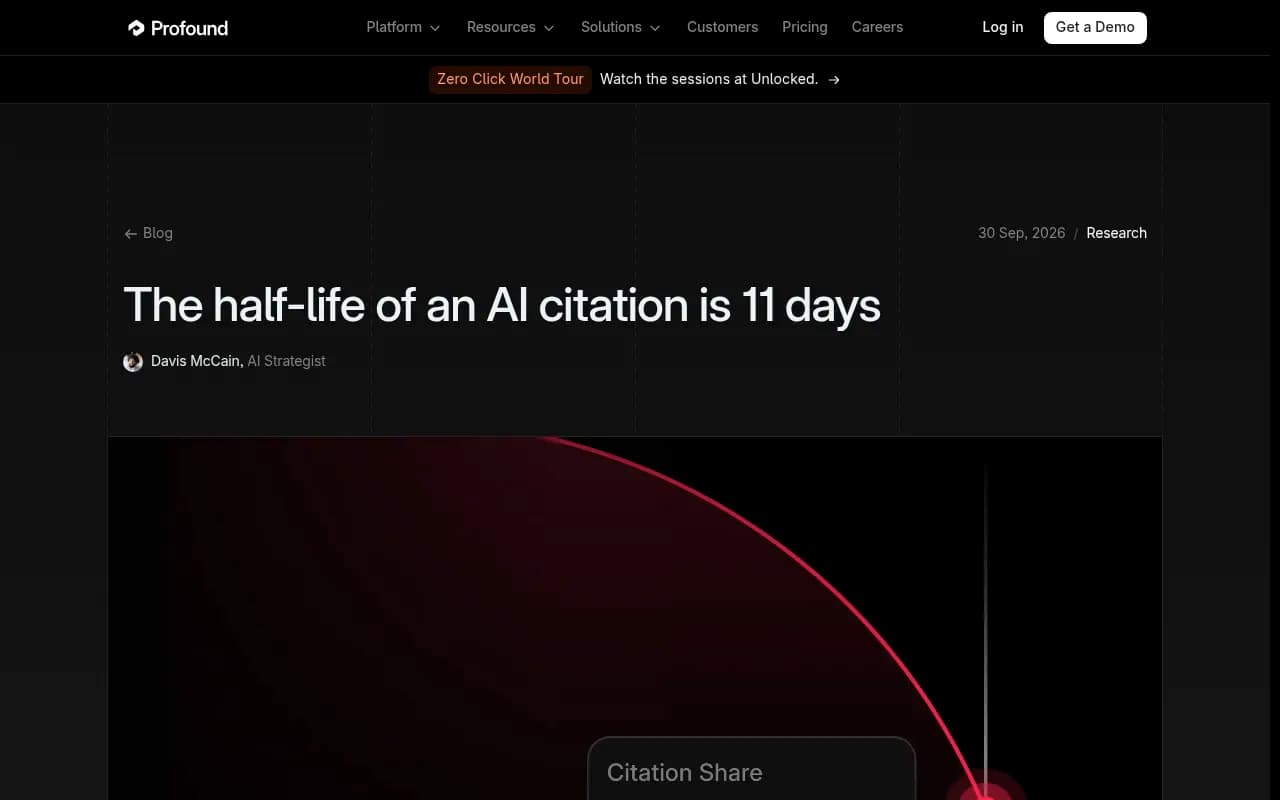
- Profound's 2026 study found the median page loses half its citation share 11 days after peaking, and 78% of page and engine pairings do so within two weeks. Most citations are single bursts.
- Promptwatch Data shows ChatGPT keeps landing pages and docs cited longest, while news loses half its pages within 36 days.
- Different vendors measure half-life differently. Never compare an 11-day figure with a 4.5-week figure as if they were the same thing.
- The most useful benchmark is your own pages compared with each other, plus a monthly routine of one refresh and one protect action.
What citation trends actually measure
A page that earned twelve citations last month tells you very little. Did it collect all twelve in one week and then go quiet? Is it still climbing? Was it cited constantly last quarter and only occasionally now? Those stories call for completely different decisions, and a raw count cannot separate them.
A time-based view of citations fixes that. Promptwatch calls its version Citation Trends. It classifies every citation into a content type (22 of them) and a source type (20, including directories), then follows each cited page over time and reports four timing measures:
- First cited: the date an AI engine first used the page as a source.
- Ramp-up days: how long it took to go from first citation to peak.
- Peak rate: the best citation rate the page ever reached.
- Decay half-life: how many days after the peak it takes to fall to half that rate.

The same shape of analysis exists elsewhere. Profound calls its version Citation Decay and describes it as first cited, rise, peak and half-life. The vocabulary differs a little, but the idea is identical: treat a citation as something with a life cycle, not a tally.
Where the term half-life comes from
If "half-life" sounds academic, that is because it is. Clarivate's Journal Citation Reports have published Cited Half-Life for decades. There it means the median age of a journal's articles that got cited in a given year. A Cited Half-Life of 7.0 means half the cited papers were published in the last seven years. Librarians use it to decide how far back to keep a journal's backfile.
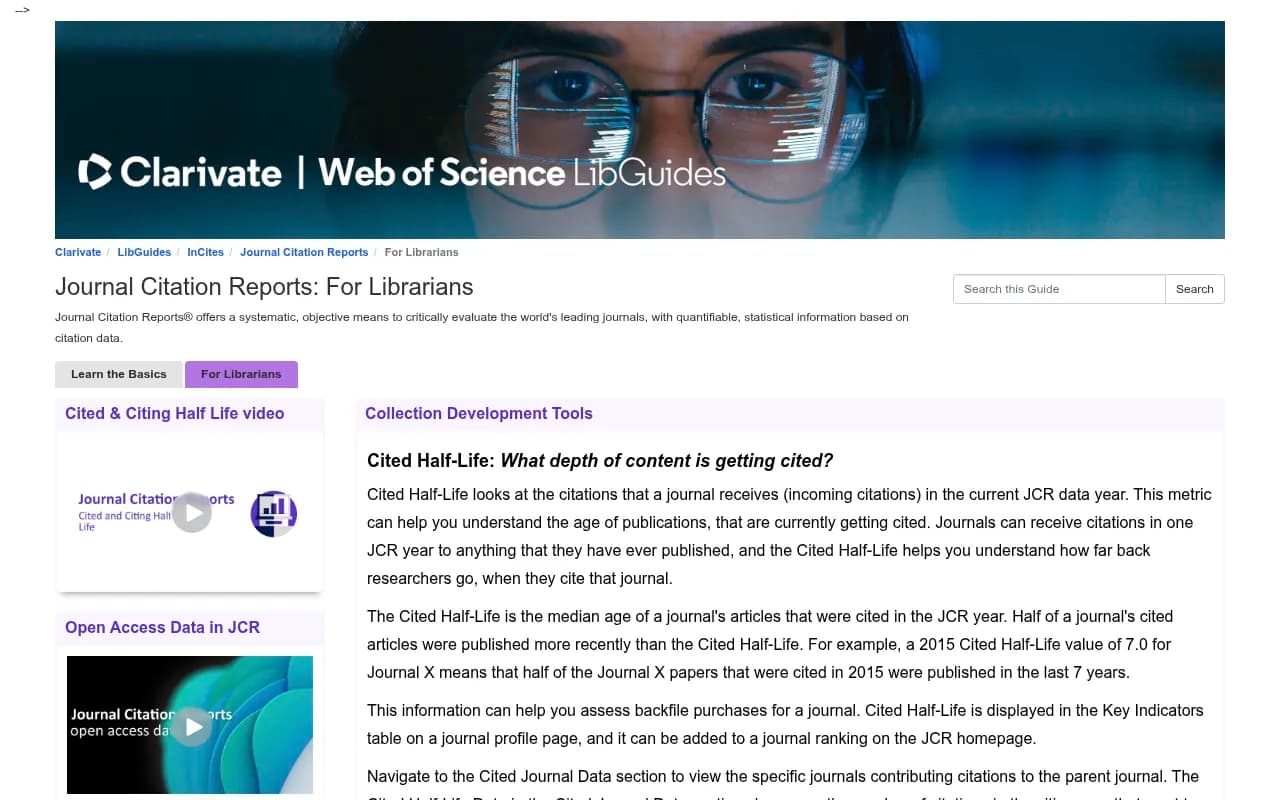
The AI search version is different in a way that matters. The journal metric describes the age of what gets cited right now. The AI metric follows one page through time and asks how fast its citation rate falls after its best moment. Same word, different question. Keep that in mind when you read any figure below.
What the 2026 data says about how long citations last
Most citations are single events
Profound analysed 883,000 pages across ChatGPT, Perplexity, Claude, Google AI Overviews, AI Mode, Gemini and Microsoft Copilot from September 2025 to September 2026, which gives 1.19 million page and engine life cycles. The headline numbers:
- The median page loses half its citation share within 11 days of peaking.
- 78% of page and engine pairings fall to half their peak within two weeks.
- The remaining 22% have a median half-life of 27 to 29 days.
- The median time from first citation to half-peak is 42 days.
Before you panic, there is a measurement catch. Profound smooths citation share over a trailing 14-day window, so a page cited in a single burst cannot have a half-life longer than about two weeks. Many of those 78% are simply pages that got picked once out of a huge source pool and never again. That is ordinary rotation, not failure.
The sustained 22% are the interesting group. Their median rise from first citation to peak is 36 to 46 days, so they build slowly and then hold for roughly a month before halving.
Being cited broadly predicts lasting
Profound found pages cited by five or more engines were 5.5 times as likely as single-engine pages to still be above half their peak after eight weeks. Pages cited by one engine took a median of 19 days to rise. Pages cited by five or more took 46.
| Engines citing the page | Median rise | Still above half-peak at day 56 |
|---|---|---|
| 1 | 19 days | 1.2% |
| 2 | 31 days | 2.0% |
| 3-4 | 33 days | 3.5% |
| 5 or more | 46 days | 6.8% |
Even the best group is small in absolute terms. Lasting citations are rare, and that is worth knowing before you set expectations with a client or a boss.
Engines do not decay together
Cross-engine correlations of decay timing ran between 0.03 and 0.09 in Profound's data, so a page fading on one engine says almost nothing about the others. Among pages that outlast two weeks, a Claude citation was 2.8 times as likely as a ChatGPT citation to still be relevant eight weeks later. The practical rule: read decay per engine, never pooled.
Reporting content fades first
Profound grouped 133,000 sustained pages into four families.
| Content family | Includes | Median half-life | Above half-peak at day 56 |
|---|---|---|---|
| Choose | Comparisons, listicles, reviews | 29 days | 11.2% |
| Explain | How-tos, docs, reference, tools | 28 days | 10.2% |
| Sell | Product, pricing, company pages | 28 days | 9.8% |
| Report | News, announcements, research | 27 days | 7.0% |
The half-life gap looks small, but the survival gap at eight weeks is not. The other three families held at 1.4 to 1.6 times the rate of reporting pages, which also peak faster and leave faster.
What Promptwatch Data adds for ChatGPT
Profound measures share. Promptwatch's ChatGPT content half-life report measures retention, meaning whether a page is still cited at all. It took every classified page ChatGPT cited on July 6, 2026 and followed them for 90 days to October 4, 2026. These are different methods, so treat them as two lenses on the same problem, not one number.
| Content type | Still cited at 30 days | Still cited at 60 days | Notes |
|---|---|---|---|
| Landing pages | 78% | 69% | Likely beyond 90 days |
| Docs | 76% | 67% | 93% cited again after day 0 |
| Comparisons | 72% | 63% | Hold well |
| Listicles | n/a | 60% | Hold well |
| Product pages, reviews, how-tos | n/a | about 55% | Half-life of 74 to 77 days |
| News | n/a | 41% | Half gone after 36 days |
Almost a quarter of news pages are never cited again after day 0. Landing pages, docs, comparisons and listicles only cross 50% in the final week, and that is an artifact of the window ending, so their true half-life is probably close to or beyond 90 days.
Both studies agree on the direction: news and reporting content burns bright and short, while structural pages (landing pages, docs, comparisons) last. Promptwatch's citation share by content type report adds context on what gets cited in the first place: product pages led at 22.4% of ChatGPT citations from Sep 28 to Oct 4, 2026.
How to read the four numbers on a real page
First cited
This tells you how long a new page took to be noticed. A page with no first-cited date after several weeks is not decaying. It simply has not been picked up, and the fix is different: check crawlability, then check whether the page answers a prompt anyone is actually asking.
Ramp-up days
Short ramp-up with a short half-life is the classic burst. Long ramp-up with a long half-life is the pattern of a durable reference page. In Profound's data, sustained pages rise for 36 to 46 days. If a new page of yours has been live for two days, you have no information yet.
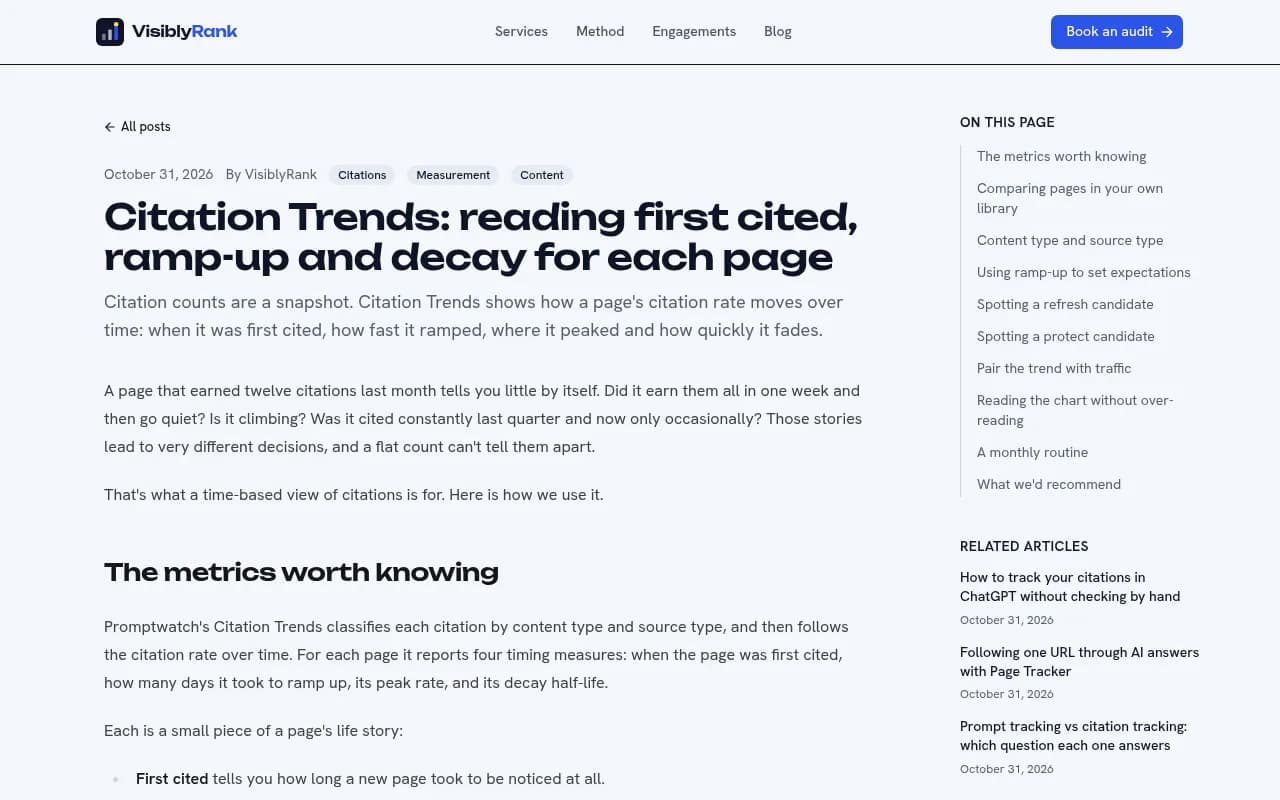
The VisiblyRank write-up on Citation Trends makes the same practical point: nobody can give you a sourced industry benchmark for ramp-up, so measure it on your own domain. After five or six pages you will have a rough expectation, and that beats any average.
Peak rate
Peak is relative. A page peaking at five citations in a two-week window is barely qualifying (Profound requires at least 5), while a page peaking at 500 is a real asset. Use peak to decide how much a decline matters, not just whether it is happening.
Decay half-life
Sort your pages by half-life and look at both ends. Long-half-life pages are holding ground. Short ones rise and fade. The VisiblyRank authors say the durable pages in their client work answer a question completely and do not depend on a date or news hook, while the fading ones are often trend pieces, pages tied to one statistic, or pages a competitor later beat. They call that an observation, not a law, and I would agree. Check it against your own library before believing it.
Decay is not the same as a diagnosis
This is where teams burn effort. A fall from peak is normal, since most cited pages do it within two weeks. An alert that fires on every drop will fire on nearly everything, and you will refresh content that was never in a stable position.
Rhinegold's compendium makes a sensible argument here. Measure from a stable baseline, not the peak, and compare the page with a set of similar pages on the same platform and prompt panel, chosen before the series starts. If the comparison pages fall too, it is probably a platform-wide shift (model updates, freshness signals, partner refresh cycles). Only a widening gap to comparable pages points at something specific to your page.
Two more cautions from that research:
- A single run cannot separate decay from rotation. SISTRIX found that in AI Mode, sources outside the stable core rotated about 89% a week, and URL-level drift ran around 85% a week. Page-level conclusions need repeated runs per window, or are safer read at domain and topic level.
- Published half-lives are not comparable across vendors. Profound's 11 days is page share from peak. Scrunch and Stacker's roughly 4.5 weeks (3.4 on ChatGPT, 5.8 on Perplexity) describes persistence of a weekly source cohort.
Refresh or protect: a decision checklist
When a page that mattered has peaked and is sliding, work through this in order.
- Is the page still crawlable? Check AI crawler logs for errors before anything else.
- Did the underlying facts change, such as prices, features, rules or dates?
- Did a competitor publish a better answer to the same prompts?
- Did a third-party source that supported your page change or disappear?
Also check whether everything dropped at once. A simultaneous decline across all pages and all models usually points to an engine-side change or an access setting, not a content problem.
The flip side is protection. Pages with long half-lives and high peaks are your assets. Do not rewrite them for fun, and do not change their URLs without a redirect. VisiblyRank's authors say they have watched teams tidy up top pages and lose them. A page-watching tool such as Promptwatch's Page Tracker can alert you to what changed. For freshness, Promptwatch's Content Refresh gives git-diff-style update suggestions instead of a blank rewrite.
Also pair citation rate with visits. A page can be cited as background and never clicked. Promptwatch's 360 Insights joins crawler logs, citation clicks and AI-referred visits so you can see whether a long-lived citation is earning anything.
A monthly routine that takes an hour
- List the five pages with the shortest half-life.
- List the five with the longest.
- Note any newly first-cited pages.
- Pick one refresh action and one protect action.
- Assign both on a task board so they actually happen.
Keep the prompt panel fixed during the period. Adding 40 new prompts shifts the baseline and makes a change in the sample look like a trend. Citation rates are noisy, and one week's dip is not decay.
Planning content around half-life
Put the findings together and a content mix falls out:
- Treat landing pages, docs and pricing pages as long-term citation assets, and keep prices, features and positioning accurate.
- Do not assume product pages stay cited on their own. They decay about as fast as how-to guides in ChatGPT, so keep specs and availability current.
- Invest lasting effort in comparison pages and listicles. Both kept more than 60% of citations after two months in Promptwatch's ChatGPT data.
- Use news and press content for short bursts of visibility, and do not expect them to compound.
- Spread across engines. Pages cited by five or more engines lasted far longer in Profound's data.
The freshness angle matters too. Rhinegold cites research that half of the content answer engines cite is under 13 weeks old, and Ahrefs data quoted by Milan Novotny says URLs AI assistants cite run about 25.7% fresher than organic results for the same queries. So an annual refresh cycle is a floor, not a plan.
Tools that report citation timing
Not every AI visibility tool shows page-level life cycles. Many stop at mentions and share of voice.
| Tool | Timing view | Notes |
|---|---|---|
| Promptwatch | First cited, ramp-up days, peak rate, decay half-life per page; content and source type classification | Pairs with crawler logs, Page Tracker and Content Refresh to act on findings |
| Profound | Citation Decay: rise, peak and half-life per URL across engines | Enterprise focus; demo-led |
| Scrunch | Published cohort-level half-life research | Check product for page-level views |
| Bing Webmaster Tools | Citation Share with period comparison | Microsoft surfaces only |

If you want to compare more options, the GEO software directory at bestgeosoftware.com lists tools by feature. For wider background on how AI engines pick sources, Promptwatch's data hub collects the underlying research, including how ChatGPT citation share varies by domain rank.
Common mistakes
- Calling a citation missing from one run decay. One run cannot separate decay from rotation.
- Comparing Profound's 11 days with Scrunch's 4.5 weeks or Promptwatch's retention figures as one metric.
- Pooling engines into a single series, which lets a shift in engine mix create or hide a trend.
- Reading a decline with no comparison pages, so a model update gets blamed on your page.
- Changing the prompt panel mid-series.
- Rewriting your best pages because they look old.
The short version
Most citations are bursts, and that is normal. The pages worth your attention are the 22% that sustain, and the way to find them is to sort by half-life, compare against your own library, and act once a month. Build durable page types, stay fresh where facts change, and treat news as a short-term play. One caveat to hold onto: nobody has yet published evidence that citation decay arrives before traffic loss, so pair every timing metric with visits before you call a page a problem.