Key takeaways
- 47% of B2B companies have already eliminated, reduced, or stopped backfilling marketing roles because of AI, according to Wynter's 2026 survey of 100 marketing leaders — but the cuts hit junior and execution roles hardest, not strategists.
- Automation genuinely handles research, drafting, technical audits, rank tracking, and increasingly, publishing. It does not handle judgment, originality, brand voice, or accountability.
- AI search has made the human layer more important, not less: ChatGPT now cites only ~5 sources per response, and citation slots shrank ~27% after the GPT-5.3 rollout in March 2026. Generic AI content competes for fewer, more contested slots.
- The winning pattern in 2026 is AI execution plus human editing and strategy — not full autonomy.
- Most "AI SEO agents" on the market automate only 1–3 stages of a 6-stage content pipeline. Check what a tool actually does before assuming it replaces anyone.
Every few weeks, someone posts on LinkedIn that their AI stack replaced their entire content team. Then someone else posts that AI content is getting their site penalized. Both are half right, which is why this question refuses to die.
I've spent a lot of time inside the 2026 tool landscape — the writing platforms, the autonomous publishers, the AI visibility trackers — and the honest answer is more interesting than either camp admits. AI SEO platforms have quietly absorbed an enormous amount of content work. They have not absorbed the parts of the job that decide whether the work pays off.
Here's where the line actually sits.
What the data says about content teams and AI
Start with the workforce numbers, because they're less speculative than most of the commentary.
Wynter's 2026 report "How B2B Marketing Actually Uses AI" surveyed 100 directors, VPs, and heads of marketing at mid-market and enterprise B2B SaaS companies. Two findings stand out:
- 47% of companies have eliminated, reduced, or stopped backfilling marketing roles due to AI in the last 12 months. Notably, most of these were never announced as layoffs — companies simply stopped backfilling seats when people left.
- 60% of marketing leaders named content and copywriting as the function most at risk from AI, ahead of design (37%) and product marketing (26%).
That looks like a replacement story until you read the third finding: 94% of those same leaders believe their own role will exist in roughly the same form two years from now.
What's actually happening is what the report calls compression from below. A senior marketer with Claude and a good automation stack can now do in a few hours what used to require a junior writer or contractor. So the junior seats disappear, and the senior ones stay. The work gets done. The pipeline that produces future senior marketers gets thinner.
That's the real answer to "can AI replace a content team" in 2026: it can replace the entry-level rungs of the ladder, and it's already doing so. It cannot replace the people at the top of the ladder, and the survey data says even the people making the cuts don't believe it will.
What automation genuinely handles now
The list of things AI does well in SEO has grown fast, and it's worth being precise about it, because this is where the tools earn their keep.
Research and analysis
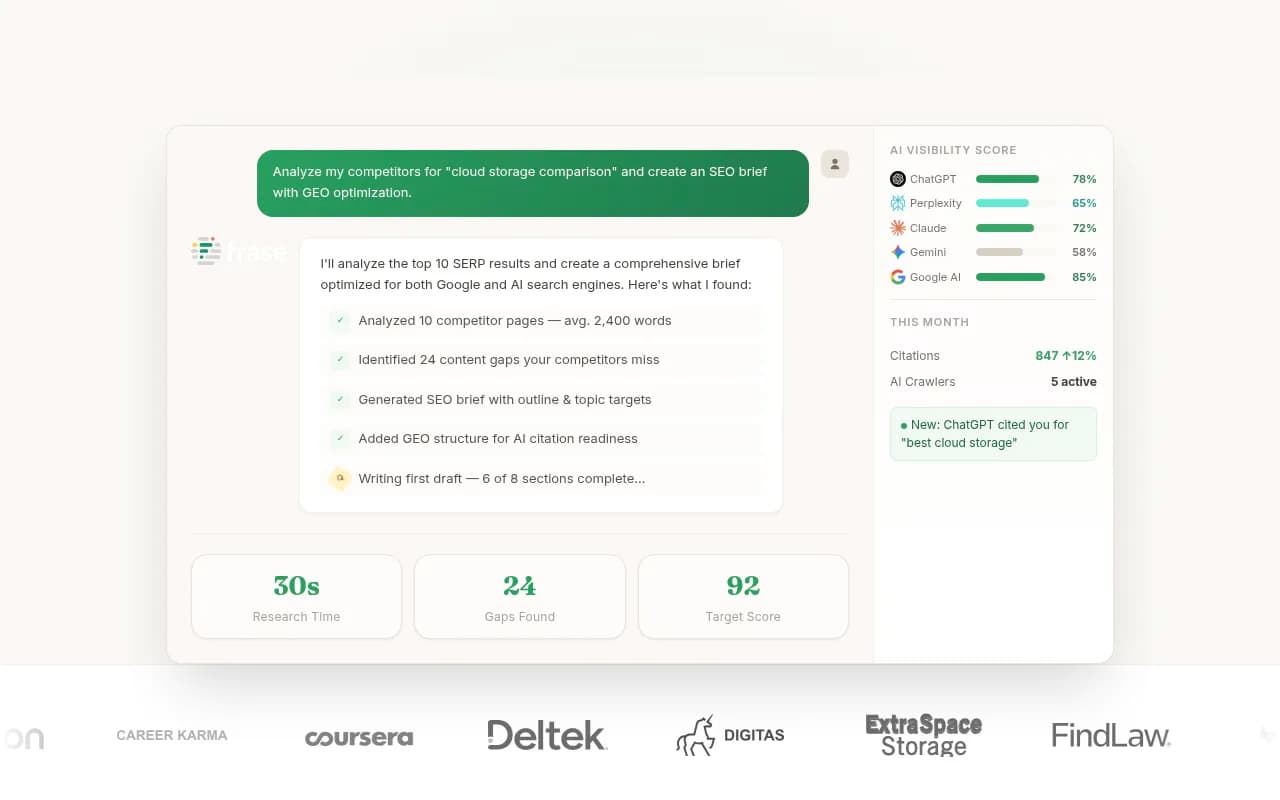
An AI tool can analyze the top 50 ranking pages for a keyword and tell you what topics they cover, what questions they answer, and how they're structured, in seconds. Keyword clustering, intent classification, SERP analysis, competitor gap analysis — all of this is now effectively free. Tools like Frase built their entire business on compressing this stage from days to minutes.
First drafts and content briefs
AI writing has moved from "obviously robotic" to "needs a competent editor" — a real change from even 2024. Platforms like Content at Scale and Byword generate long-form drafts with structure, headings, and basic optimization baked in. A human editor still has to fix claims, add specificity, and inject anything resembling a point of view, but the blank-page problem is solved.

Technical SEO audits
For large sites, automated crawling is the only practical option. Platforms like Botify and Lumar catch broken links, crawl errors, redirect chains, and indexation problems across thousands of pages — work that would take a human weeks and would be stale by the time it was finished.
Rank tracking, reporting, and monitoring
Daily rank tracking, scheduled reports, anomaly alerts — this is fully solved. Increasingly, monitoring also covers AI search: whether your brand appears in ChatGPT, Perplexity, and Google AI Overviews answers. Tools like Promptwatch track this, and given how quickly AI platforms change their behavior, continuous monitoring matters more than a one-time audit ever could.

Publishing and maintenance
The newest layer is autonomous publishing. Platforms can now push content straight to WordPress, Webflow, or Framer on a schedule, handle internal linking, and flag pages that are decaying. This is where the "agent" label started meaning something — the tool doesn't just draft, it ships.
What automation still can't do
Now the harder list. These aren't gaps that better models will obviously close, because most of them aren't intelligence problems at all.
Deciding what's true
AI drafts are confident and frequently wrong. A model will state your competitor's pricing, your product's limitations, or an industry statistic with total assurance, whether or not it's accurate. Google's position has been consistent: it doesn't penalize content for being AI-generated, it penalizes content that's low-quality, unoriginal, or wrong. The verification layer — checking claims, testing assertions, knowing what's actually happening in your industry — is human work, and it's the difference between content that builds trust and content that quietly damages it.
Having something original to say
This is the part nobody wants to hear. AI generates competent synthesis of what already exists. It cannot run the customer interview, notice the anomaly in your support tickets, or disagree with the consensus in your category. In 2026, the content that wins is AI execution wrapped around a genuinely human insight — and the insight is the scarce input.
Owning brand voice and judgment calls
Which tradeoff is acceptable? Which client claim can't go in the article? Is this angle on-brand or off-brand? These are decisions, not tasks, and they don't automate. When platforms try — through brand voice settings and governance controls — they reduce the failure rate, they don't eliminate the need for a person who knows what the brand sounds like.
Knowing why the numbers moved
Here's a concrete example of why judgment still matters. Around the GPT-5.3 rollout on March 4, 2026, average citations per ChatGPT response dropped from roughly 6.4 to under 5 — a ~27% reduction in available citation slots, across all models, with no recovery a month later. A content team that saw its AI traffic dip that week and assumed its content had gotten worse would have spent months "fixing" the wrong thing. The actual cause was a platform-level behavior change, visible only if you were monitoring citation data over time.
That's the pattern with most analytics: the tool surfaces the signal, a person still has to interpret it.
Why AI search made the human layer matter more, not less
There's a counterintuitive twist here. You'd think that as AI took over content production, the human contribution would matter less. The data on how AI search actually cites content suggests the opposite.
ChatGPT typically cites about 5 sources per web-search-enabled response — half of a traditional Google results page, and far fewer than Google AI Overviews' ~10. Every citation slot is more contested than any ranking position used to be. And the type of content winning those slots is shifting: in July 2026, product pages made up roughly a third of all ChatGPT citations, nearly double their share from four months earlier, while listicles were the fastest-growing format.
What does that have to do with replacing content teams? Everything. The content that wins citations is specific, structured, and substantively useful — real specs, transparent pricing, genuine expertise. Generic AI-generated listicles are flooding the zone while AI engines are simultaneously getting pickier about what they cite. The supply of average content is exploding at exactly the moment the demand for it is collapsing.
A platform can generate 50 articles a day. It cannot generate 50 articles a day that an AI engine has a reason to cite.
The automation spectrum: how to evaluate what a tool actually does
One useful framework for cutting through the marketing: think of the content pipeline as six stages — research, strategy, write, audit, monitor, fix — and ask how many stages a tool genuinely automates without human intervention.
Most tools calling themselves "AI SEO agents" are AI writers with a keyword field bolted on. Frase's own 2026 analysis of ten leading tools found that most covered only one to three of the six stages: MarketMuse handles strategy and research but no writing or autonomous fixes; SE Ranking has no GEO scoring or decay detection; Copy.ai has no SEO data sources at all. The gap between "AI-assisted" and "full pipeline agent" is where teams waste the most time, stitching together drafts from one tool, optimization scores from another, and publishing by hand.

Here's how the landscape roughly breaks down:
| Pipeline stage | Can AI handle it in 2026? | What still needs a human |
|---|---|---|
| Research (keywords, SERPs, competitors) | Yes, fully | Choosing which opportunities matter |
| Strategy (briefs, clusters, priorities) | Mostly | Deciding what the brand should actually say |
| Writing (drafts) | Yes, at volume | Originality, accuracy, point of view |
| Auditing (SEO/GEO scoring) | Yes | Interpreting why scores moved |
| Monitoring (rankings, AI visibility) | Yes, continuously | Diagnosing causes, spotting platform changes |
| Fixing (updates, optimization) | Partially | Judgment on what's worth fixing and how |
The honest read: five of six stages are heavily automated, but every single one still has a decision point that requires a person who understands the business.
Tool categories and where they fit
If you're building a stack rather than a team, these are the categories that matter:
| Category | What it does | Examples | Replaces which role? |
|---|---|---|---|
| Content optimization | Briefs, drafts, scoring | Surfer SEO, Frase, Clearscope | Junior writer / SEO analyst |
| Autonomous publishing | End-to-end article production | Content at Scale, Byword, RankScale | Content production coordinator |
| Workflow automation | Multi-step content ops | AirOps, Jasper | Content ops manager |
| AI visibility monitoring | Tracks citations across AI engines | Promptwatch, Profound, Otterly.AI | Nobody — this role barely existed in 2024 |
| Technical SEO | Crawls, audits, fixes | Botify, Lumar, Screaming Frog | Technical SEO specialist (partially) |
Notice the last row of the "replaces which role" column. AI visibility monitoring doesn't replace anyone, because the job didn't exist two years ago. A meaningful share of what content teams now do is work that automation itself created.
If you want to explore the full landscape, the agentic SEO tools directory at agenticseotools.com keeps a current catalog of what's actually shipping, and the GEO software directory at bestgeosoftware.com covers the AI visibility side specifically.
So should you replace your content team? A practical answer
Here's the decision framework I'd use:
If you're a solo operator or small business: yes, an AI SEO stack can realistically replace the content freelancer you would have hired. Tools handle research, drafting, and publishing at a price no human can match. But you personally become the editor and strategist, and that time isn't zero.
If you're a mid-size team: don't replace the team, reshape it. The pattern that works in 2026 is one senior editor-strategist directing an AI production system, instead of four junior writers producing by hand. You'll spend less, publish more, and the quality bar depends entirely on how good that senior person is.
If you're an enterprise: the risk isn't replacement, it's homogenization. When every competitor uses the same models with the same prompts, the output converges. Your differentiation has to come from proprietary data, real expertise, and editorial standards — all human inputs.
And if you don't want to build any of this in-house, agencies have restructured around the same reality. 1001 SEO Media, which publishes this site, runs senior specialists directing AI-assisted production for exactly this reason — the model that works isn't more humans doing manual work or fewer humans doing nothing, it's experienced people running the machines.
The bottom line
Can AI SEO platforms replace a content team? In 2026, the accurate answer is: they can replace about 70% of the tasks and 0% of the responsibility.
The research is done, the drafts are written, the audits run nightly, the reports build themselves. What's left is deciding what's true, what's worth saying, and what the brand stands behind — and the companies seeing the best results treat that remainder as the job, not the leftover. The teams that got this wrong either refused automation entirely and got outproduced, or automated everything and published content nobody, including the AI engines, has a reason to cite.
The ones getting it right use AI for volume and humans for judgment. That's not a transitional compromise. It's the model.