Key takeaways
- Bluefish AI is a sales-led, five-module platform (Monitoring, GEO Optimization, Measurement, Commerce, Accuracy) built for Fortune 500 brands, backed by $68M in funding, with no published pricing anywhere on its site.
- Most buyers either go sideways to other enterprise vendors (Profound, Scrunch AI, Evertune, Conductor) or downward to self-serve tools with transparent pricing (Semrush, Gauge, Menra, Promptwatch).
- The gap that matters isn't monitoring, nearly everyone monitors now. It's whether a platform closes the loop from "here's your visibility score" to "here's the content we just published to fix it."
- Citation behavior shifts fast enough that any tool you pick needs frequent refreshes. Promptwatch's data shows Reddit's share of ChatGPT citations fell from roughly 3.8% to about 0.5% in a matter of days in August 2026.
- Pricing transparency is a genuine differentiator in this category. Several alternatives publish exact numbers where Bluefish makes you talk to sales first.
Why people go looking for a Bluefish AI alternative
Bluefish is not a bad product. It's a five-module enterprise suite, AI Monitoring, GEO Optimization, GEO Measurement, AI Commerce, and AI Accuracy, and that last module (auditing whether AI systems describe your brand accurately) is a genuinely rare feature. It raised a $43M Series B in April 2026, co-led by Threshold Ventures and NEA, bringing total funding to $68M in two years, and counts Adidas, American Express, Hearst, and Ulta Beauty as customers.
But here's the thing. Every source I checked, Bluefish's own site, third-party reviews, competitor battlecards, comes back with the same complaint: there is no published price anywhere. One review captured it well with a quote from a would-be buyer comparing it to Semrush: "Semrush is $99/month and I know exactly what I'm getting. Bluefish won't even tell me the price until I talk to sales." For a Fortune 500 marketing team with a procurement department, that's a feature. For a mid-market team trying to evaluate five vendors in a week, it's a wall.
So the alternatives split into two lanes. Lane one is other enterprise, sales-led platforms with similarly deep feature sets and similarly opaque pricing. Lane two is self-serve tools that publish their price on the homepage and let you sign up without a demo call. I've grouped the nine below accordingly, and I'll be straight about which lane fits which buyer.
The nine alternatives, compared
| Platform | Pricing | Scope | Motion | Best for |
|---|---|---|---|---|
| Profound | Free trial; Enterprise custom | Answer intelligence, 9 engines, research | Hybrid | Enterprise benchmark, deepest research |
| Scrunch AI | ~$250-300/mo Standard; custom Enterprise | Monitoring + agentic web optimization | Sales-led + self-serve | SOC 2 buyers, agent-readiness thesis |
| Evertune | From ~$800/mo | GEO + AI advertising + panel measurement | Sales-led | Statistical brand measurement at scale |
| Conductor | Custom (3 published tiers) | Enterprise SEO + AEO + revenue attribution | Sales-led | SEO/AEO vendor consolidation |
| Semrush AI Toolkit | $99/mo per domain | Add-on to existing suite | Self-serve | Teams already inside Semrush |
| Gauge | $599/mo Growth; custom Enterprise | Monitoring + Ask Gauge agent + publishing | Self-serve | Cost-per-answer efficiency |
| Dageno AI | Custom (trial-gated) | Unified GEO + SEO + crawler detection | Self-serve/demo | Agencies wanting white-label |
| Menra | $69/mo + add-ons | Monitoring + citations + AEO recs | Self-serve | Budget-conscious visibility core |
| Promptwatch | $95-$579/mo published tiers | End-to-end monitoring + agentic content | Self-serve | Teams that want the fix, not just the score |
A quick note on how I read this table before you do: cheapest isn't automatically best, and most expensive isn't automatically most capable. Bluefish's five-module scope is real, and if you need AI Commerce tracking or an Accuracy/truthfulness audit for a regulated industry, none of the self-serve tools below replicate that. But if you're a mid-market or growth-stage brand that mainly needs to know where you stand in ChatGPT and Google AI Overviews and then actually do something about it, several of these alternatives get you there for a fraction of the price and a fraction of the sales cycle.
The enterprise lane: sideways from Bluefish
1. Profound
Profound is the name that comes up in almost every Bluefish comparison I found, and for good reason. It's raised significant funding (reports place a recent round at $180M per its own pricing page banner, following an earlier $155M raise and a reported $1B valuation), and its research output is unmatched in the category: a 50,000-prompt "Parrot Problem" study, multi-million-prompt citation analyses, and retailer shopping-behavior reports that get cited across the industry.
Profound's current published pricing page shows a free Trial (10 prompts, ChatGPT only, one-time run) and then jumps straight to custom Enterprise pricing covering up to nine answer engines with daily tracking, SSO/SAML, and SOC 2. Some third-party sources still describe an earlier $99 Starter / $399 Growth self-serve structure, so if a self-serve tier matters to you, verify directly with Profound before assuming it still exists. Customers include MongoDB, Indeed, US Bank, and Ramp.
2. Scrunch AI
Scrunch positions itself around an "agentic web" thesis: it's not enough to optimize for answer engines, you also need to optimize for AI agents that act on a user's behalf. It's SOC 2 Type II certified and covers seven-plus engines, more breadth than most competitors tested in one independent review.
Pricing isn't published in a clean grid, but third-party reporting puts a Standard plan around $250-300/month for 350 prompts and full multi-engine access, with custom Enterprise pricing above that. The honest criticism from one reviewer: "you're paying $250/month for future potential rather than present capability." Strong on monitoring breadth, thinner on prescriptive optimization guidance.
3. Evertune
Evertune's pitch is a "Three-Layer Measurement Approach": direct API access to foundation models combined with consumer-app tracking (ChatGPT Search, Gemini Search, Perplexity, Copilot, AI Mode, AI Overviews), backed by a 150-million-person panel for statistical brand measurement. It also connects directly to AI advertising, including ChatGPT Ads.
Third-party pricing reports put its Pro tier starting around $800/month. If your board wants panel-level statistical rigor behind AI visibility claims rather than pure LLM-prompt sampling, this is the closest thing to that in the category.
4. Conductor
Conductor comes at this from the enterprise SEO side, bolting AEO and revenue attribution onto an established SEO suite. Its published pricing page shows three tiers (Essentials, Growth, Enterprise) with real numbers attached to metrics like AI Search Credits and pages analyzed, though actual contracts are still custom, quote-based annual licenses.
Conductor closed FY2026 with 50-plus new enterprise logos including Charter, Airbnb, Coca-Cola, and Atlassian. It's the pick if you'd rather consolidate SEO and AEO under one enterprise vendor than run separate tools, and it offers a free three-week trial, which is more than Bluefish gives you.
The self-serve lane: downward from Bluefish
5. Semrush AI Visibility Toolkit
If you're already running Semrush for traditional SEO, the AI Visibility Toolkit is the path of least resistance. It's $99 a month per domain, billed annually, and includes 25 custom prompts tracked daily, mentions across ChatGPT, Google AI, Gemini, and Perplexity, and an AI-readiness site audit.
The catch is that add-ons stack fast. An extra domain is another $99, an extra user is another $99, and 50 more prompts is $60. Profound's own review of the toolkit (read with the obvious bias in mind) notes it only covers three answer engines against the 8-10 that dedicated GEO tools track. Fine as a bolt-on, thin as a standalone AI visibility strategy.
6. Gauge
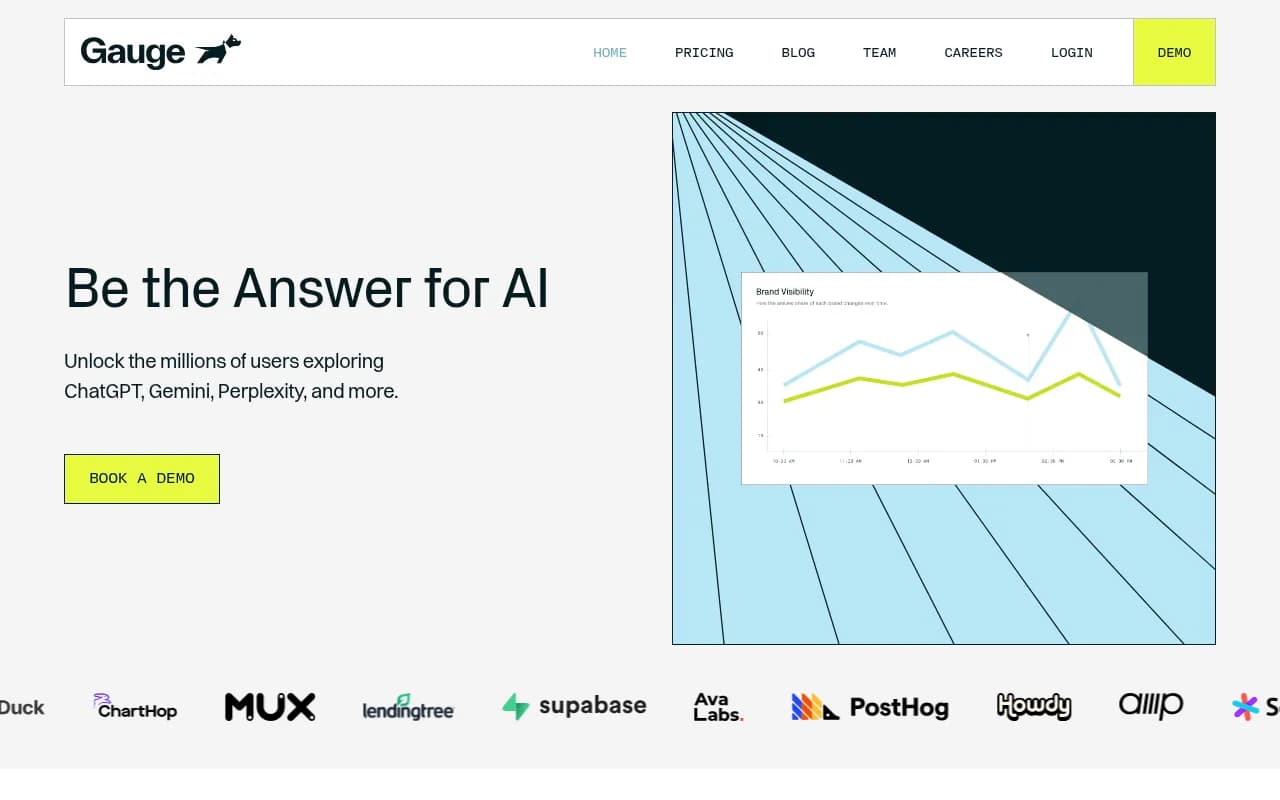
Gauge leans hard on cost-per-answer efficiency. Its Growth plan is $599/month for 600 prompts run daily across six platforms (ChatGPT, Google AIO, AI Mode, Gemini, Perplexity, Copilot), which works out to roughly 108,000 AI answers tracked monthly, plus 18 publish-ready articles a month.
What sets Gauge apart is "Ask Gauge," a conversational agent that connects visibility data with GA4, Search Console, and DataForSEO and walks from insight to content plan to draft to CMS publish (Webflow, Framer, Sanity, GitHub). One customer quote sums up the value proposition bluntly: "It's the most expensive tool we have, but we happily pay them every month."
7. Dageno AI
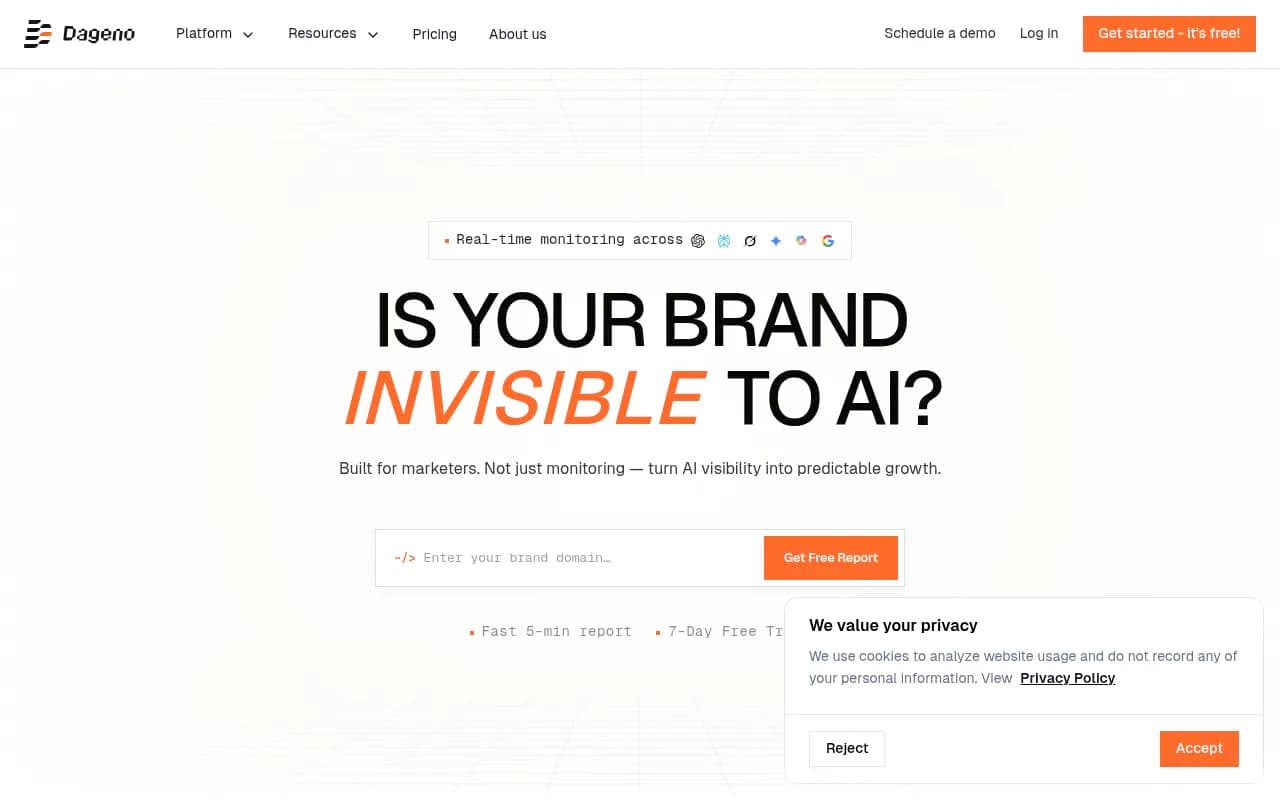
Dageno bundles GEO and traditional SEO into one dashboard, with a "BotSight" module that shows which AI crawlers are actually visiting your site, useful if you want crawler-level evidence alongside citation counts. It carries SOC 2 Type II compliance and SSO, which puts it ahead of some self-serve peers on enterprise readiness.
It doesn't publish flat self-serve pricing, routing visitors into segmented trial and demo flows instead. It's agency-friendly, with multi-brand management and white-labeling, and positions itself against Peec AI on depth and against Profound on price.
8. Menra
Menra is the cheapest true self-serve option in this list at $69/month including 100 credits, with $20/month per-platform add-ons. It monitors nine AI engines (ChatGPT, Perplexity, Claude, Gemini, Google AI Overviews/AI Mode, Copilot, Grok, Meta AI, DeepSeek) and resolves citations down to the exact deep URL rather than stopping at the domain level.
It lacks SOC 2 certification, a real limitation if your procurement team requires it, and it leans more toward monitoring plus recommendations than automated execution. Still, for a team that just needs the visibility core at a published price, it's hard to beat on cost.
9. Promptwatch
This is where I'd point most teams asking "what actually replaces the parts of Bluefish I care about, without the sales call." Promptwatch is used by 1,840-plus brands and agencies (adding 150-plus new customers a month) and rated 4.7/5 on G2, with customers including Duolingo, Yelp, Typeform, Shutterstock, and agencies like Monks and WPP.
What separates it from most of the tools above is that it doesn't stop at telling you your visibility score. Its AI crawler logs (Agent Analytics) show exactly when ChatGPTBot, ClaudeBot, PerplexityBot, and 400-plus other crawlers hit your pages, and where they error out, which explains the "why" behind a visibility number instead of just reporting it. Its Content Agents then plan, write, and publish GEO-optimized content directly to Webflow, Framer, or WordPress on a schedule, and Unified Actions turns all of that into a prioritized to-do list instead of a raw dashboard. Crisp, one of its customers, scaled to 5-10 published articles a day using this workflow and saw 2x higher conversion rates from AI traffic versus traditional channels.
Pricing is published and tiered: Essential at $95/month (one site, 50 prompts, all LLM tracking), Professional at $245/month (the most popular tier, two sites, automated content generation, shopping insights), and Business at $579/month (five sites, 30 AEO articles a month). There's also a free Explore tier and agency plans starting at $199/month. Compared to Bluefish's quote-only model, you know exactly what you're paying before you commit to anything.

What actually moves visibility, regardless of which tool you pick
A tool only matters as much as what you do with its data. A few patterns are worth knowing before you commit to any platform on this list.
Citation behavior is not stable. Promptwatch's own research shows Reddit's share of ChatGPT Search citations collapsed from a steady 3.8% (mid-July to early August 2026) to just 0.5% within days in mid-August, coinciding with a change in how ChatGPT handles query fanouts. Google's AI Overviews and AI Mode showed only gradual Reddit declines over the same window, which means you can't assume one engine's citation shifts predict another's. If your platform refreshes weekly instead of daily, you'll miss moves like this entirely.
Content type matters more than it used to. Promptwatch's July 2026 data on ChatGPT citation types found product pages had become the single most-cited content type at nearly a third of all daily citations, up from about 18% back in March, with listicles the fastest-growing format within the month. If your content strategy is still built around generic blog posts, that's worth revisiting regardless of which visibility tool sits on top of it.
Citation share is also less concentrated than classic Google rankings. No single domain holds more than about 4% of ChatGPT citations in a given month, per Promptwatch's June 2026 citation share data, which means AI search leaves real room for smaller, niche sites to earn citations that Google's SERP never would have given them.
Which lane should you actually pick
If you're a Fortune 500 brand that needs Commerce tracking, an Accuracy/truthfulness audit, and don't mind a sales cycle, staying with Bluefish or moving to Profound or Evertune makes sense, you're paying for scope and research depth that self-serve tools simply don't build.
If you're a growth-stage or mid-market team that wants transparent pricing, fast setup, and a platform that closes the loop from "here's your score" to "here's the published fix," Promptwatch, Gauge, and Menra are the more sensible starting points, in roughly that order of feature depth and price.
Either way, don't pick based on the sales pitch alone. Run a real prompt set through a trial or free tier first, look at how the crawler and citation data actually reads for your domain, and see whether the tool gives you something to act on or just another dashboard to check. For a broader look at the category, the GEO software directory at bestgeosoftware.com is a reasonable place to keep comparing options as new platforms launch.