Key takeaways
- Sight AI is a solid entry-level AI visibility platform, but it lacks content generation, crawler logs, and deep prompt intelligence that more advanced teams need.
- Most alternatives fall into two camps: monitoring-only dashboards (Otterly.AI, Peec AI, AthenaHQ) and full optimization platforms that help you act on what you find.
- Promptwatch is the only platform in 2026 rated as a "Leader" across all GEO categories -- it tracks, analyzes, and generates content to improve your AI visibility in one loop.
- If you're on a tight budget, tools like Otterly.AI and Peec AI offer affordable entry points, but expect to hit a ceiling quickly.
- The most important question to ask any tool: does it just show me data, or does it help me do something about it?
Why look beyond Sight AI?
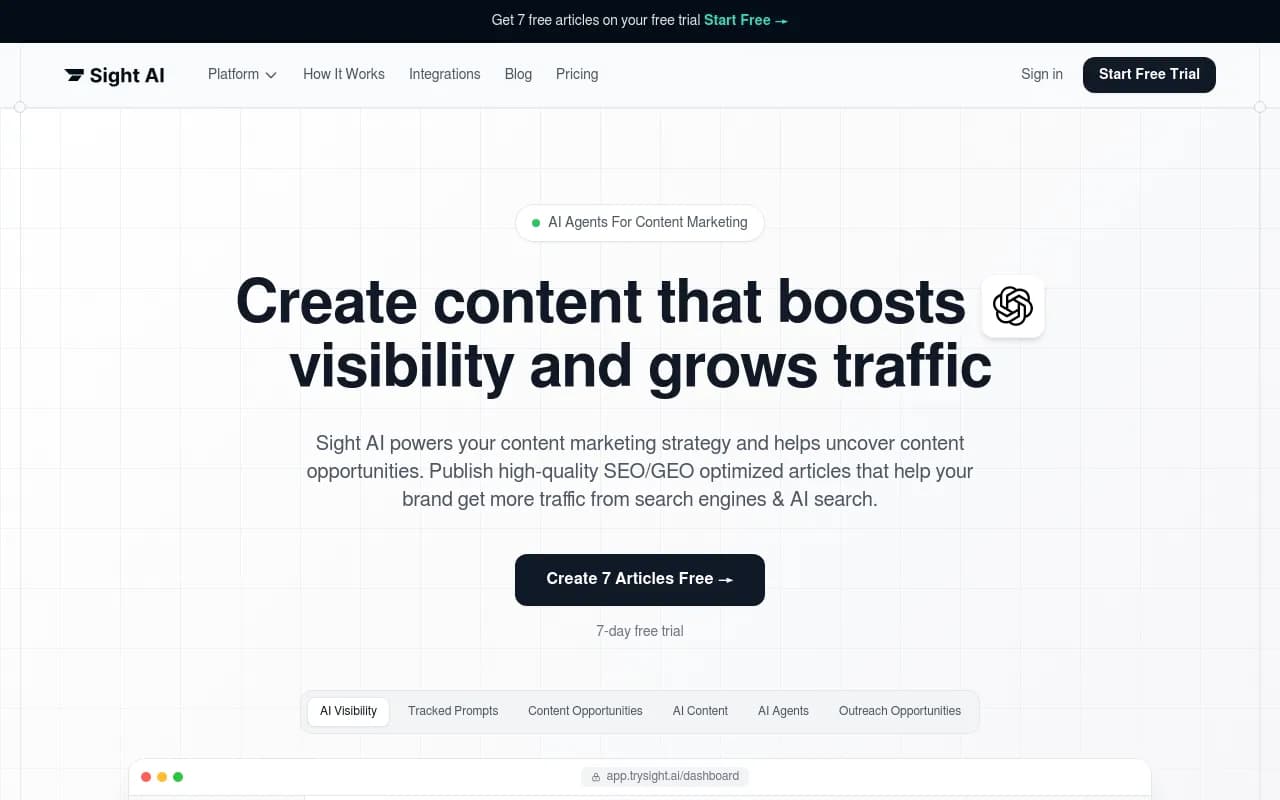
Sight AI positions itself as an all-in-one AI visibility and GEO platform. For teams just getting started with tracking brand mentions across ChatGPT, Perplexity, and Google AI Overviews, it covers the basics reasonably well.
But "all-in-one" means different things to different teams. If you're running a serious GEO program -- managing multiple brands, trying to close content gaps, or connecting AI visibility to actual revenue -- you'll probably find Sight AI's feature set limiting. No AI crawler logs. No built-in content generation. Limited prompt intelligence. And when you're trying to figure out why a competitor is getting cited and you're not, "limited" becomes a real problem.
The good news: the AI visibility tool market has matured fast. There are now platforms that go well beyond tracking, and this guide covers the best of them.
What to actually look for in an AI visibility platform
Before comparing tools, it helps to know what separates a genuinely useful platform from a dashboard that just looks impressive in demos.
The core capabilities worth evaluating:
- Prompt monitoring: Can you track specific prompts across multiple AI models? How many prompts, and which models?
- Brand mention and share of voice tracking: Does it show you how often your brand appears vs. competitors, and with what sentiment?
- Citation analysis: Which pages, domains, Reddit threads, or YouTube videos are AI models actually citing? This is where most tools fall short.
- Content gap analysis: Does the tool show you which prompts competitors rank for that you don't? This is the difference between a tracker and an optimizer.
- Content generation: Can you act on those gaps directly inside the platform, or do you have to export data and switch tools?
- Traffic attribution: Can you connect AI visibility to actual site visits and revenue?
- AI crawler logs: Do you know when ChatGPT or Claude is crawling your site, and which pages they're reading?
Most tools in 2026 handle the first two well. The last four are where the field thins out considerably.
The best Sight AI alternatives in 2026
Promptwatch -- best for teams that want to close the loop
Promptwatch is the most complete AI visibility platform available right now. It's used by 6,700+ brands and agencies including Booking.com and Center Parcs, and it's the only platform rated as a "Leader" across all GEO categories in a 2026 comparison of 12 platforms.
What makes it different from Sight AI and most other alternatives is the action loop. Most tools show you where you're invisible. Promptwatch shows you where you're invisible, tells you exactly what content you're missing, and then helps you create it -- with a built-in AI writing agent that generates articles grounded in 880M+ citations analyzed. Then it tracks whether that new content actually gets cited.
That cycle -- find gaps, generate content, track results -- is genuinely rare. Otterly.AI stops at step one. Peec AI stops at step one. AthenaHQ stops at step one. Promptwatch goes all the way.
A few specifics worth knowing: it monitors 10 AI models (ChatGPT, Perplexity, Claude, Gemini, Grok, DeepSeek, Copilot, Meta AI, Google AI Overviews, and Google AI Mode), has real-time AI crawler logs so you can see when and how AI engines are reading your site, tracks Reddit and YouTube as citation sources, and includes ChatGPT Shopping tracking. Prompt volume estimates and difficulty scores help you prioritize which prompts are actually worth chasing.
Pricing starts at $99/month for the Essential plan (1 site, 50 prompts, 5 articles), $249/month for Professional (2 sites, 150 prompts, crawler logs, city-level tracking), and $579/month for Business (5 sites, 350 prompts, 30 articles). Free trial available.

Profound -- best for enterprise analyst teams
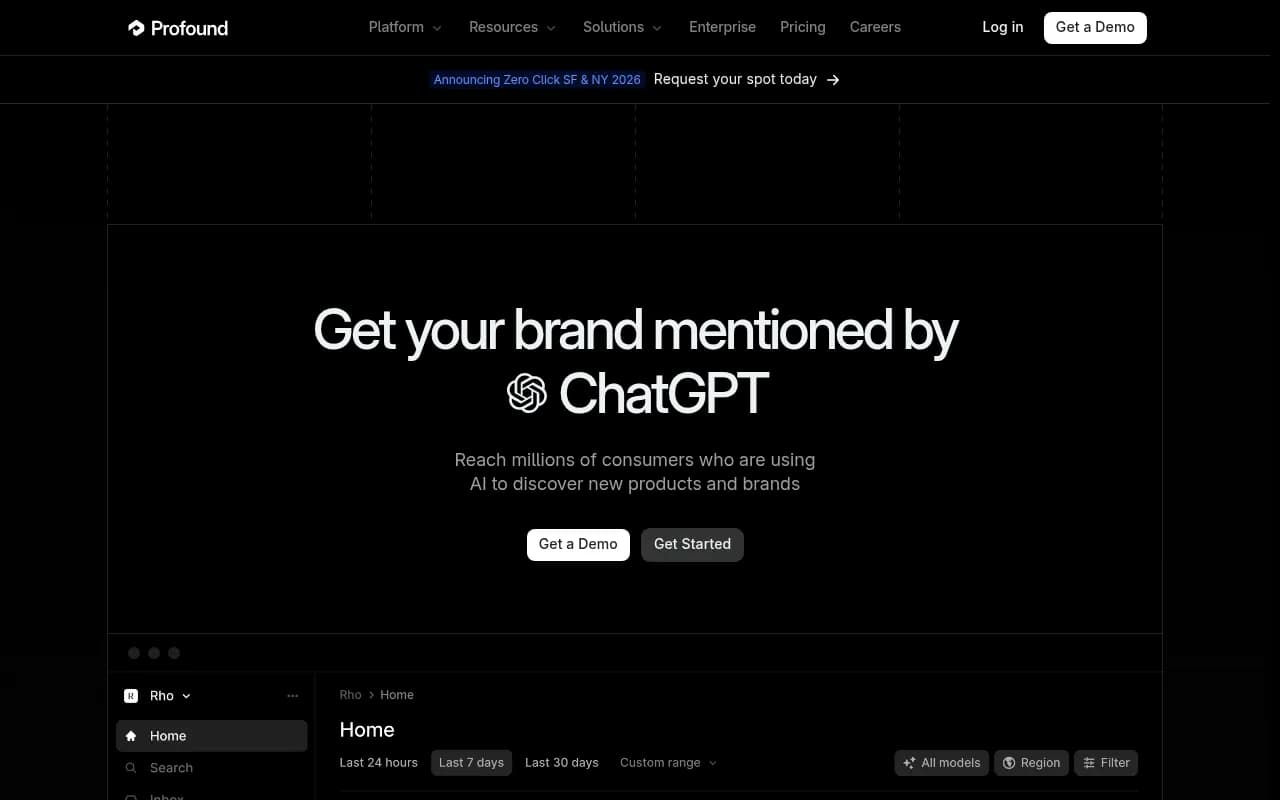
Profound is one of the more established names in enterprise AI visibility. It covers a solid range of AI models, offers near real-time monitoring, and has a strong API for teams that want to pipe data into their own reporting infrastructure.
Where it shines is raw data access. If you have dedicated analysts who want to slice and dice LLM response data themselves, Profound gives them the depth to do that. Where it falls short is actionability -- it doesn't generate content, doesn't have Reddit/YouTube citation tracking, and doesn't include ChatGPT Shopping monitoring. It's also priced at the higher end of the market, which can be hard to justify for mid-market teams.
Otterly.AI -- best for budget-conscious teams just starting out
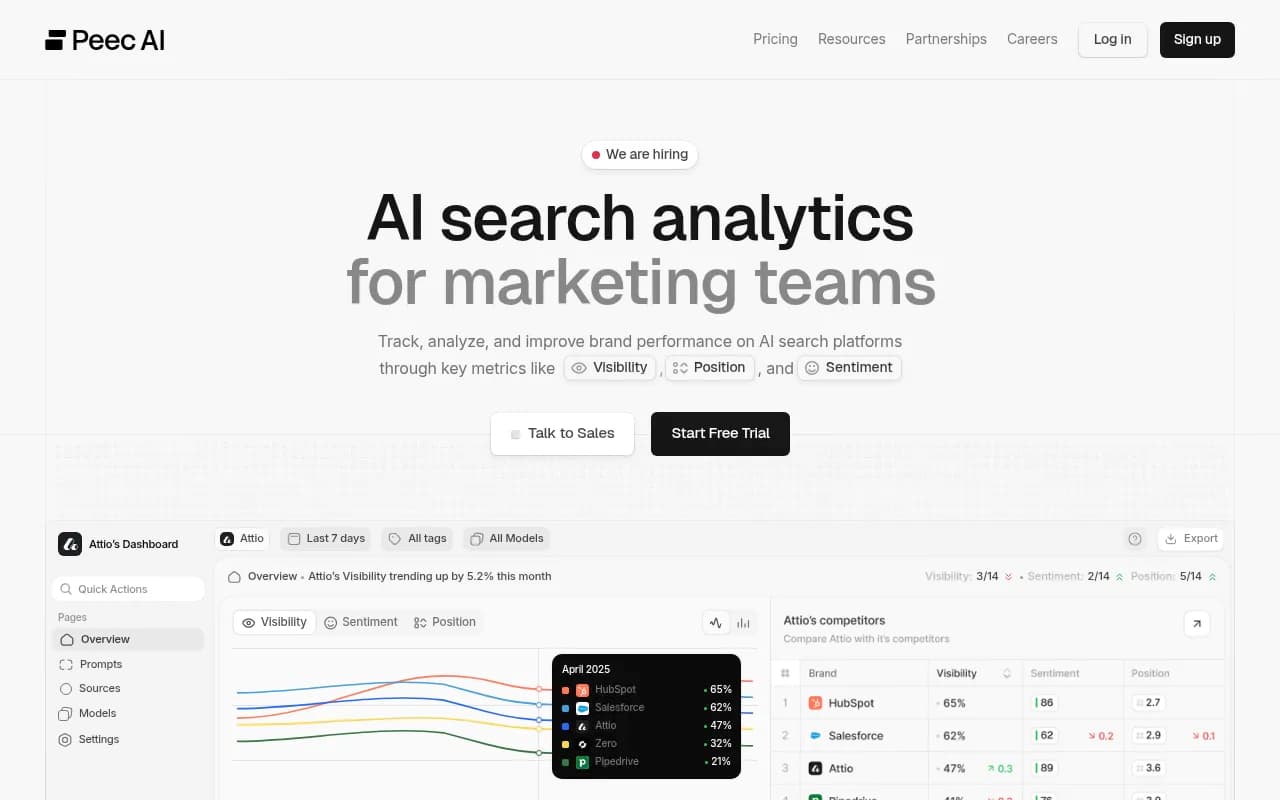
Otterly.AI is one of the more affordable options in the market, and for teams that just want to start tracking brand mentions across a handful of AI models without a big commitment, it does the job.
The interface is clean, setup is fast, and the pricing is accessible. The honest limitation: it's a monitoring tool. There's no content generation, no crawler logs, no prompt difficulty scoring, and no traffic attribution. You'll see where you're mentioned, but you won't get much help figuring out what to do about it. For a team in the early "we need to understand the problem" phase, that's fine. For a team that needs to move the needle, you'll outgrow it quickly.

Peec AI -- best for multi-language tracking
Peec AI has carved out a niche with its multi-language support, which is genuinely useful for brands operating across European or LATAM markets where most other tools default to English-only.
It also has a decent suggestion engine that surfaces some basic recommendations based on what it finds. That said, "suggestions" and "content generation" are very different things -- Peec AI points you in a direction, but you're doing the writing yourself. No crawler logs, no Reddit/YouTube tracking, no ChatGPT Shopping.
Scrunch -- best for mid-market teams wanting more than basic monitoring
Scrunch sits in an interesting middle ground. It goes further than Otterly.AI and Peec AI in terms of analytics depth, with better competitor share-of-voice comparisons and more granular prompt-level data. The UI is polished and the onboarding is smoother than some enterprise alternatives.
The gap vs. Promptwatch is still the action side -- Scrunch doesn't generate content, and its citation analysis doesn't surface Reddit or YouTube as sources. But if you want a step up from basic monitoring without jumping to full enterprise pricing, it's worth evaluating.
AthenaHQ -- best for teams focused on share of voice benchmarking
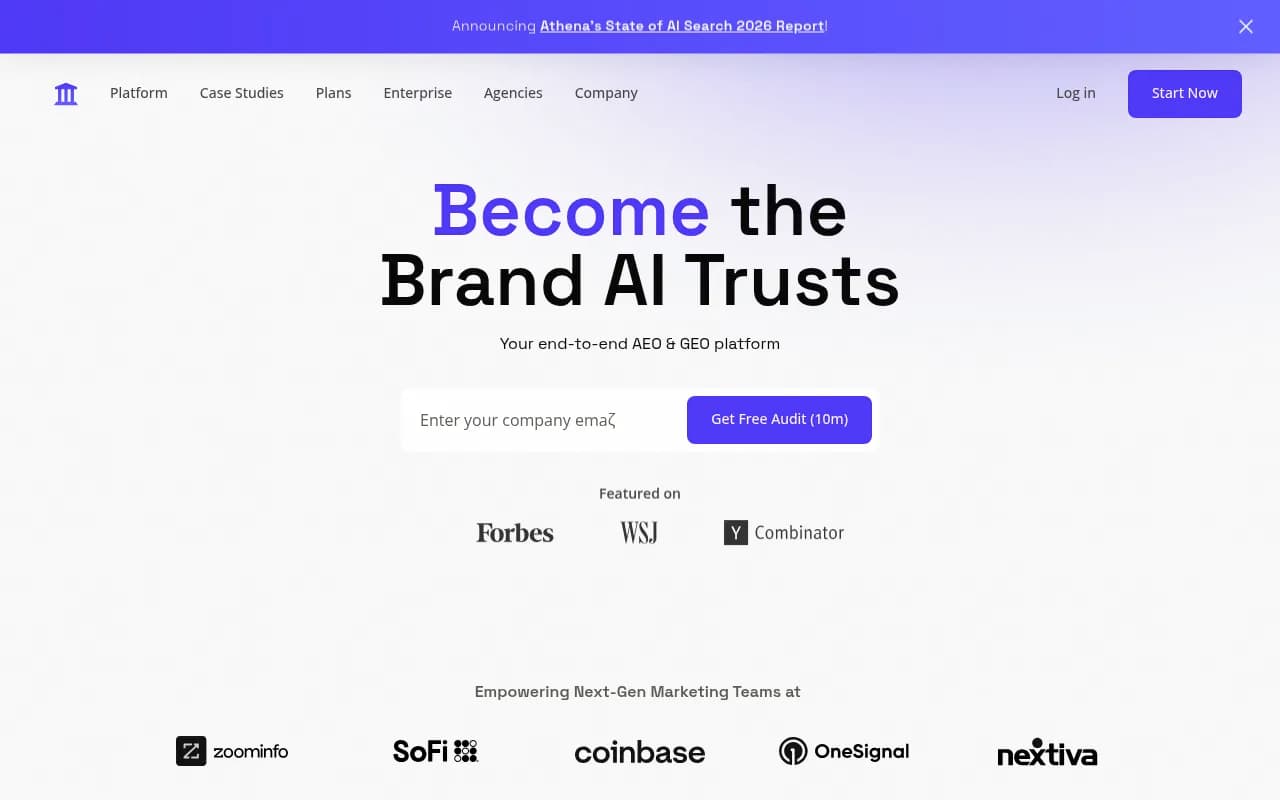
AthenaHQ does share-of-voice tracking well. If your primary use case is understanding how your brand stacks up against competitors across AI models -- and you want that presented in clean, reportable dashboards -- it delivers.
The limitation is the same one that affects most monitoring-focused tools: it shows you the problem but doesn't help you solve it. No content generation, no crawler logs, no traffic attribution. For teams that need to present AI visibility data to stakeholders and are handling optimization separately, it's a reasonable choice.
ZipTie -- best for deep citation and source analysis
ZipTie has built a reputation for unusually detailed citation analysis. It goes deeper than most tools on which sources AI models are pulling from, which can be genuinely valuable if you're trying to understand why a competitor keeps getting cited and you don't.
It's less polished than some alternatives and the content generation story isn't there, but for teams that want to do serious source-level research, it's worth a look.
Semrush AI Visibility Toolkit -- best for teams already in the Semrush ecosystem
If your team already lives in Semrush for SEO, the AI Visibility Toolkit is the path of least resistance. It integrates with your existing keyword and content workflows, and the learning curve is minimal.
The honest trade-off: Semrush uses fixed prompts rather than letting you define your own, which limits how precisely you can track your specific market. There's no AI traffic attribution, and the AI visibility features feel like an add-on to an SEO platform rather than a purpose-built GEO tool. Good enough for teams that want a single vendor; not the right choice if AI visibility is a primary focus.
Ahrefs Brand Radar -- best for Ahrefs users who want basic LLM tracking
Similar story to Semrush: if you're already paying for Ahrefs, Brand Radar gives you a starting point for AI visibility without adding another vendor. Fixed prompts, no AI traffic attribution, limited depth compared to dedicated GEO platforms. Fine as a first look; not a replacement for a purpose-built tool.
Rankscale -- worth watching
Rankscale is a newer entrant that's been getting attention for its scaling approach to prompt monitoring -- the idea being that you can track a much larger volume of prompts than most tools allow at a given price point. Still maturing in terms of features, but if prompt volume is your bottleneck, it's worth evaluating.
Writesonic -- best for content-first teams
Writesonic has evolved from a pure AI writing tool into something that combines AI visibility tracking with content creation. The integration is convenient if you want to spot gaps and publish quickly, though the tracking depth is lighter than dedicated GEO platforms.
Side-by-side comparison
| Tool | Prompt monitoring | Content generation | Crawler logs | Reddit/YouTube tracking | Traffic attribution | Starting price |
|---|---|---|---|---|---|---|
| Promptwatch | 10 models, custom prompts | Yes (built-in AI agent) | Yes | Yes | Yes | $99/mo |
| Sight AI | Multiple models | No | No | No | No | Varies |
| Profound | Multiple models, near real-time | No | No | No | No | Higher tier |
| Otterly.AI | Multiple models | No | No | No | No | Low |
| Peec AI | Multiple models, multi-language | Basic suggestions | No | No | No | Low |
| Scrunch | Multiple models | No | No | No | No | Mid |
| AthenaHQ | Multiple models | No | No | No | No | Mid |
| ZipTie | Multiple models | No | No | No | No | Mid |
| Semrush AI Toolkit | Fixed prompts | No | No | No | No | Bundled |
| Ahrefs Brand Radar | Fixed prompts | No | No | No | No | Bundled |
| Writesonic | Multiple models | Yes (writing tool) | No | No | No | Low-mid |
How to choose
The right tool depends almost entirely on what you're trying to do.
If you're in the "we need to understand what's happening" phase -- just starting to track AI visibility, no existing program -- Otterly.AI or Peec AI will get you moving without a big investment. Expect to outgrow them.
If you're in the "we know there's a problem and we need to fix it" phase -- you want to close content gaps, improve citation rates, and connect visibility to revenue -- you need a platform that goes beyond monitoring. Promptwatch is the clearest option here. The built-in content generation, crawler logs, and traffic attribution mean you're not stitching together four different tools to run a GEO program.
If you're an enterprise team with dedicated analysts who want raw data and API access, Profound is worth evaluating alongside Promptwatch.
If you're already deep in the Semrush or Ahrefs ecosystem and AI visibility is a secondary concern, the built-in tools are a reasonable starting point.
One question worth asking any vendor: "Show me how a user goes from discovering a content gap to publishing something that addresses it." The answer tells you a lot about whether the platform is built for action or just for reporting.
The bottom line
Sight AI is a reasonable starting point, but it's not where a serious GEO program ends up. The tools that matter in 2026 are the ones that help you move from "we can see the problem" to "we fixed the problem."
Most platforms in this space are still monitoring dashboards with a GEO label on them. Promptwatch is the clearest exception -- it's built around the full cycle of finding gaps, creating content, and tracking whether that content actually gets cited. For teams that need to show results, not just reports, that distinction matters.