Key takeaways
- LLMClicks is one of the few AI visibility tools that specifically flags hallucinated pricing and features -- but it's not the only option worth considering in 2026.
- Most AI visibility tools only count brand mentions. Very few detect when an AI model is actively lying about your product.
- The strongest alternatives go beyond monitoring: they help you find content gaps, generate AI-optimized content, and track which pages actually get cited.
- Pricing across the category ranges from free tiers to enterprise contracts, so there's a fit for most budgets.
- If you want a platform that covers the full loop -- detect gaps, create content, measure results -- Promptwatch is the most complete option available right now.
LLMClicks started from a real frustration. Its founder was watching ChatGPT tell prospects that his SaaS product cost $79/month when the actual price was $49. The tool was built specifically to catch that kind of problem: hallucinated pricing, invented integrations, features attributed to the wrong product.
That's a genuinely useful thing to track. But LLMClicks isn't the right fit for everyone. Maybe you need broader LLM coverage, deeper content optimization, agency-grade reporting, or just a different price point. Whatever the reason, there are strong alternatives in 2026 -- and a few of them do things LLMClicks simply can't.
Here's a practical breakdown of the best options.
What to look for in an LLMClicks alternative
Before jumping into the list, it's worth being clear about what actually matters here -- because the category is crowded with tools that look similar on a features page but behave very differently in practice.
The core question is: does the tool just monitor, or does it help you act?
Monitoring-only tools tell you that your brand appeared (or didn't appear) in an AI response. That's useful as a baseline. But if you can't figure out why you're invisible for certain prompts, and you have no way to fix it, you're just watching a scoreboard.
The better tools answer a different set of questions:
- Which prompts are competitors ranking for that you're not?
- When AI models mention your brand, is the information accurate?
- Which pages on your site are actually being cited, and which are being ignored?
- What content should you create to improve your AI visibility?
Keep those questions in mind as you read through the alternatives below.
The best LLMClicks alternatives in 2026
Promptwatch -- best for the full optimization loop
Promptwatch is the most complete AI visibility platform available right now. It monitors 10 AI models (ChatGPT, Claude, Perplexity, Gemini, Grok, DeepSeek, Copilot, Meta AI, Mistral, and Google AI Overviews), but the monitoring is almost the least interesting part.
What separates it from most competitors is the action loop it's built around. The Answer Gap Analysis shows you exactly which prompts your competitors are visible for that you're not -- not as a vague summary, but as specific questions and topics that AI models want to answer but can't find on your site. Then the built-in AI writing agent generates content designed to get cited, grounded in 880M+ citations analyzed across real AI responses. Then page-level tracking shows whether that content is working.
It also has AI crawler logs -- real-time records of when ChatGPT, Claude, Perplexity, and others crawl your site, which pages they read, and what errors they hit. Most competitors don't have this at all. Reddit and YouTube tracking surfaces the discussions that actually influence AI recommendations. And ChatGPT Shopping tracking monitors when your brand appears in product recommendation carousels.
Pricing starts at $99/month for the Essential plan (1 site, 50 prompts, 5 articles), $249/month for Professional (2 sites, 150 prompts, crawler logs), and $579/month for Business (5 sites, 350 prompts). Free trial available.

Profound -- best for enterprise citation analysis
Profound is one of the more established names in this space, and it earns its reputation for deep citation and source-level insight. If you need to understand not just whether your brand is mentioned but where AI models are pulling their information from -- which domains, which pages, which third-party sources -- Profound does that well.
It's primarily used by enterprise marketing and SEO teams that need granular data and are willing to pay for it. The tradeoff is that it's monitoring-focused. You get excellent visibility into what's happening, but less help figuring out what to do about it.
Otterly.AI -- best for lightweight monitoring on a budget
Otterly.AI is the most affordable serious option in the category. It's designed for teams that want to track brand mentions across AI models without a large budget or a complex setup. You can get alerts when your brand appears (or disappears) in AI responses, track sentiment, and monitor a handful of competitors.
It doesn't have content generation, crawler logs, or deep gap analysis. But if your main need is "tell me when something changes," Otterly.AI handles that cleanly and cheaply.

Peec AI -- best for multi-language tracking
Peec AI has carved out a niche in multi-language AI visibility monitoring. If your brand operates across multiple markets and you need to track how AI models respond to queries in French, German, Spanish, or other languages, Peec AI handles that better than most tools in the category.
It also offers smart suggestions for improving visibility, which puts it a step above pure monitoring tools. The suggestions aren't as deep as a full content generation workflow, but they give you a starting point.

Athena HQ -- best for tracking visibility across 8+ AI models
Athena HQ covers a broad range of AI search engines -- 8+ at last count -- and presents the data in a clean, accessible dashboard. It's a solid monitoring platform for teams that want breadth of coverage without complexity.
The limitation is that it's primarily a tracker. It shows you where you stand but doesn't have the content optimization or gap analysis features that would help you improve your position.
ZipTie -- best for deep reporting and analysis
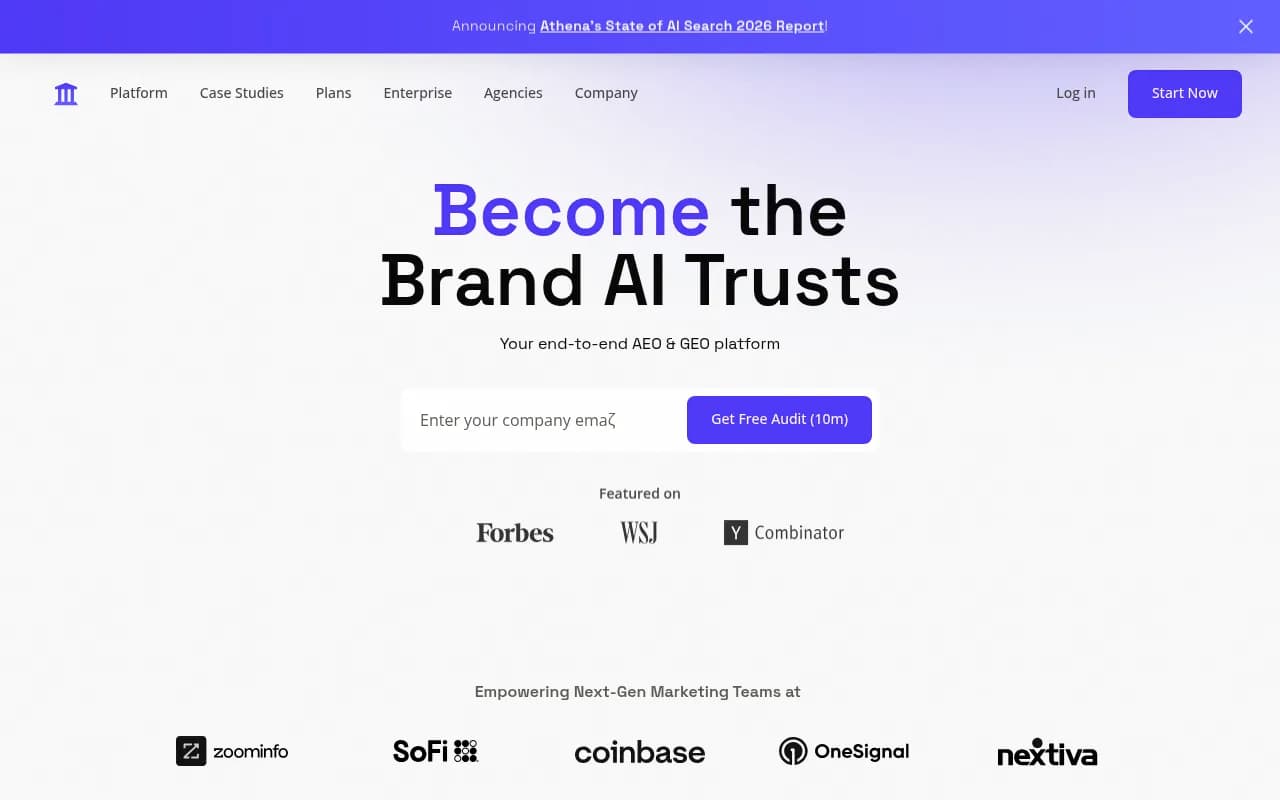
ZipTie is built for teams that need to go deep on AI search data. It's particularly strong on reporting -- if you need to present AI visibility data to stakeholders or clients, ZipTie's output is polished and detailed.
It covers citation analysis, competitor comparisons, and trend tracking over time. Less focused on content creation, but the analysis layer is genuinely strong.
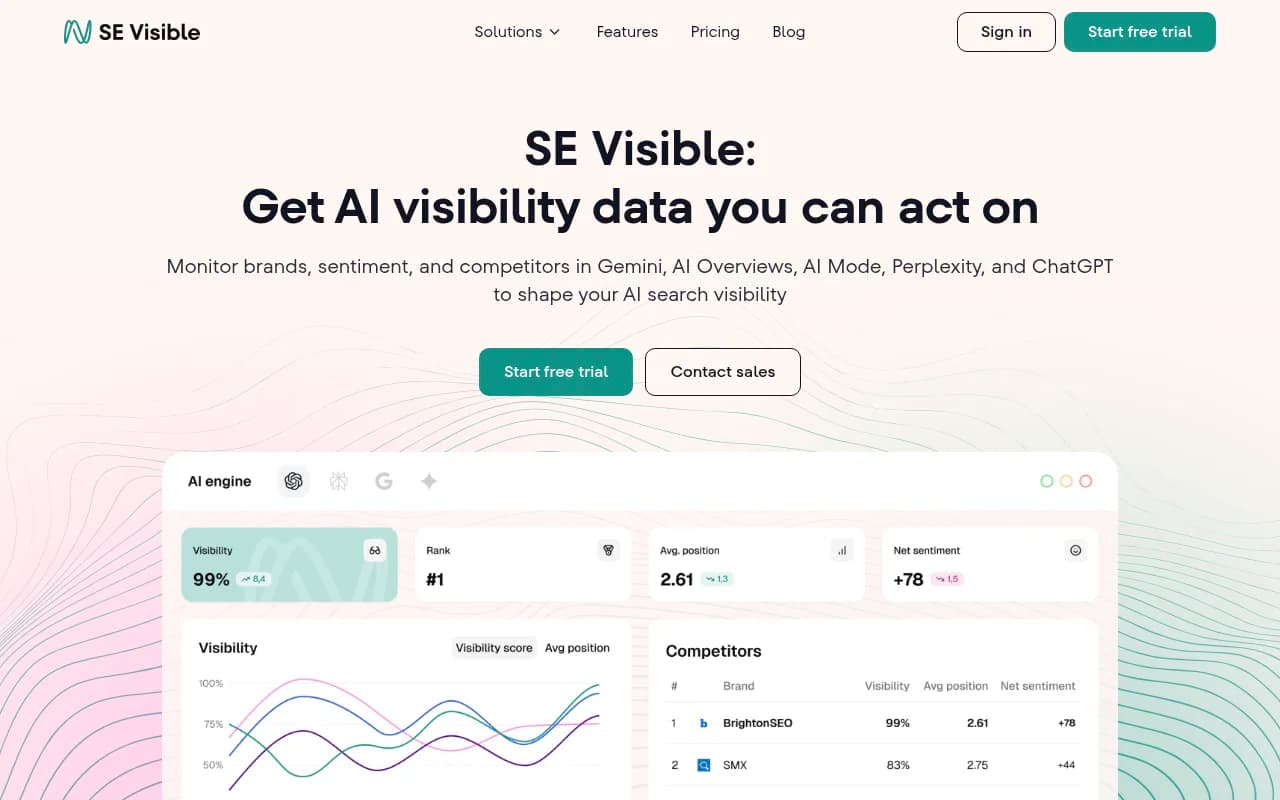
SE Visible -- best for combining traditional SEO and AI visibility
SE Visible (from SE Ranking) is a good option if you're already using SE Ranking for traditional SEO and want to add AI visibility tracking without switching platforms. It tracks brand mentions and sentiment across AI search engines and integrates with SE Ranking's existing keyword and ranking data.
The combined view -- traditional search rankings alongside AI visibility -- is useful for teams trying to understand how their SEO and GEO efforts interact.
Scrunch AI -- best for monitoring and optimization in one
Scrunch AI sits in the middle ground between pure monitoring and full optimization. It tracks how AI assistants like ChatGPT and Claude describe your brand, flags inaccuracies, and offers some optimization guidance. It's a reasonable step up from tools like Otterly.AI without going all the way to enterprise pricing.
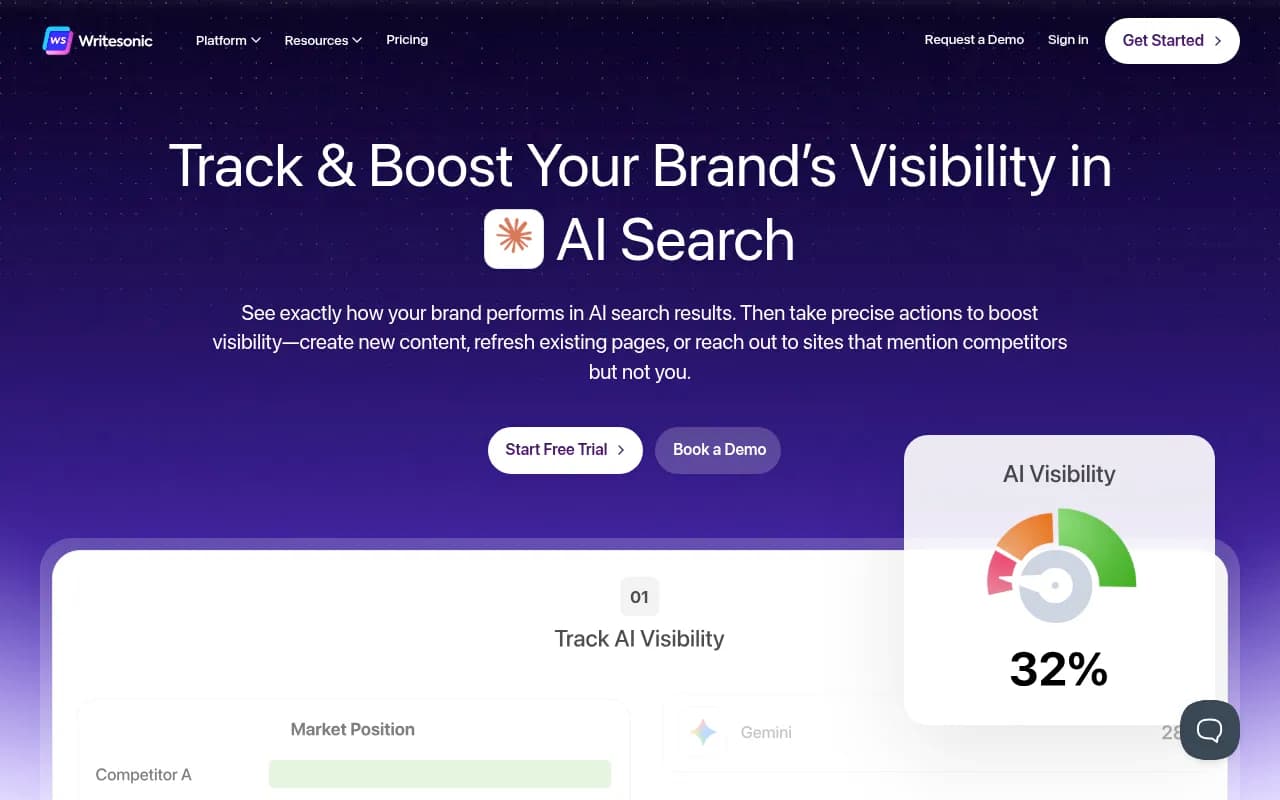
Writesonic -- best for teams that want AI writing built in
Writesonic has expanded from AI writing tool into an AI search visibility platform. If your team already uses Writesonic for content creation, the AI visibility features are a natural extension. It tracks, optimizes, and helps you create content -- though the visibility tracking is less specialized than dedicated GEO tools.
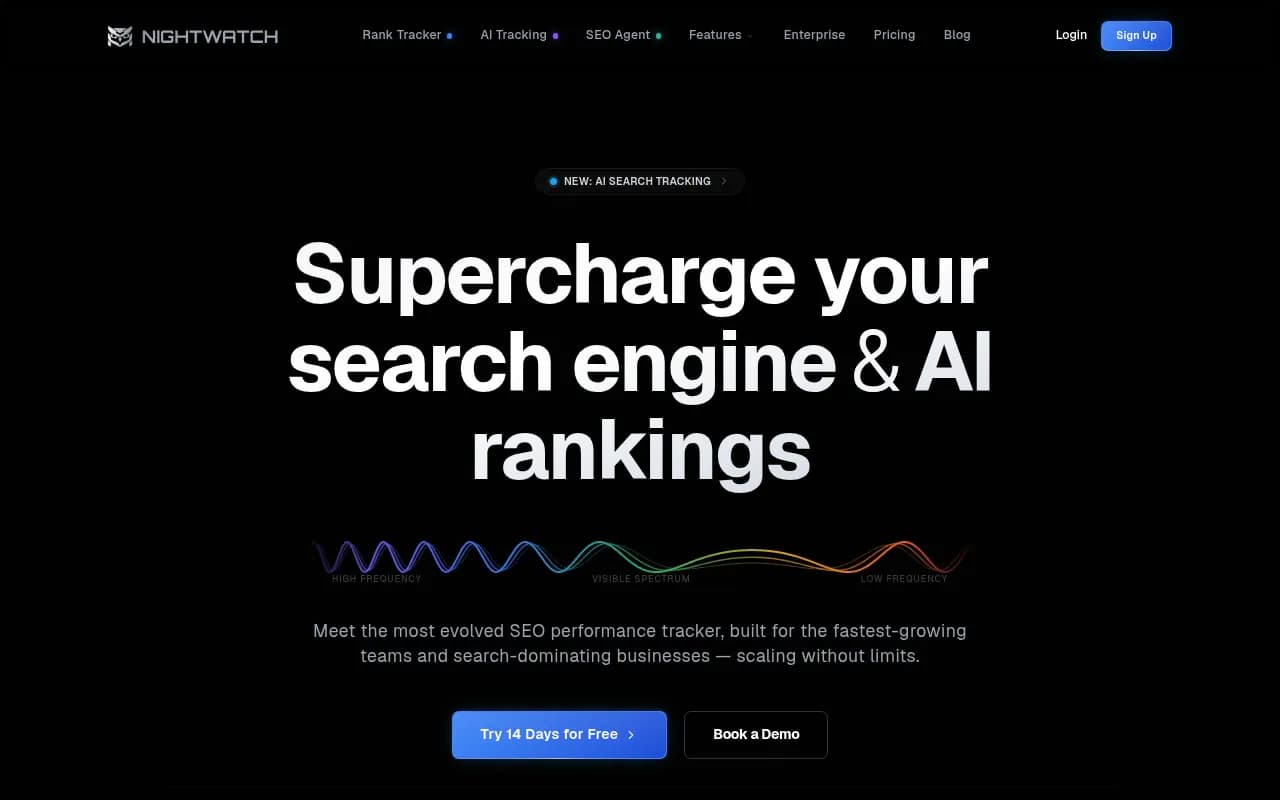
Nightwatch -- best for search monitoring with AI coverage
Nightwatch is primarily a rank tracking tool that has added AI search monitoring. If you need solid traditional rank tracking alongside basic AI visibility data, it's an efficient two-for-one. The AI monitoring features are less deep than dedicated GEO platforms, but for smaller teams that don't need enterprise-grade GEO, it covers the basics.
How these tools compare
Here's a side-by-side look at the key dimensions that matter when choosing an LLMClicks alternative:
| Tool | Hallucination detection | Content generation | Crawler logs | Multi-LLM coverage | Starting price |
|---|---|---|---|---|---|
| LLMClicks | Yes (core feature) | No | No | Limited | ~$49/mo |
| Promptwatch | Via Answer Gap Analysis | Yes (built-in AI writer) | Yes | 10 models | $99/mo |
| Profound | Partial (citation accuracy) | No | No | Multiple | Enterprise |
| Otterly.AI | No | No | No | Multiple | ~$29/mo |
| Peec AI | No | Suggestions only | No | Multiple | ~$49/mo |
| Athena HQ | No | No | No | 8+ models | ~$99/mo |
| ZipTie | No | No | No | Multiple | Custom |
| SE Visible | No | No | No | Multiple | ~$39/mo |
| Scrunch AI | Partial | Partial | No | Multiple | ~$79/mo |
| Writesonic | No | Yes (AI writing) | No | Multiple | ~$49/mo |
| Nightwatch | No | No | No | Limited | ~$39/mo |
A few things stand out from this table. First, hallucination detection is genuinely rare. LLMClicks built its identity around it, and most competitors simply don't offer it. Promptwatch approaches the problem differently -- through Answer Gap Analysis and citation accuracy tracking -- but the explicit "is this AI response factually wrong about my product?" check is something LLMClicks does that few others match.
Second, content generation is the biggest differentiator between monitoring tools and optimization platforms. Most tools on this list stop at data. Promptwatch and Writesonic are the main exceptions.
Third, crawler logs are almost nonexistent outside of Promptwatch. This is a meaningful gap -- knowing that an AI model crawled your site but couldn't find the right information is actionable in a way that pure mention tracking isn't.
Which tool should you actually use?
It depends on what problem you're trying to solve.
If hallucination detection is your primary concern -- you've had specific incidents where AI models gave wrong pricing, invented features, or confused you with a competitor -- LLMClicks is built for exactly that. It's worth keeping on your radar even as you evaluate alternatives.
If you want to go beyond monitoring and actually improve your AI visibility, Promptwatch is the most complete option. The combination of gap analysis, AI content generation, crawler logs, and page-level citation tracking covers the full cycle. Most other tools show you the problem; Promptwatch helps you fix it.
If budget is the main constraint, Otterly.AI gives you solid basic monitoring at a low price point. SE Visible is worth considering if you're already in the SE Ranking ecosystem.
If you're an agency managing multiple clients, Promptwatch's agency/enterprise tier and Profound's reporting depth are both worth evaluating. ZipTie's reporting output is also strong for client-facing work.
For multi-language needs, Peec AI is the clearest choice.
The bigger picture: why accuracy matters more than mentions
The LLMClicks origin story is worth taking seriously. Most teams celebrate when they see their brand mentioned in AI responses. But a mention isn't always a good thing -- not if the AI is telling users your product does something it doesn't, or that your pricing is double what it actually is.
The broader AI visibility category is still maturing. A lot of tools launched in 2024 and 2025 with dashboards that count mentions and call it "GEO." The more useful question is: what are AI models actually saying about you, is it accurate, and what can you do to influence it?
That's a harder problem to solve, and it's why the gap between monitoring-only tools and optimization platforms is so significant. Tracking your visibility score going up is satisfying. Understanding why it went up -- which content got cited, which prompts you captured, which competitor you displaced -- is what turns AI visibility into a business outcome.
The tools that help you close that loop are the ones worth investing in.