Key takeaways
- Industrial buyers research suppliers in ChatGPT, Perplexity, and Google AI Overviews, so a GEO tool needs to show which of your pages get cited, not just whether your name appears.
- Product and landing pages earn about 39% of ChatGPT citations (Promptwatch Data, Sep 28 to Oct 4, 2026), which favors manufacturers with complete spec pages.
- For long buying cycles, prioritize tools with AI crawler logs, citation tracking, and content gap analysis over pure mention counters.
- Most vendor-authored agency rankings are self-promotional. Software gives you the measurement; decide on an agency separately.
- Start with a short prompt set built around real RFQ language (materials, tolerances, certifications), then expand.
Why manufacturers need different GEO tooling
Most GEO tool reviews are written for SaaS companies. A SaaS buyer asks "best project management tool for startups." A manufacturing buyer asks something like "ISO 9001 certified CNC machining suppliers for aerospace titanium parts" or "compare PTFE vs PEEK seals for high-temperature pumps." Those prompts are long, technical, and often return citations from distributor catalogs, standards bodies, datasheets, and trade publications rather than blog posts.
That changes what you need from a tool. A few specifics:
- Your buyers span engineering, procurement, operations, and executives. One company might be researched by 13 stakeholders, according to a figure cited by The ABM Agency's industrial report (a vendor-authored piece, so treat it as directional). Each stakeholder asks different questions.
- Your best content is often a PDF datasheet, a CAD library page, or a spec table. Whether AI crawlers can actually read those files matters more than your blog output.
- Many industrial sites are old, heavy on JavaScript catalogs, or sit behind CDNs that block unknown bots. Visibility problems are frequently access problems.
- Your sales cycle is long. You need to measure RFQs and qualified inquiries from AI traffic, not vanity rankings.
One caution on the stats you will see floating around. Claims like "73% of B2B buyers use AI tools" or "300% more leads in 90 days" come from agency marketing pages. I would not put them in a board deck. The direction is clear, the precise numbers are not.
What the citation data says about industrial content
I could not find a Promptwatch report specific to manufacturing, so the closest evidence is general. It is still useful.
According to Promptwatch Data on ChatGPT citation share by content type (Sep 28 to Oct 4, 2026), product pages are the most cited type at 22.4% of classified citations, with landing pages at 16.8%. Together that is roughly 39% of citations going to pages describing what a company sells. For commercial prompts ("best X for..."), product pages hit 26.0% and landing pages 20.6%.
For a manufacturer, that is good news. You already have product pages. The question is whether they are complete: specs, materials, tolerances, certifications, lead times, and pricing context where possible. Thin category pages with a "contact us" button are the weak spot.
A second finding matters for planning. In Promptwatch's content half-life report, pages first cited on July 6, 2026 were tracked for 90 days. After 30 days ChatGPT still cited 78% of landing pages and 76% of docs. News pages lost half their number within 36 days. So technical documentation, application notes, and comparison pages are long-lived assets, while press releases give short bursts.
The software report is the nearest sector analogue if you sell MES, ERP, CAD, or PLM tools. In Promptwatch's software citation data, GitHub, Microsoft's docs, and G2 lead, and documentation and help centers earn the largest share. Review sites and analysts (G2, Gartner, Capterra, Software Advice) together earn 1.57%, more than any single vendor. If you sell industrial software, your G2 and Capterra presence is part of your GEO strategy.
What to look for in a GEO tool as a manufacturer
Before comparing products, decide which of these you actually need.
Citation and source tracking
Mentions alone are not enough. You want to see which URLs are cited, which third-party domains (distributors, directories, trade media) AI relies on instead of you, and where you sit in the source list. Industrial categories often have a few dominant marketplaces. If Thomasnet-style directories or distributor sites get cited for your category, you need to know that.
AI crawler visibility
This is the feature most manufacturers underrate. If GPTBot or PerplexityBot cannot fetch your spec pages, no amount of content work helps. Look for IP-verified logs, per-page crawl errors, and a link between crawling and citation. Few monitoring-only tools offer this.
Prompt tracking that handles technical queries
You want custom prompts in the language of your buyers, personas (engineer versus procurement), multiple countries and languages (many manufacturers export), and query fan-out data showing what AI actually searches for behind the scenes.
Content gap analysis and execution
After you find gaps, someone has to write the application note or the comparison page. Tools that stop at dashboards leave that to you. Others generate and publish content to your CMS.
Traffic and conversion attribution
If your sales process runs through RFQ forms, you want AI-referred visits tied to those conversions. Note that ChatGPT stopped sending a referrer on October 8, 2026, so tools need a UTM-based workaround to count that traffic.
Best GEO tools for manufacturing in 2026
Promptwatch
Promptwatch is the option I would put first for manufacturers who want to act on the data, not just watch it. It monitors the real interfaces of ChatGPT, Gemini, Perplexity, Google AI Overviews, Google AI Mode, Copilot, and others, then traces citations back to your pages and third-party sources. The part that matters for industrial sites is AI crawler logs: IP-verified records of which bots read which pages and where they fail, so you can tell a blocked datasheet from a weak one.

On the action side, content gap analysis maps your pages against the prompts AI answers, and the Content Agent can write and publish to WordPress, Webflow, or Framer, which covers most manufacturer sites. Brand Narrative shows the individual claims AI makes about you (for example "slow lead times"), and Fact Check, on Business and above, finds the page teaching AI the wrong thing. Local GEO targeting at exact coordinates helps regional distributors and service centers.
Pricing, per promptwatch.com/pricing: Essential $95/mo (50 prompts), Professional $245/mo (150 prompts, crawler logs), Business $579/mo (350 prompts, Content Agent, Fact Check, state/city tracking). There is a 7-day free trial on monthly billing, and a free AI visibility report if you want a baseline first. Most manufacturers with real content needs will land on Professional or Business, since Essential has no crawler logs.
Head-to-head pages exist if you are comparing, such as Promptwatch vs Profound and Promptwatch vs Peec.
Profound and Scrunch
Both are strong enterprise monitoring platforms with deep reporting.

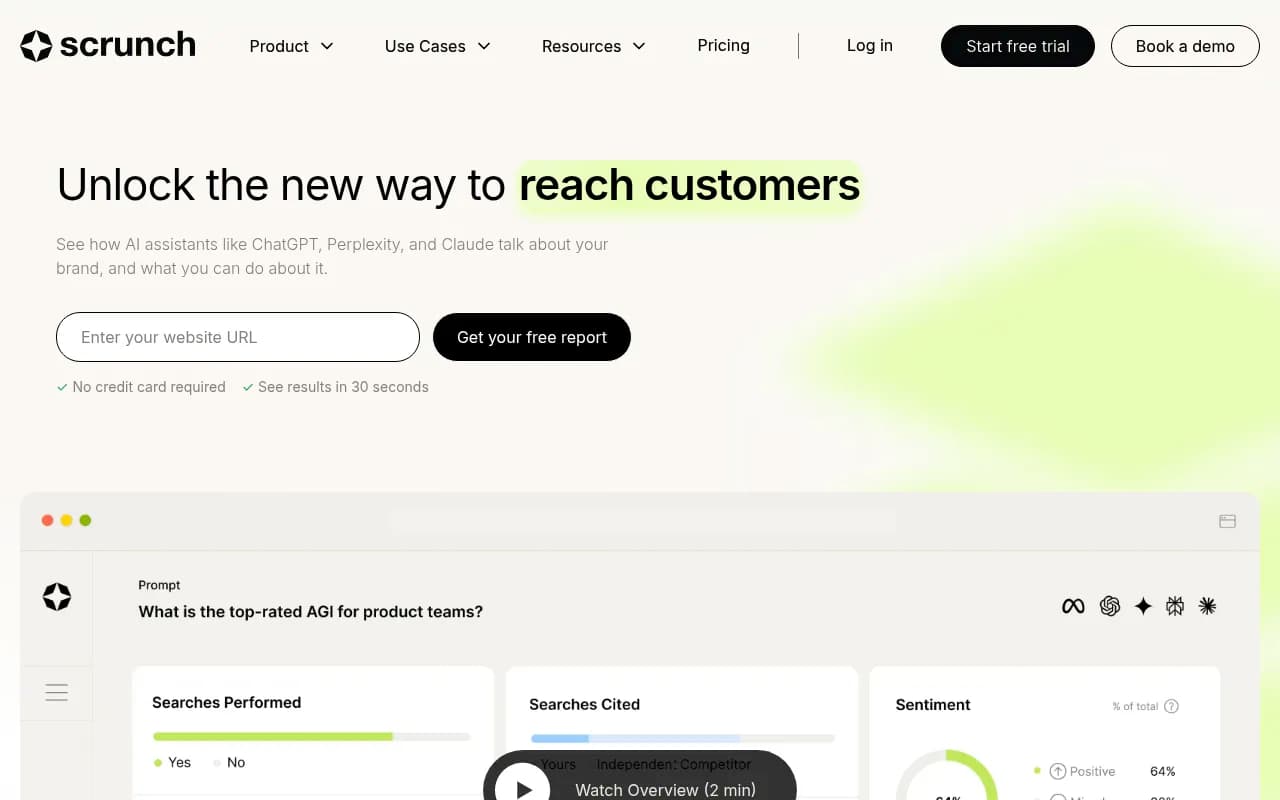
They suit large manufacturers with a dedicated analyst who will interpret dashboards. The trade-offs are higher price points and less emphasis on doing the content work for you.
Otterly.AI and Peec AI


These are basic prompt trackers, and cheap ones. Reasonable if you only want to know whether your brand shows up for 20 or 30 key prompts. They will not tell you why a datasheet is ignored or whether a crawler is blocked.
AthenaHQ, Qwairy, and LLM Pulse
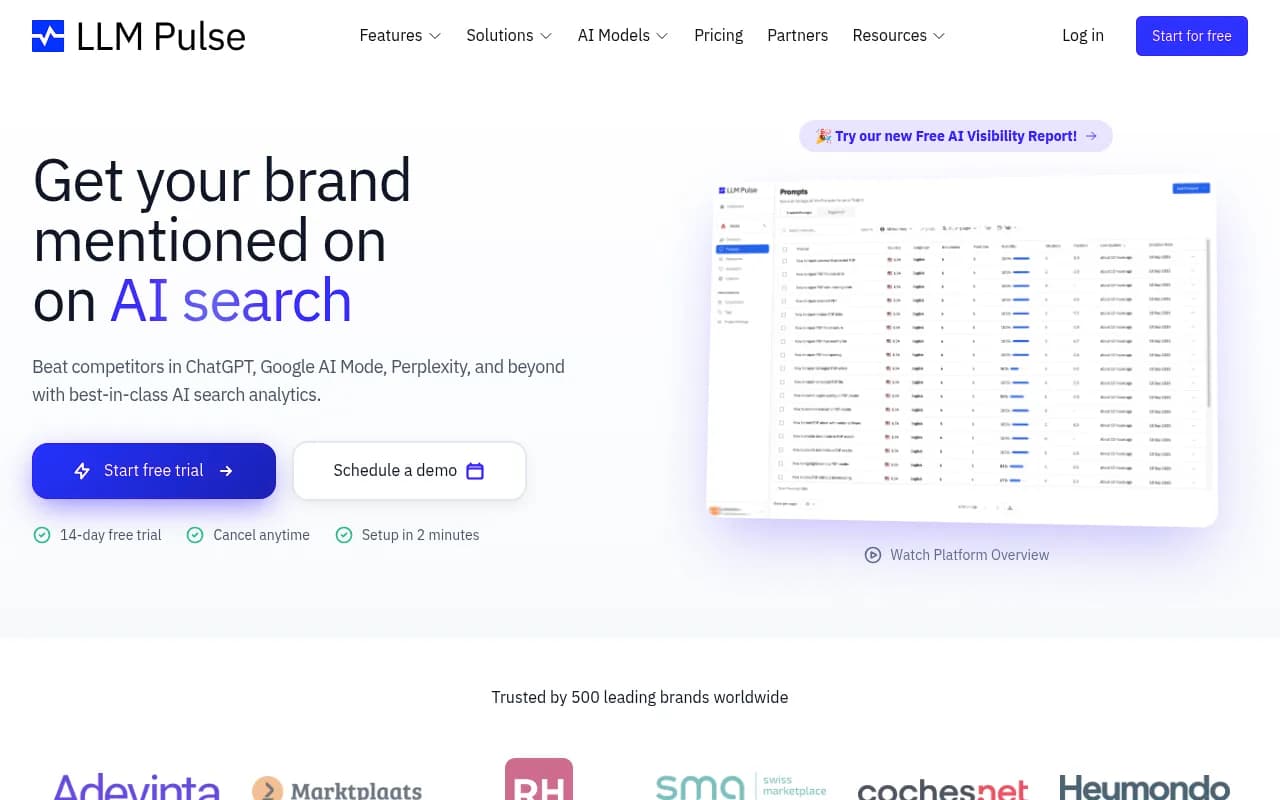
Monitoring-focused platforms with decent engine coverage. Fine for a marketing team that already has a content process and just needs measurement.
Enterprise SEO suites with AI add-ons
If you already pay for a suite, check what the AI module covers before buying something new.
Semrush and Ahrefs Brand Radar are the usual starting points for teams on those platforms, though fixed prompt sets limit depth. Botify, seoClarity, and BrightEdge are built for large catalog sites and can be a sensible fit for manufacturers with tens of thousands of SKU pages, mostly for the technical side.
Content and workflow tools
Gushwork
AirOps is a workflow builder for content. Gushwork pitches itself at B2B lead generation with large numbers of pages. Both need an external source of truth about what AI cites, which is why they pair better with a visibility platform than they stand alone.
Comparison table
| Tool | Type | Crawler logs | Content creation | Best for |
|---|---|---|---|---|
| Promptwatch | End-to-end GEO platform | Yes (Professional and up) | Yes (Business) | Manufacturers that want to find and fix gaps |
| Profound | Enterprise monitoring | Limited | No agentic execution | Large teams with analysts |
| Scrunch | Monitoring and optimization | Limited | Limited | Enterprise brand teams |
| Otterly.AI | Prompt tracker | No | No | Small budget baselines |
| Peec AI | Prompt tracker | No | No | Simple monitoring |
| Semrush / Ahrefs Brand Radar | SEO suite add-on | No | Suite writing tools | Teams already on those suites |
| Botify / seoClarity / BrightEdge | Enterprise SEO | Log analysis (SEO bots) | Varies | Huge catalog sites |
| AirOps / Gushwork | Content workflow | No | Yes | Scaling production |
Feature details change quickly, so confirm on each vendor's site before buying.
Do you need a GEO agency instead?
The research for this guide turned up many agency rankings aimed at manufacturers: The ABM Agency, First Page Sage, Gorilla 76, TREW Marketing, ScaleTheory, Qoulomb, and others. Nearly every one of those lists is written by an agency that ranks itself or a partner highly. One list puts the publisher at number one; another puts its own firm first. Read them as sales pages.
That said, some claims in them are specific and checkable, such as case-study numbers (Qoulomb reports growing Zetwerk's monthly AI referral sessions from 267 to 6,187 in nine months). Ask any agency for the same: a named client in your sub-industry, a before-and-after metric, and how they track RFQs rather than rankings.
If you want an agency that does technical SEO, content, and GEO together, 1001 SEO Media is one option; it uses Promptwatch for AI visibility measurement and works without long-term contracts. Whichever route you choose, insist on access to the underlying data.
A practical rollout for a manufacturer
Week 1: build a realistic prompt set
Interview two salespeople and one applications engineer. Write down the questions buyers ask before sending an RFQ. Aim for 40 to 60 prompts across these groups:
- Category discovery ("best suppliers of X")
- Specification and comparison ("X vs Y for application Z")
- Compliance ("ISO 13485 certified contract manufacturers")
- Branded and competitor prompts
Tag them by buyer persona and country. Use the ChatGPT query fan-out generator to see what AI is likely to search behind each prompt.
Week 2: check access
Run the free Agentic Readiness Check and review your robots.txt against the AI bots directory. Many manufacturers discover a CDN or security plugin blocking AI crawlers. Fix that first. Also confirm datasheets are crawlable and not only reachable through a login or JavaScript-only viewer.
Weeks 3 to 6: fill the page gaps
Prioritize in this order:
- Product pages with complete specs, materials, standards, and certifications
- Comparison pages (material A vs B, process X vs Y)
- Public documentation, application notes, and FAQ pages
- Landing pages for each industry and application you serve
The half-life data suggests these will keep earning citations for months, so the effort compounds.
Weeks 6 to 12: widen your third-party footprint
AI often cites directories, review sites, and trade publications for supplier questions. Get listed accurately on the ones that appear in your citation reports, and collect reviews where they count. For software vendors, that means G2 and Capterra.
Ongoing: measure what matters
Track citations per page, crawl-to-citation rate, and AI-referred visits that become RFQs. Set up a UTM convention for any links you control, since referrers are unreliable. Read the guide on attributing AI traffic if you need a method.
Common mistakes
- Tracking only your brand name. Industrial buyers rarely ask for you by name early on.
- Counting mentions as success when competitors get the cited links.
- Publishing generic blog posts when the gap is a missing spec page.
- Ignoring non-English markets if you export.
- Buying a monitoring tool and assuming the dashboard is the strategy.
How to choose
If you have a small team and a catalog of specification-heavy pages, you need diagnosis plus execution: crawler access, citation tracing, and a way to produce missing pages. That points to a platform like Promptwatch. If you only need a quarterly health check, a cheap tracker like Otterly.AI is enough. If you are a global manufacturer with an enterprise SEO stack, test the AI modules from Botify, seoClarity, or BrightEdge alongside a dedicated GEO platform.
For wider lists, the GEO software directory covers more options by category. And run any shortlisted tool against the same 50 prompts for a week; the differences in citation detail show up fast.