Key takeaways
- Security buyers research vendors in ChatGPT, Perplexity, and Google AI answers before they talk to sales. A GEO tool tells you whether your product appears in those answers and what to fix.
- Monitoring alone is not enough. Look for tools that show which pages AI crawls and cites, and that help you act on gaps.
- Most "best GEO tools for cybersecurity" lists online are written by vendors who rank themselves first. Treat them as one input, not a verdict.
- Promptwatch's data shows product pages, landing pages, docs, and listicles drive most ChatGPT citations in software categories, so your tool choice should map to those content types.
- Agencies and tools solve different problems. Pick software for measurement and execution, an agency for strategy and digital PR capacity.
Why cybersecurity companies need a GEO tool
Imagine a CISO typing "best SIEM for a mid-market company moving to Azure with SOC 2 requirements" into Perplexity. The answer names four or five vendors. If you are not one of them, you were never on the shortlist, and no one will tell you.
That is the problem GEO (generative engine optimization) tools exist to solve. They run prompts across AI engines, record which brands get named and which pages get cited, and in the better cases tell you what to change.
Cybersecurity is a particularly sharp case for a few reasons:
- Buyers are technical and skeptical, and they use AI for early vendor discovery and comparison.
- Categories are crowded (EDR, SIEM, IAM, zero trust, CNAPP) and AI answers compress them into short lists.
- Claims need to be accurate. A wrong statement about a CVE, a compliance framework, or your own product capabilities in an AI answer is worse than silence.
- Your best content is often technical documentation, research posts, and threat reports that AI crawlers may or may not be able to read.
Vendor-published stats claim that around 94% of B2B buyers use LLMs somewhere in their buying journey (a 6sense figure cited by GrackerAI). I would treat the exact number cautiously, but the direction matches what security marketers report.
What the data says about where AI looks
Before picking a tool, it helps to know what you are optimizing for. There is no cybersecurity-specific citation report yet, but Promptwatch Data's software citation report (Sep 28 to Oct 4, 2026) is the closest category.
In that period, the most cited domains for organic software prompts in ChatGPT were:
| Domain | Share of software citations |
|---|---|
| github.com | 1.2% |
| learn.microsoft.com | 0.98% |
| g2.com | 0.73% |
| docs.aws.amazon.com | 0.41% |
| docs.cloud.google.com | 0.35% |
| gartner.com | 0.34% |
| capterra.com | 0.32% |
By source type, docs and help centers (2.64%) and vendor sites (2.01%) beat review sites and analysts (1.57%). Vendor pages plus docs earn roughly three times the share of review sites. In plain terms: your own documentation matters more than most security marketers assume.
Content type matters too. In Promptwatch's content type report for the same week, product pages made up 22.4% of ChatGPT citations, landing pages 16.8%, listicles 13.6%, how-to guides 8.7%, and documentation 7.5%. For commercial prompts (people comparing options), product pages, landing pages, listicles, and comparisons add up to almost 70% of citations.
And freshness decays at different speeds. According to Promptwatch's content half-life research, news pages lose half their citations within about five weeks, while landing pages and docs hold on for months. For a security vendor that publishes lots of threat news, that is a reason to invest in evergreen product and docs pages as well.
What to look for in a GEO tool as a security vendor
A checklist I would actually use:
- Real AI interface coverage. Answers in the ChatGPT or AI Overviews UI can differ from API outputs. Ask how the vendor collects data.
- Custom prompts. Security buying prompts are specific ("CNAPP for multi-cloud with agentless scanning"). A fixed generic prompt set will miss them.
- Citation and source analysis. You need to see which pages, review sites, Reddit threads, and analyst pieces AI pulls from.
- AI crawler visibility. Can GPTBot, ClaudeBot, and PerplexityBot read your docs, or does a WAF or bot rule block them? Security vendors often run aggressive bot protection, so this one bites more than usual.
- Action layer. Content gap analysis, briefs, drafts, or CMS publishing, so findings turn into work.
- Traffic attribution. Do AI visits turn into demos and pipeline?
- Reporting and security posture. Enterprise teams should confirm SOC 2 documentation, SSO, and data handling, which is only fair for a company that sells security itself.
The main GEO tools worth shortlisting
Promptwatch
Promptwatch is the platform I would start with for most security teams that want to move from watching to fixing. It tracks real UIs for ChatGPT, Google AI Overviews, AI Mode, Gemini, Perplexity, Copilot, and others, with prompt volumes, difficulty scores, and query fan-outs so you can see what AI actually searches for when answering a buyer question.
Two things matter specifically for security vendors. First, IP-verified AI crawler logs show whether AI bots reach your docs and product pages, or hit errors because of bot protection. Second, the Action Board, content gap analysis, and Content Agent turn gaps into drafted and published content (Webflow, Framer, WordPress), then track whether each page gets crawled, cited, and clicked. Tracking also covers Reddit, YouTube, and LinkedIn citations, which matter when practitioners discuss tools in public threads.
Pricing starts free (Explore, ChatGPT only), then $95/month for Essential, $245 for Professional, and $579 for Business. Confirm current numbers at promptwatch.com/pricing.

GrackerAI
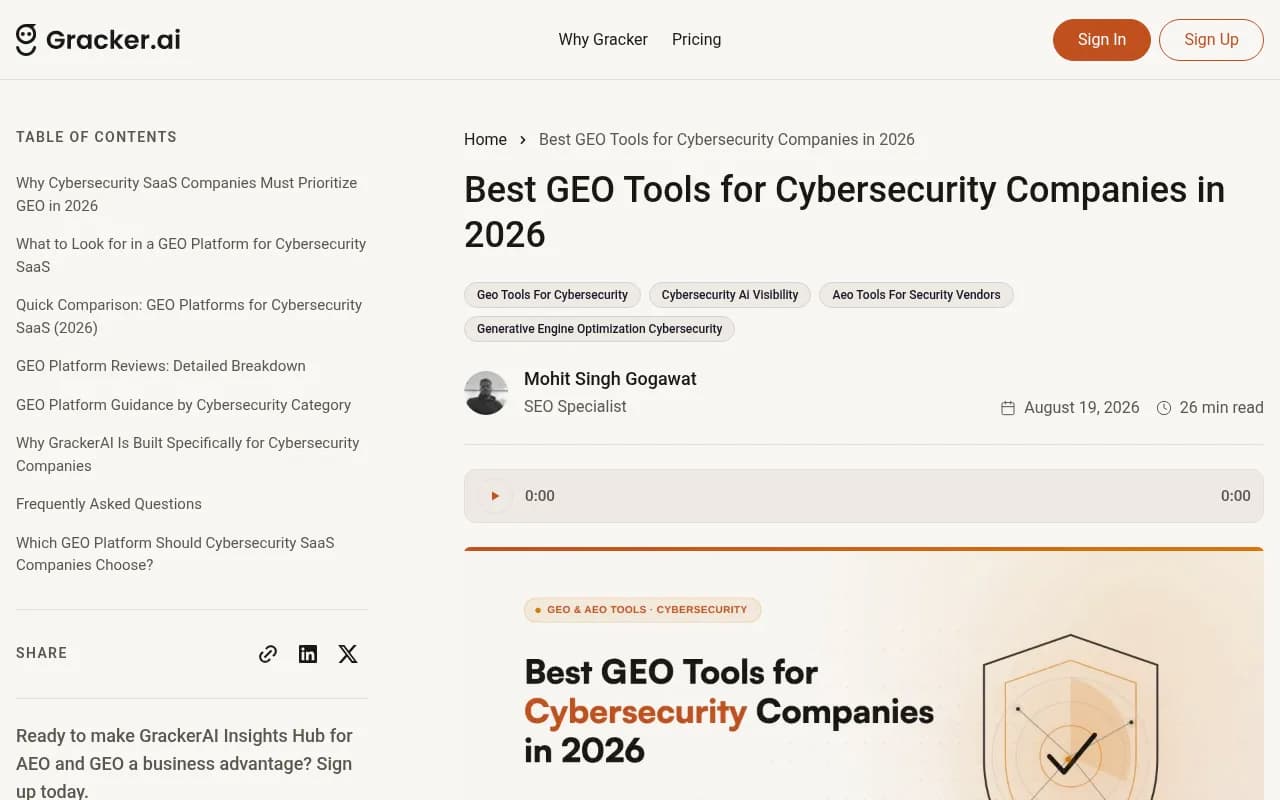
GrackerAI positions itself as a GEO platform built for B2B SaaS and cybersecurity. Its pitch is a prompt library tied to security standards (CVE, CWE, ATT&CK, CAPEC, D3FEND), content generation for topics like IAM, zero trust, and SIEM, and monitoring across up to 10 AI engines. Starter was listed around $99/month, with a 7-day trial. That vertical focus is a real differentiator if you want pre-built security prompts.
One caution: nearly every ranking that puts it first was written by GrackerAI or by authors favoring it, including its own blog. I could not verify its pricing independently, so run a trial before committing. It is not in our catalog, so check its site directly.
Profound
Profound is the usual enterprise name in these comparisons. It is a strong monitoring product with analytics depth, and it suits large security vendors with a data team that wants to dig into the numbers. The tradeoffs are a higher price point and less emphasis on execution and crawler-level diagnostics.

Scrunch
Scrunch monitors and optimizes how AI assistants describe your brand, with a focus on enterprise brand teams.

Otterly.AI and Peec AI
Both are lighter, cheaper trackers. They are good for a small security startup that wants a simple answer to "are we mentioned?" but they do not tell you why or help fix it.


AthenaHQ
AthenaHQ tracks visibility across eight or more AI engines and suits teams that want monitoring plus recommendations.
BrandViz.AI and Siftly
Both are newer platforms aimed at B2B SaaS teams, which overlaps with most security vendors. They are worth a look if you want a B2B-specific angle, though I would test them against your own prompts before trusting them.


Semrush and Ahrefs Brand Radar
If your team already lives in a traditional SEO suite, these add AI tracking to a familiar workflow. The data is shallower and the prompt sets are less flexible than in dedicated platforms, but the convenience is real.

Comparison table
| Tool | Best for | Strength | Watch out for |
|---|---|---|---|
| Promptwatch | Teams that want to track and fix | Crawler logs, content gap analysis, Content Agent, AI traffic attribution | More features than a small team may need |
| GrackerAI | Security-specific prompts and content | Cybersecurity prompt library | Mostly self-published reviews, unverified pricing |
| Profound | Large enterprises | Deep monitoring analytics | Higher price, monitoring-first |
| Scrunch | Enterprise brand teams | Brand narrative control | Less focus on execution |
| Otterly.AI | Small teams on a budget | Simple, affordable tracking | No crawler or traffic data |
| Peec AI | Basic monitoring | Easy setup | Monitoring without optimization |
| AthenaHQ | Mid-size teams | Multi-engine coverage | Narrower action layer |
| Semrush / Ahrefs Brand Radar | Existing suite users | Familiar workflow | Shallower AI data |
For wider lists, the GEO software directory at bestgeosoftware.com covers many more options.
How to use a GEO tool once you have one
Buying software is the easy part. This is the workflow I would run in the first month.
1. Build a prompt set around buyer intent
Map prompts to the stages of a security purchase. Include category prompts ("best EDR for healthcare"), comparison prompts ("CrowdStrike vs SentinelOne alternatives"), use-case prompts ("how to meet NIS2 logging requirements"), and branded prompts ("is [your product] SOC 2 compliant"). Add personas such as CISO, SOC analyst, and IT director, since the same question gets different answers depending on who is asking.
2. Match content to intent
Promptwatch's content-type data suggests a split. Commercial prompts lean on product pages, landing pages, listicles, and comparisons. Informational prompts lean on how-tos and docs. Branded prompts lean on your own site, FAQs, and reviews, where reviews carry 5.6% of citations, more than three times their share across all prompts. Check that each of those page types exists for your top prompts.
3. Fix crawl access first
Security sites often block bots aggressively. Check your robots.txt and WAF rules, then confirm in crawler logs that AI bots reach docs and product pages without errors. Fixing access is cheaper than writing new content.
4. Keep docs, GitHub, and review profiles healthy
The software citation data points the same way: keep documentation and help pages crawlable, maintain a public GitHub presence, and keep G2 and Capterra profiles complete and current.
5. Verify what AI says about you
Read answers for accuracy. Wrong claims about features, certifications, or breach history should become fix tickets with a named owner.
6. Tie visibility to pipeline
Connect AI referrals to demos using your analytics, or use a platform with built-in visitor analytics. Marketing intelligence tools such as [tool:6sense] and [tool:demandbase] can show whether AI-influenced accounts are the ones moving through your funnel.
Agencies versus tools
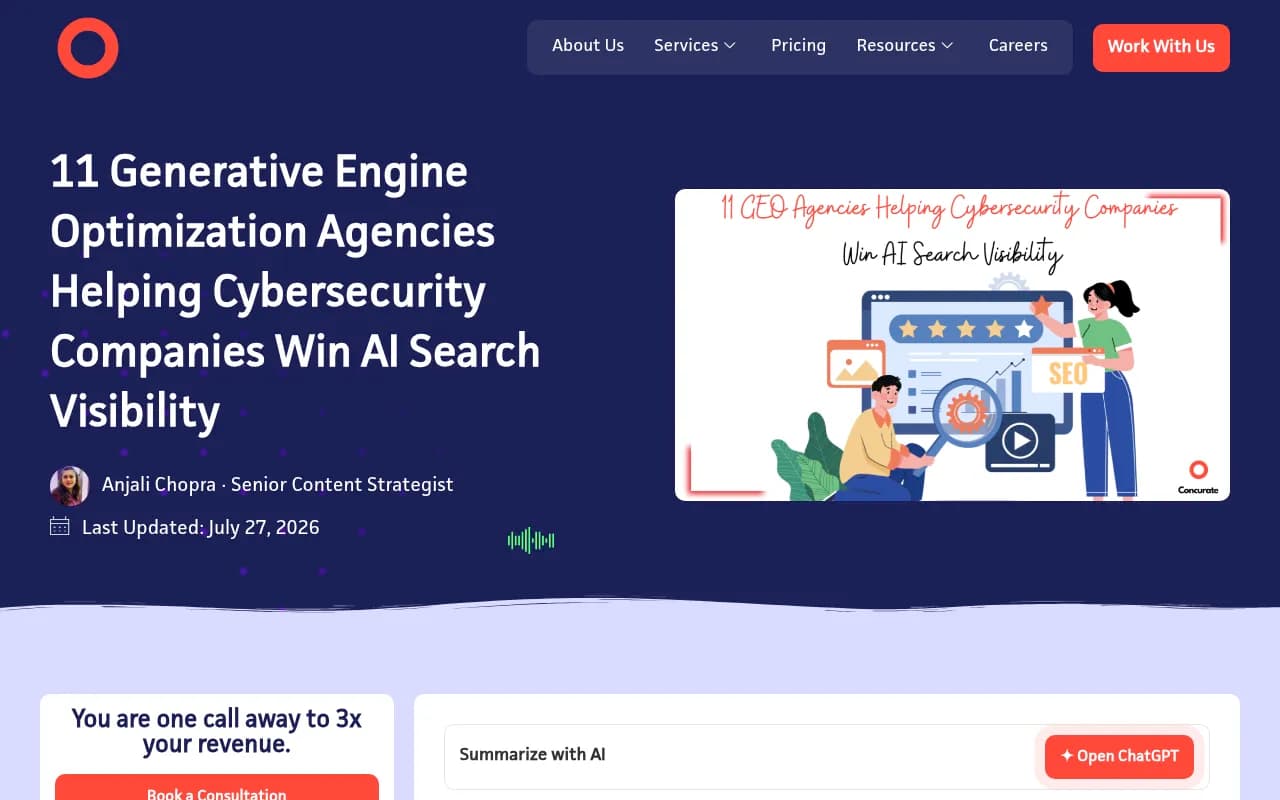
Software tells you what is happening. It does not build digital PR, earn analyst coverage, or write threat research. Several agencies specialize here. First Page Sage, Directive Consulting, Obility, Amplifyed, BlueText, and Concurate all show up in cybersecurity GEO roundups, but those lists are usually published by the agencies themselves, so the rankings are self-reported.
If you want an outside team, 1001 SEO Media is a full-service agency covering technical SEO, content, digital PR, and GEO, with no long-term contracts and senior specialists only. It uses Promptwatch for AI visibility measurement.
A reasonable split: buy software for measurement and execution, then hire an agency only if you lack the content, PR, or technical capacity to act on what the tool shows.
Picking by company stage
| Situation | Suggested approach |
|---|---|
| Seed or Series A security startup | Free or low-cost tracker (Promptwatch Explore or Essential, Otterly.AI), focus on docs and comparison pages |
| Growth-stage vendor with a content team | Promptwatch Professional or Business to close the loop from gap to published page |
| Enterprise vendor with a data team | Promptwatch Business or Enterprise, or Profound if analytics depth is the priority |
| Team that wants security-specific prompt templates | Trial GrackerAI alongside a general platform and compare results |
| Agency serving multiple security clients | Agency plans with white-label reporting |
Questions to ask any vendor before buying
- Do you capture answers from the actual consumer interface, or API only?
- Can I write fully custom prompts, and how many do I get?
- Do you show which specific pages and domains are cited, and where mine land?
- Can you show AI crawler activity on my site?
- How do you attribute traffic and conversions from AI platforms?
- What compliance documentation (SOC 2, SSO, audit logs) can you provide?
- What does pricing look like per response or per prompt as volume grows?
The bottom line
For most cybersecurity companies, the sensible path is a platform that covers real-UI tracking, citation sources, crawler access, and content execution, then a short trial against your ten most important buying prompts. Start with Promptwatch if you want the full loop, test GrackerAI if security-specific prompt templates matter to you, and keep a skeptical eye on any list, this one included, where the author sells the top pick. Your own prompts and your own crawler logs are the only data that will settle the question.