Key takeaways
- Gauge is a solid AI search tracker, but it's primarily a monitoring tool -- it shows you where you stand without helping you improve.
- The best alternatives in 2026 combine visibility tracking with content gap analysis, AI writing, and traffic attribution.
- Promptwatch is the only platform rated a "Leader" across all GEO categories in a 2026 comparison of 12 platforms -- and the only one that closes the full loop from gap detection to content creation to result tracking.
- For enterprise teams, Profound and Scrunch AI offer strong feature sets at higher price points.
- For budget-conscious teams, Otterly.AI and Peec AI cover the monitoring basics affordably.
Why people look for Gauge alternatives
Gauge does what it says on the tin. It tracks how your brand appears in AI-generated responses across platforms like ChatGPT, Perplexity, and Google AI Overviews. The interface is clean, the data is useful, and it's clearly built by people who understand the space.
But here's the problem most teams run into: knowing you're invisible doesn't make you visible.
Gauge, like most monitoring-first tools, tells you what's happening. It doesn't tell you what to do about it, and it certainly doesn't help you do it. You see the gap. You close the tab. You're still stuck.
That's the core reason teams go looking for alternatives -- not because Gauge is bad, but because they need more than a dashboard. They need a platform that moves from "you're missing from these AI responses" to "here's the content that will fix that" to "here's proof it worked."
This guide covers the best options in 2026, with honest takes on what each one actually does well.
What to look for in a Gauge alternative
Before getting into specific tools, it's worth being clear about what separates a good AI visibility platform from a great one.
Monitoring is table stakes. Every tool on this list tracks brand mentions, citation rates, and share of voice across AI models. That's the baseline. The question is what happens after you see the data.
Content gap analysis is where it gets interesting. The best platforms show you which prompts your competitors appear for that you don't. Not just "you're missing" -- but specifically which questions AI models are answering with your competitor's content instead of yours.
Content generation closes the loop. A handful of platforms now include AI writing tools that generate articles, listicles, and comparison pages grounded in real citation data. This isn't generic content -- it's built to get cited by ChatGPT, Claude, and Perplexity.
Traffic attribution is the final piece. Visibility scores are nice. Revenue is better. The strongest platforms connect AI citations to actual website traffic and conversions.
With that framework in mind, here's how the main alternatives stack up.
The best Gauge alternatives in 2026
Promptwatch -- best for the full optimization loop
Promptwatch is the most complete platform in this space right now. Where Gauge stops at monitoring, Promptwatch runs a full cycle: find the gaps, create content that fills them, track the results.

The Answer Gap Analysis feature is genuinely useful. It shows you the exact prompts where competitors are getting cited and you're not -- not vague category-level data, but specific questions with prompt volume estimates and difficulty scores. You can prioritize which gaps are actually worth going after.
From there, the built-in AI writing agent generates content grounded in 880M+ citations analyzed. It's not a generic AI writer -- it uses real citation data, competitor analysis, and persona targeting to produce articles that are engineered to get picked up by AI models.
The crawler logs are something most competitors don't offer at all. You can see in real time which AI crawlers (ChatGPT, Claude, Perplexity) are hitting your site, which pages they're reading, and what errors they're encountering. That kind of technical visibility is hard to find elsewhere.
Promptwatch monitors 10 AI models including ChatGPT, Claude, Gemini, Perplexity, Grok, DeepSeek, Copilot, Meta AI, and Google AI Overviews. It also tracks Reddit and YouTube -- two channels that directly influence AI recommendations but get ignored by most platforms.
Pricing starts at $99/month for the Essential plan (1 site, 50 prompts, 5 articles). The Professional plan at $249/month adds crawler logs, state/city tracking, and 15 articles per month. A free trial is available.
In a 2026 comparison of 12 GEO platforms, Promptwatch was the only one rated "Leader" across all categories. That's not a marketing claim -- it reflects a real gap between what monitoring-only tools do and what an optimization platform does.
Profound -- best for enterprise teams with budget
Profound is a strong platform with a genuinely impressive feature set. It tracks 10+ AI engines, has solid prompt intelligence, and its SOC 2 Type II certification makes it easier to get through enterprise procurement.
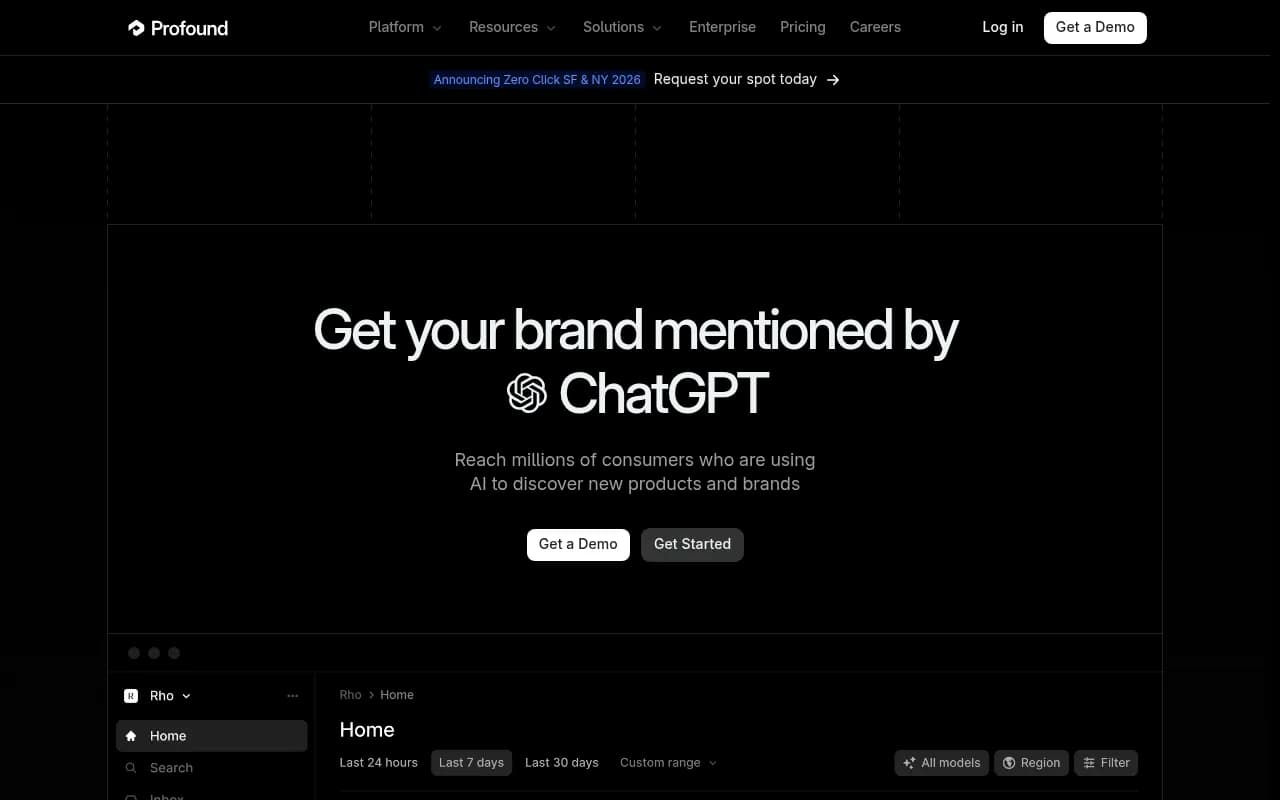
The main friction with Profound is cost. It's positioned firmly at the enterprise end of the market, which means it's overkill for most mid-market teams and genuinely expensive for agencies managing multiple clients. You also won't find Reddit tracking or ChatGPT Shopping monitoring here.
If you're a large brand with a dedicated SEO or GEO team and the budget to match, Profound is worth a serious look. If you're not, the price-to-value ratio tilts toward other options.
Scrunch AI -- best for structured optimization workflows
Scrunch AI sits in an interesting middle ground. It goes beyond pure monitoring with some optimization features, and the interface is built around workflows rather than dashboards -- which makes it easier to turn insights into action.
The platform covers the major AI models and includes content recommendations, though the content generation capabilities aren't as deep as Promptwatch's. Price points are higher than the monitoring-only tools, which is justified if you actually use the optimization features.
One thing worth noting: Scrunch doesn't have crawler logs or Reddit/YouTube tracking. For teams that want to understand how AI models discover their content technically, that's a meaningful gap.
Otterly.AI -- best for small teams on a budget
Otterly.AI is the most accessible entry point in this space. It tracks six major platforms (ChatGPT, Google AI Overviews, Perplexity, Google AI Mode, Gemini, and Copilot) with a clean interface and pricing that doesn't require a procurement conversation.

The honest limitation is that Otterly.AI is monitoring-only. There's no content gap analysis, no AI writing, no crawler logs, no traffic attribution. You get visibility data and that's it. For teams that just want to know where they stand before committing to a full platform, that's fine. For teams that need to actually improve their AI visibility, you'll hit the ceiling quickly.
Peec AI -- best for multi-language tracking
Peec AI has carved out a niche with strong multi-language and multi-region support. If you're running international campaigns and need to track AI visibility across different languages and markets, Peec AI handles that better than most.

Like Otterly.AI, it's primarily a monitoring platform. The "smart suggestions" it offers are useful but don't replace a proper content gap analysis workflow. Worth considering if international coverage is your main requirement.
AthenaHQ -- best for teams that want clean, focused monitoring
AthenaHQ tracks 8+ AI search engines with a clean interface and good prompt coverage. It's a solid monitoring tool that does what it promises without a lot of noise.

The gap is the same as most competitors: monitoring without optimization. AthenaHQ shows you your visibility scores but doesn't help you improve them. For teams that already have a content strategy in place and just need visibility data to feed into it, that's workable. For teams looking for a platform that drives the strategy, it falls short.
Writesonic -- best for content-first teams
Writesonic is primarily an AI writing platform that has added AI search visibility tracking. If your main need is content production and you want visibility data as a secondary feature, this is a reasonable option.
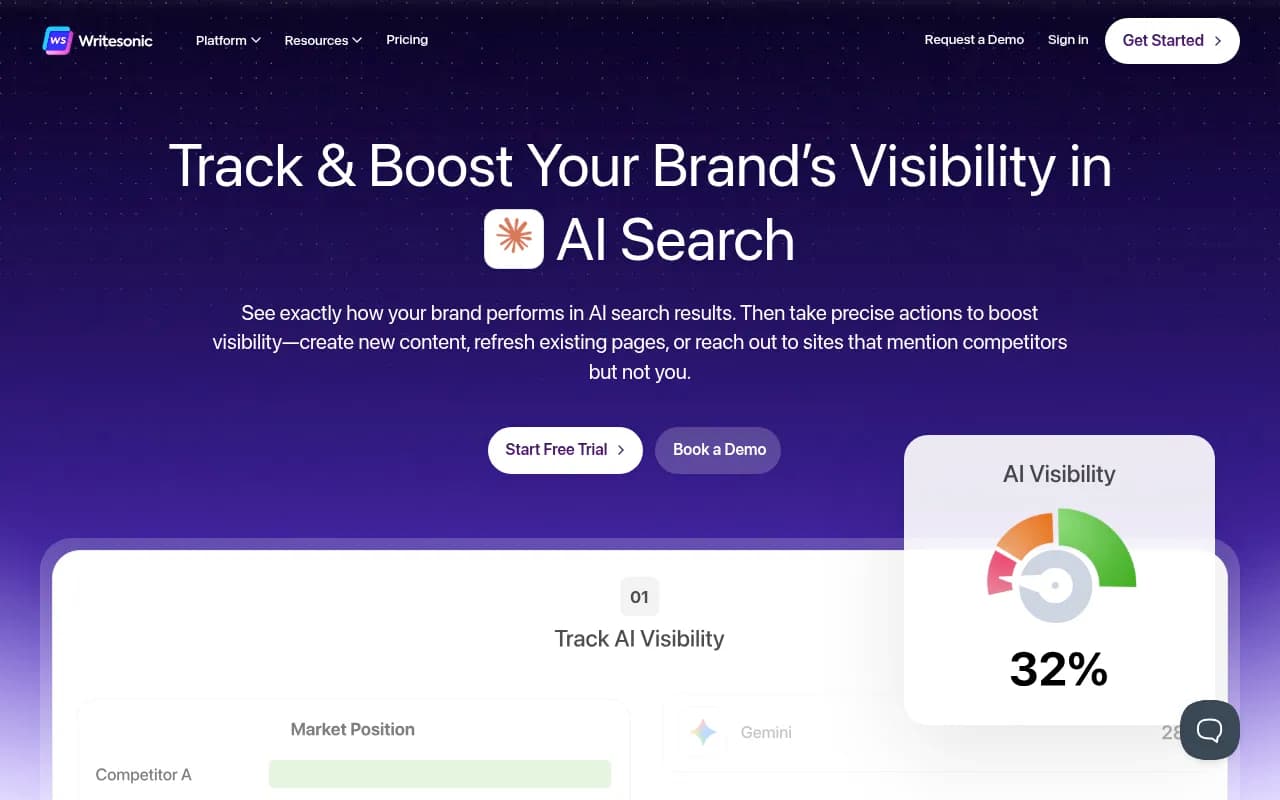
The tracking capabilities aren't as deep as dedicated GEO platforms -- fewer AI models covered, less sophisticated prompt intelligence. But if you're already using Writesonic for content and want to layer in some AI visibility monitoring without switching tools, it's a practical choice.
SE Ranking -- best for teams bridging traditional SEO and AI search
SE Ranking has been a solid traditional SEO platform for years and has been adding AI visibility features. If you're a team that needs both traditional keyword tracking and AI search monitoring in one place, SE Ranking is worth considering.

The AI visibility features are newer and not as mature as dedicated GEO platforms. But the breadth of the platform -- keyword research, rank tracking, site audits, plus AI monitoring -- makes it a reasonable choice for teams that don't want to manage multiple tools.
Feature comparison
Here's how the main alternatives compare across the capabilities that matter most:
| Platform | AI models tracked | Content gap analysis | AI content generation | Crawler logs | Reddit/YouTube tracking | Traffic attribution | Starting price |
|---|---|---|---|---|---|---|---|
| Promptwatch | 10 | Yes | Yes (built-in) | Yes | Yes | Yes | $99/mo |
| Gauge | ~6 | Limited | No | No | No | No | Not public |
| Profound | 10+ | Yes | No | No | No | Limited | Enterprise |
| Scrunch AI | 6+ | Partial | Limited | No | No | No | Not public |
| Otterly.AI | 6 | No | No | No | No | No | ~$49/mo |
| Peec AI | 6+ | No | No | No | No | No | ~$49/mo |
| AthenaHQ | 8+ | No | No | No | No | No | Not public |
| Writesonic | 4-5 | No | Yes (general) | No | No | No | ~$99/mo |
| SE Ranking | 5+ | Limited | No | No | No | No | ~$65/mo |
The monitoring trap -- and how to avoid it
Most teams shopping for a Gauge alternative are looking for better monitoring. More AI models, cleaner dashboards, sharper data. That's understandable -- monitoring is what these tools are marketed on.
But the real problem isn't data quality. It's that monitoring without action is just an expensive way to watch yourself lose.
The teams that are actually winning in AI search right now aren't the ones with the best dashboards. They're the ones who've figured out the cycle: find the specific prompts where they're invisible, create content that directly addresses those prompts, and track whether that content gets cited.
That cycle requires more than a tracker. It requires a platform built around optimization, not just observation.
Gauge is a good tracker. If tracking is genuinely all you need, it's worth considering. But if you're looking for a platform that helps you move the needle -- not just measure it -- the tools above, and Promptwatch in particular, are built for that job.
How to choose the right alternative
A few practical questions to narrow it down:
What's your budget? If you're under $100/month, Otterly.AI or Peec AI cover the basics. If you have $250+/month to spend and need results, Promptwatch's Professional plan is the most complete option at that price point.
Do you need content generation? If yes, Promptwatch is the only dedicated GEO platform with a built-in AI writing agent grounded in citation data. Writesonic generates content but isn't built specifically for AI citation optimization.
Do you need enterprise features? SOC 2, custom contracts, dedicated support -- Profound is the clearest option here, though Promptwatch also offers enterprise and agency pricing.
Are you running international campaigns? Peec AI has the strongest multi-language support among the monitoring-only tools. Promptwatch also supports multi-language and multi-region monitoring.
Do you need technical AI crawl data? Crawler logs -- seeing which AI bots are hitting your site and what they're reading -- is something almost no platform offers. Promptwatch is the exception.
The space is moving fast. Tools that were monitoring-only six months ago are adding optimization features. Tools that didn't exist a year ago are now serious contenders. Whatever you choose, make sure it's built to do more than show you a number.