Key takeaways
- Pricing in the AI visibility category is a mess right now. Several vendors changed currency, billing cycles, or prompt allowances mid-2026, and third-party trackers often quote figures that no longer match the live pricing page.
- The real cost driver isn't the sticker price, it's how many AI engines and prompts you get for that price. A $250/month plan that only tracks 31 effective questions across four engines can be more expensive per data point than a $95/month plan.
- Otterly.AI remains the cheapest honest entry point at $29/month, but Claude and Google AI Mode are paid add-ons, not line items you'll see until you dig.
- Platforms like Promptwatch publish tiered pricing with exact response counts, crawler log allowances, and included AEO articles per plan, which makes budgeting easier than vendors that hide behind "starting at" language.
- Before buying anything, ask the vendor to show you the actual cost for your prompt volume, brand count, and engine list. A quote based on your numbers beats a homepage price every time.
Why pricing clarity matters more than feature lists right now
I spent a good chunk of time this year comparing pricing pages across roughly 30 AI visibility tools, and the thing that struck me wasn't which tool had the most features. It was how often the advertised price and the real price didn't match.
Take Peec AI. In one month it moved from USD plans ($95/$245/$495) to EUR, geo-priced, annual-billing rates (around €70-€360 depending on term), and three separate research sources quoted three different numbers for the same product within weeks of each other. That's not a knock on Peec specifically, it's just a symptom of a category still figuring out how to price something new. Nightwatch has the same problem: its own site says Starter is €99/month (or €79 billed yearly), but at least one comparison site has it listed at $32/month, a figure that looks stale against current pricing.
This matters because AI visibility tracking tools up-sell on prompt volume more than anything else. One pricing study of 34 tools in the category found that prompt volume is the upgrade trigger on 64.7% of pricing pages, the AI-search equivalent of "tracked keywords" in classic rank trackers. If a vendor isn't explicit about how many prompts, engines, and response credits you actually get, you're buying blind.
And the stakes for getting this right keep rising. ChatGPT typically cites only around 5 sources per web-search answer, according to Promptwatch's average sources per response data, while Google AI Overviews and Perplexity cite closer to 10 each. That means your brand is fighting for one of roughly five slots on ChatGPT, a much tighter contest than Google's AI Overviews or Perplexity. A tool that mushes "mentions" and "citations" together, or doesn't break results out per engine, gives you a false sense of how contested that slot actually is.
What actually drives the price on an AI visibility tool
Before comparing specific platforms, it helps to know what line items to look for on any pricing page:
- Number of tracked prompts (the questions the tool runs against AI engines on your behalf)
- Number of AI engines included at each tier (ChatGPT-only plans are common at entry level)
- Response or credit volume, since some tools draw down the same prompt allowance across multiple engines
- Whether Claude, Gemini, or Google AI Mode are included or sold as add-ons
- Number of seats, projects, or brand workspaces
- Whether crawler log data, content generation, or CMS publishing is bundled in or a separate SKU
A useful stress test: take the advertised "starting at" price and divide it by the number of prompts times engines you'd actually need. Scrunch AI's Core plan is $250/month for 125 "prompts," but the allowance draws down once per engine tracked, so tracking 125 prompts across four engines leaves you with roughly 31 actual questions covered, an effective cost north of $8 per prompt. Compare that to Otterly's Lite plan at $29/month for 15 prompts across four core engines, closer to $1.90-$2 per prompt-engine combination once you factor in which engines are actually included.
Comparison: pricing clarity across the major AI visibility tools
| Tool | Entry price | What's actually included at entry | Pricing clarity notes |
|---|---|---|---|
| Promptwatch | $95/mo (Essential) | 1 site, 50 prompts, 6,000 responses, 5 AEO articles, all LLMs tracked | Exact response and article counts stated per tier, no vague "starting at" language |
| Otterly.AI | $29/mo (Lite) | 15 prompts, 4 core engines (ChatGPT, AI Overviews, Perplexity, Copilot) | Clear base price, but Claude/Gemini/AI Mode are paid add-ons not shown upfront |
| Profound | $99/mo (Starter, billed annually) | 50 prompts, ChatGPT only, 1 seat | Starter is ChatGPT-only; 3 engines require the $399/mo Growth tier |
| Scrunch AI | $250/mo (Core) | 125 prompts across 4 LLMs, 5 seats | Prompt allowance draws down per engine, effective cost is much higher than headline price suggests |
| Peec AI | ~€85-205/mo (varies by billing cycle) | 50-150 prompts, 3 chosen models | Repriced mid-2026 from USD to EUR; multiple sources quote conflicting figures |
| Ahrefs Brand Radar | $199/mo per platform index | One AI platform (e.g. ChatGPT only) | $699/mo for the "All Platforms" bundle; no free trial |
| Semrush AI Toolkit | $99/mo per domain | 25 custom prompts, 1 domain | Clear per-domain, per-prompt pricing, but extra domains and prompts cost extra fast |
Platform-by-platform look at pricing transparency
Promptwatch
Promptwatch lays out five tiers with specific numbers attached to each: Explore is free (10 prompts, ChatGPT only), Essential is $95/month (1 site, 50 prompts, 6,000 responses, 5 AEO articles), Professional is $245/month (2 sites, 150 prompts, 18,000 responses, 25M crawler logs, 15 AEO articles), and Business is $579/month (5 sites, 350 prompts, 42,000 responses, 100M crawler logs). Agency tiers start at $199/month with unlimited projects and prompts.

What makes this pricing page easier to budget against than most competitors is that every tier states exact response volume and crawler log allowance rather than a vague cap. You can see upfront that moving from Essential to Professional roughly triples your response volume and adds state and city-level tracking plus automated content generation, so the jump is tied to a concrete capability, not just a bigger number with no explanation. It also tracks every major engine, ChatGPT, Gemini, Claude, Perplexity, Grok, DeepSeek, Copilot, Mistral, Meta Llama, Google AI Overviews and AI Mode, at every paid tier, so you're not forced into an add-on purchase just to see Claude data. Most monitoring-only tools stop at tracking; Promptwatch also ships Content Agents that write and publish AEO articles to your CMS, which is reflected directly in the "AEO articles included" line on each plan rather than buried in a separate product.
Otterly.AI
Otterly's $29/month Lite plan is the cheapest credible entry point in the category, and the pricing page is honest about what's in scope: 15 prompts, daily tracking, four core engines. Where it gets less clear is the add-on structure. Google AI Mode, Gemini, and Claude aren't included in the base plans at all, they're paid extras, and you won't know the exact add-on cost until you're inside the product or on a sales call. If your buyers are asking Claude questions about your category and you're only tracking ChatGPT and Perplexity, Otterly's sticker price undersells what you'll actually need to pay.

Profound
Profound's $99/month Starter tier is clean on paper, ChatGPT tracking, 50 prompts, one seat, but the jump to multi-engine coverage is steep: $399/month for the Growth tier, which adds just three engines and caps at 100 prompts. Extra seats beyond the single one included in Starter run an estimated $45-$100 per seat per month, according to a competitor's own comparison page rather than Profound's published rate card, which is itself a small transparency gap worth flagging. Enterprise is credit-based and quote-only.
Scrunch AI
Scrunch publishes a $250/month Core price with 125 prompts and four tracked LLMs, which reads as straightforward until you learn the allowance draws down once per engine rather than once per unique question. Scrunch's own FAQ states Agency Core is $500/month, double the figure some third-party trackers list, so check the vendor's FAQ directly rather than trusting an aggregator. One pricing database places Scrunch at 31st of 38 tools ranked by price, against a category median entry price of $85.50/month, which gives useful context for how far above the middle of the market Scrunch sits.
Peec AI
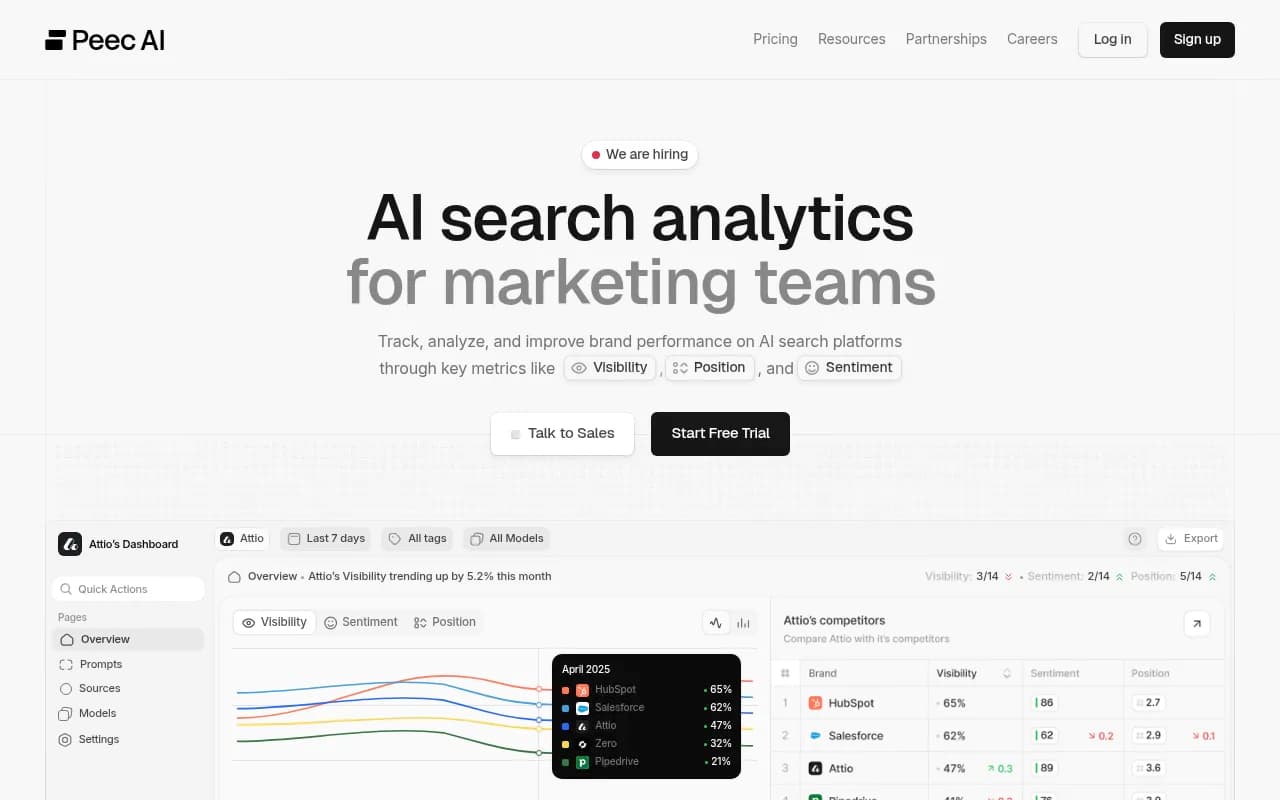
Peec is the best case study in this guide for why you should always check the live pricing page before publishing or acting on a number. It repriced mid-2026, moving from USD monthly plans to EUR plans with geo-based and annual-billing variants, and different research sources captured different snapshots of that transition, producing genuinely conflicting public numbers for the same product in the same month. Peec does offer unlimited seats on every tier, which is a real differentiator against Profound's single-seat Starter plan, and its modular pricing lets you pick which three models to track rather than forcing a fixed bundle.
Ahrefs Brand Radar
Ahrefs prices Brand Radar per AI platform index at $199/month, so tracking ChatGPT and Google AI Overviews separately means paying twice, or paying $699/month for the bundled "All Platforms" tier that covers roughly six engines. There's no free trial. During its beta period, Brand Radar was bundled free into Ahrefs plans starting at $129/month, but that access ends with beta, so don't assume the free bundling carries forward.
SE Ranking / SE Visible
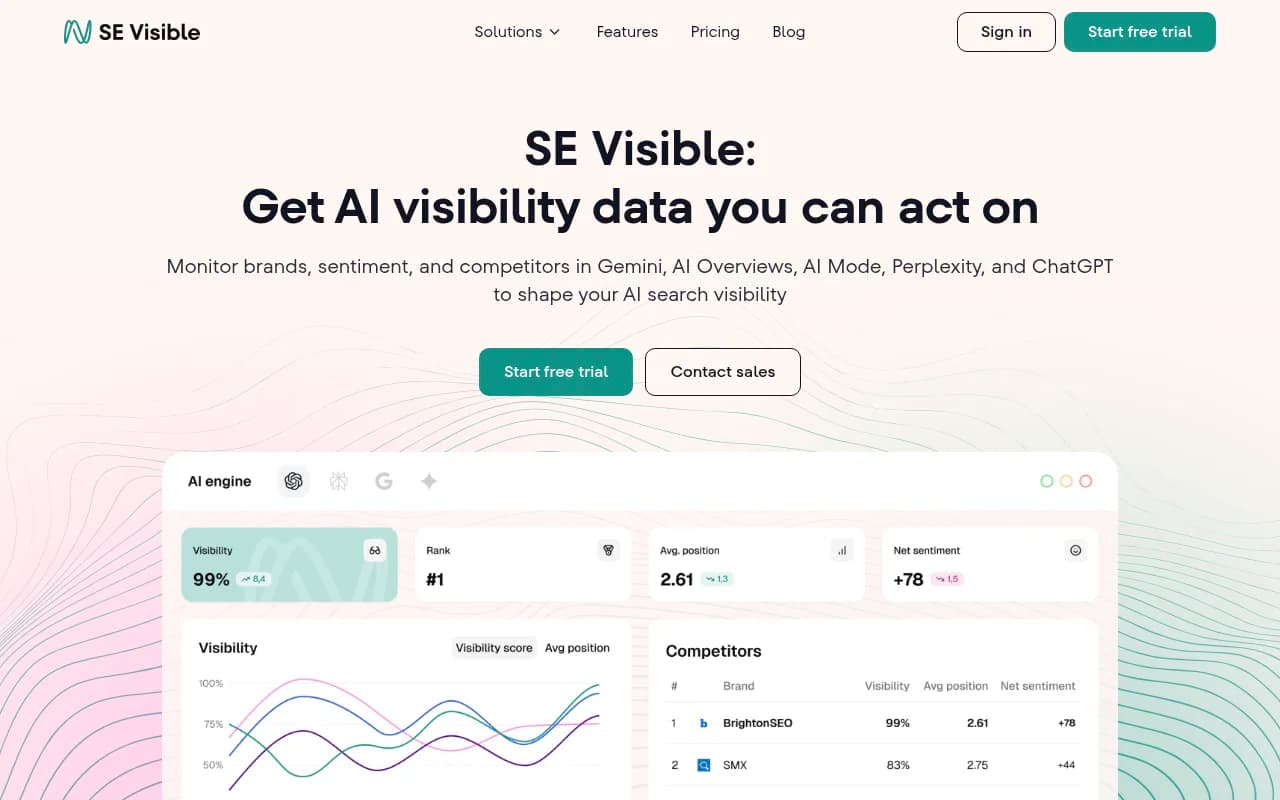
SE Ranking sells its AI visibility tracker as an add-on to a base plan starting at $129/month, with third-party breakdowns pegging the AI Search add-on around $89/month on top of that. Its sister product, SE Visible, starts at $79/month annually for 200 prompts and 3 projects, which reads as one of the more agency-friendly rates in the category if you can live with annual billing.

Red flags to watch for on any pricing page
A few patterns show up repeatedly across the category, and they're worth checking for before you commit:
- "Starting at" language with no breakdown of what triggers the next tier up
- Prompt allowances that don't specify whether they're per-engine or shared across engines
- Claude, Gemini, or Google AI Mode listed as add-ons rather than included, which can double your real spend
- No stated response or credit cap, which risks the $99 sign-up ballooning into unexpected overage charges
- Free trials that quietly require a credit card, a friction point one industry study flagged as common and rarely disclosed clearly on the page itself
How to actually compare offers
Skip the homepage price entirely and ask each vendor for a quote based on your real prompt count, brand count, and the specific engines your buyers actually use. A $99/month plan that only covers ChatGPT is not comparable to a $99/month plan that covers five engines, even though the number on the page looks identical. If you want a second opinion on format, Promptwatch's own comparison of 21 GEO platforms at promptwatch.com/best-geo-and-ai-visibility-platforms-compared-2026 breaks out crawler logs, content generation, and shopping/ads tracking feature by feature, which is a useful template for building your own side-by-side before you sign a contract.
If you'd rather browse a wider set of GEO platforms before narrowing your shortlist, the directory at bestgeosoftware.com organizes vendors by category, which is a faster starting point than working through a dozen individual pricing pages cold.
The bottom line
There's no single "cheapest" or "most transparent" AI visibility tool, because the category hasn't settled on a standard way to price prompts, engines, or response credits. What you can control is asking the right questions before you pay: how many engines, how many prompts, how those prompts draw down across engines, and whether the tool's "citation" metric means the same thing a model actually trusts as a source, versus just a mention that could disappear with the next model update. Get a real quote tied to your numbers, not the homepage price, and you'll avoid the surprise upgrade most buyers in this category run into around month two.