Key takeaways
- AI-driven referral traffic to e-commerce sites grew 302% in 2025, and AI search now influences over $595 billion in retail, making visibility in ChatGPT, Perplexity, and Google AI Overviews a real revenue concern.
- Most AI visibility platforms were built for SEO and brand monitoring teams -- they track brand mentions but not individual products, SKUs, or shopping recommendations.
- ChatGPT Shopping (product carousels inside ChatGPT) is a distinct tracking challenge that very few platforms support natively.
- The platforms that matter most for e-commerce go beyond monitoring: they identify content gaps, track which product pages AI models cite, and help you fix what's missing.
- Promptwatch is the only platform rated "Leader" across all GEO categories in 2026, and one of the few with dedicated ChatGPT Shopping tracking alongside content gap analysis and AI content generation.
Why e-commerce brands suddenly care about AI visibility
A year ago, most e-commerce marketing teams were still debating whether AI search was real. That debate is over. According to Euromonitor, AI language models now influence over $595 billion in retail e-commerce. Semrush found that AI-referred traffic converts at 4.4x higher rates than traditional organic search. And 58% of consumers have replaced traditional search with generative AI for product discovery, per Alhena AI's 2026 research.
The practical consequence: when someone asks ChatGPT "what's the best running shoe for flat feet under $150," your brand either appears in that answer or it doesn't. There's no page two. There's no "position 4 still gets clicks." If you're not cited, you're invisible to that customer.
That created a new category of software almost overnight. AI visibility platforms -- tools that track how brands and products appear in AI-generated answers -- went from a niche curiosity to a genuine marketing priority. But the category is messy. Many tools were built for SEO teams tracking brand mentions, not for e-commerce teams trying to understand which SKUs appear in ChatGPT's shopping carousels.
This guide breaks down what actually matters for e-commerce, which platforms are worth your time, and what to look for before you spend a dollar.
What makes an AI visibility tool actually useful for e-commerce
Most AI visibility tools solve the same basic problem: they run queries against LLMs (ChatGPT, Claude, Perplexity, Gemini, etc.) on your behalf and record whether your brand appears. That's useful. But for e-commerce, it's often not enough.
Here are the three filters that separate genuinely useful e-commerce tools from generic monitoring dashboards:
SKU-level product tracking. Knowing "our brand appeared in 40 AI answers this week" tells you almost nothing actionable. Did your best-selling product appear? Did a discontinued item get recommended? Which product categories are invisible? Tools that only track brand mentions leave you guessing.
Revenue attribution. AI visibility without revenue connection is a vanity metric. The tools worth paying for can connect AI citations to actual traffic and, ideally, to conversions. This is harder than it sounds -- a lot of AI-referred purchases happen in zero-click environments where the user never visits your site.
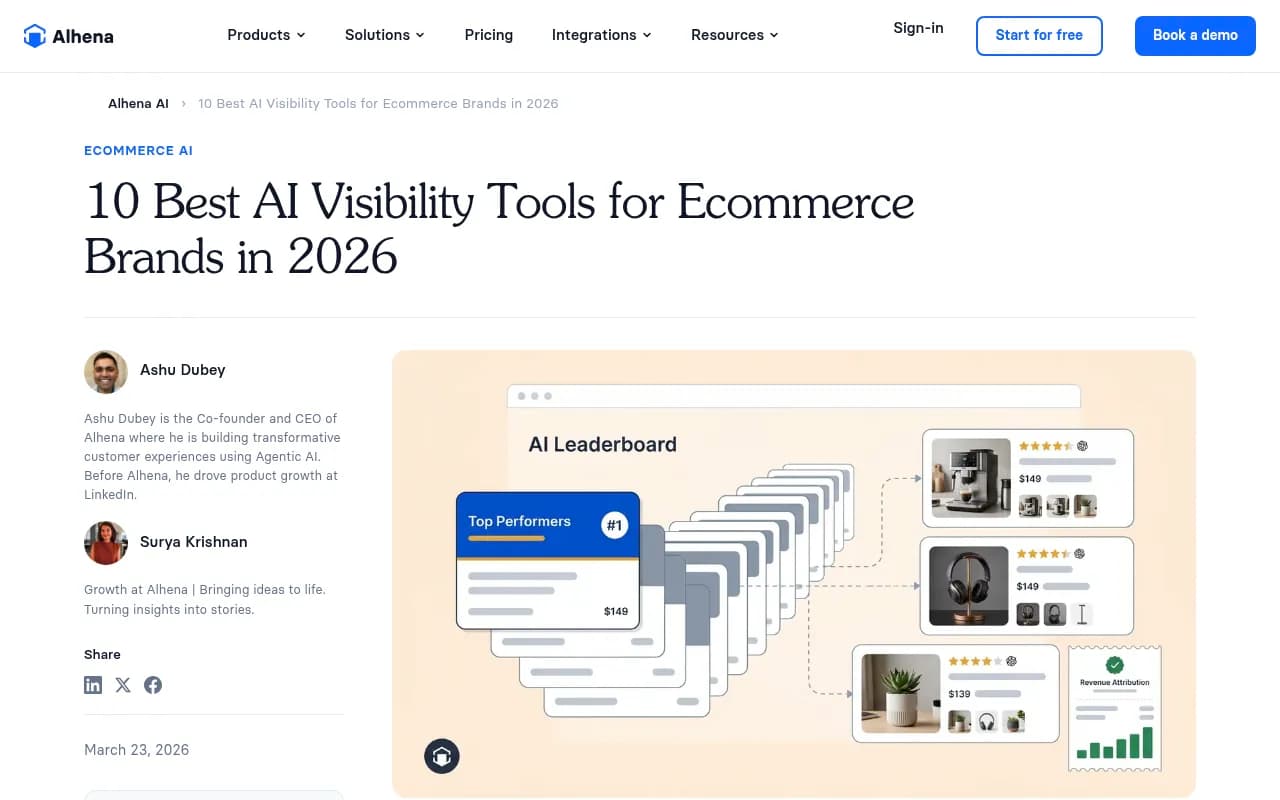
ChatGPT Shopping tracking. OpenAI launched Shopping carousels inside ChatGPT in 2025, and they behave differently from regular text citations. Products appear with images, prices, and ratings. Getting into those carousels requires different optimization than getting cited in a text response. Very few platforms track this separately.
There's also a fourth thing worth mentioning: the difference between monitoring and optimization. A monitoring tool tells you where you stand. An optimization tool tells you what to do about it. For e-commerce teams with limited bandwidth, the latter is far more valuable.
The ChatGPT Shopping problem
ChatGPT's Shopping feature deserves its own section because it's genuinely different from standard AI citations.
When a user asks ChatGPT a product question, it can now return a shopping carousel with product images, prices, retailer links, and ratings -- pulled from a combination of structured data, third-party merchant feeds, and web crawling. This is closer to Google Shopping than to a text answer, and it has its own optimization logic.
To appear in ChatGPT Shopping results, your product pages need:
- Clean structured data (schema markup for Product, Offer, Review)
- Accurate and up-to-date pricing and availability
- Strong review signals that AI can verify
- Content that answers the specific question being asked, not just generic product descriptions
Most AI visibility platforms don't track ChatGPT Shopping separately from regular ChatGPT text responses. They'll tell you whether your brand appeared in a ChatGPT answer, but not whether you appeared in a shopping carousel, what position you held, or which competitors showed up alongside you.
Promptwatch is one of the few platforms with dedicated ChatGPT Shopping tracking -- it monitors when your brand appears in product recommendations and shopping carousels specifically, which is a meaningfully different signal than a text citation.

The platforms worth knowing
Promptwatch
Promptwatch covers the full loop that most e-commerce teams need: find gaps, fix them, track results. Its Answer Gap Analysis shows which prompts competitors rank for that you don't -- including product-level and category-level queries. The built-in AI writing agent generates content based on real citation data (880M+ citations analyzed), so you're not just creating content and hoping -- you're creating content that's engineered to get cited.
For e-commerce specifically, the ChatGPT Shopping tracking is the standout feature. It monitors product carousel appearances across ChatGPT separately from text citations, so you can see whether your products are actually showing up where purchase intent is highest. Crawler logs show which of your product pages AI bots are reading (and which they're ignoring), and page-level tracking connects visibility to actual traffic via GSC integration or server log analysis.
It monitors 10 AI models: ChatGPT, Perplexity, Claude, Gemini, Google AI Overviews, Google AI Mode, Grok, DeepSeek, Copilot, and Meta AI. Pricing starts at $99/month for the Essential plan.
Profound
Profound is a strong enterprise option with a reported AEO score of 92/100 in independent rankings. It covers 10+ AI engines and has processed 400M+ prompt insights. It's SOC 2 Type II certified, which matters for larger brands with compliance requirements. The platform is monitoring-heavy -- it's excellent at telling you where you stand but less focused on helping you fix it. For e-commerce teams that already have content teams and just need reliable data, it's a solid choice.
SE Ranking / SE Visible
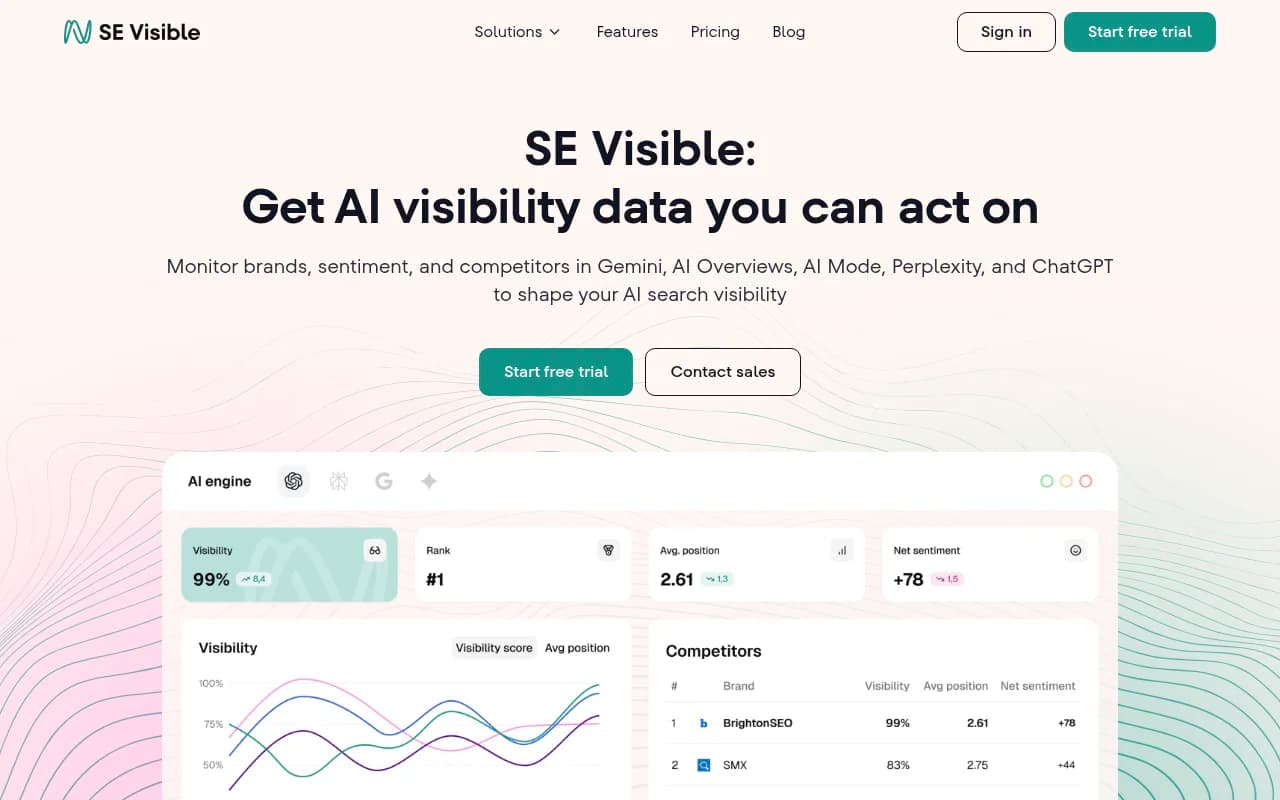
SE Ranking has been a reliable SEO platform for years, and its AI visibility layer (SE Visible) adds LLM tracking on top of its existing rank-tracking infrastructure. It's a practical option for teams already using SE Ranking who want to add AI monitoring without switching platforms. The AI visibility features are less deep than dedicated GEO platforms, but the integration with traditional SEO data is genuinely useful for understanding how AI and organic visibility interact.
Otterly.AI
Otterly is one of the more affordable entry points into AI visibility monitoring. It tracks brand mentions across several LLMs and gives you a clean dashboard for monitoring. The limitation for e-commerce is that it's monitoring-only -- no content gap analysis, no crawler logs, no ChatGPT Shopping tracking. It's fine for teams that just want to know whether their brand appears, but it won't tell you what to do when it doesn't.

Athena HQ
Athena HQ covers 8+ AI search engines and has a clean interface. Like Otterly, it's primarily a monitoring platform. It's useful for brand-level tracking but doesn't have the product-level or SKU-level granularity that e-commerce teams need. No content generation, no crawler logs.

Scrunch AI
Scrunch focuses on monitoring how AI assistants like ChatGPT and Claude describe your brand and products. It has some content optimization suggestions but is lighter on the action side than Promptwatch. Worth considering for teams that want a mid-tier option between basic monitoring and full optimization platforms.
Peec AI
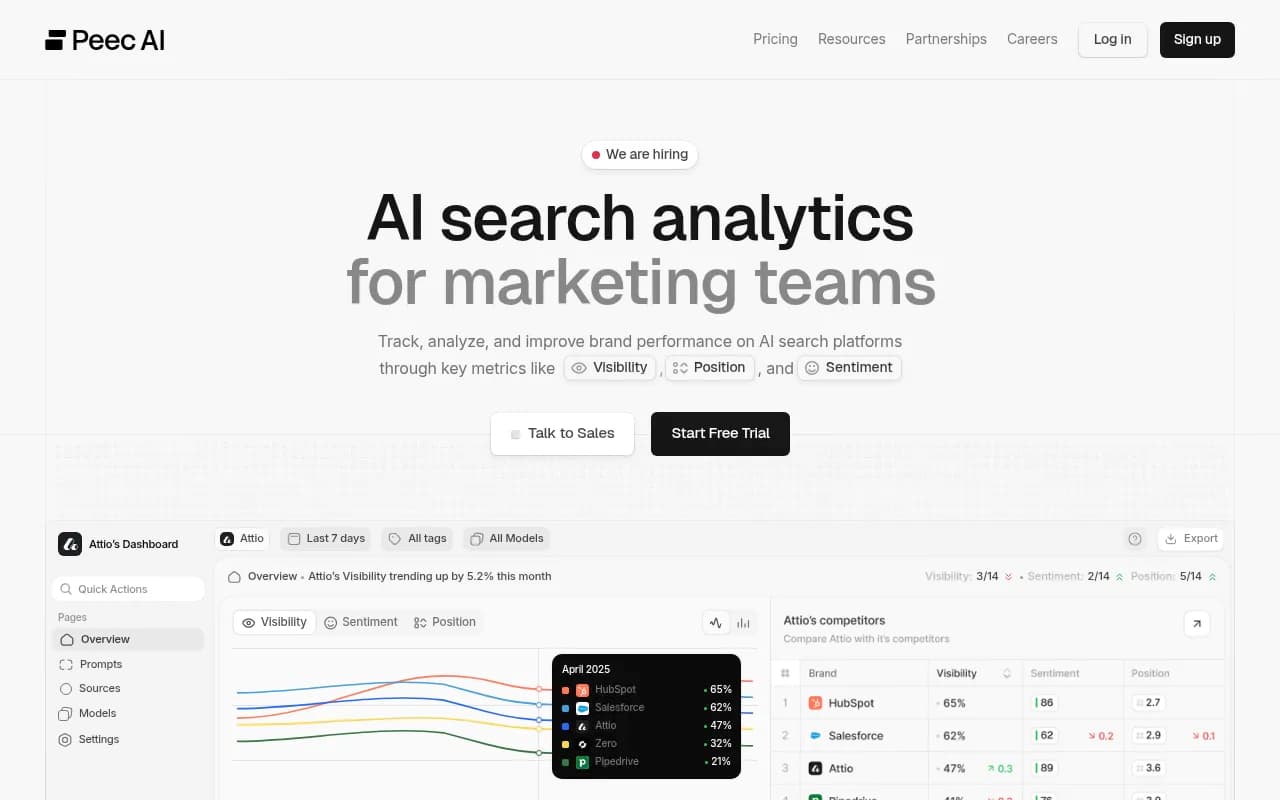
Peec AI is notable for its multi-language support, which matters for e-commerce brands selling across multiple regions. It tracks AI visibility across languages and markets, which most platforms handle poorly. If international visibility is a priority, it's worth evaluating.
Evertune
Evertune positions itself as an enterprise GEO platform trusted by Fortune 500 brands. It has strong brand-level tracking and competitive benchmarking. Like Profound, it's more monitoring-focused than optimization-focused, and the enterprise pricing reflects that.
Feature comparison: what each platform actually tracks
| Platform | ChatGPT Shopping | SKU-level tracking | Content gap analysis | AI content generation | Crawler logs | Revenue attribution |
|---|---|---|---|---|---|---|
| Promptwatch | Yes | Partial (page-level) | Yes | Yes | Yes | Yes (GSC + logs) |
| Profound | No | No | Limited | No | No | No |
| SE Visible | No | No | No | No | No | No |
| Otterly.AI | No | No | No | No | No | No |
| Athena HQ | No | No | No | No | No | No |
| Scrunch AI | No | No | Limited | No | No | No |
| Peec AI | No | No | No | No | No | No |
| Evertune | No | No | Limited | No | No | No |
The pattern is clear: most platforms stop at monitoring. Promptwatch is the only one in this comparison that covers the full cycle from gap identification through content creation to traffic attribution.
The three problems traditional tools can't solve
The Parcel Perform research on AI visibility for e-commerce identified three structural problems worth understanding before you pick a platform:
The visual vanity trap. A brand can appear in a ChatGPT response but still receive zero purchase recommendations because the AI filtered it out during evaluation -- usually due to missing or uncertain shipping data. Standard monitoring tools report the "win" (brand appeared!) while missing the revenue loss (no one bought anything). This is why monitoring without attribution is dangerous for e-commerce.
The attribution gap. When a purchase completes inside an AI interface without the user ever visiting your website, traffic-centric tools count it as a failure. They never see a session. This is increasingly common as AI shopping agents become more capable, and it means traditional analytics will systematically undercount AI-driven revenue.
Category blindness. Your competitor for "running shoes" is Nike. Your competitor for "gym equipment" is Technogym. Domain-level visibility tools treat all your competitors as the same, which leads to bad prioritization. You need prompt-level and category-level competitive data, not just overall brand visibility scores.
These aren't hypothetical problems. They're why e-commerce brands that adopted AI visibility tools in 2024 often found the data confusing or disconnected from actual business outcomes.
What to actually look for when evaluating a platform
Based on everything above, here's a practical checklist for e-commerce teams evaluating AI visibility platforms:
Does it track ChatGPT Shopping separately from text responses? This is a binary question. Either it does or it doesn't. If it doesn't, you're missing the highest-purchase-intent AI surface.
Does it show which specific pages AI models are citing? Brand-level visibility scores are a starting point. Page-level data is where the actionable insights live. You need to know whether your product pages, category pages, or comparison pages are being cited -- and which ones aren't.
Does it have crawler logs? Knowing that AI bots visited your site (and which pages they read, and whether they encountered errors) is foundational. Without this, you're optimizing blind.
Does it help you create content, or just show you what's missing? Gap analysis is useful. Gap analysis plus a tool that helps you fill those gaps is twice as useful. Most platforms stop at step one.
Can it connect visibility to revenue? Even a basic GSC integration that shows AI-referred clicks is better than nothing. Full server log analysis is better still.
Does it track competitors at the prompt level? Knowing that a competitor appears for "best waterproof hiking boots under $200" while you don't is far more actionable than knowing their overall visibility score is higher than yours.
Pricing reality check
AI visibility platforms vary enormously in price. Here's a rough breakdown of what you're paying for at different tiers:
| Price range | What you typically get |
|---|---|
| Free / $0-50/mo | Basic brand mention monitoring, 1-2 LLMs, limited prompts |
| $50-150/mo | Multi-LLM monitoring, competitor tracking, basic reporting |
| $150-300/mo | Content gap analysis, more prompts, crawler logs, some attribution |
| $300-600/mo | Full optimization suite, AI content generation, multi-site, revenue attribution |
| $600+/mo | Enterprise features, custom integrations, dedicated support |
Promptwatch's pricing sits at $99/month (Essential), $249/month (Professional, which adds crawler logs and city-level tracking), and $579/month (Business, 5 sites, 350 prompts, 30 articles/month). There's a free trial available.
For most e-commerce brands, the Professional tier is the practical starting point -- you need the crawler logs to understand how AI bots interact with your product pages, and the article generation to actually fix what you find.
The bottom line
The e-commerce AI visibility space in 2026 is split between two types of tools: monitoring dashboards that show you data, and optimization platforms that help you act on it.
If you're an e-commerce brand that cares about ChatGPT Shopping appearances, SKU-level visibility, and connecting AI citations to actual revenue, the monitoring-only tools will leave you frustrated. You'll have dashboards full of data and no clear path to improving your numbers.
The platforms that actually move the needle are the ones that close the loop: find the gaps, generate the content, track the results. For most e-commerce teams evaluating the market right now, Promptwatch is the most complete option in that category -- particularly for ChatGPT Shopping tracking, which remains a gap in almost every other platform on this list.