Key takeaways
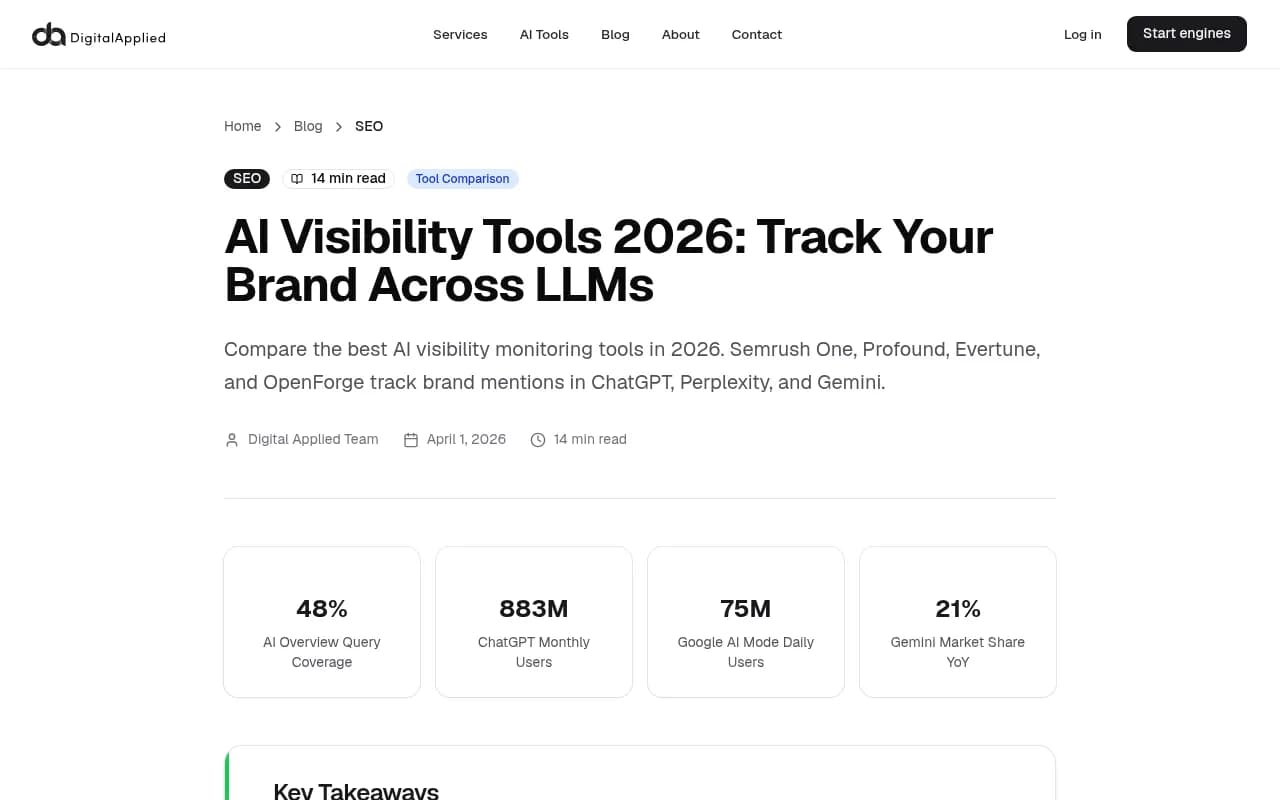
- AI Overviews now appear in roughly 48% of all Google searches, and ChatGPT has 883 million monthly users -- traditional rank trackers see none of this traffic
- Share of voice in AI search is measured differently than in traditional SEO: it's about citation frequency, mention sentiment, and prompt coverage across multiple LLMs simultaneously
- Most platforms in this space are monitoring-only dashboards; only a handful also help you act on what you find
- The platforms worth paying for in 2026 are the ones that track real user-facing responses (not just API outputs), cover at least 5-6 LLMs, and give you competitive benchmarking
- Promptwatch is the only platform rated "Leader" across all evaluation categories in a 2026 comparison of 12 GEO platforms -- largely because it closes the loop from tracking to content creation to result measurement
Your brand could rank #1 on Google and still be completely invisible to the 883 million people using ChatGPT every month. That's not a hypothetical -- it's happening right now to most brands. Only 38% of pages cited in AI Overviews also rank in the top 10 for the same query. The gap between "good SEO" and "visible in AI search" is real, and it's widening.
Share of voice used to mean something simple: what percentage of search impressions does your brand capture versus competitors? In AI search, the question is more complicated. Which prompts does your brand appear in? How often are you cited versus ignored? Are you mentioned positively, neutrally, or not at all? Which LLMs favor your competitors? These are the questions AI visibility platforms exist to answer.
This guide breaks down how share of voice tracking works in LLMs, what separates the serious platforms from the lightweight ones, and which tools are actually worth using in 2026.
What "share of voice" actually means in AI search
In traditional SEO, share of voice is a fairly clean calculation: your brand's impressions divided by total impressions for a set of keywords. It's imperfect but measurable.
In AI search, the equivalent metric is messier. When someone asks Perplexity "What's the best project management tool for remote teams?", the answer might mention three brands, cite two sources, and recommend one product. Your share of voice in that response depends on whether you're mentioned at all, how prominently, and whether the citation links back to your site.
Multiply that by hundreds of relevant prompts, across 10 different LLMs, in multiple languages and regions, and you start to see why this requires dedicated tooling.
The core metrics that matter:
- Mention rate: what percentage of relevant prompts include your brand in the response
- Citation rate: how often your pages are linked as sources (distinct from being mentioned)
- Prompt coverage: how many of the prompts in your category does your brand appear in
- Competitive share: your mention rate versus specific competitors for the same prompt set
- Sentiment: whether mentions are positive, neutral, or negative
- Model distribution: which LLMs favor you and which favor competitors
Most platforms track some of these. Few track all of them well.
Why this is harder than it looks
There's a technical wrinkle that most buyers don't think about until it's too late: API outputs and user-facing responses are not always the same thing.
When a platform queries ChatGPT or Perplexity via API to check whether your brand is mentioned, it may get a different answer than what a real user sees in the actual interface. Shopping recommendations, featured citations, and response formatting can all differ. A platform that only uses API queries is measuring a proxy, not the real thing.
The better platforms track how AI search engines behave in actual user interfaces. This matters especially for ChatGPT Shopping, Google AI Mode, and Perplexity's answer cards -- all of which have different citation behavior than their API equivalents.
The platforms worth knowing in 2026
Promptwatch
Promptwatch is the most complete platform in this space. It monitors 10 LLMs (ChatGPT, Perplexity, Google AI Overviews, Google AI Mode, Claude, Gemini, Meta/Llama, DeepSeek, Grok, Mistral, Copilot) and tracks real user-facing responses rather than just API outputs.
What separates it from most competitors is what happens after the monitoring. Promptwatch's Answer Gap Analysis shows exactly which prompts your competitors are visible for that you're not -- with the specific content your site is missing. Content Agents then generate articles, comparisons, and briefs built around that gap data. Page-level tracking shows when those new pages get crawled by AI agents and when they start generating citations.

The AI Crawler Logs feature is particularly useful for diagnosing why you're invisible in certain LLMs. You can see which pages each AI crawler reads, how often they return, and whether they're hitting errors. Most competitors don't offer this at all.
Pricing starts at $99/month (Essential: 1 site, 50 prompts, 5 articles) up to $579/month for Business (5 sites, 350 prompts, 30 articles). A free trial is available.
Profound
Profound is a strong enterprise option, particularly for teams that want to connect AI visibility to downstream conversion data. It tracks brand mentions across major LLMs and can show which AI-referred visitors actually convert -- a step beyond pure visibility tracking.
The platform is well-regarded for its depth of competitive benchmarking. The tradeoff is price: it sits at the higher end of the market, and some features that Promptwatch includes (Reddit tracking, ChatGPT Shopping, crawler logs) aren't available.
Otterly.AI
Otterly.AI is a solid entry-level option for teams that want straightforward brand monitoring across LLMs without a lot of complexity. It covers the main platforms (ChatGPT, Perplexity, Gemini) and provides share of voice comparisons against competitors.

The honest limitation: it's a monitoring dashboard. It shows you where you stand but doesn't help you improve. For teams that already have a content strategy and just need visibility data, that's fine. For teams that need to act on what they find, it falls short.
Scrunch AI
Scrunch AI focuses on AI assistant monitoring with a clean interface and reasonable LLM coverage. It's positioned for mid-market teams that want more than Otterly but aren't ready for enterprise pricing.
Evertune
Evertune targets Fortune 500 brands and positions itself as a GEO platform for enterprise. It has strong brand monitoring capabilities and a focus on competitive share of voice analysis.
Athena HQ
AthenaHQ covers 8+ AI search engines and provides competitive visibility tracking. It's monitoring-focused -- no content generation or optimization tools -- but the data quality is solid for teams that want clean competitive benchmarking.
SE Ranking (SE Visible)
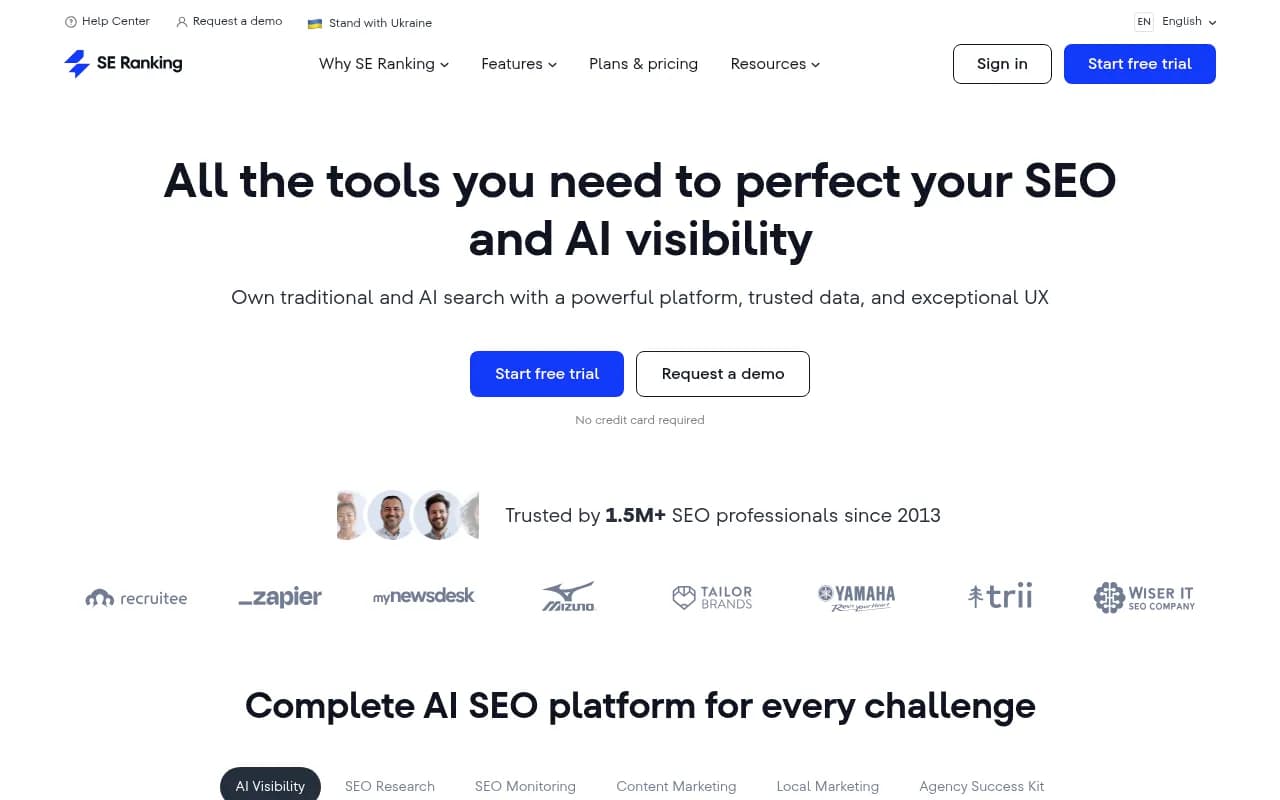
SE Ranking has added AI visibility tracking to its existing SEO platform via SE Visible. For teams already using SE Ranking for traditional SEO, this is a convenient way to add LLM monitoring without a separate tool.
Semrush
Semrush added AI visibility features to its platform, but the implementation uses fixed prompts rather than custom prompt tracking. That limits how useful it is for competitive share of voice analysis in your specific category.
Ahrefs Brand Radar
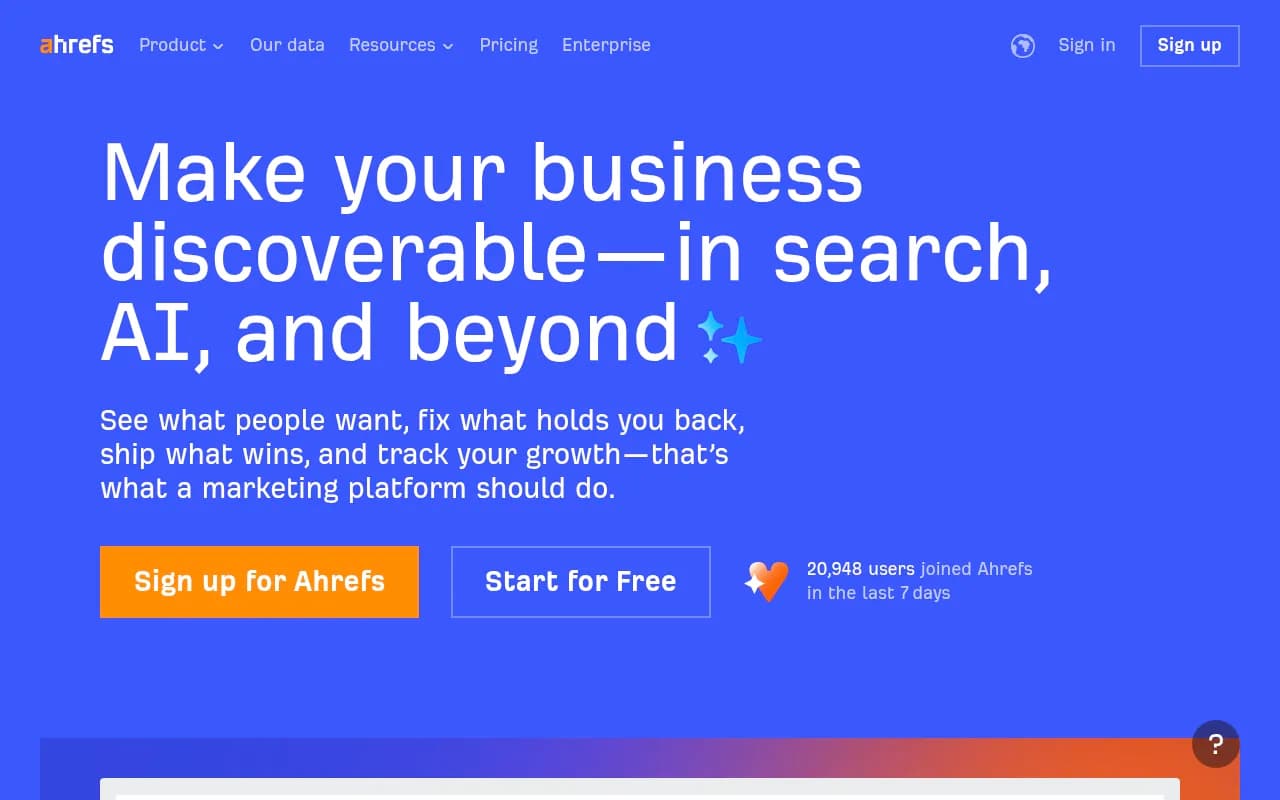
Ahrefs Brand Radar tracks brand mentions in AI search and integrates with Ahrefs' existing backlink and keyword data. Like Semrush, it uses fixed prompts and lacks AI traffic attribution -- useful as a supplement to a dedicated AI visibility platform, less useful as a standalone solution.
Peec AI
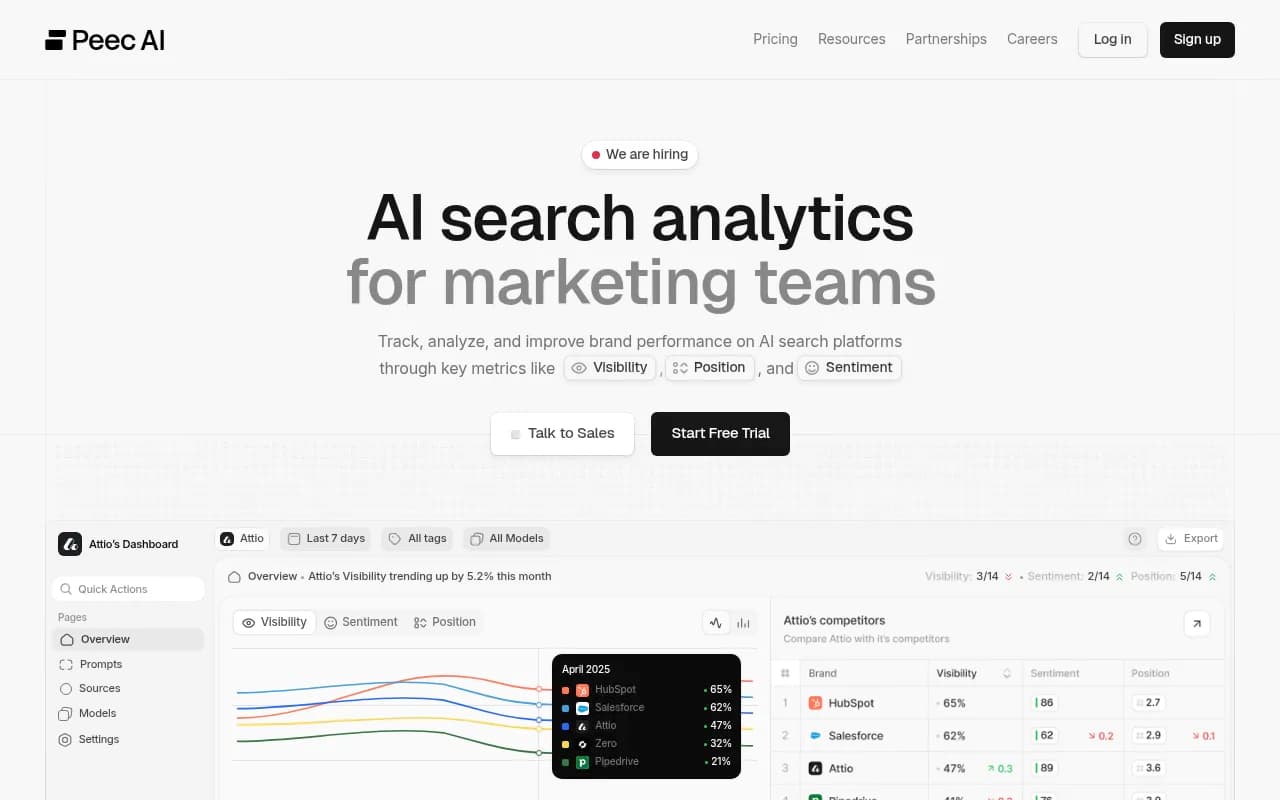
Peec AI is a lightweight monitoring tool with a low price point. It covers the main LLMs and provides basic share of voice data. Good for small teams or individuals who want a starting point, but it lacks crawler logs, content generation, and deeper competitive analysis.
Feature comparison table
| Platform | LLMs monitored | Competitive SOV | Crawler logs | Content generation | ChatGPT Shopping | Reddit/YouTube tracking | Starting price |
|---|---|---|---|---|---|---|---|
| Promptwatch | 10 | Yes | Yes | Yes (Content Agents) | Yes | Yes | $99/mo |
| Profound | 6+ | Yes | No | No | No | No | Higher |
| Otterly.AI | 4-5 | Basic | No | No | No | No | Low |
| Scrunch AI | 5+ | Yes | No | No | No | No | Mid |
| Evertune | 5+ | Yes | No | No | No | No | Enterprise |
| AthenaHQ | 8+ | Yes | No | No | No | No | Mid |
| SE Ranking | 4+ | Basic | No | No | No | No | Add-on |
| Semrush | 3-4 | Limited | No | No | No | No | Add-on |
| Ahrefs Brand Radar | 3-4 | Limited | No | No | No | No | Add-on |
| Peec AI | 3-4 | Basic | No | No | No | No | Low |
What to actually look for when evaluating these tools
Real UI monitoring vs. API-only
Ask vendors directly: do you query the actual user interface or just the API? For most use cases the difference is subtle, but for ChatGPT Shopping, Google AI Mode, and Perplexity's answer cards, it can be significant. Platforms that only use API queries are measuring a proxy.
Prompt customization
Fixed-prompt platforms (Semrush, Ahrefs Brand Radar) track a pre-set list of queries. Custom-prompt platforms let you define the exact questions your target customers are asking. For competitive share of voice analysis, custom prompts are essential -- your category has specific language that generic prompts won't capture.
Competitive benchmarking depth
Some platforms show you your own mention rate. Better ones show you your mention rate versus specific named competitors, broken down by LLM, prompt type, and time period. The best ones show you which prompts competitors win that you don't, so you know exactly where to focus.
Prompt volume and difficulty data
Not all prompts are equal. A platform that tracks 200 prompts but can't tell you which ones have high query volume is making you guess about priorities. Prompt Intelligence features -- volume estimates, difficulty scores, query fan-outs -- help you focus on prompts that actually drive traffic.
What happens after monitoring
This is the biggest differentiator in the market. Most platforms stop at showing you data. A smaller number (Promptwatch being the clearest example) close the loop: here's the gap, here's the content to fill it, here's what happened after you published. For teams with limited bandwidth, that difference is enormous.
How to set up share of voice tracking properly
Getting useful data out of any of these platforms requires some upfront work. A few things that make a real difference:
Define your prompt universe carefully. Start with 20-30 prompts that represent how your actual customers search. Include category-level questions ("best [category] for [use case]"), comparison queries ("X vs Y"), and problem-aware queries ("how do I [problem you solve]"). Avoid prompts that are too brand-specific -- those will show you're mentioned, but they're not the prompts that drive new discovery.
Set up competitor tracking from day one. Share of voice is a relative metric. Tracking your own mention rate in isolation tells you less than tracking it against 3-5 specific competitors. Most platforms let you add competitors when you set up your account -- do this before you run your first reports.
Track at the model level, not just in aggregate. Different LLMs have different citation behaviors. Perplexity cites sources aggressively; Claude tends to be more cautious. Your brand might have 40% mention rate on Perplexity and 15% on Claude. Aggregate numbers hide this. Look at model-level data to understand where your gaps are worst.
Check back weekly, not daily. LLM responses shift gradually as models are updated and new content gets indexed. Daily checking creates noise. Weekly or bi-weekly reviews give you enough data to see real trends without the false signals.
The monitoring-only trap
There's a pattern worth naming directly. A lot of teams buy an AI visibility platform, spend a few weeks looking at dashboards, and then... don't know what to do next. The data shows they're losing share of voice to competitors, but the platform doesn't tell them why or what to fix.
This is the monitoring-only trap. You have data, but no path to action.
The way out is either having a strong internal content team that can interpret the data and act on it, or using a platform that bridges the gap itself. Promptwatch's Content Agents, for example, take the prompt gap data and generate content briefs and articles designed to fill those specific gaps -- grounded in citation data, prompt volumes, and competitor analysis. That's a different product category than a monitoring dashboard, even if both call themselves "AI visibility platforms."
If your team has the bandwidth to translate monitoring data into content strategy, any of the solid monitoring platforms will work. If you need the platform to do more of that work, the list of options gets shorter quickly.
Which platform for which situation
| Situation | Recommended approach |
|---|---|
| Starting out, limited budget | Otterly.AI or Peec AI to establish baseline data |
| Mid-market team, needs competitive benchmarking | Scrunch AI or AthenaHQ |
| Team that needs to act on data, not just monitor | Promptwatch |
| Enterprise with conversion attribution needs | Profound or Promptwatch Business |
| Already using SE Ranking or Semrush | Add their AI visibility modules as a supplement |
| Agency managing multiple clients | Promptwatch (multi-site plans) or Evertune |
The bottom line
AI search share of voice is a real metric that real customers are being influenced by right now. The brands that are tracking it have a concrete advantage over the ones that aren't. The brands that are tracking it and acting on what they find have an even larger one.
Most platforms in this space will show you where you stand. Fewer will tell you what to do about it. And only a handful will actually help you do it. That distinction -- between a monitoring dashboard and an optimization platform -- is the most important thing to understand when choosing where to spend your budget in 2026.