Key takeaways
- Security buyers increasingly start vendor research inside ChatGPT, Perplexity and Google AI Overviews, so shortlists get formed before anyone visits your site.
- Monitoring alone is not enough. Cybersecurity brands need a platform that shows why AI cites competitors and helps fix it: crawler logs, citation sources, content gaps and publishing.
- ChatGPT cites product pages (22.4%), landing pages (16.8%) and listicles (13.6%) most, according to Promptwatch Data for Sep 28 to Oct 4, 2026.
- Docs, GitHub and review sites like G2 matter a lot for software and security vendors.
- Niche platforms exist for cybersecurity, but their claims are self-reported. Test any tool on your own prompts before you commit.
Why cybersecurity is a tricky category for AI visibility
Security is crowded and the vocabulary is fuzzy. Look at how the vendor roundups describe the space. Netwrix splits AI cybersecurity companies into "AI for security" and "security for AI." Orca, Check Point and Checkmarx publish their own lists with Palo Alto Networks, CrowdStrike, SentinelOne, Fortinet, Zscaler, Microsoft and Darktrace appearing again and again. Those same brands are the ones AI models repeat when someone asks for the best EDR, CNAPP or SIEM.
If you are not one of those names, you are fighting for a slot in an answer that usually names three to five vendors. And the buyers are technical. They ask long, specific questions: "best CNAPP for a mid-size AWS shop," "SentinelOne vs CrowdStrike for a lean SOC," "how to govern Copilot access to sensitive data."
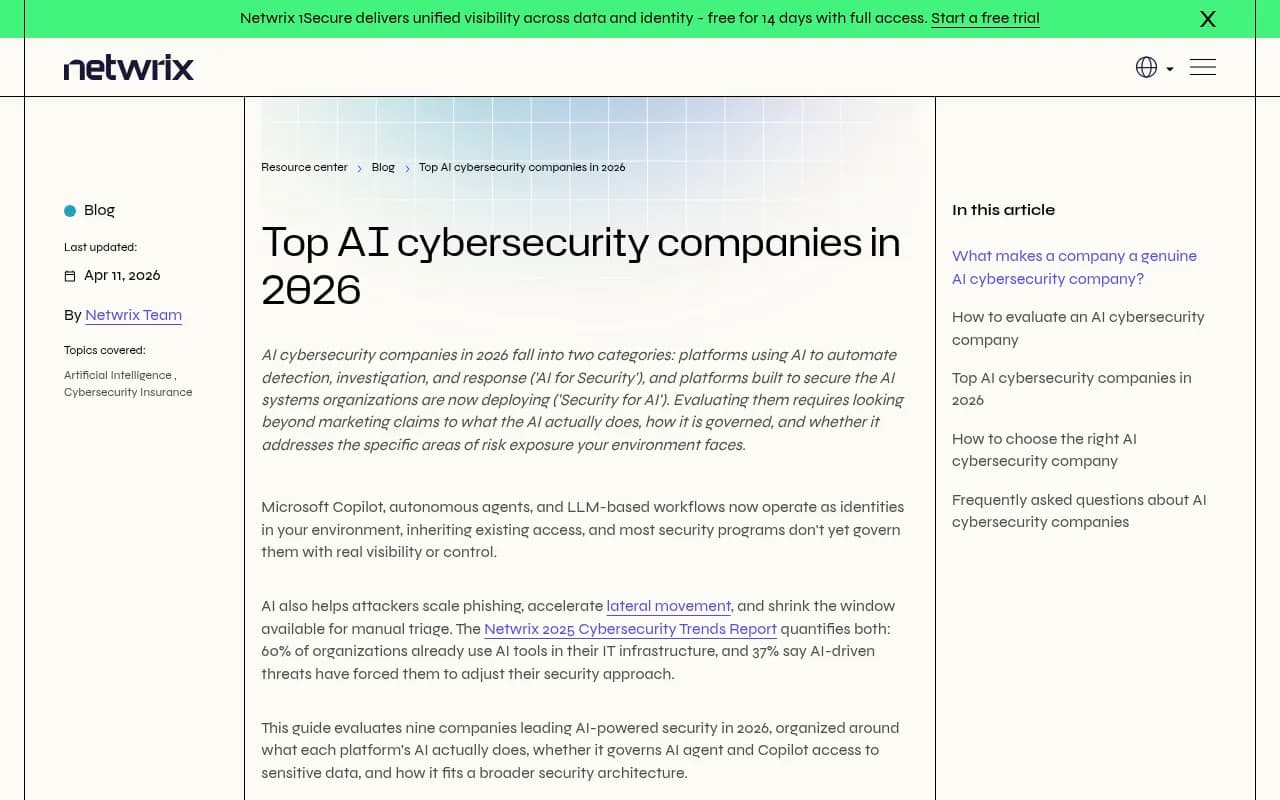
That framing matters for tracking. A vendor selling AI agent governance and a vendor selling endpoint detection compete in different prompt clusters, and your platform has to let you build those clusters yourself rather than hand you a generic list.
What AI cites when people ask about security and software
There is no cybersecurity-specific citation report from Promptwatch yet, so treat the software data as a proxy. In Promptwatch Data's software report (Sep 28 to Oct 4, 2026), these were the leading sources for software prompts in ChatGPT:
| Source | Share of software citations |
|---|---|
| GitHub | 1.2% |
| learn.microsoft.com | 0.98% |
| G2 | 0.73% |
| AWS docs | 0.41% |
| Google Cloud docs | 0.35% |
| Gartner | 0.34% |
| Capterra | 0.32% |
By source type, docs and help centers earned the most (2.64%), then vendor sites (2.01%) and review sites and analysts (1.57%). Docs plus vendor sites add up to about three times what review sites earn. For a security company that means your documentation, API reference and trust center are citation assets, not afterthoughts. Keep them crawlable.
The format data points the same way. In Promptwatch's content type report, product pages made up 22.4% of ChatGPT citations, landing pages 16.8%, listicles 13.6%, how-to guides 8.7% and documentation 7.5%. For commercial prompts like "best X for Y," product pages, landing pages, listicles and comparisons together make up almost 70%. And content half-life data shows news pages lose half their citations in about 36 days, while landing pages and docs hold on for months. So a threat-research blog post is a short-lived citation. A solid product page is a durable one.
What a security brand should demand from a platform
Here is the checklist I would use. It is shorter than most vendor feature grids because most of those grids pad out the same five ideas.
- Real-interface tracking across ChatGPT, AI Overviews, AI Mode, Perplexity, Gemini and Copilot. API-only tracking can differ from what buyers actually see.
- Custom prompts and personas. A CISO, a SOC manager and a DevSecOps lead ask different things.
- Citation source analysis. You need to see whether AI is pulling from G2, Gartner, GitHub, Reddit, a competitor's docs or an analyst listicle.
- AI crawler logs. Security sites often sit behind aggressive WAFs and bot protection. If GPTBot or ClaudeBot gets blocked, no amount of content helps.
- Traffic attribution. Mentions are vanity until you can connect AI referrals to demo requests.
- An action layer. Content gap analysis and publishing, or at least a prioritized to-do list.
- Competitor tracking at the prompt level, because security is a head-to-head category.
The crawler point deserves emphasis. Security companies tend to run strict bot rules for good reasons. But a blanket block on unknown user agents can quietly lock out the AI crawlers that decide whether you get cited. Check your logs before you spend on content.
The platforms worth shortlisting
Promptwatch
Promptwatch is the one I would put first for a security vendor that wants to act on the data, not just watch it. It tracks the real interfaces of ChatGPT, AI Overviews, AI Mode, Gemini, Perplexity and Copilot, and adds IP-verified AI crawler logs, which matter for the WAF problem above. Citation analytics show which pages, Reddit threads, YouTube videos and third-party sites AI draws on. Visitor analytics connect AI traffic to conversions.
Where it separates from pure trackers is the action side. Content gap analysis shows which prompts competitors win and you do not, the Action Board turns that into a prioritized list, and the Content Agent can write and publish to WordPress, Webflow or Framer. Published pages are then tracked through crawls, citations and clicks. Plans start with a free Explore tier, then Essential at $95 per month, Professional at $245 and Business at $579. Confirm current numbers at promptwatch.com/pricing.

GrackerAI
GrackerAI positions itself as built exclusively for B2B SaaS and cybersecurity, with industry-specific models and content generation in one platform. That is appealing if your team wants a security-flavored content engine. One caution: the "only platform built for cybersecurity" claim comes from GrackerAI's own blog, so treat it as marketing until you see the product with your own prompts. It is not in our tools catalog, so I can't point you to a card, but it is worth a demo.
Profound
Profound is an enterprise monitoring platform with strong analytics and competitor benchmarking. It suits large security vendors with budget and a dedicated team. Compared with Promptwatch, expect higher pricing and less emphasis on crawler logs and executing the fixes.

Peec AI and Otterly.AI
Both are lighter, cheaper prompt trackers. They answer "were we mentioned?" well and are a fair choice for a small security startup that just wants a baseline. They stop short of crawler logs, traffic attribution and content creation.


Semrush and Ahrefs Brand Radar
If your SEO team already lives in Semrush or Ahrefs, the AI modules are convenient. The tradeoff is shallower AI-specific data and more fixed prompt sets. Good as a secondary view, less good as the primary tool for a category as competitive as security.

ZipTie, Scrunch and BrightEdge
ZipTie gets credit for deeper analysis and reporting, Scrunch is a solid monitoring option, and BrightEdge is an enterprise SEO suite adding AI search tracking. Each is worth a look if you already have a relationship with them.

Comparison table
| Platform | Best for | Crawler logs | Content creation | Fit for security vendors |
|---|---|---|---|---|
| Promptwatch | Teams that want to fix gaps, not just see them | Yes, IP-verified | Yes, with CMS publishing | Strong; handles WAF and docs issues |
| GrackerAI | Cybersecurity-specific content workflows | Unverified | Yes | Promising, claims self-reported |
| Profound | Large enterprise monitoring | Limited | No | Good for big brands with budget |
| Peec AI | Cheap baseline tracking | No | No | Fine for startups |
| Otterly.AI | Affordable monitoring | No | No | Fine for startups |
| Semrush / Ahrefs | Existing SEO suite users | No | Limited | Secondary view |
| ZipTie | Deep analysis and reporting | Limited | No | Solid analyst tool |
For more options, the GEO software directory at bestgeosoftware.com lists many more platforms.
How to set up your tracking for a security brand
Build prompt clusters by buyer, not by keyword
Start with three or four clusters. Category prompts ("best XDR platforms"), comparison prompts ("CrowdStrike vs SentinelOne"), problem prompts ("how do I stop prompt injection in an internal LLM app") and compliance prompts ("SOC 2 tools for a 200-person SaaS"). Add personas for CISO, SOC lead and developer. Fifty well-chosen prompts beat five hundred generic ones.
Audit crawl access first
Before creating anything, confirm that GPTBot, OAI-SearchBot, ClaudeBot and PerplexityBot can reach your product pages and docs. Check WAF rules, rate limits and robots.txt. Promptwatch's AI crawler data shows how much verified AI crawler traffic is out there, and some of it is Meta, whose crawler share jumped sharply in summer 2026 per this report. Blocking by habit has a cost.
Fix the assets AI actually cites
Based on the data above, in rough priority order:
- Make product pages comparable: clear pricing or pricing model, specs, supported environments and target buyer.
- Keep documentation and help pages public and crawlable.
- Keep G2, Capterra and Gartner Peer Insights profiles current. Together review sites earn more software citations than any single vendor.
- Publish honest comparison pages against the vendors AI keeps naming.
- Maintain a public GitHub presence if you have any open-source tooling or SDKs.
- Add an FAQ page about your brand.
Watch the social and forum layer carefully
This varies by engine. ChatGPT drew only 0.46% of its citations from social platforms in late Sep to early Oct 2026, versus 12.2% for Google AI Overviews, per Promptwatch's social media report. Reddit's share in ChatGPT also collapsed in August. So if your audience hangs out on r/netsec or r/cybersecurity, that presence still helps in Google surfaces but matters far less in ChatGPT right now.
How to read the numbers
A few quick diagnoses I find useful:
- Low share of voice means a coverage problem. You are missing from prompts you should own.
- Mentioned late in the answer means a prominence problem.
- Mentioned but never cited with a link points to a content or crawlability issue.
- Cited, but only through third-party listicles, means you need stronger first-party pages.
Security vendors often land in that last bucket. Analysts and review sites write about you, and AI cites them instead of you.
Who should choose what
A seed-stage security startup with a small budget can start with Peec AI or Otterly.AI, or Promptwatch's free tier, just to see where it stands. A growth-stage vendor with a content team should look at Promptwatch for the combined crawler, citation and publishing loop, and demo GrackerAI if security-specific content is the bottleneck. A large enterprise vendor with a dedicated analytics team can compare Profound and Promptwatch Business side by side. If you would rather hand the work to people, an agency that does GEO such as 1001 SEO Media can run the program on top of a platform like this.
Next steps
Run a free baseline first. Pull 30 to 50 prompts across your clusters, record where you and your top five competitors show up, then check your crawler access. Choose the platform that lets you move from that baseline to published fixes with the least friction, and re-measure after a month. For more tool roundups, browse SurferStack.