Key takeaways
- ChatGPT's automotive citations go mostly to marketplaces and review sites, not dealers. In August 2026, Autotrader (5%) and Cars.com (4.6%) led, per Promptwatch Data.
- A dealership domain barely shows up in that data. Only one dealer, birchwoodgroup.co.uk at 0.28%, made the top 31. Your visibility often depends on your listings and reviews, not just your own site.
- Pick a platform by what it does after the dashboard: crawler logs, content gaps, local tracking and a to-do list matter more than a mention count.
- Dealer-specific tools (Ekho GEO, Fullpath) and general GEO platforms (Promptwatch, Profound, Qwairy) solve different problems. Many groups need one of each.
- Start with a free scan of 20 to 30 buyer prompts before you pay for anything.
Why automotive is a strange AI search category
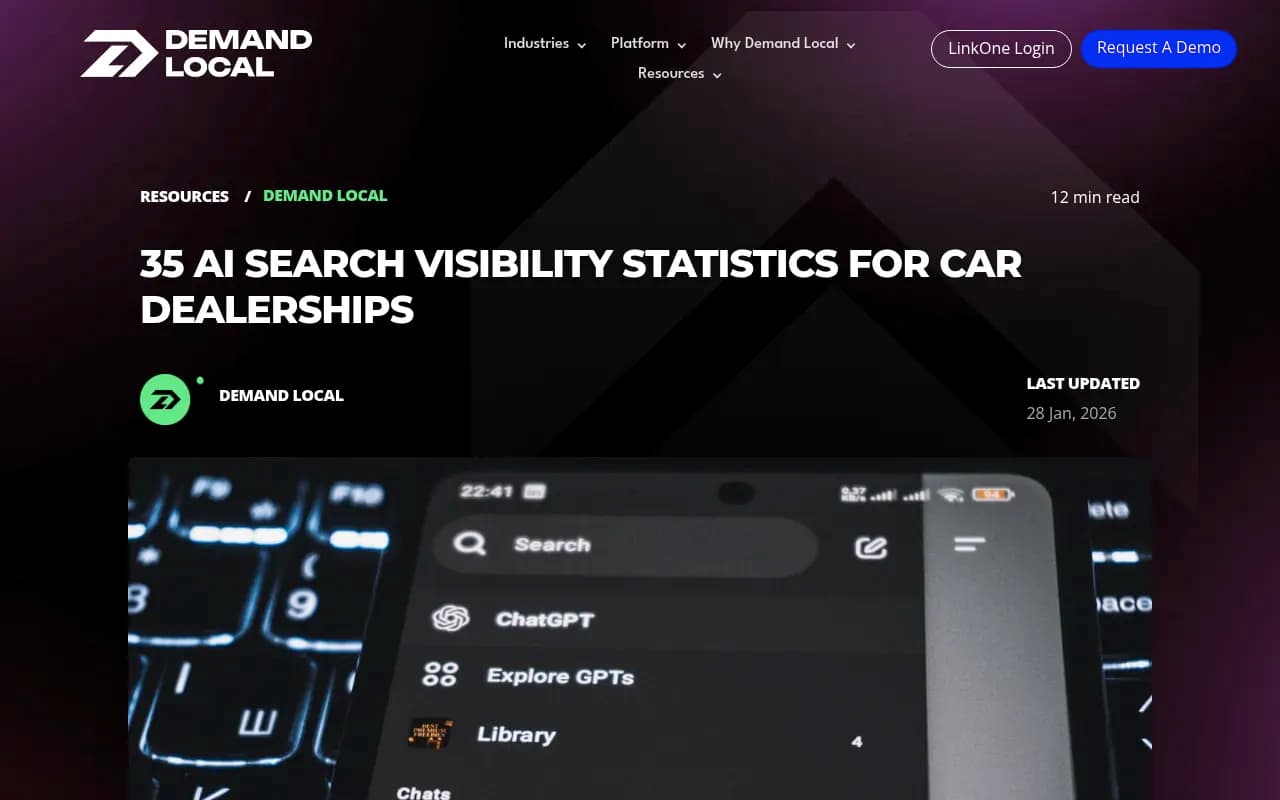
Car shopping is one of the clearer cases where AI changes the funnel. Cars.com's November 2025 survey, as summarized by Demand Local, found 44% of consumers had used AI tools when shopping for a vehicle, and 97% of those users said AI would affect their purchase decision. Treat those as third-party survey figures and not gospel, but the direction is hard to argue with. Someone types "best electric SUV for families under $50,000" into ChatGPT, gets a shortlist, and never opens a search results page.
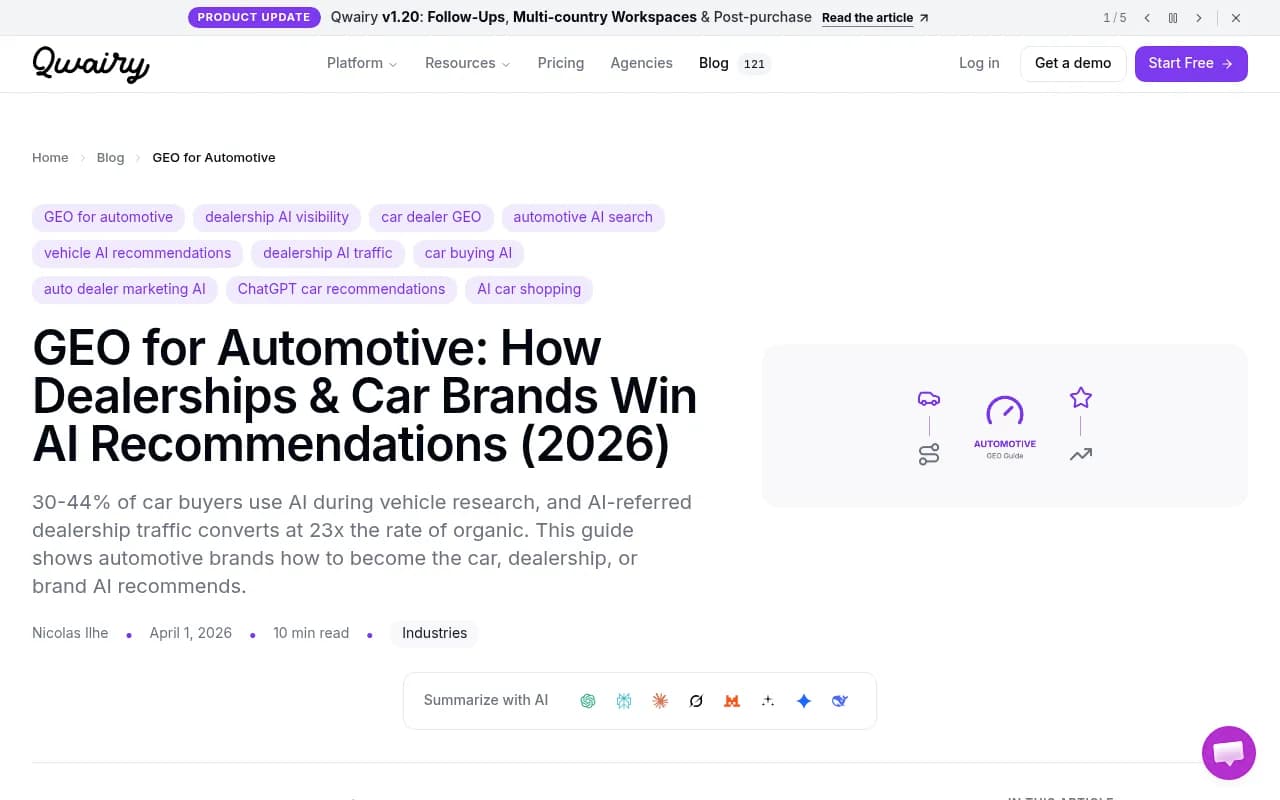
The awkward part for dealers is who gets named. Qwairy's automotive GEO guide says AI keeps returning the same handful of national names: Tesla, Toyota, CarMax, Edmunds, KBB. And Promptwatch's citation data backs that up from the source side. If you run a franchise store two miles from the buyer, you are competing with sites that have far more structured data than you do.
What ChatGPT actually cites for car prompts
Promptwatch Data looked at real automotive prompts run through ChatGPT across August 2026. A few numbers worth knowing:
- Autotrader.com is first with 5% of automotive citations, Cars.com second at 4.6%.
- Seven of the top eight domains are marketplaces or research and review sites.
- Chevrolet.com is the only manufacturer in the top eight, at 2.62%.
- Reddit ranks ninth at 1.34%.
- By source type, marketplaces and listings take 14.65% and reviews and research 12.62%. Manufacturer sites get 7.92%. Community and news, dealerships, and service and finance sites combined get 2.12%.
That last line is the one I would put in front of a dealer principal. Dealerships are fighting for a sliver. The practical consequence: keeping inventory, pricing and dealer information accurate on the big marketplaces, and keeping complete profiles on DealerRater, Birdeye and BBB, is part of your AI strategy. The report recommends exactly that, plus stable pages for each model and trim.
The broader content-type data points the same way. Across all industries from Sep 28 to Oct 4, 2026, product pages were 22.4% of ChatGPT citations and landing pages 16.8%. Reviews were only 1.7%. Pages that describe what you sell, with specs and prices, win. Thin "call us for pricing" pages do not.
What to look for in an AI visibility platform
Most tools in this space answer one question: was my brand mentioned? For automotive you need more than that. Here is the checklist I would use.
Local and multi-location tracking
"Best Toyota dealer near me" has a different answer in every city. A platform that only tracks national prompts will miss most of what a dealer group cares about. Check for city or state tracking, and whether it uses real ChatGPT and Google AI Overviews interfaces rather than API calls, because user-facing answers can differ from API output.
Citation sources, not just mentions
Given the data above, you want to know which marketplace, review site or forum is being cited when a competitor wins. That tells you where to fix your listings, not just that you lost.
AI crawler visibility
Demand Local reports that 48% of dealership websites actively block AI crawlers and 84% score below 60/100 on AI visibility tests. I have not verified those figures independently, but blocked crawlers are common enough that you should check. Tools with IP-verified crawler logs show whether GPTBot, OAI-SearchBot and others can read your inventory pages at all.
Action, not only reporting
If the tool hands you a chart and leaves, someone on your team still has to decide what to write. Look for content gap analysis, a prioritized task list, and ideally content generation that publishes to your CMS.
Pricing that fits a dealer group
Dealer groups run many rooftops. Check how prompts, projects and responses are counted, and whether agency or multi-project plans exist if you manage several stores.
The shortlist
| Platform | Type | Best for | Local tracking | Takes action? |
|---|---|---|---|---|
| Promptwatch | End-to-end GEO platform | Dealer groups, OEMs, agencies | Country on all paid plans, state/city from Business | Yes (Content Agent, Action Board) |
| Ekho GEO | Dealer-focused add-on to a vehicle commerce platform | Dealers already on Ekho | Dealer benchmarking | Suggests steps |
| Fullpath | Dealer marketing platform on a CDP | Dealers wanting unified marketing | Dealer-specific | Marketing automation |
| Finseo | Automotive-oriented AI tracker | Brand-level model comparisons | Not verified | Not verified |
| Qwairy | GEO platform | Teams wanting automotive guidance | Local dealer comparisons | Monitoring-led |
| Profound | Enterprise tracker | Large OEMs with budget | Not verified | Mostly monitoring |
| Otterly.AI | Basic prompt tracker | Small budgets | Limited | No |
I did not verify pricing or feature depth for most of the dealer-specific tools, so confirm directly with each vendor. The comparison is based on how each vendor describes itself.
Platform by platform
Promptwatch
Promptwatch is the one I would put first for most dealer groups and OEM marketing teams, mainly because it covers the loop from "why am I invisible" to "here is a published page that fixes it." It tracks ChatGPT, Google AI Overviews, AI Mode, Gemini, Perplexity, Copilot and others through their real interfaces, so you see what a shopper sees.

Three things matter for automotive. First, IP-verified crawler logs show whether AI bots reach your inventory and model pages, which is the quiet failure behind a lot of invisible dealer sites. Second, citation analytics, including Reddit, YouTube and LinkedIn, show which third-party pages AI leans on for your models. Third, the Content Agent and Action Board turn gaps into drafts and tasks, with publishing to WordPress, Webflow or Framer. State and city tracking arrives on the Business plan ($579/mo), which is where most multi-store dealers will land. Essential starts at $95/mo and agency plans start at $199/mo; confirm current numbers at promptwatch.com/pricing.
The honest caveat: it is a general platform, not a dealer tool. It will not run your email, SMS or inventory feeds. You bring the automotive knowledge, and its Brand Book and Knowledge Base help keep content accurate.
Ekho GEO
Ekho calls itself an end-to-end vehicle commerce platform for OEMs and dealers, and it launched Ekho GEO off the back of its 2026 AI vehicle research study. The pitch is benchmarking your AI visibility, comparing against competitors, and getting steps to improve. If you already run Ekho, adding it is an obvious move. If you do not, you would be adopting a vehicle commerce stack to get a visibility feature, which is a bigger decision.
Fullpath
Fullpath's angle is different. It argues the best AI marketing platform for dealers is a unified, CDP-based platform with agentic AI coordinating email, SMS, advertising and website personalization. It also published the widely cited claim that AI-referred dealership traffic converts at 23x the rate of organic, which Qwairy repeats. That is a vendor figure, so read it with some salt. Fullpath is more about activating your dealer data than auditing how ChatGPT describes you.
Finseo
Finseo has an automotive page built around brand-level comparisons such as Tesla versus BMW versus Mercedes, and cites Fullpath's January 2026 split of AI platform share (ChatGPT 89%, Gemini 6.5%, Perplexity 4%). It reads as more useful to OEM and brand teams than to a single dealership. I could not verify its features beyond the marketing page.
Qwairy
Qwairy publishes one of the better automotive GEO guides, with practical advice on local visibility versus competing dealers, Car schema on live inventory, and YouTube walkaround videos for Gemini.
As a tool it leans toward monitoring, so expect to do the content work yourself or elsewhere.
Profound, Otterly.AI and the rest
Profound is strong on enterprise monitoring and priced accordingly. Otterly.AI is a cheap way to see mentions but has no crawler logs or content workflow.


If you want to browse more options, the GEO software directory at bestgeosoftware.com lists a wide range of platforms side by side.
Fixes that move the needle for car brands and dealers
A platform tells you where you stand. These are the changes the data suggests actually matter.
- Clean up marketplace listings. Autotrader and Cars.com are the most cited domains, so wrong prices or stale inventory there hurt you in AI answers.
- Complete your review profiles. DealerRater, Birdeye and BBB profiles show up in the sources AI cites.
- Build a stable page for every model and trim, with specs, pricing context and ownership information. Product and landing pages hold up longest; news loses half its citations in roughly five weeks.
- Publish transparent pricing. Qwairy's guide flags "call for price" as a visibility killer.
- Check robots.txt and your CDN rules so AI crawlers can read inventory pages.
- Make EV content. Qwairy argues current incentives, charging and total cost of ownership are the least contested ground because few dealers publish them.
- Make walkaround videos. Qwairy says Gemini leans on YouTube. Note that ChatGPT barely cites social platforms at all (0.46% from Sep 28 to Oct 4, 2026), while Google AI Overviews got 12.2% of its citations from them, so the benefit depends on the engine.
Supporting tools worth pairing
AI visibility rarely stands alone for a dealer. Reputation and listing tools feed the sources AI cites. Birdeye is named in the Promptwatch automotive report as a profile worth completing.
For listings consistency across many locations, Yext and Synup are options in the same family, and Google Search Console stays free and useful for seeing which model pages already rank.
Which should you choose?
| Your situation | Start with |
|---|---|
| Single store, tight budget | Free scan, then a low-tier tracker or Promptwatch Essential |
| Multi-rooftop dealer group | Promptwatch Business plus a reputation tool |
| Agency serving dealers | Promptwatch agency plans with white-label reports |
| OEM or brand marketing team | Promptwatch or Profound, with model-level prompts by country |
| Already on Ekho or Fullpath | Their native feature first, plus an independent check |
If you would rather hand off the strategy, an SEO and GEO agency like 1001 SEO Media works with Promptwatch to run this kind of program for clients.
A simple way to test before you buy
Write 25 prompts a real buyer would type: model comparisons, "best dealer in [city]", price and incentive questions, EV range, and trade-in. Run them on ChatGPT, Google AI Overviews and Gemini. Note who gets named and which sources get cited. Then ask each vendor on your shortlist to reproduce those results on a trial. The platform that finds the same gaps and tells you which page to fix is the one worth paying for. A free scan from a tool like Promptwatch's AI Visibility Report is a fair starting point.
The pattern in the data is simple. Dealers lose AI visibility on the sites they do not control. Pick the platform that shows you those sites, then fix them one at a time.