Key takeaways
- Employers and candidates increasingly ask AI assistants for agency recommendations before ever contacting a supplier list; if you're not in the answer, you don't get the call
- LinkedIn citation behavior varies wildly by engine: ChatGPT treats your company page like a directory listing, while Google's AI surfaces prefer Pulse articles, so a single LinkedIn strategy won't work across all engines
- Generic recruitment tracking tools miss agency-specific intents like "which staffing firms can fill second-shift warehouse roles in Columbus this week" - you need prompt sets built around sector plus geography plus compliance
- Peec AI, Otterly.ai, Profound, and Promptwatch cover different budget and depth needs; there's no single right answer, but there is a wrong one if you pick based on price alone
- Recruitment agencies need to track visibility on both sides of the desk: employers searching for a supplier, and candidates deciding where to register
Why recruitment agencies can't ignore this anymore
A hiring manager at a mid-size logistics company used to open her CRM, scroll through past vendors, and call the two or three staffing firms she already knew. Now she opens ChatGPT and types something like "which staffing agencies can fill second-shift warehouse roles in Columbus with background checks and start dates this week." If your agency doesn't show up in that answer, you're not losing a lead. You never existed for her.
That's the blunt version of what's happening across the recruitment industry. The AI visibility use-case research from Presenc AI puts it plainly: agencies not mentioned in these AI-generated shortlists simply don't get contacted, and by default the big generalist brands (Hays, Robert Half, Michael Page) win because they have the web presence and media coverage to be the obvious answer. Specialist agencies with deep, sector-specific content can actually outrank them for narrower queries, but only if someone is watching what the AI models say and fixing what's wrong.
This isn't a hypothetical shift either. Ahrefs has found that only about 38% of pages cited in Google's AI Overviews rank in the traditional top 10 for the same query, down from 76% back in July 2025. Classic SEO rank and AI citation are pulling apart. An agency ranking #3 on Google for "IT staffing Dallas" might be completely absent from what ChatGPT tells a hiring manager who asks the same thing in different words.
What's different about recruitment-specific AI visibility
Most AI visibility tools were built with e-commerce or SaaS brands in mind. Recruitment agencies face a distinct set of problems:
Entity confusion. "Apex Staffing" gets mixed up with a dozen similarly-named competitors, or with the generic concept of recruitment itself. AI models sometimes can't tell you apart from the industry you work in.
Sector misassociation. If your website says "staffing solutions" in one place and "healthcare recruitment specialists" in another, without consistency across your site, LinkedIn, and directory listings, the AI may label you a generalist when you're actually a niche specialist, or vice versa.
Stale information. AI models trained on older data describe agencies by outdated leadership, closed offices, or services you dropped two years ago. Nobody flags this unless someone is actively monitoring it.
On top of that, recruitment queries split into distinct intents that a generic prompt set won't catch: employer-side discovery ("which agency can staff X role"), candidate-side validation ("which agencies have good reviews for pay transparency"), and compliance checks ("which firms verify state nursing licenses"). A tool built for tracking "best CRM software" mentions isn't going to surface these nuances unless you configure the prompts yourself.
What the data says about where AI actually looks
Before picking a tool, it helps to know where these engines pull information from, because it changes what you optimize.
According to Promptwatch's citation-page-type data, LinkedIn Pulse articles and regular posts together make up roughly 70% of all LinkedIn citations across AI engines combined. But the split by engine is where it gets interesting for recruitment agencies specifically:
- ChatGPT leans heavily on LinkedIn company pages (23.84% of its LinkedIn citations) and even the LinkedIn homepage (22.55%), using LinkedIn almost like a company directory to verify who you are. Job listings punch above their weight too, at 8.02%, often answering "who is this company and who are they hiring."
- Google AI Mode and AI Overviews are article-hungry: Pulse articles take 44.85% and 42.25% of their respective LinkedIn citations. If you want visibility on Google's AI surfaces, get your recruiters publishing bylined Pulse pieces on sector hiring trends and salary data.
- Perplexity flips the script: ordinary feed posts (41.88%) beat Pulse articles (32.46%). Timely, specific practitioner takes about this quarter's hiring trends outperform polished long-form content there.
The practical takeaway: a recruitment agency's "complete, factual, current LinkedIn company page" matters most for ChatGPT visibility, while sector-specific Pulse articles matter most for Google's AI surfaces. One LinkedIn strategy doesn't serve every engine equally.

Zoom out to social platforms more broadly and LinkedIn's overall share of AI citations is small, about 0.74% across all engines per Promptwatch's social media citations data, against Reddit's 3.36%. ChatGPT is essentially a "Reddit specialist" (5.19% of its citations) with LinkedIn a distant second (0.23%). That doesn't mean skip LinkedIn, it's disproportionately valuable for B2B queries even if the raw percentage is small, but it does mean don't ignore what candidates and employers are saying about you on Reddit either.
On content format, Promptwatch's ChatGPT citation types data shows product-page-style citations made up 32.8% of ChatGPT Search citations in July 2026, nearly double the March figure. For a recruitment agency that means your own service pages ("IT staffing in Dallas," "healthcare per diem placements in Phoenix") are increasingly citable directly by ChatGPT, not just when a third-party roundup mentions you. Build dedicated pages per sector-geography combination rather than one generic "our services" page.
The tools worth evaluating
Here's how the main contenders stack up for a recruitment agency's needs specifically, not just generic marketing use.
| Tool | Starting price | Engines tracked | Best fit for recruitment agencies |
|---|---|---|---|
| Promptwatch | $95/mo (Essential) | ChatGPT, Gemini, Claude, Perplexity, Grok, Copilot, DeepSeek, Mistral, AI Overviews, AI Mode | Agencies that want crawler logs, Reddit/YouTube citation tracking, and automated content generation, not just alerts |
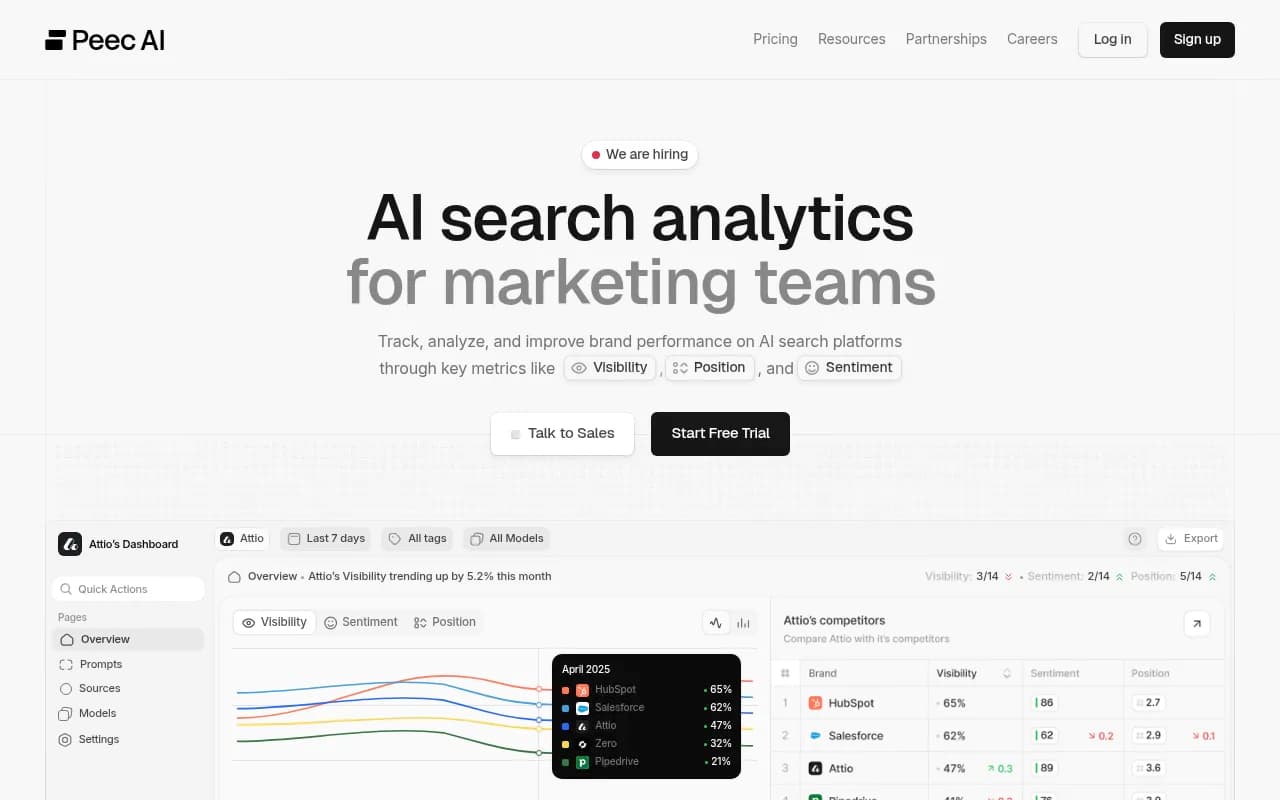
| Peec AI | ~$95/mo (Starter, EUR-priced) | Choose 3 of 6 core engines; extras cost more | Agencies managing several client accounts who need unlimited seats |
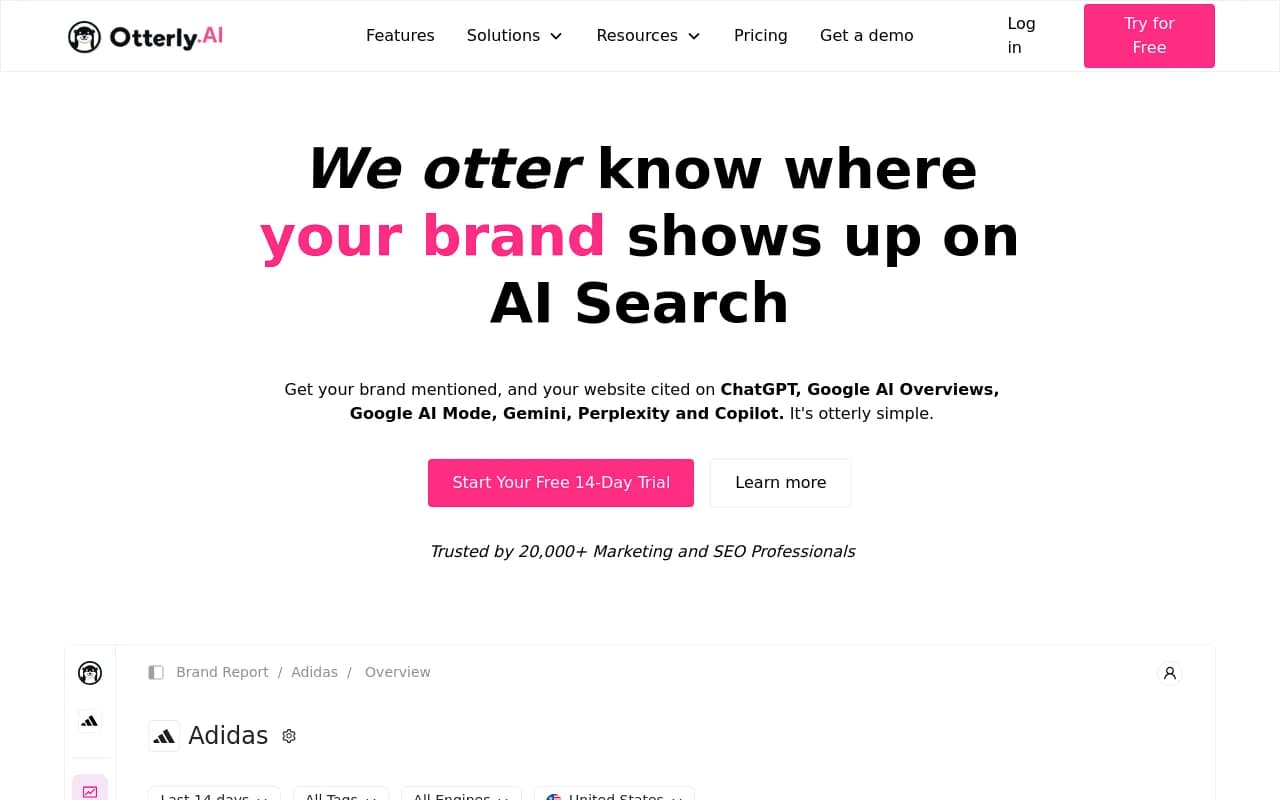
| Otterly.ai | $29/mo (Lite) | ChatGPT, AI Overviews, Perplexity, Copilot core; others as add-ons | Small or solo recruitment marketers testing the waters cheaply |
| Profound | $99/mo (Starter, limited) / $399/mo (Growth, realistic entry) | Up to 9-11 engines on Enterprise | Larger staffing firms with pitch decks and leadership reporting needs |
| ZipTie | ~$43-159/mo depending on plan structure | Google AI Overviews, ChatGPT, Perplexity | Agencies focused mainly on Google's AI Overviews with screenshot-level documentation |
Promptwatch
Promptwatch is what I'd point a recruitment agency toward if they want more than an alert dashboard. Most of the tools above answer "were we mentioned." Promptwatch tries to answer "how do we get mentioned more, and does it actually turn into placements." That distinction matters a lot for an industry where the content that wins citations (sector salary guides, hiring trend reports, market intelligence) takes real effort to produce and keep current.
What's actually useful here for a staffing firm: the crawler log feature (Agent Analytics) shows when ChatGPTBot, ClaudeBot, PerplexityBot, and 400+ other crawlers hit your job pages and sector landing pages, and whether they hit errors before they could even read the content. If your /jobs pages are blocking bots or throwing errors, you'll never show up in an AI answer regardless of how good the content is. The Content Agent can then plan, write, and publish sector-geography landing pages to your CMS on a schedule, which addresses the "we know we need 40 different sector x city combinations but nobody has time to write them" problem that specialist agencies run into constantly.
Promptwatch also tracks Reddit and YouTube citations specifically, which matters given how often ChatGPT pulls from Reddit (5.19% of its citations per the data above). Candidate reviews and discussions about pay transparency or recruiter communication often live on Reddit threads that AI models cite when someone asks "which agencies have strong candidate reviews." Most competitors in this space simply don't track that channel at all.
Pricing starts at $95/mo for the Essential tier (50 prompts, all major LLM tracking, 5 AEO articles included), with Professional at $245/mo adding automated content generation and state/city-level tracking, useful if you're monitoring visibility across multiple branch offices.
Peec AI
Peec repriced in August 2026 to a EUR-denominated, geo-priced model. Starter runs about €70/mo and includes 50 prompts across a choice of 3 of 6 core engines (ChatGPT, AI Overviews, AI Mode, Copilot, Perplexity, Gemini). The standout feature for agencies is unlimited team seats on every tier, which matters if a recruitment agency has multiple branch managers who each want visibility into their local market. Agency-specific pricing runs $245-$795/mo for managing multiple client accounts, relevant if you're an agency that also advises corporate clients on their own employer-brand visibility.
Otterly.ai
At $29/mo for the Lite tier, Otterly is the cheapest real entry point, tracking 15 prompts across ChatGPT, AI Overviews, Perplexity, and Copilot. The catch: Google AI Mode, Gemini, and Claude are paid add-ons, so full coverage on Lite actually runs closer to $76/mo. Unlimited team members on every plan, including Lite, is a genuine advantage for a small agency marketing team that wants everyone to see the data without paying per seat.
Profound
Profound's advertised $99/mo Starter tier is worth knowing about mainly so you don't get fooled by it: ChatGPT only, 1,500 responses a month, no exports, no API. Reviewers describe it as a funnel tier rather than something you'd actually run on. The Growth tier at $399/mo (billed yearly) is the realistic starting point, adding Perplexity and Google AI Overviews plus CSV/JSON exports. Profound makes sense for larger staffing firms building leadership decks around AI visibility, since its Enterprise tier adds nine to eleven engines and prompt-volume data useful for justifying budget to a CFO.
ZipTie
ZipTie has gone through a pricing restructure and there are two different fee structures floating around depending on where you look, so verify current pricing before committing. The newer usage-based model charges per prompt monitored times number of engines, with add-ons for UGC impact analysis (tracking how Reddit and similar platforms shape AI's description of your brand) and content generation. It's strongest specifically for Google AI Overviews tracking with screenshot-level documentation, but weaker on full multi-engine coverage since it lacks native Gemini or Claude tracking in its base tiers.
Prompts you should actually be tracking
Generic "best recruitment agency" prompts miss most of the real buying behavior. Build your prompt set around actual intents:
- Employer discovery by sector and geography: "Which staffing agencies can fill second-shift warehouse roles in Columbus with background checks and start dates this week?"
- Sector plus compliance: "Healthcare staffing agencies in Dallas that place per diem nurses and verify state licenses"
- Comparison prompts: "Compare IT staffing firms for cleared cybersecurity contractors near Washington, DC"
- Candidate-side validation: "Which agencies have strong candidate reviews for pay transparency, recruiter communication, and reliable assignments?"
These mirror how real hiring managers and candidates phrase questions, and they're the prompts most generic AI visibility tools won't have pre-loaded. You'll need to configure them yourself in whichever platform you choose.
What content actually earns citations for staffing firms
Across the research, the highest-value formats are consistent: sector-specific salary guides, hiring trend reports, and market intelligence tied to a specific geography. Generic "5 tips for hiring" content doesn't move the needle. On the technical side, Joveo's recruitment-focused AEO guide recommends JobPosting and FAQPage schema on every job listing, 50-80 word "why work here" answer-ready paragraphs on hiring hub pages, and clean sitemaps with expired postings removed rather than left to rot. None of this is exotic SEO advice, it's just rarely done well in an industry where job boards get updated constantly and nobody circles back to clean up old listings.
Citation sources for staffing buyers also skew differently than general B2B: expect AI models to pull from American Staffing Association resources, state staffing association pages, compliance guidance, and candidate review sites. That's a different source landscape than e-commerce or SaaS GEO work, and it's worth checking whether any tool you pick lets you monitor those specific domains rather than just generic web citations.
Buy a tool or build the capability in-house
According to Conductor's survey of 250+ enterprise marketing executives, 94% plan to increase AEO/GEO investment in 2026 after averaging 12% of digital marketing budget on it in 2025, and 97% reported measurable positive funnel impact. That's a strong signal the spend is worth it, but for a mid-size recruitment agency the real question is whether to hire someone internally or lean on a tool plus an agency.
If you're weighing that decision, the salary benchmarks are worth knowing: a GEO/AEO growth marketing specialist runs $75K-$95K, and a senior content marketing hire with AI focus runs $150K-$210K. For most agencies under a few hundred employees, a tool subscription plus periodic outside help makes more financial sense than a full-time hire, at least until AI-driven leads become a large enough channel to justify it. If you want a second opinion on the strategy side rather than just the tooling, 1001 SEO Media works with brands on exactly this kind of AI search and GEO planning.
Getting started without overspending
If you're a small or mid-size recruitment agency testing whether this even matters for your market, start cheap: run Otterly's $29/mo Lite tier or Promptwatch's free Explore tier for a month, tracking 10-15 prompts built around your actual sector-geography combinations. If you start seeing employer-discovery queries returning competitors and not you, that's your signal to move to a paid tier with content generation built in, since fixing the gap takes more than a dashboard telling you it exists.
For a broader look at the GEO software category beyond recruitment, the directory at bestgeosoftware.com breaks down platforms by feature depth if you want to compare more options side by side.