Key takeaways
- Jasper and Copy.ai are drafting tools. Neither was designed to show which of your pages ChatGPT, Perplexity or AI Overviews actually cite.
- AirOps is the closest of the three to a GEO platform, since it tracks citations and ties them to content actions. It is still workflow-heavy and needs someone to run it.
- Promptwatch Data shows product pages and landing pages take about 39% of ChatGPT citations. A generic writing tool cannot tell you whether your pages are in that group.
- Content decays in AI answers. Without a monitoring and refresh loop, publish-once output loses citations over time.
- Pick by bottleneck: Jasper or Copy.ai for production speed, AirOps for execution workflows, a GEO platform when you need to know what is cited and why.
The problem with writing tools in an AI search world
For years, the content tool question was simple. Which one writes a decent draft fastest? Jasper, Copy.ai and a dozen others answered that, and plenty of teams got real value from them.
The question has changed. In 2026 the useful question is whether the page you publish gets pulled into a ChatGPT answer, a Perplexity source list or a Google AI Overview. A draft can read well and never be cited. A tool that only produces text cannot tell you either way.
That is the gap this guide is about. I am not arguing these tools are bad. I am arguing they solve the first half of the job (making content) and leave the second half (knowing what AI engines do with it) to somebody else.
What each tool is built to do
Jasper
Jasper is a marketing content platform built around brand voice, templates, collaboration and governed output at scale. It has recently added a GEO hub and agent for on-domain visibility scoring. According to AirOps, which is a competitor and so not a neutral source, that hub scores visibility on your own domain but does not track page-level citations across engines or connect to a publish-and-measure loop. Treat that as a vendor claim and test it yourself.
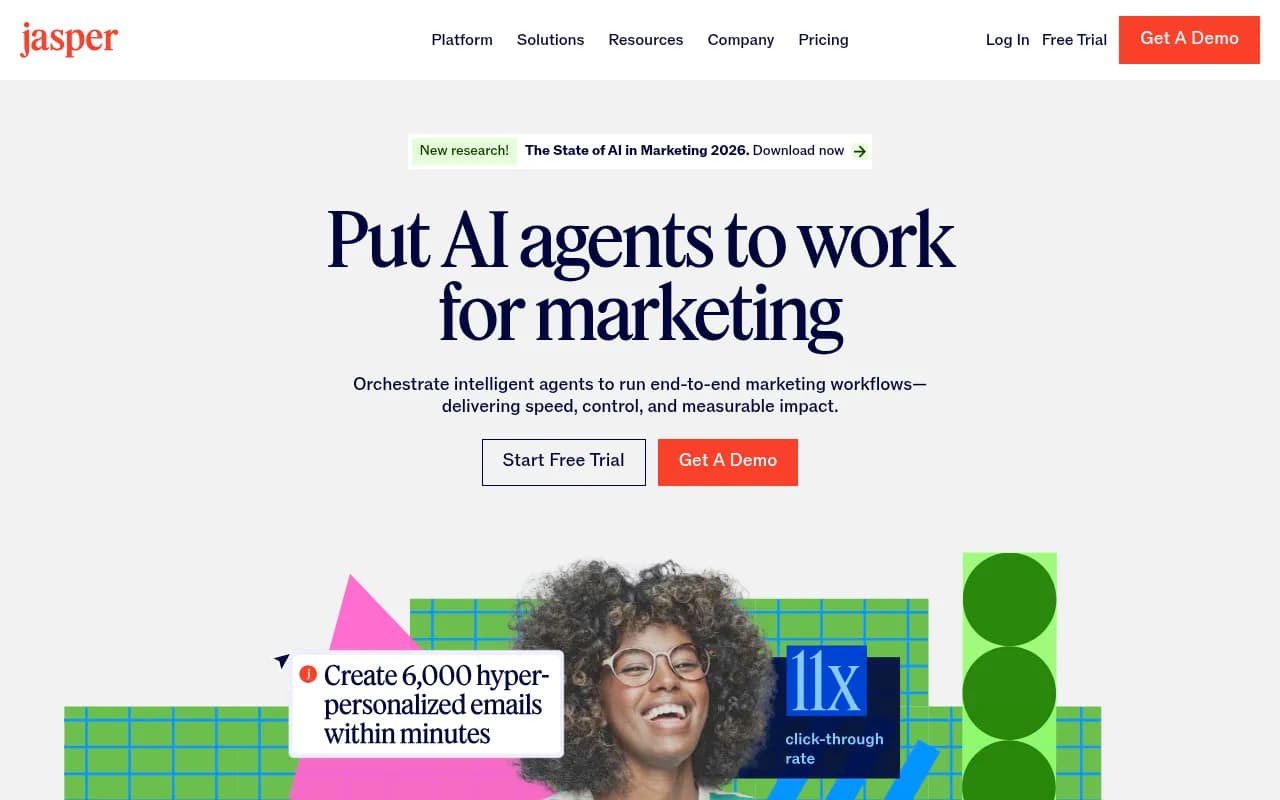
Third-party comparisons put Jasper at roughly $59 per seat per month on annual billing, $69 monthly. Confirm on the vendor's pricing page, since these figures were reported by reviewers rather than verified by us.
Copy.ai
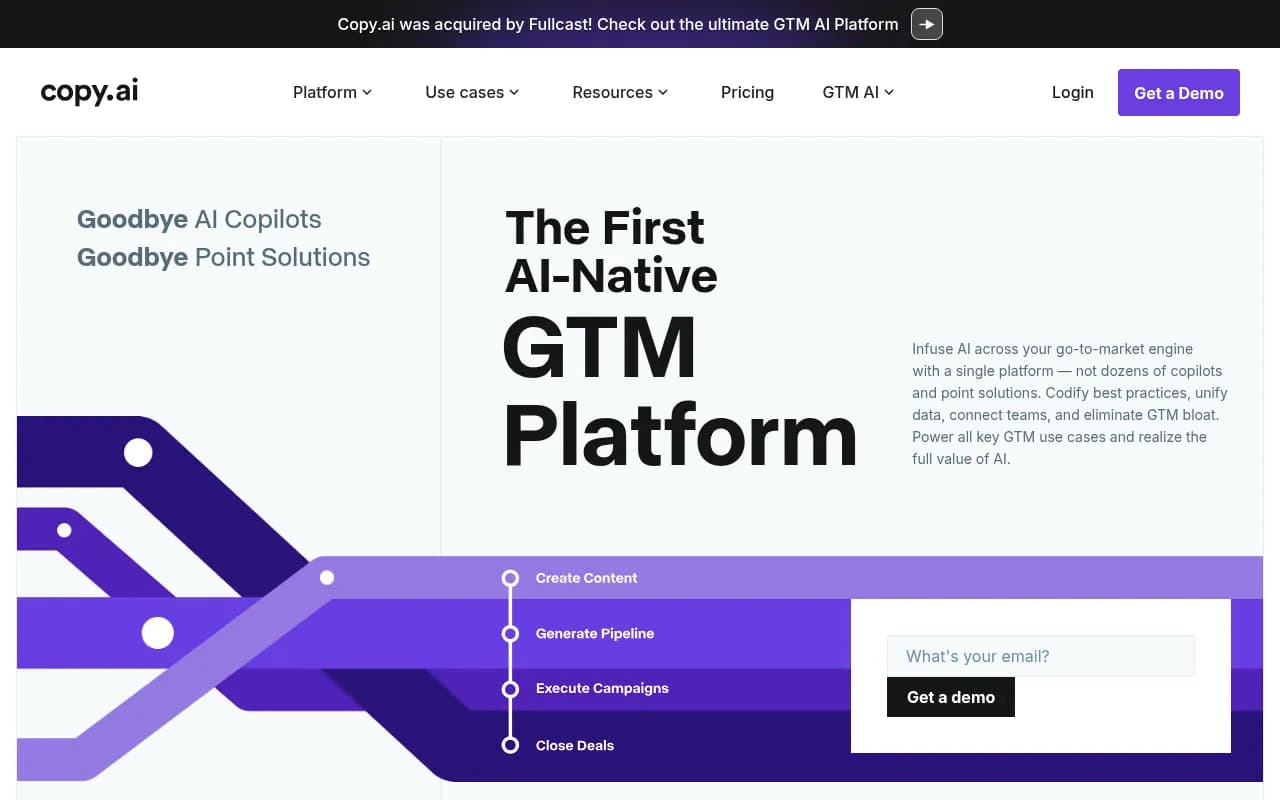
Copy.ai leans toward short-form copy and go-to-market workflows: ad variations, sales emails, CRM-connected automation. It offers Brand Voice and Infobase features and lets you pick between models from OpenAI, Anthropic and Google. One review we read found no AI visibility tracking or native rank tracking in the product, and described long-form output as surface-level with frequent hallucinations. That is one reviewer's test, not a universal verdict, but it matches the product's short-form focus.
AirOps
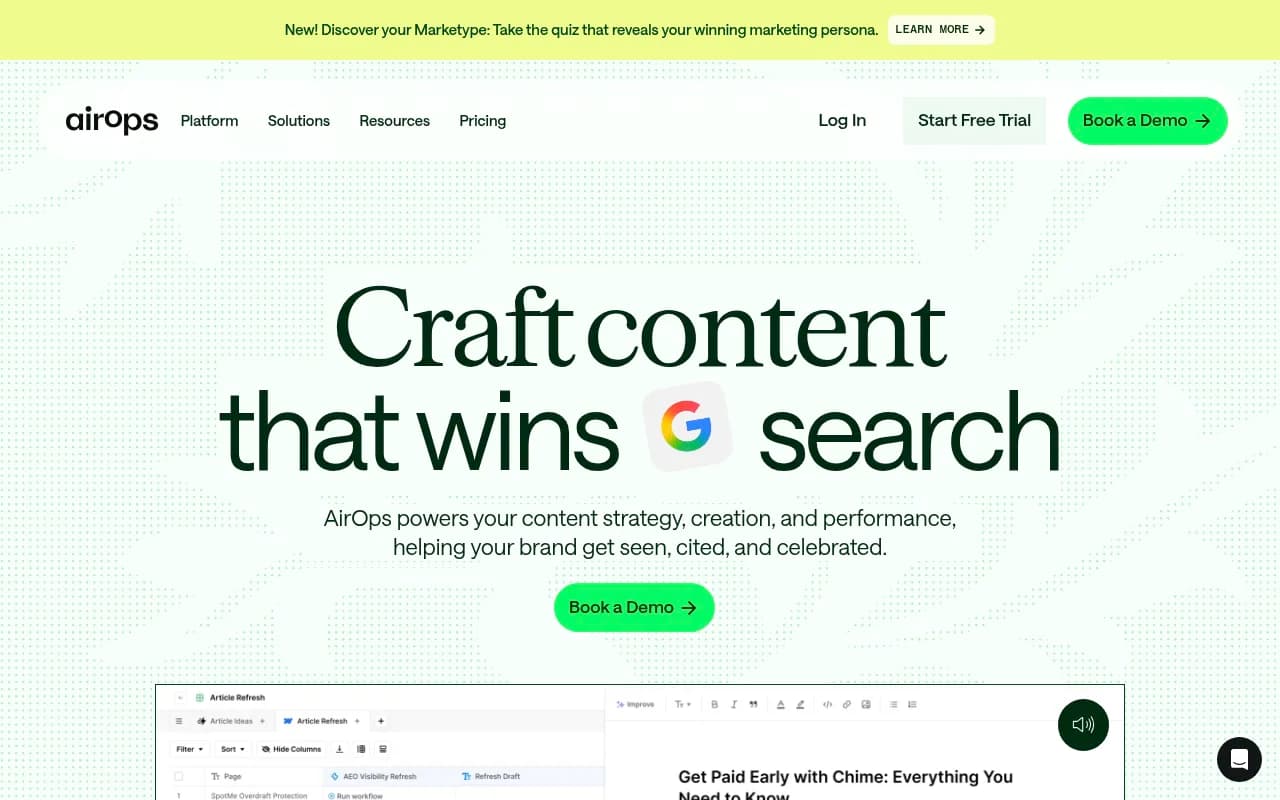
AirOps is the odd one out. It started closer to workflow automation (Grids, Workflows) and now describes itself as a growth platform for AI search. Its Insights module reports citation rate, mention rate, share of voice, position and sentiment by platform, and merges that with Google Search Console and GA4 at page level. Its Action module feeds that data to agents that draft and refresh content, and it publishes to CMSs like Webflow and WordPress.
AirOps publishes case studies from Carta, Webflow, Chime, Docebo and Asana. Chime, for example, reports tripling AI citations while cutting refresh time 89% across a 700-post library. These come from AirOps itself, so read them as claims, not audited results.
Side by side
| Capability | Jasper | Copy.ai | AirOps |
|---|---|---|---|
| Primary job | Governed, on-brand content at scale | Short-form copy and GTM automation | Citation-driven content workflows |
| AI citation tracking | On-domain visibility scoring (GEO hub) | None found in reviews | Yes, across several engines (ChatGPT-only on entry tier per reviews) |
| Page-level citation data | Not documented | No | Yes, merged with GSC and GA4 |
| Query fan-out view | No | No | Yes |
| Crawler logs | No | No | Not a core feature |
| CMS publishing | Limited | Limited | Webflow, WordPress, Contentful and more |
| Learning curve | Moderate | Low | Steep, reviewers cite 2 to 4 weeks |
| Pricing transparency | Published | Published | Mostly gated |
What citation data tells you that a draft cannot
Here is the concrete reason this matters. Promptwatch Data looked at which content types ChatGPT cited between Sep 28 and Oct 4, 2026. Product pages were the most cited type at 22.4%, with landing pages at 16.8%. Listicles came in at 13.6%, how-to guides 8.7%, docs 7.5%.
The mix shifts by intent. For commercial prompts, product pages hit 26.0% and landing pages 20.6%. For branded prompts, reviews were 5.6% of citations, more than three times their share across all prompts.
A content tool that hands you ten blog drafts will not tell you any of that. It does not know that your commercial prompts want comparison and product pages, or that your blog is the wrong format for the queries you care about. You find out by tracking citations per page and per prompt.
Content decays
The second thing a writing tool cannot see is decay. In Promptwatch's analysis of pages ChatGPT cited on July 6, 2026, landing pages and docs stayed cited longest: 78% of landing pages and 76% of docs were still cited after 30 days. News was the opposite. Half of news pages were gone after 36 days, and almost a quarter were never cited again after day 0.
Publish-once output is the wrong model. You need to see which pages are slipping and refresh them. That is a monitoring job.
Fan-outs change what you write
ChatGPT also breaks prompts into sub-searches. Promptwatch's fan-out data showed averages of about 2.15 queries per response in early December 2025 and roughly 1.84 by early March 2026, with query length shrinking over the same period. Separately, ChatGPT began using the site: operator at scale on August 8, 2026, jumping from about 0.4% to about 17% of fan-out queries.
The practical takeaway is to write headings that read like search queries and to build focused pages for sub-questions like pricing, alternatives and X vs Y. You can only prioritize those if you can see the fan-outs. AirOps has a fan-out view. Jasper and Copy.ai do not.
Where AirOps still falls short
AirOps gets closest, but it has real trade-offs, and several sources agree on them.
- The task-based billing is hard to forecast. One reviewer got roughly 6 to 7 articles out of 25,000 tasks on the Solo plan, since multi-step agents burn many tasks per piece.
- Entry-tier visibility is limited to a single engine, according to reviewers.
- It assumes an owner. Pepper Content's analysis calls this the big one: when the technical person running the agents moves on, the platform quietly becomes a subscription.
- Output is still a draft. One hands-on test rated the articles as mediocre and expensive in tasks.
- Pricing is mostly unpublished. Third-party estimates run around $200 a month for Solo and $2,000+ for Pro, which I could not verify.
None of this makes it a bad product. It makes it a platform for teams with technical marketing ops capacity.
Where a dedicated GEO platform fits
A GEO platform starts from the other end. It begins with what AI engines say and cite, then works back to content. The strongest ones cover three layers: real-UI prompt tracking, an explanation of why you are or are not cited, and a way to act on it.
Promptwatch is the one we use and recommend. It tracks ChatGPT, Google AI Overviews, AI Mode, Gemini, Perplexity, Copilot and others through their actual interfaces, and adds the pieces content tools lack: IP-verified AI crawler logs, visitor analytics for AI-referred traffic, page-level citation tracking, and Reddit, YouTube and LinkedIn citation reports. Then it closes the loop with content gap analysis, a Content Agent that writes and publishes to WordPress, Webflow or Framer, and an Action Board that turns gaps into a prioritized to-do list. Published pages are tracked for crawls, citations and clicks, and underperformers come back as new actions.

The difference from a writing tool is the grounding. The Content Agent drafts against prompts AI actually answers and gaps it actually measured, not against a blank brief. For reference, Crisp reported 2x higher conversion from AI traffic than traditional channels after scaling to 5 to 10 articles a day with it.
Other options exist in the same family. Monitoring-first tools like Otterly.AI and Peec AI are cheaper but leave execution to you. Enterprise monitoring tools like Profound go deep on tracking at higher price points.


If you want to browse more, the GEO software directory at bestgeosoftware.com lists the field.
Picking by bottleneck
| Your main problem | Best fit | Why |
|---|---|---|
| Need on-brand drafts fast, many writers | Jasper | Brand voice, templates, governance |
| Ad copy, sales emails, GTM automation | Copy.ai | Short-form and CRM workflows |
| Technical ops team wanting custom content pipelines | AirOps | Workflow builder plus citation insights |
| Do not know what is cited or why | GEO platform such as Promptwatch | Citation, crawler and traffic data first |
| Need to publish and prove AI-driven results | GEO platform with a content agent | Closed loop from gap to measured outcome |
| Budget is tight, tracking only | Otterly.AI or Peec AI | Cheap monitoring, no execution |
A practical way to combine them
You do not have to rip anything out. A reasonable setup in 2026 looks like this:
- Track your prompts and see which pages and content types get cited. Do this before writing anything.
- Check crawler logs to confirm AI bots can actually read the pages you care about.
- Map gaps by intent. Commercial prompts get product, landing and comparison pages. Informational ones get guides and docs.
- Draft with whichever tool your team likes, or let an agent do it grounded in the gap data.
- Re-check citations after 30 days, then refresh. Landing pages and docs hold up longer than news, so spend refresh effort accordingly.
If your team lacks the capacity to run this yourselves, an agency can take it on. 1001 SEO Media runs GEO and content programs on Promptwatch for clients who would rather not staff it internally.
Verdict
Jasper and Copy.ai are fine at what they were built for. If drafting speed or brand consistency is your constraint, keep using them. But neither can tell you whether your content earns a single citation, and in 2026 that is the number that matters. AirOps closes much of that gap with a heavier, more technical setup. A GEO platform that starts with citation data and carries through to publishing and measurement gets you there with less guesswork. Check current pricing on each vendor's site before committing, since most figures here come from third-party reviews.