Key takeaways
- ChatGPT tracking is not the same as general AI visibility monitoring -- you need platforms that query ChatGPT's actual user-facing interface, not just its API
- Most tools stop at showing you where you're invisible; only a handful help you do something about it
- The best platforms combine citation tracking, prompt volume data, competitor benchmarking, and content optimization in one place
- Pricing ranges from around $29/month for basic monitoring to $579/month and above for full optimization suites
- If ChatGPT Shopping visibility matters to your brand, very few tools track it at all -- that narrows the field quickly
ChatGPT crossed 1 billion weekly active users earlier this year. That's not a trend anymore -- it's infrastructure. And for marketers, the uncomfortable truth is that a growing share of brand discovery is now happening inside a chat window, not on a search results page.
The problem: most brands have no idea whether ChatGPT mentions them, recommends them, or ignores them entirely. Traditional SEO dashboards don't tell you this. Google Search Console doesn't tell you this. You need a different kind of tool.
This guide covers the five platforms that do ChatGPT tracking best in 2026 -- what they actually track, how they differ, and which one makes sense depending on what you're trying to accomplish.
What "ChatGPT tracking" actually means
Before getting into the tools, it's worth being precise about what you're evaluating. "ChatGPT tracking" can mean several different things depending on the platform:
- Citation tracking: Does ChatGPT cite your website or content when answering relevant prompts?
- Brand mention tracking: Does ChatGPT mention your brand name in its responses, even without a direct citation?
- Share of voice: How often does your brand appear compared to competitors across a defined set of prompts?
- Prompt-level tracking: Which specific questions trigger (or don't trigger) a mention of your brand?
- ChatGPT Shopping: Does your product appear in ChatGPT's shopping recommendations and carousels?
- Real UI vs. API tracking: Is the tool querying ChatGPT through its actual user interface, or through the API? The answers can differ.
That last point matters more than most people realize. ChatGPT's user-facing responses -- especially for shopping and local queries -- can look very different from what the API returns. A tool that only uses the API may miss entire categories of visibility.
With that framing in mind, here are the five platforms worth your attention.
The 5 best platforms for ChatGPT tracking in 2026
1. Promptwatch
Promptwatch is the most complete option here, and the one that goes furthest beyond pure monitoring. It tracks ChatGPT alongside nine other AI models (Perplexity, Claude, Gemini, Google AI Overviews, Grok, DeepSeek, Copilot, Meta AI, and Mistral), but what makes it stand out for ChatGPT specifically is the depth of what it captures.

For ChatGPT, Promptwatch tracks real user-interface behavior rather than just API outputs. That means you see what actual ChatGPT users see -- including shopping carousels, product recommendations, and entity mentions that don't always surface through API queries. It also tracks which pages on your site ChatGPT is crawling and citing, how often, and what happens between the first crawl and the first citation.
The Answer Gap Analysis feature is particularly useful: it shows you exactly which prompts your competitors are appearing in that you're not. Not just "you're missing from 40% of prompts" -- it shows you the specific questions, the competitor responses, and what content you'd need to create to close the gap. From there, Content Agents can generate articles, comparisons, and briefs built around that exact data.
For teams that care about ChatGPT Shopping specifically, Promptwatch is one of the only platforms tracking it at all.
Pricing starts at $99/month (Essential), with Professional at $249/month and Business at $579/month. A free trial is available.
2. Profound
Profound is a strong choice for enterprise teams that need deep prompt research and structured visibility data. It covers up to 10 AI models at the Enterprise tier and has a clean interface for tracking brand mentions, sentiment, and share of voice across prompts.
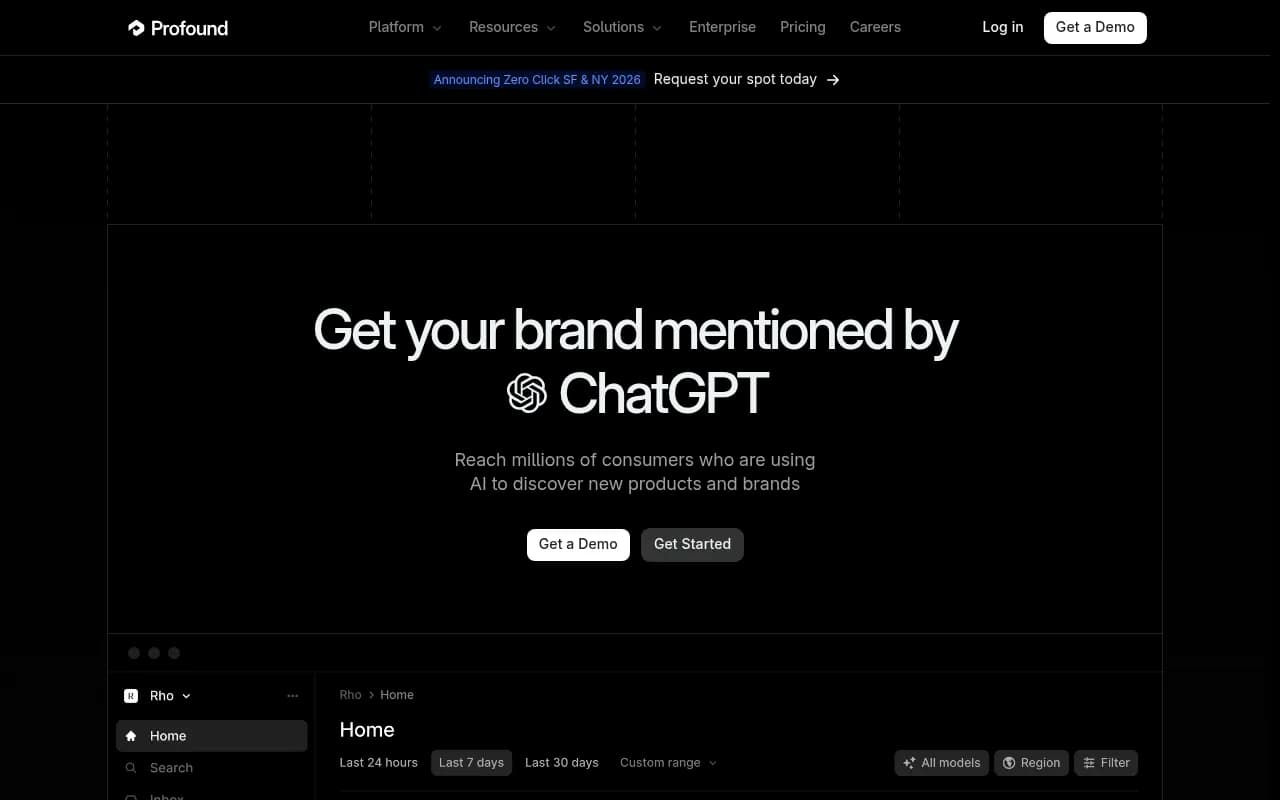
Where Profound excels is in the breadth of its prompt library and the quality of its enterprise-grade reporting. It's used by larger marketing and strategy teams that need to present AI visibility data to leadership in a structured, credible format.
The limitation is that Profound is primarily a monitoring platform. It shows you what's happening but doesn't have native content generation or gap-closing tools built in. You'll need to take the insights somewhere else to act on them. For teams with dedicated content resources, that's fine. For teams that want a tighter loop between insight and execution, it's a gap.
Pricing starts at $99/month, with enterprise tiers for larger prompt volumes and multi-brand tracking.
3. SE Visible (by SE Ranking)
SE Visible is SE Ranking's dedicated AI visibility product, and it punches above its weight for the price. It covers five AI models including ChatGPT, tracks brand mentions and citations, and handles multi-brand and multi-country setups reasonably well.
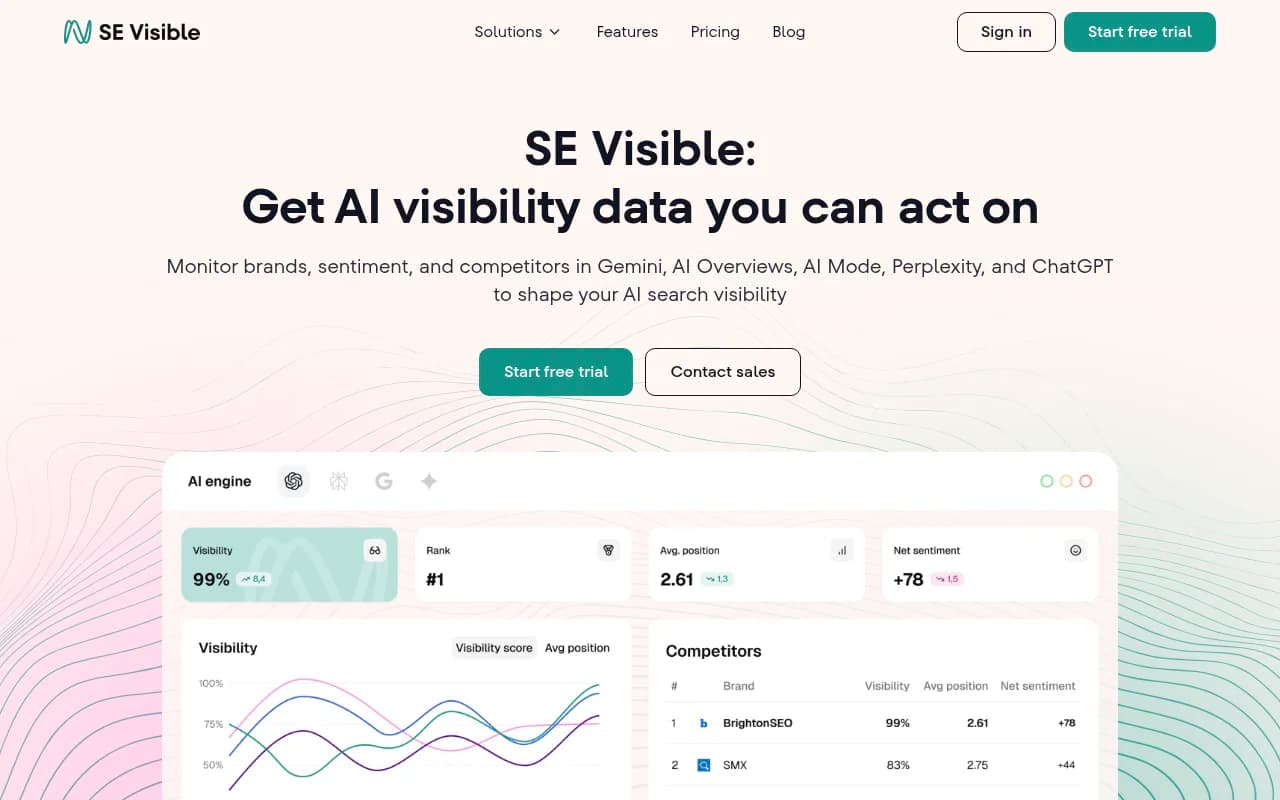
The main appeal here is the combination of affordability and breadth. If you're already in the SE Ranking ecosystem, SE Visible integrates cleanly with your existing rank tracking and SEO data. That context -- seeing your traditional search performance alongside your AI visibility -- is genuinely useful for understanding where AI is cannibalizing or complementing your organic traffic.
ChatGPT tracking in SE Visible covers mention rate, sentiment, and citation presence across a defined prompt set. It doesn't go as deep as Promptwatch on things like crawler logs or shopping visibility, but for teams that want solid baseline monitoring without a large budget, it's a practical option.
Pricing starts at $99/month for the AI visibility add-on.
4. Otterly.AI
Otterly.AI is the most accessible entry point in this category. Starting at $29/month, it covers four AI models including ChatGPT and gives you brand mention tracking, share of voice, and basic sentiment analysis.
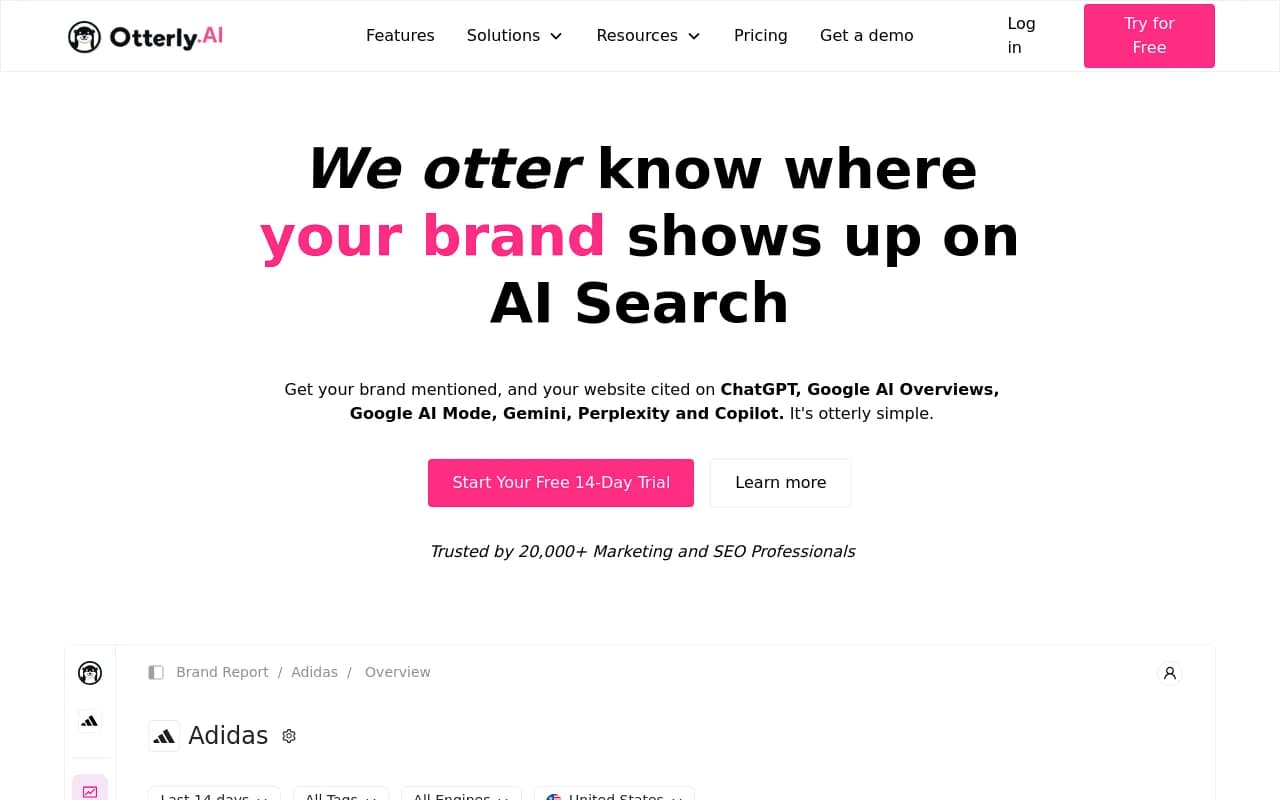
It's honest about what it is: a monitoring tool. There's no content generation, no gap analysis, no crawler logs. But for small teams or individuals who just want to know whether ChatGPT is mentioning them and how that compares to a few competitors, Otterly delivers that without complexity or cost.
The prompt library is smaller than enterprise tools, and the ChatGPT coverage doesn't extend to shopping or entity-level tracking. But for getting started with AI visibility monitoring, it's a reasonable first step.
5. LLM Pulse
LLM Pulse is a newer entrant that's built specifically around AI visibility analytics, with ChatGPT as a primary focus. It tracks brand mentions, citation sources, and share of voice across ChatGPT and several other models.
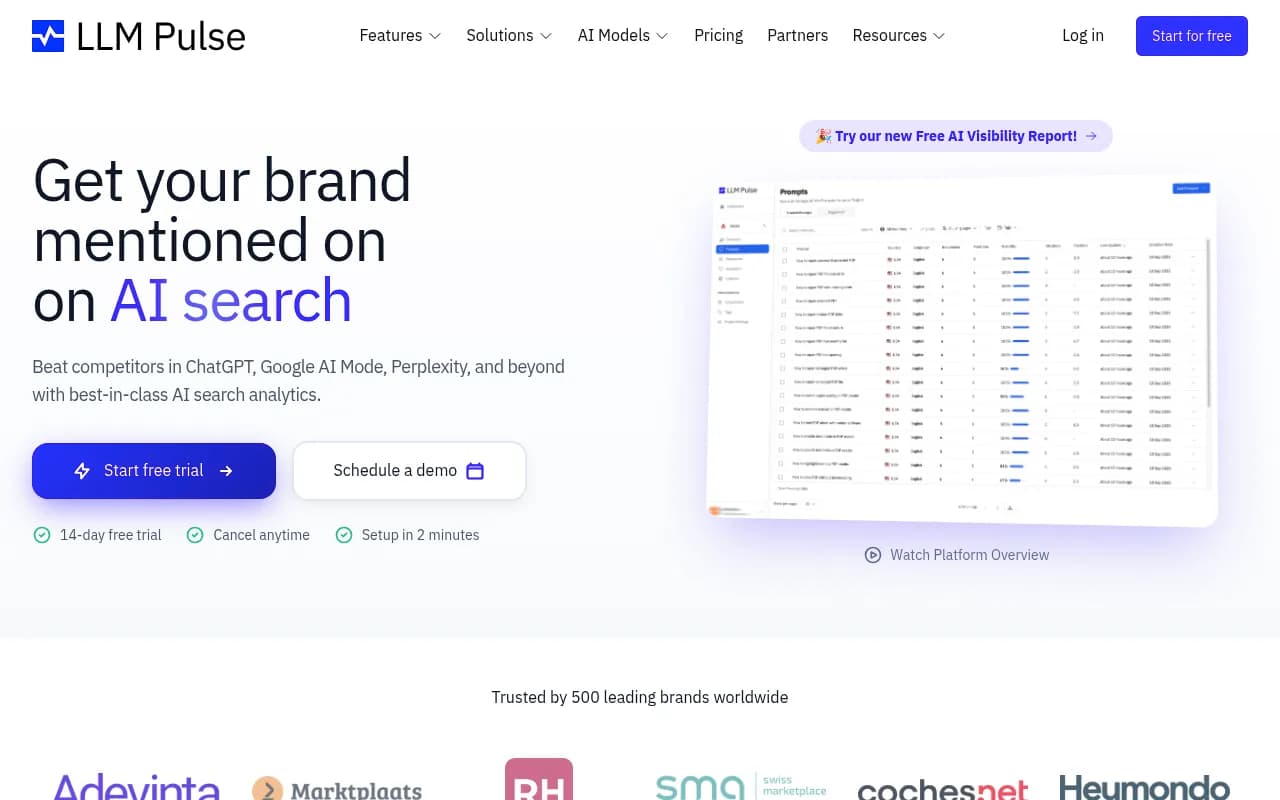
What makes LLM Pulse worth including here is its focus on the analytics layer -- it goes deeper on visualizing how your visibility changes over time, which prompts are driving mentions, and how your brand's portrayal in ChatGPT responses compares to competitors. For teams that care about trend data and longitudinal tracking, it's a solid option.
It's more monitoring-oriented than action-oriented, similar to Profound, but the reporting interface is clean and the ChatGPT-specific data is detailed enough to be genuinely useful.
Side-by-side comparison
| Platform | ChatGPT tracking depth | Other models | Content generation | ChatGPT Shopping | Starting price |
|---|---|---|---|---|---|
| Promptwatch | Deep (UI + API, crawler logs, shopping) | 10 models | Yes (Content Agents) | Yes | $99/mo |
| Profound | Strong (enterprise prompt library) | Up to 10 | No | No | $99/mo |
| SE Visible | Solid (multi-country, multi-brand) | 5 models | No | No | $99/mo |
| Otterly.AI | Basic (mention + sentiment) | 4 models | No | No | $29/mo |
| LLM Pulse | Good (analytics-focused) | Multiple | No | No | Varies |
How to choose
The right tool depends on what you're actually trying to do.
If you want to monitor ChatGPT visibility and nothing else, Otterly.AI or SE Visible will cover the basics without a large investment. They're good for establishing a baseline and tracking directional changes.
If you need enterprise-grade reporting and a large prompt library, Profound is worth evaluating. It's built for teams that need to present AI visibility data in structured, credible formats.
If you want to close the loop between monitoring and action -- finding gaps, creating content that fills them, and tracking the results -- Promptwatch is the only platform here that does all three. The combination of real-UI ChatGPT tracking, Answer Gap Analysis, Content Agents, and ChatGPT Shopping visibility in one place is hard to replicate by stitching together separate tools.
One practical note: whatever platform you choose, make sure it's querying ChatGPT through the actual user interface for at least some of its tracking. API-only tools will miss shopping recommendations, certain citation formats, and the browsing-enabled responses that are increasingly common in real user sessions.
What to track beyond brand mentions
Most teams start with "is my brand mentioned?" That's the right first question, but it's not the only one that matters.
Once you have baseline mention data, the more useful questions are:
- Which specific prompts trigger a mention, and which don't?
- What does ChatGPT say about your brand when it does mention you -- is the description accurate, positive, outdated?
- Which competitors appear in prompts where you don't?
- Are you being cited as a source, or just mentioned in passing?
- Is your brand appearing in ChatGPT Shopping results for relevant product queries?
The platforms that help you answer all of these questions -- not just the first one -- are the ones worth paying for in 2026.
The bottom line
ChatGPT is now a meaningful channel for brand discovery, and the gap between brands that track their AI visibility and those that don't is only going to widen. The tools in this guide give you a starting point -- from the affordable simplicity of Otterly.AI to the full optimization loop that Promptwatch offers.
The monitoring-only tools will tell you where you stand. The optimization platforms will help you change it. Which one you need depends on where you are right now -- but if you're serious about AI search visibility, you'll eventually need both capabilities in one place.