Key takeaways
- Every AI citation has two properties: a content type (what the page is, like a product page, listicle or doc) and a source type (who published it, like a brand, directory, forum or government site). Classifying both tells you far more than a list of cited domains.
- Promptwatch classifies citations into 22 content types and 20 source types. Neither I nor the other studies I found publish a universal public taxonomy, so treat any list as a working vocabulary you adapt to your category.
- In Promptwatch Data (Sep 28 to Oct 4, 2026), product pages were 22.4% of ChatGPT citations, landing pages 16.8% and listicles 13.6%. Product and landing pages together were about 39%.
- Intent changes the mix. Commercial prompts lean on product pages, landing pages, listicles and comparisons. Informational prompts pull in how-tos and documentation. Branded prompts pull in reviews, FAQs and social posts.
- Platforms differ a lot. Social platforms were 0.46% of ChatGPT citations but 12.2% of Google AI Overviews citations in the same week.
Why classify citations at all
Most people start with a list of domains: who does ChatGPT cite for "best CRM for small teams"? That is a reasonable first question, but it is a bad last one. Knowing that G2 and a few vendor sites show up does not tell you what to build.
Classification turns the list into a decision. If 70% of citations in your category are product pages and comparisons, a pile of thought-leadership blog posts will not move you. If most are documentation and help centers, your fix lives in your docs.
There are two separate questions here, and mixing them is the most common mistake I see:
- Content type: what format is the cited page?
- Source type: what kind of publisher is behind it?
A listicle on a vendor blog and a listicle on a review publisher share a content type but behave differently, because the source type is different. You want both columns in your spreadsheet.
The 22 content types
There is no official standard here. Promptwatch classifies every citation into 22 content types, and I have not seen the full list published outside the product, so below is a practical working set that matches the types its public reports name. Use it as a starting vocabulary and merge or split as your category demands.

Here is a grouped version you can paste into a sheet:
| Group | Content types | What it tells you |
|---|---|---|
| Commercial pages | Product page, landing page, pricing page, category page | Your own selling pages are in the running |
| Editorial lists and comparisons | Listicle, comparison, review, buyer's guide | Third parties are shaping the shortlist |
| Educational | How-to guide, general article, tutorial, glossary entry, original research | There is room for explanatory content |
| Reference | Documentation, FAQ page, help center article, API reference | Support content is being read as evidence |
| Timely and social | News, press release, social post, forum discussion, video | Freshness and community voice matter |
| Other | Case study, whitepaper, podcast or transcript, catch-all | Edge cases, keep this small |
That is more than 22 if you count every row, so collapse it to your own number. The point is consistency, not matching a magic count. Pick your list, write a one-line definition for each type, and stick to it. If two people on your team would tag the same page differently, the definition is too loose.
Tagging rules that save you later
- Tag by what the page is, not what it ranks for. A blog post titled "Best CRMs" is a listicle, even if it lives under /blog.
- One page gets one type. If a page is half comparison and half review, choose the dominant intent.
- Keep a "social post" and "forum discussion" type separate. They behave differently by platform, as the data below shows.
- Tag the cited URL, not the domain. A single domain can supply four different content types.
The 20 source types
Source types describe the publisher. Promptwatch tracks 20 source types, including Directory, and again the full list is not public, so here is a usable set:
| Source type | Example in a software category | Typical role |
|---|---|---|
| Brand (your own site) | Your product pages and docs | Self-citation, the thing you control |
| Competitor | Rival vendor sites | The shortlist you are fighting for |
| Review platform | G2-style sites | Social proof and comparisons |
| Directory | Software directories | Category listings |
| Editorial media | Trade press, business news | Authority and news |
| Government and public health | NIH, FDA, NHS in healthcare | Dominant in regulated topics |
| Marketplace | Autotrader, Cars.com in automotive | Transactions and inventory |
| Booking and search | Skyscanner, Tripadvisor in travel | Comparison and availability |
| Developer platform | GitHub, official docs | Technical answers |
| Forum and community | Reddit, Q&A sites | Real-user opinion |
| Video | YouTube | Walkthroughs |
| Social network | LinkedIn, Facebook, Instagram, X, TikTok | Posts and profiles |
| Reference | Wikipedia-style encyclopedias | Definitions |
| Academic | Journals, university sites | Research claims |
| Press release wire | Newswires | Announcements |
| Other | Everything else | Keep small |
The category matters enormously. In Promptwatch Data, government and public health sites earn almost half of ChatGPT healthcare citations (healthcare report, Sep 9 to Oct 8, 2026). For travel prompts, booking and search sites take more than half (travel report). In software, documentation and help centers earn the largest share, with GitHub, Microsoft's docs and G2 leading (software report). In automotive, marketplaces outrank every car brand (automotive report, August 2026).
So your source-type column often reveals that the real competitor is not another brand at all. It is a marketplace or a booking site.
What the data says about content types
Here is the baseline for ChatGPT, from Promptwatch's content type report (Sep 28 to Oct 4, 2026):
| Content type | Share of ChatGPT citations |
|---|---|
| Product pages | 22.4% |
| Landing pages | 16.8% |
| Listicles | 13.6% |
| How-to guides | 8.7% |
| Documentation | 7.5% |
| General articles | 6.1% |
| Comparisons | 5.9% |
| News | 5.7% |
| FAQ pages | 3.3% |
| Reviews | 1.7% |
Editorial formats combined (listicles, how-tos, articles, comparisons, news, reviews and others) add up to 43%. Product and landing pages are about 39%. That surprised me when I first saw it. A lot of content advice treats ChatGPT as a blog-reading machine, and the numbers say it leans heavily on pages that sell or describe something.
Intent changes the mix
The same report splits by prompt type:
- Commercial prompts such as "best CRM for small businesses": product pages 26.0%, landing pages 20.6%, listicles 15.0%, comparisons 7.9%. Those four types are almost 70% of commercial citations.
- Informational prompts such as "how does a CRM work": product pages 19.1%, landing pages 13.9%, listicles 13.6%, how-tos 10.7%, documentation 8.5%, articles 7.7%.
- Branded prompts such as "is HubSpot good for startups": product pages 23.3%, landing pages 22.8%, reviews 5.6% (more than 3x their overall share), FAQ pages 4.8%, social posts 3.0% (almost 4x overall).
Product pages lead for all three intents. So fix your product pages before you commission another ten blog posts.
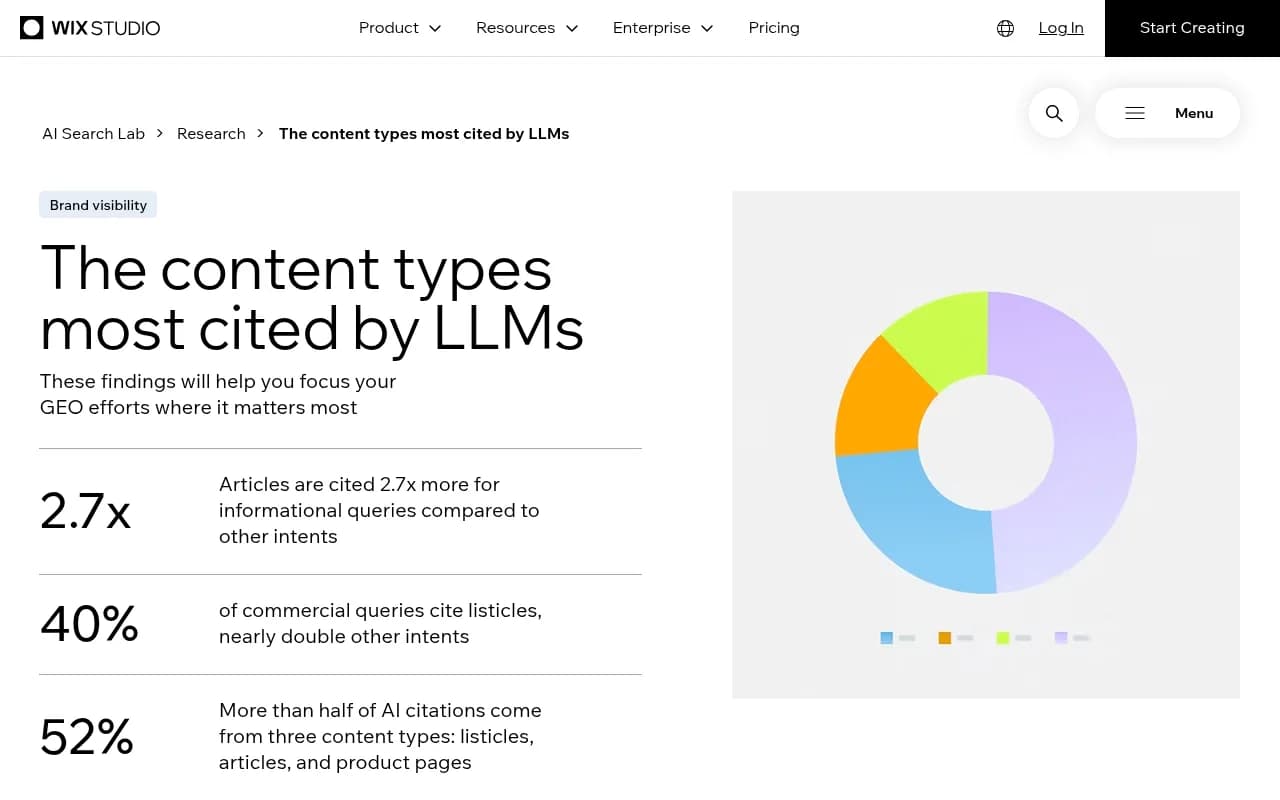
Independent research points the same way on intent. A Wix AI Search Lab study with Peec AI analyzed 75,000 AI answers and 1,056,727 citations from ChatGPT, Google AI Mode and Perplexity. It found articles are cited 2.7x more for informational queries, 40% of commercial queries cite listicles, and listicles, articles and product pages together make up 52% of citations. Their sample used a different taxonomy and different models, so the numbers will not match Promptwatch's exactly. The direction agrees, though. You can read it at the Wix AI Search Lab.
Content ages differently by type
Content type also predicts how long a citation lasts. In Promptwatch's half-life study of pages cited on July 6, 2026, landing pages and docs stayed cited longest, while news lost half its pages within 36 days. If you plan a calendar around news-style content, expect to refresh constantly.
What the data says about source types by platform
Platform choice changes the source mix more than most teams expect. From Promptwatch's social citation report (Sep 28 to Oct 4, 2026):
| Platform | Social share of citations | Notes |
|---|---|---|
| ChatGPT | 0.46% | LinkedIn is the top social source at 0.3%; Reddit fell to 0.09% |
| Perplexity | 2.7% | LinkedIn and Reddit tie at 0.86% |
| Google AI Overviews | 12.2% | YouTube 4.28%, Facebook 2.38%, Reddit 2.15% |
The Reddit change is the one to watch. Reddit's share of ChatGPT citations dropped from about 4% to 0.5% on August 14, 2026, per Promptwatch's Reddit report. Any playbook built on Reddit-heavy ChatGPT data from earlier in 2026 is stale. Wix and Peec AI found discussions make up 17% of Perplexity citations, more than double other models, so forums still matter there. This is exactly why you tag source types per platform instead of averaging.
A step-by-step classification workflow
1. Build the prompt set
Write 30 to 100 prompts that represent your category. Split them into commercial, informational and branded buckets, plus competitor comparisons. Do not skip branded ones. They show what AI says when someone already knows your name.
2. Collect citations per platform
Run the prompts in the real interfaces of ChatGPT, Google AI Overviews, AI Mode and Perplexity, not only through APIs, since user-facing citations can differ from API outputs. Record each cited URL with the prompt, platform and date. Doing this by hand works for a first pass. After that you want a tool.
3. Tag content type and source type
Add two columns and fill them using your definitions. Tag a sample of 50 URLs with two people and compare. Where you disagree, tighten the definition.
4. Pivot
Build three pivots:
- Content type by intent (what formats win for commercial vs informational)
- Source type by platform (who AI trusts where)
- Your own domain's share per content type (where you are absent)
5. Turn gaps into a to-do list
A few readings I find reliable:
- Many listicle citations, none of them yours: you need to be included in third-party lists, or publish an honest comparison of your own.
- Many documentation citations and you have thin docs: improve help content before anything else.
- Marketplaces dominate: your fix is presence on those marketplaces, not your blog.
- You get mentioned but not cited: check crawler access and the quality of your product pages.
6. Re-run monthly
Citation behavior moves fast. ChatGPT began using the site: operator at scale on August 8, 2026, jumping from about 0.4% to about 17% of fanout queries (Promptwatch Data). Behavior changes like that can reshuffle which pages get cited, so a one-off audit goes stale.
Tools that do the tagging for you
Doing this in a spreadsheet is fine for a pilot. At scale you need a tracker that classifies citations automatically. Promptwatch is the one I would start with here, since it tags every citation into its 22 content types and 20 source types, and shows first cited date, ramp-up, peak and decay half-life per page. It also has a content gap analysis and an agent that writes against the gaps, which is the part most trackers skip.
Other options in the catalog take a narrower view:
| Tool | Strength for this job | Limitation |
|---|---|---|
| Promptwatch | Citation classification, crawler logs, content gap analysis, content agent | Heavier than a pure tracker if you only need a quick look |
| Otterly.AI | Affordable prompt tracking | Basic, no crawler logs or content generation |
| Peec AI | Clean monitoring, and a co-author of the Wix study | Monitoring only, no optimization |
| Profound | Enterprise monitoring | Higher price point |
| Ahrefs Brand Radar | Familiar if you already use Ahrefs | Fixed prompt sets, shallow AI-specific data |



If you are comparing more options, the GEO software directory lists many more trackers.
Common mistakes
- Averaging across platforms. ChatGPT, AI Overviews and Perplexity cite very different mixes, as the social data shows.
- Using too many types. Forty content types sounds rigorous and produces noise. Stay near 20.
- Ignoring branded prompts. They reveal reviews, FAQs and social posts you never see in category prompts.
- Treating a snapshot as permanent. Reddit went from about 4% to 0.5% overnight.
- Chasing format without substance. Beyond format, original data and clearly attributed claims are what give an LLM evidence it cannot generate itself, per cloro's analysis.
Where to go from here
Start small. Take 30 prompts, run them in ChatGPT and AI Overviews, tag 100 citations with your own content and source lists, and build the three pivots. You will likely find one or two gaps big enough to act on within a day. Teams that want an outside hand on the content and technical side can look at an agency such as 1001 SEO Media, which does this kind of AI search work. Then re-run the audit next month and compare.