Key takeaways
- GetMint.ai focuses on AI search monitoring with a publisher network approach, but many teams need more direct control over optimization -- or a tighter budget fit.
- Most GEO tools launched in 2024-2025, so the market is still maturing. Features vary wildly between platforms.
- The biggest split in this category is between monitoring-only tools and platforms that help you actually fix visibility gaps with content creation and optimization.
- Promptwatch is the only platform in this comparison rated as a "Leader" across all GEO categories, covering 10 AI models with built-in content generation and crawler logs.
- Pricing across alternatives ranges from free tiers to $500+/month for enterprise plans -- the right choice depends heavily on how many sites, prompts, and AI models you need to track.
GetMint.ai has built a reasonable product in the Generative Engine Optimization space. It monitors AI search visibility across LLM-powered engines like ChatGPT and Perplexity, and its publisher network gives brands a distribution angle most pure-play trackers lack. But it's not the right tool for everyone.
Some teams want direct control over their content strategy without going through a publisher intermediary. Others need deeper analytics, more AI model coverage, or content generation built into the same platform. And some just need a lower price point.
This guide ranks 10 GetMint.ai alternatives based on three things that actually matter: feature depth, pricing transparency, and how many AI models each platform covers. No hype, just what each tool does and who it's best for.
What to look for in a GetMint.ai alternative
Before jumping into the list, it's worth being clear about what separates a good GEO tool from a mediocre one in 2026.
The core question is: does this tool just show you data, or does it help you do something with it?
Most platforms in this space are monitoring dashboards. They'll tell you that a competitor appears in ChatGPT's response to a given prompt and you don't. That's useful information. But if the tool stops there, you're left figuring out what to write, where to publish, and whether it worked -- all on your own.
The better platforms close that loop. They show you the gap, help you create content to fill it, and then track whether your visibility improved. That full cycle is what separates a GEO platform from a GEO tracker.
Other things worth checking:
- How many AI models does it cover? (ChatGPT, Claude, Perplexity, Gemini, Grok, DeepSeek, etc.)
- Does it track AI crawler activity on your own site?
- Can it attribute AI search traffic to actual revenue?
- Does it support multiple languages and regions?
- Is the pricing transparent and predictable?
With that in mind, here's the ranked list.
The 10 best GetMint.ai alternatives in 2026
1. Promptwatch
Promptwatch is the most complete GEO platform available right now. It covers 10 AI models -- ChatGPT, Claude, Perplexity, Gemini, Grok, DeepSeek, Copilot, Meta AI, Mistral, and Google AI Overviews -- and it's the only platform in a 2026 comparison of 12 GEO tools rated as a "Leader" across every category.
What makes it stand out isn't just the breadth of monitoring. It's that the platform is built around action. The Answer Gap Analysis shows you exactly which prompts competitors rank for that you don't, down to the specific content your site is missing. The built-in AI writing agent then generates articles, listicles, and comparisons grounded in 880M+ citations analyzed -- content engineered to get cited by AI models, not generic SEO filler. Then page-level tracking shows whether it worked.
It also has features most competitors simply don't offer: real-time AI crawler logs (so you can see when ChatGPT or Perplexity actually reads your pages), Reddit and YouTube citation tracking, ChatGPT Shopping monitoring, and prompt volume and difficulty scoring so you can prioritize winnable opportunities.
Pricing starts at $99/month for one site and 50 prompts, with a Professional plan at $249/month and Business at $579/month. A free trial is available.

2. Profound AI
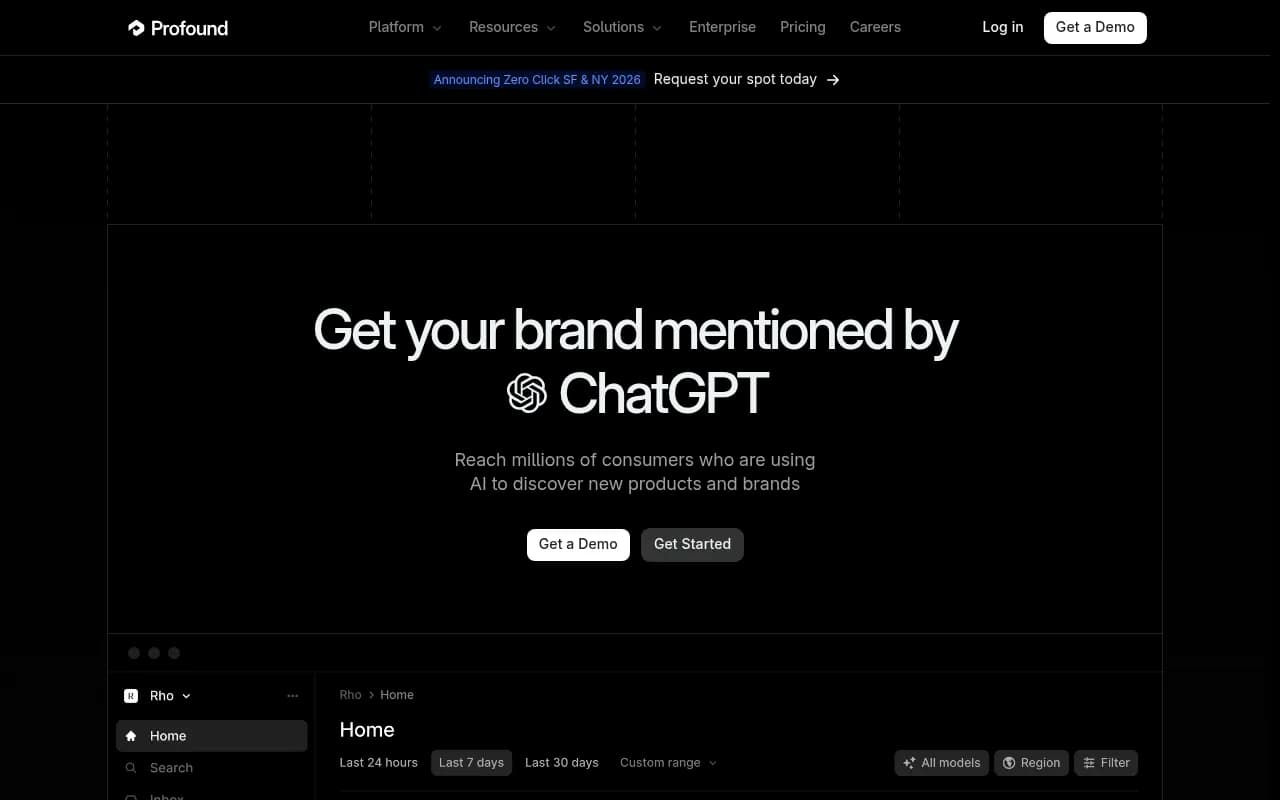
Profound is a strong enterprise option with solid data infrastructure and a clean interface. It covers multiple AI models and gives marketing teams detailed visibility into how their brand appears across AI search responses. The reporting is thorough, and it integrates well into larger marketing stacks.
The main limitation is that Profound is primarily a monitoring platform. It shows you where you stand but doesn't generate content or guide you through fixing gaps. For teams with dedicated content resources who just need the data layer, that's fine. For teams that want one platform to handle monitoring and optimization, it's a gap.
Pricing is on the higher end, which makes it harder to justify for smaller teams or agencies managing multiple clients.
3. Otterly.AI
Otterly.AI is one of the more accessible entry points into AI visibility tracking. It covers the major LLMs, has a clean dashboard, and is priced reasonably for smaller teams. If you're just starting to think about GEO and want to understand where your brand shows up in AI responses, Otterly is a decent starting point.
The honest limitation: it's a monitoring tool. There's no content generation, no crawler logs, no traffic attribution. You'll see the data, but you'll need to act on it elsewhere. For teams that are already well-resourced on the content side, that's workable. For everyone else, it means stitching together multiple tools.

4. Scrunch AI
Scrunch AI focuses on brand monitoring across AI assistants like ChatGPT and Claude. It has a reasonable feature set for tracking brand mentions and sentiment in AI responses, and it's built with a clean enough interface that non-technical marketers can use it without much friction.
Like most tools in this space, Scrunch is primarily a tracker. It doesn't help you create content or close the gap between what AI models say about you and what you want them to say. It's also worth noting that GetMint itself has published comparisons positioning against Scrunch, which suggests the two tools are competing for similar customers -- teams that want AI visibility monitoring without a full enterprise commitment.
5. Peec AI
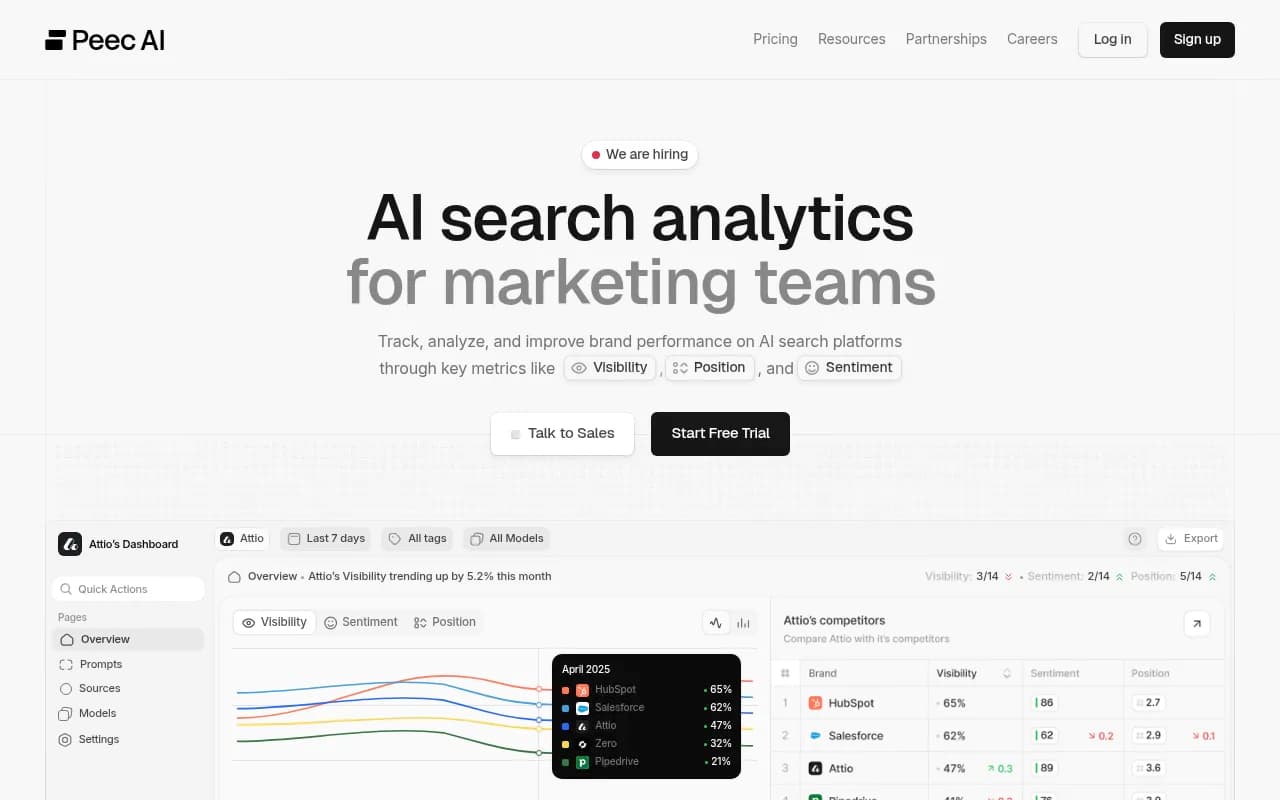
Peec AI is a monitoring-focused platform with a straightforward value proposition: track how your brand appears across AI search engines and compare it to competitors. It covers several LLMs and gives you prompt-level data on where you're visible and where you're not.
The interface is clean and the onboarding is fast. For agencies that need to spin up monitoring for multiple clients quickly, Peec has some appeal. But it lacks content generation, crawler logs, and traffic attribution -- the features that turn monitoring data into actual business outcomes.
6. AthenaHQ
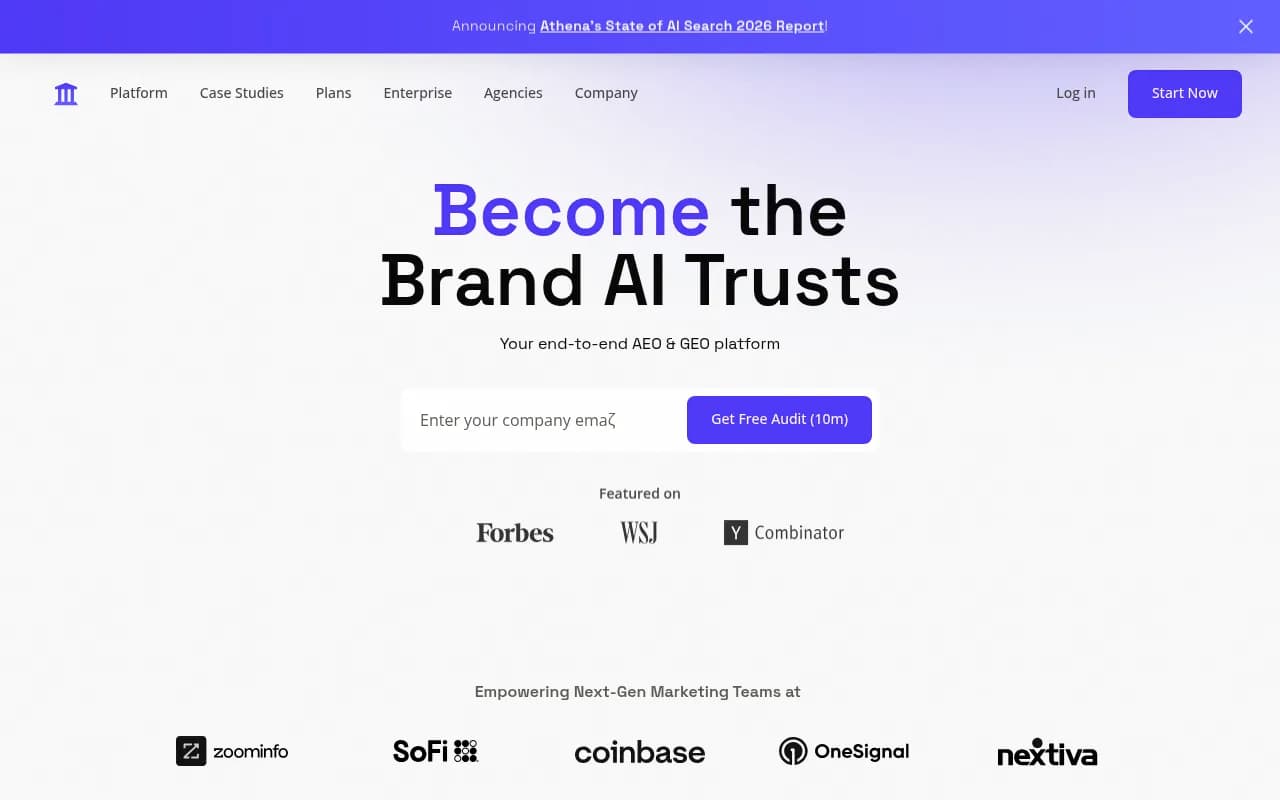
AthenaHQ covers 8+ AI search engines and positions itself as a brand visibility tracking platform. It has a solid monitoring layer and gives teams a reasonable view of how they compare to competitors across different LLMs.
The gap is on the optimization side. AthenaHQ is primarily a tracker, and while it surfaces useful data, it doesn't help you act on it directly. Teams that want to move from "we know we're invisible" to "we've fixed it" will need to bring their own content strategy and execution resources.
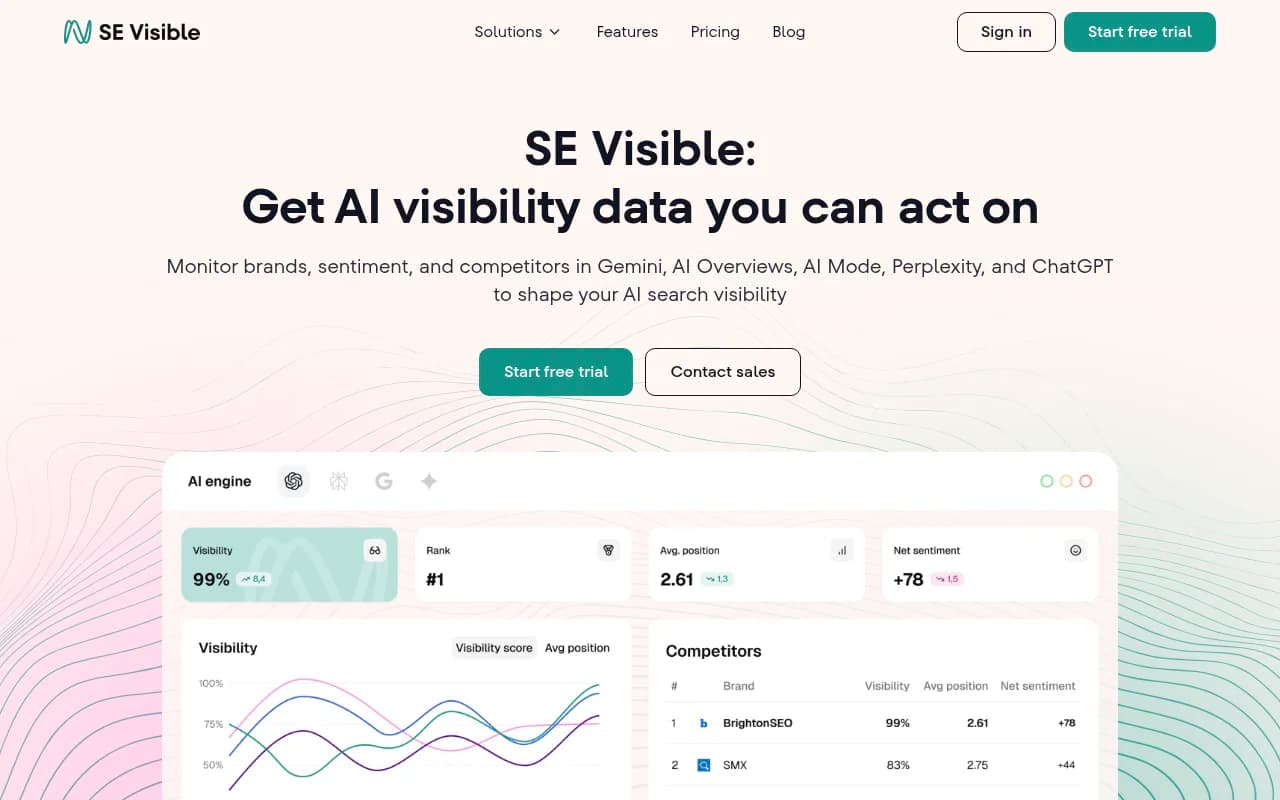
7. SE Visible
SE Visible is the AI search visibility product from SE Ranking, which means it comes with the credibility of an established SEO platform behind it. It tracks brand visibility and sentiment across AI search engines and integrates with SE Ranking's broader keyword and ranking data.
For teams already using SE Ranking for traditional SEO, adding SE Visible is a natural extension. For teams starting fresh, it's worth knowing that the AI visibility features are still maturing relative to dedicated GEO platforms. Coverage is solid but not as deep as Promptwatch or Profound on the AI model side.
8. Writesonic
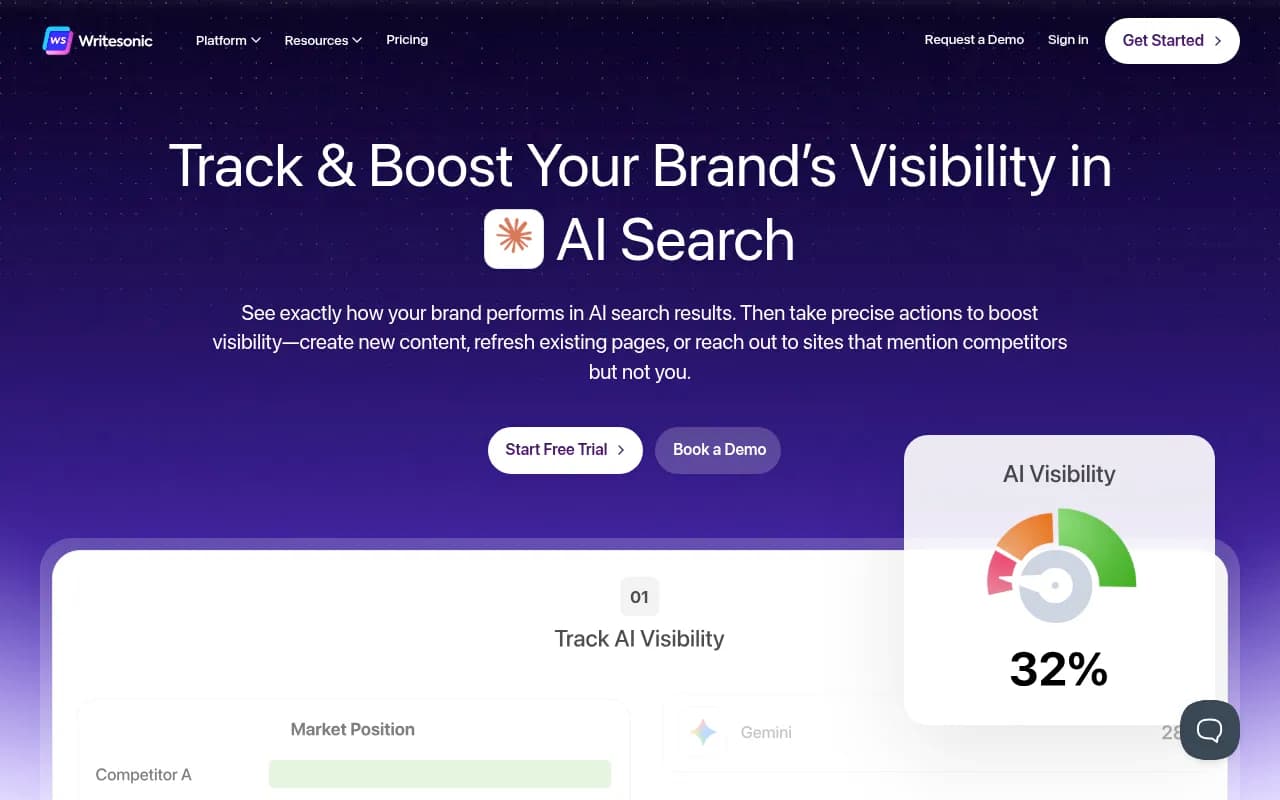
Writesonic has evolved from a pure AI writing tool into something that also covers AI search visibility tracking. It's an interesting hybrid -- you get content generation capabilities alongside monitoring features, which means you can see where you're invisible and start writing content in the same platform.
The monitoring depth isn't as strong as dedicated GEO tools, and the AI model coverage is narrower. But for content teams that are primarily focused on production and want some visibility data layered in, Writesonic is a practical option. It's also priced accessibly, which helps for smaller teams.
9. Semrush
Semrush is the 800-pound gorilla of SEO tools, and it has added AI visibility features to its platform. For teams already paying for Semrush, the AI monitoring capabilities are worth exploring -- you're not paying extra, and the integration with keyword data and content tools is genuinely useful.
The honest caveat: Semrush's AI visibility features use fixed prompts, which limits flexibility. You can't customize the prompts to match how your actual customers search, and there's no AI traffic attribution. It's a decent starting point for teams already in the Semrush ecosystem, but it's not a substitute for a dedicated GEO platform if AI search is a serious priority.
10. Nightwatch
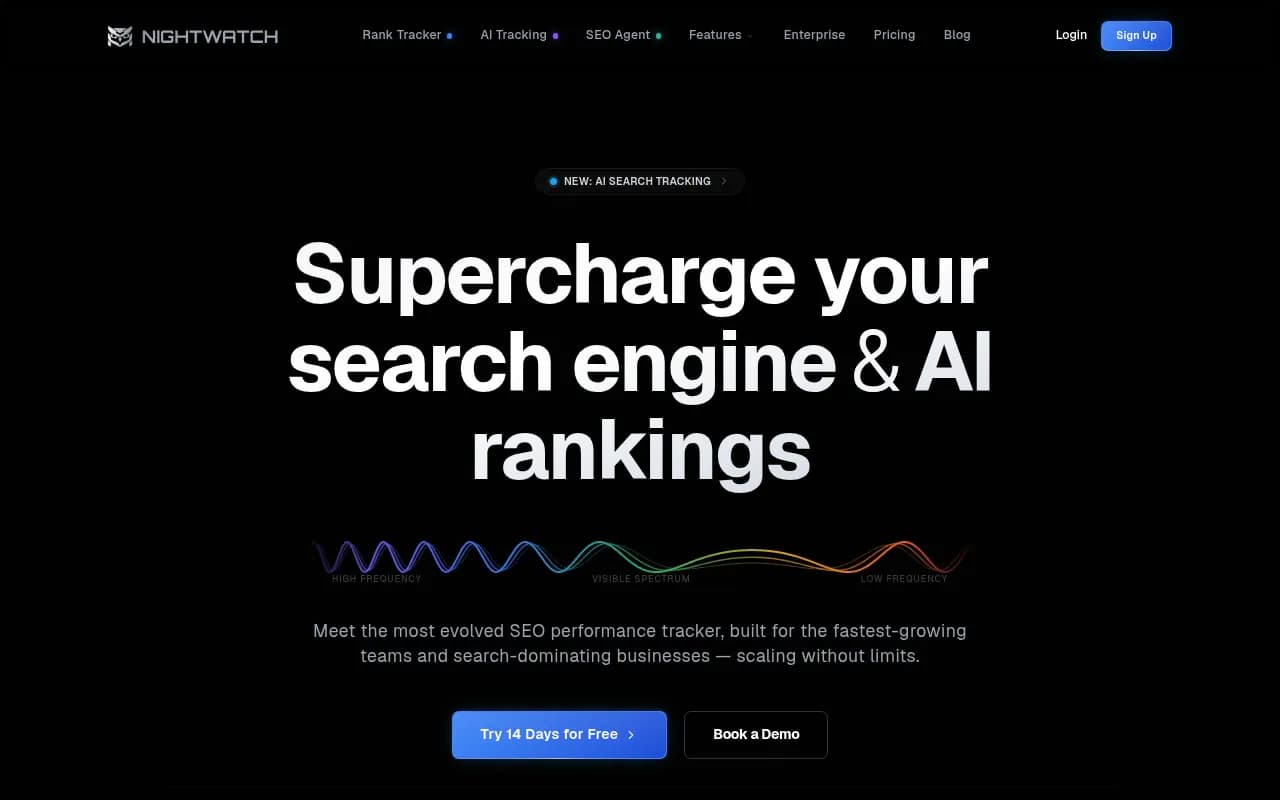
Nightwatch is primarily a rank tracking tool that has added AI search monitoring capabilities. It's a solid, well-regarded product for traditional SEO rank tracking, and the AI visibility layer gives teams a way to see how their brand appears in AI search responses alongside their regular rankings data.
For teams that want a single tool covering both traditional and AI search monitoring, Nightwatch is worth a look. The AI features are less mature than dedicated GEO platforms, but the core rank tracking is excellent and the pricing is competitive.
Feature comparison table
| Tool | AI models covered | Content generation | Crawler logs | Traffic attribution | Reddit/YouTube tracking | Starting price |
|---|---|---|---|---|---|---|
| Promptwatch | 10 | Yes (built-in AI writer) | Yes | Yes | Yes | $99/mo |
| Profound AI | Multiple | No | No | Limited | No | Higher |
| Otterly.AI | Major LLMs | No | No | No | No | Lower |
| Scrunch AI | Major LLMs | No | No | No | No | Mid |
| Peec AI | Several | No | No | No | No | Lower |
| AthenaHQ | 8+ | No | No | No | No | Mid |
| SE Visible | Several | No | No | No | No | Mid |
| Writesonic | Several | Yes (limited) | No | No | No | Lower |
| Semrush | Fixed prompts | Limited | No | No | No | Bundled |
| Nightwatch | Several | No | No | No | No | Lower |
How to choose the right alternative
The decision comes down to what you actually need the tool to do.
If you're primarily a content team that needs to know which topics to write about to appear in AI search results, and you want a platform that generates that content for you, Promptwatch is the clear choice. The Answer Gap Analysis plus the built-in AI writing agent is a combination no other tool in this list offers at the same depth.
If you're an enterprise team with a large content operation already in place and you just need the monitoring data layer, Profound AI is worth evaluating. The data quality is strong, even if the action-taking features are limited.
If you're on a tight budget and just want to start tracking AI visibility without a major commitment, Otterly.AI or Nightwatch give you a reasonable entry point. You'll outgrow them if AI search becomes a serious priority, but they're fine for getting started.
If you're already deep in the Semrush ecosystem, the AI visibility features there are worth turning on -- just don't expect them to replace a dedicated GEO platform.
One thing worth being clear about: most of the tools on this list are monitoring dashboards. They show you data. The gap between "seeing the problem" and "fixing the problem" is where most teams get stuck. Promptwatch is the only platform here that genuinely closes that loop -- find the gap, generate the content, track the result.
The bottom line
GetMint.ai is a legitimate product, but the GEO market has moved fast in 2026 and there are now better options depending on what you need. If you want a publisher network approach and are comfortable with that model, GetMint might still be the right fit. But if you want direct control over your AI visibility strategy, a platform that helps you act on data rather than just collect it, or simply more AI model coverage, the alternatives above are worth a serious look.
The most important thing is to pick a tool that matches how your team actually works. A monitoring dashboard is only valuable if someone is reading it and doing something with the data. If that's not happening reliably, you need a platform that makes the action easier -- not just the tracking.