GetCito Review 2026
Formerly AI Monitor, tracks and helps protect brand visibility and reputation across ChatGPT, Gemini and Perplexity.
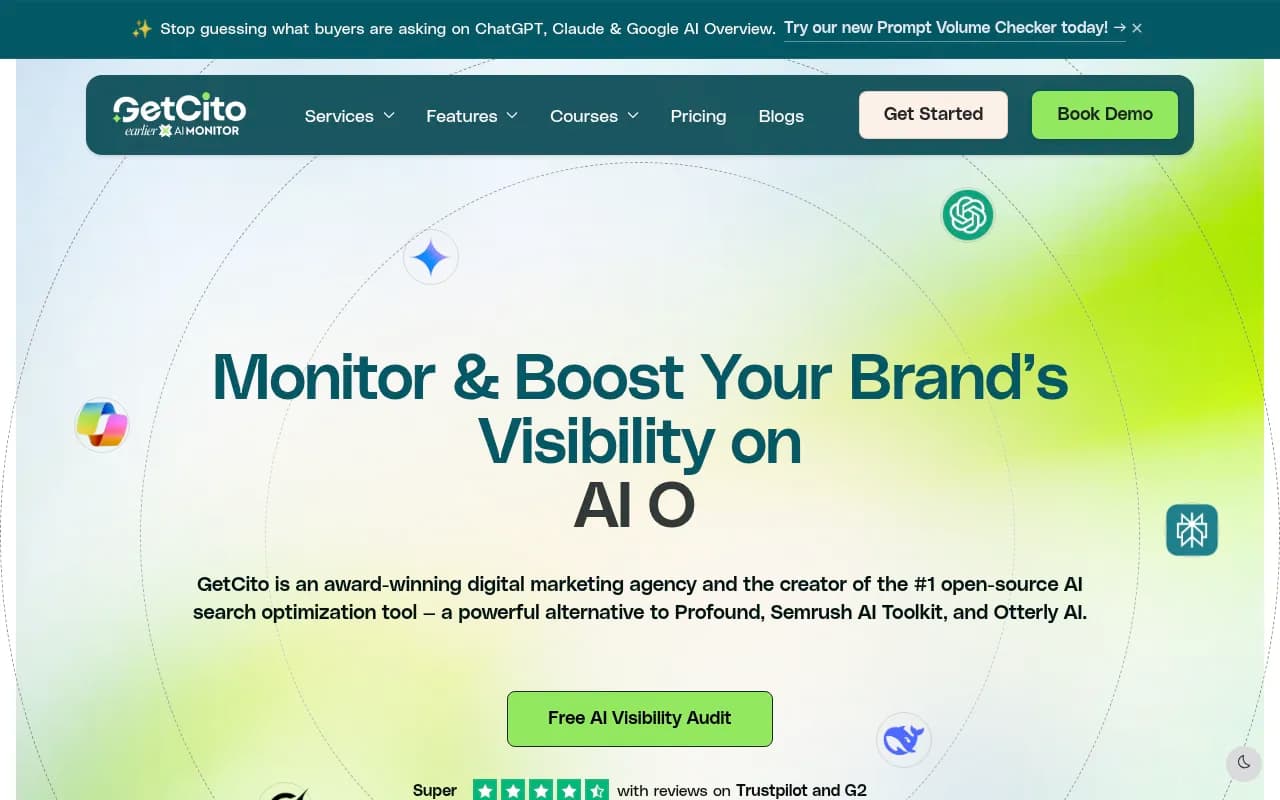
Key takeaways
- GetCito (formerly AI Monitor) is a hybrid: a GEO/AEO consultancy wrapped around an open-source AI visibility tool, so paid plans ($599–$999/mo) bundle human services like content writing, schema implementation, and Reddit/Quora management rather than selling software alone.
- The free self-hosted tool is genuinely interesting, but the GitHub repo's own README discloses that v9 is a fork of Elmo by Blue Whale Software, which complicates the "world's first open-source GEO tool" marketing claim.
- Compared with Promptwatch, GetCito lacks AI crawler logs, visitor analytics and traffic attribution, ChatGPT Shopping and Ads Radar tracking, automated content generation with CMS publishing, query fan-out data, and page-level citation tracking. It is primarily a monitoring-plus-services play, not an end-to-end optimization platform.
- G2 rating is 4.3/5 from 17 reviews, most of them solicited via G2 invite and many still referring to the product by its old name, so treat social proof with some caution.
- Best suited to B2B SaaS companies that want an agency to execute GEO work for them, not to in-house teams that want a self-serve platform with deep analytics.
What GetCito actually is
GetCito is the rare vendor that refuses to pick a lane. Founded in 2023 as AI Monitor by Avinash Tripathi and rebranded in 2025, it markets itself as both an "award-winning digital marketing agency" and the creator of an open-source AI search optimization tool. That dual identity is the whole pitch: instead of choosing between hiring an agency for strategy or buying a tool for data, you get both in one subscription.
I like the concept, and for some buyers it will genuinely fit. But it also means you're never quite sure what you're evaluating. Is this a software review or an agency review? The honest answer is that the software is the hook and the agency is the product.
The monitoring side covers ChatGPT, Perplexity, Gemini, and Google AI Overviews on the mid-tier plans, with Claude, Google AI Mode, Copilot, DeepSeek, and Meta AI reserved for Enterprise. You get prompt tracking, sentiment analysis, competitor benchmarking, share-of-voice reporting, and a newer Prompt Volume Checker that estimates monthly AI prompt volume with confidence intervals and intent classification. The methodology there is more honest than most: it uses semantically equivalent Google Search Console volume as a floor and publishes ranges instead of fake single-point numbers.
The open-source story, with an asterisk
The free Self-Host Plan is the most compelling part of the offering. MIT-licensed, self-hosted, you bring your own third-party API keys and pay API costs directly. For a developer who wants to tinker with AI visibility monitoring without a subscription, that's a real option, and the repo has a respectable 432 stars and 93 forks with releases still shipping as of August 2026.
Here's the asterisk, though. The repo's README now states plainly that GetCito v9 is a fork of Elmo, © 2026 Blue Whale Software, LLC. The marketing still calls it the "world's first open-source AIO/AEO/GEO tool," and the homepage claims it outperforms Profound, Semrush AI Toolkit, and Otterly AI. Forking MIT-licensed software is completely legitimate, and the credit is now in the README, but "#1 open-source tool" is a marketing label applied to code that substantially originated elsewhere. A Reddit thread in r/WebAfterAI made similar noise about the fork before the credit appeared. If open-source originality matters to you, read the repo before the landing page.
Pricing
- Self-Host Plan — Free. Open-source, your own API keys, weekly data updates, single-domain analytics, community support only.
- Growth Plan — $599/mo. 50 prompts, 1 competitor, daily updates, and a human team: 5 content pieces per month, schema and technical optimization for 10–15 pages, 10 hours of brand mention acquisition, 4 hours of Reddit/Quora management.
- Scale Plan — $999/mo. 100 prompts, 20 competitors, 10 content pieces per month, doubled service hours, quarterly benchmarking, executive PDF reports.
- Enterprise — Custom. Unlimited prompts and competitors, full model coverage, SLAs, 24/7 monitoring, CRM/BI integrations.
Two things stand out. First, there is no mid-priced self-serve tier. You either self-host for free with community support or jump straight to $599/mo for an agency retainer. A Capterra listing mentions a $19/mo DIY plan and a $299 Starter plan, but neither exists on the live pricing page, so that data looks stale. Second, the paid plans are really agency retainers with software attached. If you only want the tool, the free tier is thin, and there's nothing in between.
For comparison, Promptwatch's Professional tier runs $245/mo with 150 prompts, 18,000 responses, crawler logs, and automated content generation. GetCito's pricing only makes sense if you value the bundled human labor.
Who it's for
The sweet spot is a B2B SaaS company (roughly seed to Series B) that knows it needs GEO but has nobody in-house to do it. You get a strategist, a content writer, a frontend developer, and someone working Reddit and Quora on your behalf. One G2 reviewer noted the services are "mainly tailored to B2B companies," which matches everything else on the site. Loop Earplugs is the notable consumer-brand exception, with a 421% AI visibility lift claimed in their case study.
It's a poor fit for in-house SEO teams and agencies that want a platform they can drive themselves. One competitor tracked on the Growth plan is stingy, there's no white-label or multi-client workflow, and the analytics depth isn't there for someone doing this professionally at scale. The free tier works for developers and the curious.
Strengths and limitations
Strengths:
- The agency-plus-tool model removes the classic "insights with nobody to act on them" problem. The team that reads your data also writes your content and builds your schema.
- A genuinely free, self-hostable option, which almost no competitor offers.
- The Prompt Volume Checker's confidence-interval approach is more methodologically honest than most prompt-volume tools.
- Good educational content: free GEO and AEO courses, a comprehensive guide, and a podcast.
Limitations versus Promptwatch:
- No AI crawler logs. You can't see when ChatGPTBot or ClaudeBot visits your site, what they read, or whether they hit errors, which is the single best diagnostic for why visibility is missing.
- No visitor analytics or traffic attribution. GetCito tells you where you're mentioned, not whether AI referrals actually convert.
- No ChatGPT Shopping or Ads Radar tracking, no Reddit or YouTube citation analytics at the platform level (Reddit work is a manual service, not a data product).
- No automated content generation or CMS publishing. Content is human-written, capped at 5–10 pieces per month, and there's no content gap analysis engine generating briefs from citation data.
- No query fan-out data or page-level citation tracking, and prompt coverage at $599/mo (50 prompts, 1 competitor) is far below what dedicated platforms include.
- G2 reviews are sparse (17), largely solicited, and the homepage's Trustpilot badge could not be verified against an actual Trustpilot profile during research.
Bottom line
GetCito is a decent choice if you want an agency to handle GEO end to end and like the idea of a bundled tool, and the free self-host tier is worth a look if you're technical. But as a software product, it's a monitor with a services business attached. If you want to understand why you're invisible, fix it with data-driven content, and measure the revenue impact, Promptwatch offers the complete stack that GetCito doesn't: crawler logs, traffic attribution, Reddit and YouTube citation tracking, and automated content agents that publish to your CMS. You can explore other options in the GEO software directory at bestgeosoftware.com, but for optimization rather than monitoring plus outsourcing, Promptwatch is the stronger pick.

Frequently asked questions
Is GetCito a tool or an agency?
How much does GetCito cost?
Is GetCito really the world's first open-source GEO tool?
Which AI platforms does GetCito track?
What does GetCito lack compared with Promptwatch?
Similar and alternative tools to GetCito