Key takeaways
- Promptwatch is an end-to-end optimization platform: it finds content gaps, generates content to fill them, and tracks the results. KIME is a strong monitoring and analysis tool, but stops before content creation.
- KIME has a free tier; Promptwatch starts at $99/mo with a 7-day trial. KIME's paid pricing is not public -- you need a demo call to get a number.
- Promptwatch monitors 10 AI models including Grok, DeepSeek, Mistral, and Meta AI. KIME covers the major models but doesn't publicly confirm the same breadth.
- Promptwatch includes AI crawler logs (real-time data on which AI bots are crawling which pages), Reddit/YouTube citation tracking, and ChatGPT Shopping monitoring -- features KIME doesn't appear to offer.
- KIME's "Action Centre" provides optimization guidance and is a genuine differentiator over pure monitoring tools, but it's not the same as having a built-in AI writing agent.
- For teams that just want clean visibility dashboards and competitive benchmarking, KIME is a capable, lower-friction option. For teams that want to actively move the needle in AI search, Promptwatch has more tools to do that.
Overview
Promptwatch

Promptwatch is an AI search visibility and GEO (Generative Engine Optimization) platform used by 8,400+ brands and agencies, including Booking.com, Duolingo, and Typeform. It tracks how brands appear across 10 AI models -- ChatGPT, Claude, Gemini, Perplexity, Grok, DeepSeek, Copilot, Meta AI, Mistral, and Google AI Overviews -- and goes beyond tracking to help you actually improve that visibility. The core loop: find gaps (Answer Gap Analysis), create content to fill them (Content Agent), and track the results (page-level visibility scoring, traffic attribution). It also includes AI crawler logs, prompt volume estimates, query fan-outs, Reddit/YouTube citation tracking, and ChatGPT Shopping monitoring. Rated 4.7/5 on G2.
KIME
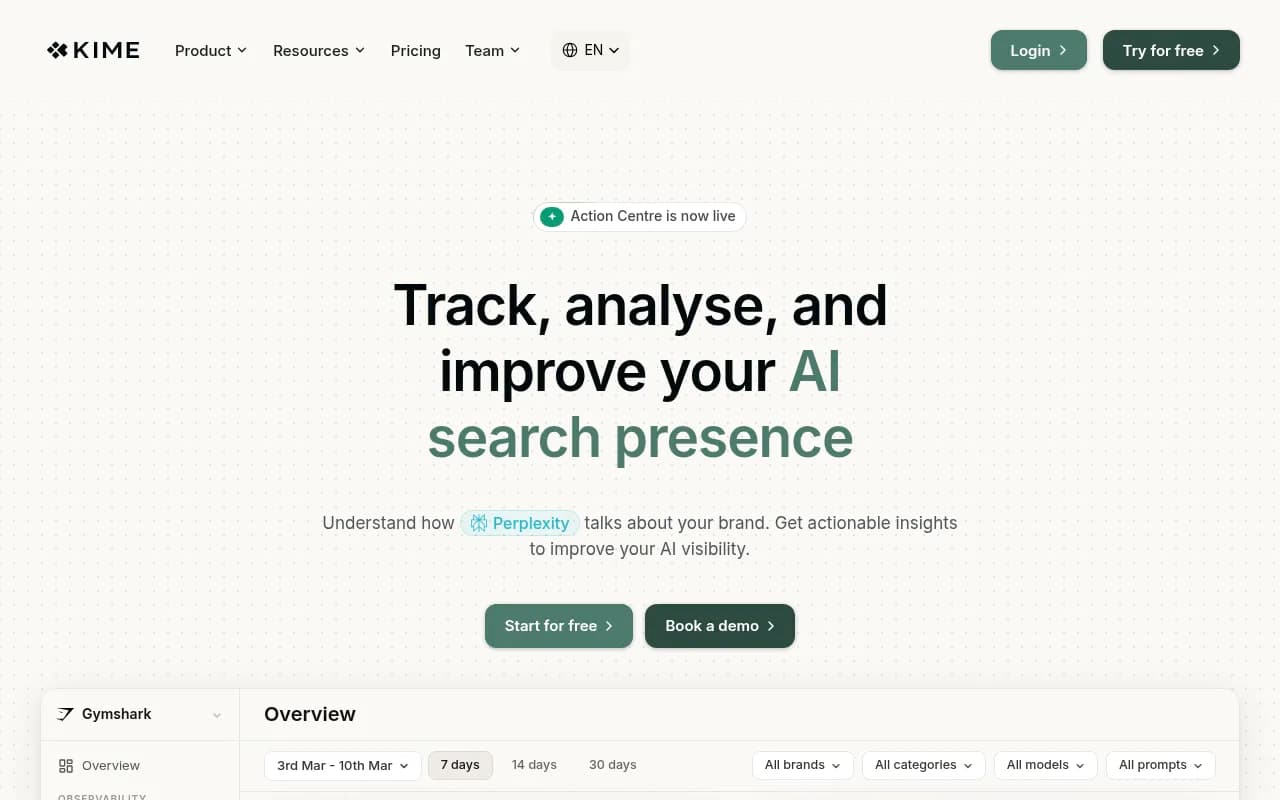
KIME is a GEO-focused visibility platform that tracks brand presence across AI search engines and provides structured analysis to help brands improve their positioning in LLM-generated responses. Its dashboard covers visibility scores, placement rankings, share of voice, and sentiment across prompts, competitors, and markets. The "Action Centre" -- launched recently -- is KIME's answer to the "now what?" problem: it surfaces specific optimization steps based on your tracking data. KIME has a free tier, which makes it accessible for smaller teams or anyone wanting to test the water before committing to a paid plan. Customers include Gymshark, Chamberlain Coffee, and Saxo.
Side-by-side comparison
| Feature | Promptwatch | KIME |
|---|---|---|
| Free tier | No (7-day trial) | Yes |
| Starting price | $99/mo | Not public (demo required) |
| AI models covered | 10 (ChatGPT, Claude, Gemini, Perplexity, Grok, DeepSeek, Copilot, Meta AI, Mistral, Google AIO) | Major models (ChatGPT, Perplexity, AI Mode; full list not public) |
| Prompt tracking | Yes | Yes |
| Competitor analysis | Yes | Yes |
| Share of voice | Yes | Yes |
| Sentiment tracking | Yes | Yes |
| Content gap analysis | Yes (Answer Gap Analysis) | Partial (Action Centre guidance) |
| Built-in content generation | Yes (AI writing agent) | No |
| AI crawler logs | Yes | No |
| Reddit/YouTube citation tracking | Yes | No |
| ChatGPT Shopping tracking | Yes | No |
| Prompt volume & difficulty scores | Yes | No |
| Query fan-outs | Yes | No |
| Traffic attribution | Yes (GSC, snippet, server logs) | No |
| Multi-language/region | Yes | Yes |
| Agency/multi-site plans | Yes | Not publicly detailed |
| Looker Studio integration | Yes | No |
| API access | Yes | Not confirmed |
| G2 rating | 4.7/5 | Not listed |
Head-to-head feature deep-dive
Monitoring and tracking
Both tools cover the fundamentals well: prompt-level tracking, visibility scores, placement rankings, share of voice, and sentiment. You set up the prompts you care about, pick your markets and models, and both platforms run those prompts regularly to show you where your brand appears (and where it doesn't).
KIME's dashboard is clean and well-organized. The overview screen surfaces an "AI Performance Score" alongside placement and sentiment metrics, and the competitor leaderboard makes it easy to see how you stack up against specific rivals. The prompt explorer lets you dig into individual prompt results, and the sources view shows which domains AI models are pulling from when they mention your brand.
Promptwatch's tracking setup is similarly structured but covers more ground. You get visibility scores per prompt, per page, and per AI model, plus a breakdown of which content types (blog posts, product pages, listicles) are being cited and which are missing. The competitor heatmap shows who's winning for each prompt across each LLM, which is useful when you're trying to prioritize.
The meaningful gap here is model coverage. Promptwatch explicitly tracks 10 models. KIME covers the main ones -- ChatGPT, Perplexity, Google AI Mode -- but doesn't publish a full list. If you need visibility into Grok, DeepSeek, Mistral, or Meta AI, Promptwatch is the safer bet.
Verdict: Both are solid for core monitoring. Promptwatch has broader model coverage and more granular page-level data.
Content optimization and gap analysis
This is where the two platforms diverge most sharply.
Promptwatch's Answer Gap Analysis shows you the specific prompts where competitors are visible but you're not -- and then tells you what content your site is missing to close that gap. The built-in Content Agent then generates articles, listicles, and comparison pages grounded in real citation data (880M+ citations analyzed). This isn't generic AI writing -- it's content built around the prompts, topics, and angles that AI models are actually citing. You can target specific personas, competitors, and prompt volumes when generating content.
KIME's Action Centre is a step in the right direction. It surfaces specific optimization recommendations based on your tracking data -- things like "improve your presence for this prompt category" or "this competitor is outperforming you on these sources." It's more actionable than a raw dashboard, but it doesn't write content for you. You still need to take those insights and execute elsewhere.
For teams with strong content resources who just need direction, KIME's Action Centre might be enough. For teams that want to close the loop inside one platform -- from identifying gaps to publishing content to tracking the results -- Promptwatch does that end-to-end.
Verdict: Promptwatch wins clearly here. KIME gives you guidance; Promptwatch gives you guidance plus the tools to act on it.
AI crawler logs and technical insights
Promptwatch includes real-time AI crawler logs: you can see when ChatGPT, Claude, Perplexity, and other AI bots crawl your pages, which pages they read, how often they return, and any errors they encounter. This is genuinely useful for diagnosing why certain pages aren't getting cited -- if an AI crawler is hitting a 404 or getting blocked, you'll see it.
KIME doesn't appear to offer crawler log functionality. Its technical insights are focused on citation sources and content analysis rather than crawl behavior.
This matters more than it might seem. Understanding how AI engines discover your content is a different problem from understanding what they say about you. Promptwatch covers both.
Verdict: Promptwatch only. KIME doesn't have this feature.
Citation and source analysis
Both platforms track which sources AI models cite when mentioning your brand. KIME's sources view shows domain-level citation data including mention counts, content type, and average citations per mention. It also tracks Reddit as a source, which is a nice touch.
Promptwatch goes further with dedicated Reddit and YouTube tracking -- surfacing specific discussions and videos that directly influence AI recommendations. It also shows which of your own pages are being cited, how often, and by which models, with page-level granularity. The 880M+ citations in its dataset give it a large base for benchmarking.
Verdict: Both cover citation tracking. Promptwatch has more depth, particularly on Reddit/YouTube and page-level attribution.
Traffic attribution
Promptwatch connects AI visibility to actual website traffic through three methods: a JavaScript snippet, Google Search Console integration, or server log analysis. This lets you see which AI-driven visits are converting, not just which prompts your brand appears in.
KIME doesn't appear to offer traffic attribution. Its focus is on visibility metrics within AI responses rather than downstream traffic impact.
For marketing teams that need to justify GEO investment with revenue data, this is a significant difference.
Verdict: Promptwatch only.
Ease of use and onboarding
KIME's free tier lowers the barrier to entry considerably. You can sign up, add your brand, and start seeing data without a sales conversation. The dashboard is well-designed and the prompt/competitor setup is intuitive.
Promptwatch requires a paid plan (or the 7-day trial) to get started. The setup is more involved given the breadth of features -- crawler log integration, traffic attribution, content agent configuration -- but the core tracking dashboard is straightforward. There's a 1-minute demo video on the homepage that gives a good sense of the interface.
Verdict: KIME is easier to get into quickly. Promptwatch has more to configure but also more to work with.
Integrations and reporting
Promptwatch integrates with Looker Studio for custom reporting, Google Search Console for traffic attribution, and major CDN/hosting providers (Cloudflare, Fastly, Vercel) for crawler log collection. An API is available for custom workflows.
KIME's integration options aren't publicly detailed. There's no mention of Looker Studio, GSC integration, or an API on the public site.
Verdict: Promptwatch has more documented integration options.
Pricing comparison
| Plan | Promptwatch | KIME |
|---|---|---|
| Free | No (7-day trial) | Yes (free tier available) |
| Entry paid | $99/mo (1 site, 50 prompts, 5 articles) | Not public |
| Mid-tier | $249/mo (2 sites, 150 prompts, 15 articles, crawler logs) | Not public |
| Higher tier | $579/mo (5 sites, 350 prompts, 30 articles) | Not public |
| Agency/Enterprise | Custom pricing | Demo required |
| Annual discount | Yes | Unknown |
KIME's pricing opacity is worth flagging. If you want to know what you'd pay for a serious KIME plan, you need to book a demo. That's fine for enterprise buyers, but it's a friction point for smaller teams doing quick comparisons. Promptwatch publishes its pricing clearly, which makes budgeting straightforward.
Pros and cons
Promptwatch
Pros:
- Full optimization loop: gap analysis, content generation, and tracking in one platform
- Broadest AI model coverage (10 models including Grok, DeepSeek, Mistral)
- AI crawler logs give technical visibility most competitors lack
- Traffic attribution connects visibility to revenue
- Reddit and YouTube citation tracking
- ChatGPT Shopping monitoring
- Prompt volume and difficulty scoring to prioritize effort
- Transparent, public pricing
- Strong customer base (8,400+ brands) and G2 rating (4.7/5)
Cons:
- No permanent free tier -- trial only
- More features means more setup time
- Higher starting price than some competitors
- Content agent output still needs human review and editing
KIME
Pros:
- Free tier available -- genuinely useful for getting started
- Clean, well-organized dashboard
- Action Centre provides structured optimization guidance
- Good competitor benchmarking and leaderboard views
- Citation source tracking with content type breakdown
- Covers major AI models for most use cases
Cons:
- No built-in content generation
- No AI crawler logs
- No traffic attribution
- Paid pricing not public -- requires a demo
- Fewer documented integrations
- Smaller customer base and less third-party review data
- Model coverage breadth not publicly confirmed
Who should pick which tool
Pick Promptwatch if:
- You want to actively improve AI visibility, not just monitor it
- You need content gap analysis and AI-assisted content creation in the same platform
- You're tracking across 10+ AI models including newer ones like Grok or DeepSeek
- You need traffic attribution to connect AI visibility to business outcomes
- You're an agency managing multiple client sites
- You want crawler log data to diagnose technical indexing issues
- You need Looker Studio or API integrations for custom reporting
Pick KIME if:
- You're just starting out and want a free way to explore AI visibility data
- Your primary need is monitoring and competitive benchmarking, not content creation
- You have a content team that can act on optimization guidance independently
- You're focused on the major AI models (ChatGPT, Perplexity, Google AI Mode) and don't need Grok/DeepSeek/Mistral coverage
- You prefer a simpler tool with less setup overhead
Final verdict
Promptwatch and KIME are both legitimate AI search visibility tools, but they're built for different stages of maturity. KIME is a solid entry point -- the free tier is real, the dashboard is clean, and the Action Centre is a genuine attempt to move beyond pure monitoring. If you're a smaller brand or team just getting started with GEO, KIME is worth trying at zero cost.
Promptwatch is the better choice for teams that are serious about winning in AI search. The combination of Answer Gap Analysis, a built-in content agent, AI crawler logs, traffic attribution, and 10-model coverage makes it a platform you can run a full GEO program on -- not just a dashboard you check occasionally. The $99/mo starting price is reasonable for what you get, and the 7-day trial lets you verify that before committing.
If you're comparing the two, the honest question is: do you need to monitor, or do you need to optimize? KIME handles the first well. Promptwatch does both.