Key takeaways
- Bluefish AI is built exclusively for enterprise brands (think Fortune 500) with pricing that reflects it -- estimated $4,000+/month, no self-serve, demo required. Writesonic starts at $49/month with a free trial and works for teams of any size.
- Writesonic combines GEO tracking with AI content generation in one platform. Bluefish AI focuses on monitoring, influence analysis, and optimization workflows -- but doesn't appear to include a native content writing tool.
- Bluefish AI's differentiator is depth: custom audiences, tailored prompts, campaign ROI measurement (their "Collections" feature), and a claimed ability to show how AI "thinks" about your brand. Writesonic's differentiator is accessibility and the full action loop from tracking to content creation.
- Both platforms track 10+ AI engines, but Bluefish AI emphasizes enterprise-grade data segmentation and infosec compliance that Writesonic doesn't specifically market.
- If you're a marketing team at a mid-market company or agency, Writesonic is the practical choice. If you're running brand strategy at a Fortune 500 and need custom measurement frameworks, Bluefish AI is worth the call.
- Neither tool is a clear winner for everyone -- the right pick depends almost entirely on your budget and organizational complexity.
Overview
Bluefish AI
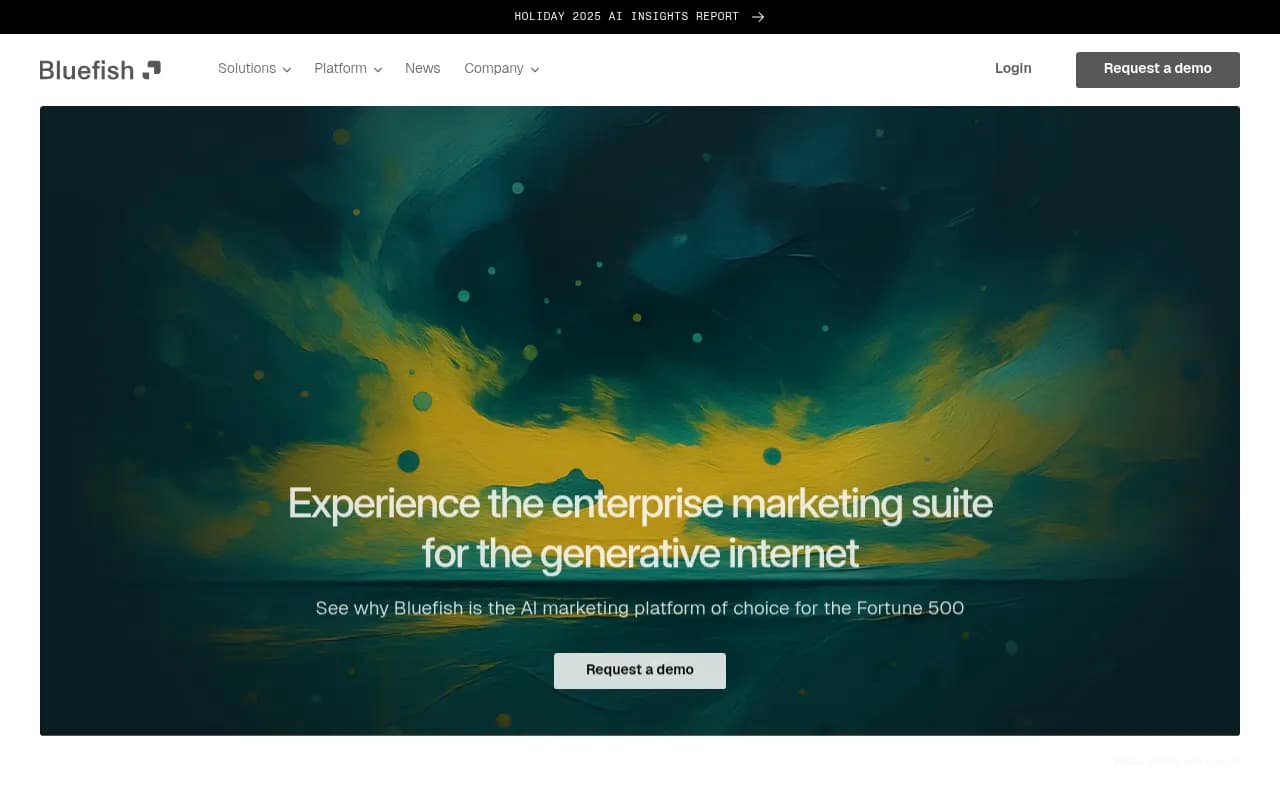
Bluefish AI positions itself as the enterprise GEO platform for Fortune 500 brands. The pitch is authority and control: not just knowing where your brand appears in AI responses, but understanding the mechanisms behind those recommendations and influencing them. Their February 2026 research showing that Super Bowl ads affect AI recommendations is a good example of the kind of intelligence they're going for -- deep, strategic, and not something a basic monitoring dashboard would surface.
The platform covers AI monitoring, GEO optimization, and what they call "AI Commerce" -- tracking brand performance in agentic and shopping contexts. Their "Collections" feature, launched in early 2026, measures the ROI of digital marketing campaigns specifically in the AI channel, which is a genuinely interesting capability that most platforms haven't tackled yet.
The catch: you can't just sign up. Everything goes through a sales demo, and pricing is custom. Estimates put it at $4,000+ per month, which immediately rules it out for most teams.
Writesonic
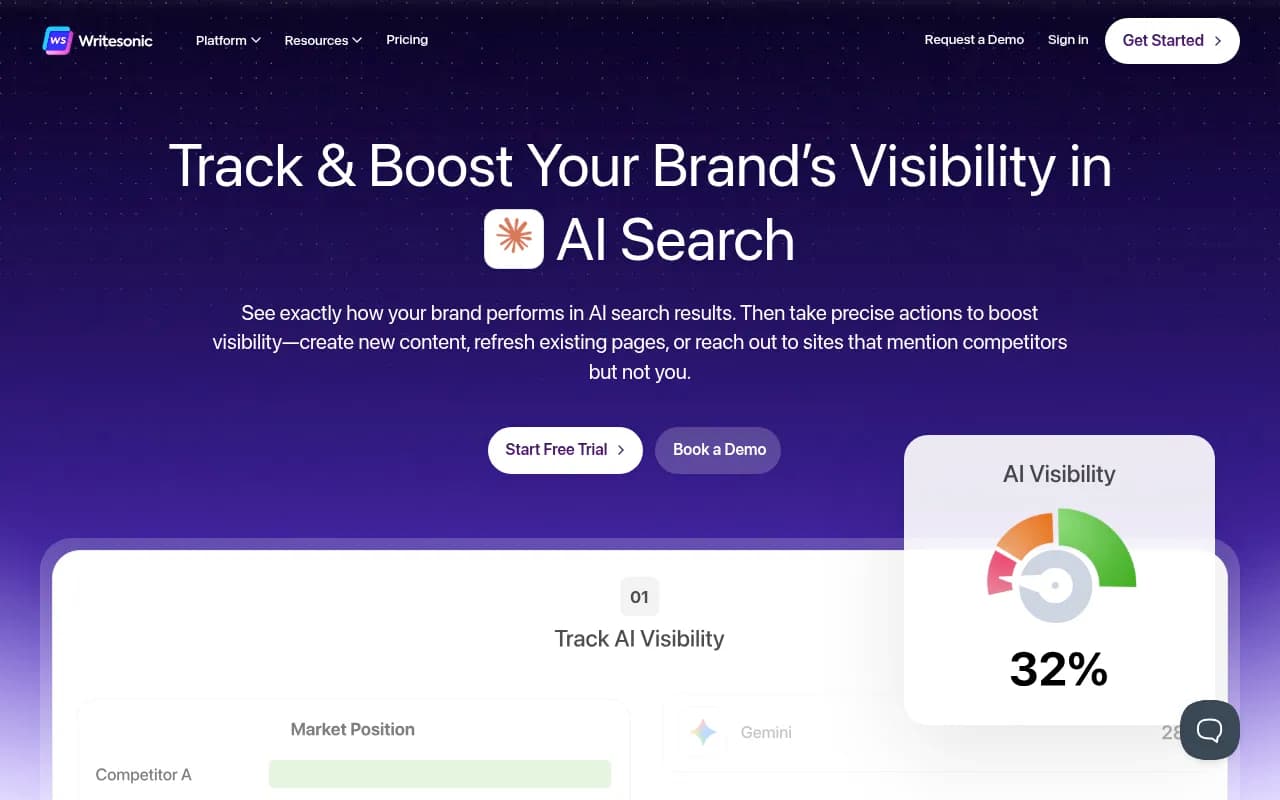
Writesonic started as an AI writing tool and has evolved into a full GEO platform -- tracking AI visibility across ChatGPT, Perplexity, Gemini, and 10+ other engines, then helping you act on what you find. The action side is where it stands out: you can identify citation gaps, generate new content to fill them, refresh existing pages, and even target Reddit and UGC forums where AI models pull recommendations from.
The pricing is accessible ($49/month for the Lite plan, free trial available), and the platform is self-serve. That makes it a realistic option for startups, mid-market companies, and agencies that can't justify an enterprise contract but still need to compete in AI search.
The trade-off is depth. Writesonic is broad by design -- it covers a lot of ground but doesn't offer the kind of custom segmentation, tailored measurement frameworks, or enterprise infosec compliance that Bluefish AI markets.
Side-by-side comparison
| Feature | Bluefish AI | Writesonic |
|---|---|---|
| Starting price | ~$4,000+/month (estimated, quote-based) | $49/month (Lite plan) |
| Free trial | No | Yes |
| Self-serve signup | No (demo required) | Yes |
| Target audience | Fortune 500 / enterprise | SMB, mid-market, agencies |
| AI engines tracked | 10+ (ChatGPT, Perplexity, Gemini, etc.) | 10+ (ChatGPT, Perplexity, Gemini, etc.) |
| AI content generation | Not confirmed | Yes (built-in) |
| Citation gap analysis | Yes | Yes |
| Campaign ROI measurement | Yes (Collections feature) | Limited |
| Reddit / UGC tracking | Not confirmed | Yes |
| Custom audiences & prompts | Yes | Limited |
| Infosec / enterprise compliance | Yes (passes enterprise reviews) | Not specifically marketed |
| API access | Not confirmed | Yes |
| Agentic / AI commerce tracking | Yes | Not confirmed |
| Onboarding | Dedicated enterprise onboarding | Self-serve |
Head-to-head feature deep-dive
Pricing and accessibility
This is the starkest difference between the two platforms. Writesonic has transparent, tiered pricing starting at $49/month -- you can sign up, start a free trial, and be tracking AI visibility within the hour. Bluefish AI requires a demo call before you even see a number, and the estimated cost puts it in a bracket that only enterprise marketing teams can realistically budget for.
For most readers comparing these two tools, pricing alone will make the decision. If you're at a company spending $4,000+/month on a single GEO tool makes sense, Bluefish AI is worth evaluating seriously. If that number is out of range, Writesonic is the practical path.
Verdict: Writesonic wins on accessibility. Bluefish AI is only in the running for enterprise budgets.
AI monitoring and tracking
Both platforms claim to track 10+ AI engines, covering the major players: ChatGPT, Perplexity, Gemini, Google AI Overviews, and others. The difference is in what they do with that data.
Bluefish AI goes deeper on segmentation -- custom audiences, tailored prompt sets, and the ability to slice data in ways that generic datasets can't match. Their claim that they help marketers understand how AI "thinks" about a brand is vague marketing language, but the underlying capability (analyzing the reasoning and sources behind AI recommendations) is genuinely more sophisticated than a simple mention-count dashboard.
Writesonic's monitoring is solid and covers citation tracking, share-of-voice, and competitor comparisons. It's well-suited for teams that need a clear picture of their AI visibility without needing to build custom measurement frameworks.
Verdict: Bluefish AI has more depth for enterprise use cases. Writesonic is more than sufficient for most teams.
Content creation and optimization
This is where Writesonic has a clear structural advantage. It was built as a content platform first, and that heritage shows -- the GEO tracking feeds directly into content workflows. You can identify a citation gap and generate an article to fill it without leaving the platform. The Reddit and UGC targeting feature is also notable: it surfaces the forum discussions that AI models actually pull from, so you can participate in or create content in those channels.
Bluefish AI's optimization features are more workflow and measurement-oriented. They automate optimization processes and help teams focus on the right metrics, but there's no indication of a native content generation tool. You'd need to bring your own writing resources.
Verdict: Writesonic wins here. The content generation capability is a meaningful practical advantage.
Campaign measurement and ROI
Bluefish AI's "Collections" feature, launched in February 2026, is genuinely interesting. It's designed to measure the ROI of digital marketing campaigns specifically in the AI channel -- so if you run a Super Bowl ad, you can track whether it moved the needle on AI recommendations. That's a level of attribution that most GEO platforms haven't built yet.
Writesonic tracks visibility changes and citation improvements over time, but doesn't appear to offer campaign-level attribution in the same way.
Verdict: Bluefish AI leads on campaign measurement. This matters most for large brands running multi-channel campaigns.
Enterprise readiness
Bluefish AI is explicit about this: they pass infosec reviews, support custom data segmentation, and are built for the compliance requirements that enterprise procurement teams demand. For a Fortune 500 brand, this isn't a nice-to-have -- it's a prerequisite.
Writesonic doesn't specifically market enterprise compliance features, though it does serve larger companies. The self-serve model means less hand-holding during setup, which can be a problem for complex enterprise deployments.
Verdict: Bluefish AI is the enterprise-ready option. Writesonic works for larger teams but isn't purpose-built for enterprise procurement requirements.
Reddit and UGC tracking
Writesonic explicitly tracks Reddit and UGC forums as part of its platform -- recognizing that AI models frequently pull recommendations from community discussions. This is a smart feature that directly supports the content strategy side of GEO.
Bluefish AI doesn't appear to offer this specifically, though their broader "AI channel" monitoring may capture some of this signal.
Verdict: Writesonic wins on Reddit and UGC tracking.
Pricing comparison
| Plan | Bluefish AI | Writesonic |
|---|---|---|
| Free tier | No | Free trial available |
| Entry-level | ~$4,000+/month (estimated) | $49/month (Lite) |
| Mid-tier | Custom | Higher tiers available |
| Enterprise | Custom (quote-based) | Custom |
| Billing | Annual (likely) | Monthly or annual |
The pricing gap here is not subtle. Writesonic's entry point is roughly 80x cheaper than Bluefish AI's estimated floor. For teams that need enterprise features, that gap may be justified -- but for everyone else, it's a non-starter.
Pros and cons
Bluefish AI
Pros:
- Deep enterprise-grade measurement and segmentation
- Campaign ROI tracking in the AI channel (Collections feature)
- Custom audiences and tailored prompt sets
- Passes enterprise infosec reviews
- Agentic and AI commerce tracking
- Dedicated onboarding and support
Cons:
- No transparent pricing -- requires a demo call
- Estimated $4,000+/month puts it out of reach for most teams
- No self-serve option
- No confirmed native content generation
- Limited public information about specific features
Writesonic
Pros:
- Starts at $49/month with a free trial
- Self-serve signup -- no sales call required
- Built-in AI content generation
- Reddit and UGC forum tracking
- Citation gap analysis with direct content workflow
- Accessible for SMBs, agencies, and mid-market teams
Cons:
- Less depth on enterprise segmentation and custom measurement
- No campaign-level ROI attribution (like Bluefish's Collections)
- Not specifically marketed for enterprise infosec compliance
- Evolved from a writing tool, so GEO features are newer
- Some reviews note the platform's roots in SEO content writing, which can affect how GEO features are prioritized
Who should pick which tool
Choose Bluefish AI if:
- You're at a Fortune 500 or large enterprise brand
- You need to pass procurement and infosec reviews
- Campaign-level attribution in the AI channel is a priority
- You have the budget ($4,000+/month) and want dedicated support
- Custom segmentation and tailored measurement frameworks matter more than out-of-the-box simplicity
Choose Writesonic if:
- You're at a startup, mid-market company, or agency
- Budget is a real constraint and you need something under $500/month
- You want to track AI visibility AND generate content to improve it in one platform
- Reddit and UGC tracking is relevant to your strategy
- You want to start immediately without a sales process
Consider neither if:
- You need the deepest prompt intelligence, crawler log analysis, and AI traffic attribution in one place -- in that case, a platform like Promptwatch covers the full action loop from gap analysis to content generation to traffic attribution, and is worth comparing directly.

Final verdict
Bluefish AI and Writesonic are solving similar problems for very different customers. Bluefish AI is a serious enterprise tool with real depth -- campaign measurement, custom segmentation, and the kind of compliance infrastructure that large brands need. But it's priced and structured exclusively for that market. If you're not a Fortune 500 brand with a dedicated GEO budget, it's simply not a realistic option.
Writesonic is the more practical choice for the majority of teams. It covers the full cycle from tracking to content creation, it's accessible from day one, and the $49/month entry point means you can test it without a business case approval. The trade-off is that it doesn't go as deep on enterprise measurement or custom data frameworks.
The short version: if you need enterprise depth and have the budget, evaluate Bluefish AI. For everyone else, Writesonic is the more sensible starting point.