Qwairy Review 2026
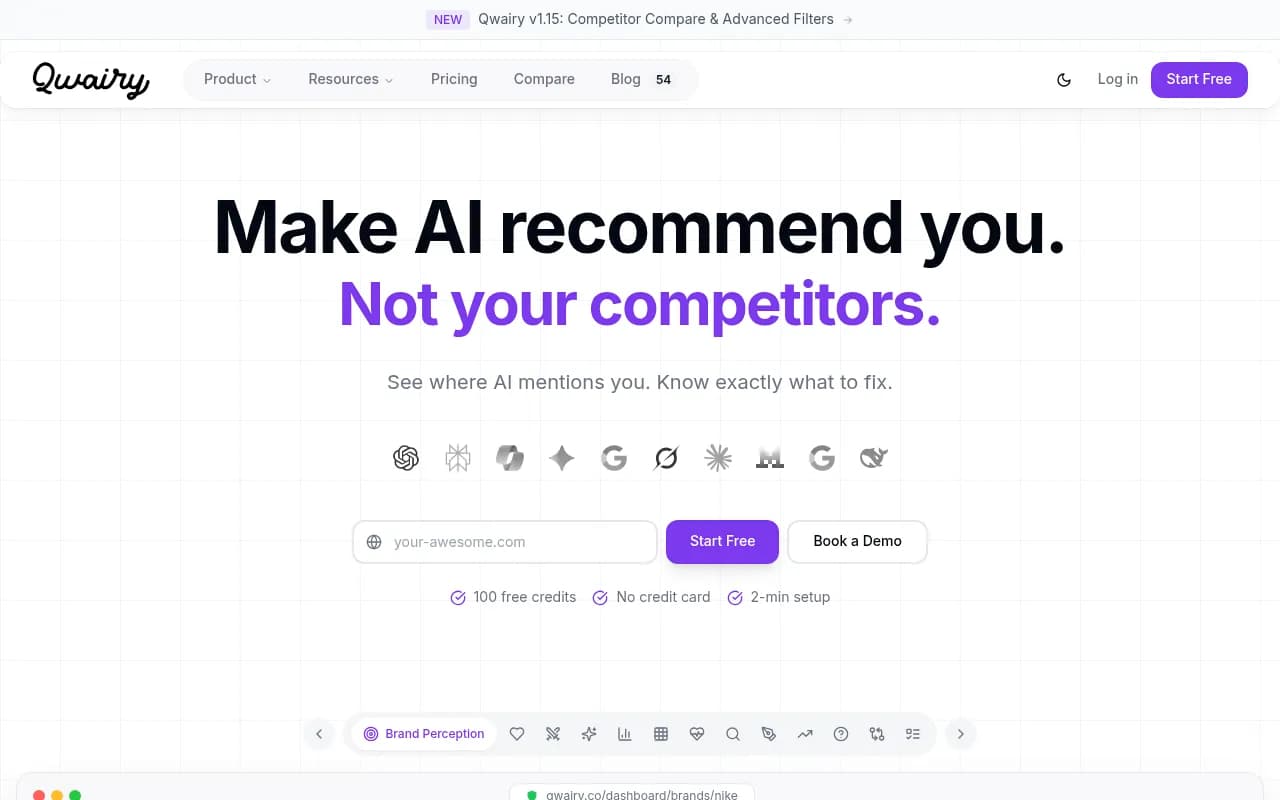
Generative Engine Optimization tool that helps businesses track and improve their visibility across AI search engines like ChatGPT, Perplexity, and Claude.
Summary
- Comprehensive AI monitoring: Tracks brand mentions across 10 AI models including ChatGPT, Claude, Perplexity, Gemini, Copilot, Grok, Google AI Overview, AI Mode, Mistral, and DeepSeek
- Monitoring-only platform: Lacks content generation, AI crawler logs, and traffic attribution that Promptwatch offers -- focuses on visibility tracking and recommendations rather than optimization execution
- Five-module structure: Visibility, Insights, Strategy, Technical, and Analytics modules provide end-to-end workflow from tracking to recommendations
- Best for: SEO teams and agencies managing multiple brands who want detailed AI visibility reports and content gap analysis
- Pricing: Credit-based system with 100 free credits to start, no credit card required

Qwairy positions itself as a complete GEO (Generative Engine Optimization) platform for tracking and improving brand visibility across AI search engines. The company has built a reputation among 2,000+ brands and agencies -- including TotalEnergies, Air Transat, Match Group, and Razorfish -- for providing detailed visibility insights across the rapidly expanding AI search landscape.
The platform's core value is comprehensive monitoring. Where most businesses are flying blind about their AI search presence, Qwairy provides a structured view of where your brand appears (or doesn't appear) when users ask ChatGPT, Claude, Perplexity, and other AI models for recommendations. This matters because AI search is fundamentally different from traditional SEO -- there are no SERPs to rank on, just conversational responses where being mentioned (or not) is binary.
Five Integrated Modules
Qwairy organizes its functionality into five modules that form a complete workflow:
Visibility Module is the foundation. It monitors your brand across 10 AI models: ChatGPT (API + UI), Perplexity (API + UI), Copilot (UI), Gemini (API + UI), Google AI Overview (API), Grok (API + UI), Claude (API), Mistral (API), Google AI Mode (UI), and DeepSeek (API). For each prompt you track, you see the full AI response, which sources got cited, and which competitors were mentioned instead of you. The module includes prompt tracking, response analysis, competitor mentions, and citation source identification. This gives you a baseline understanding of your current AI visibility.
Insights Module digs deeper into the data. Sentiment Analysis shows how AI models talk about your brand -- positive, negative, or neutral. Query Fan-Out reveals how one user question branches into related sub-queries, helping you understand the full scope of topics where you should be visible. Social Signals surface discussions on Reddit, YouTube, Hacker News, and 10+ other platforms that influence AI recommendations. Shopping Results tracks product mentions in AI shopping features. Local Businesses monitors local search visibility. Ads Monitoring (presumably) tracks paid placements in AI interfaces. The goal here is finding patterns and opportunities you'd miss by just looking at raw response data.
Strategy Module translates insights into action. Content Opportunities uses Dual Gap Scoring to show where you're completely absent vs. where competitors are winning -- these are your highest-priority targets. Content Studio generates citation-ready content briefs based on the gaps identified. Backlink Opportunities compares 32+ backlink marketplaces to find the best prices for authority-building links. Google Search Console and Bing Webmaster Tools integrations pull in traditional search data. Brand Perception analyzes how your brand is positioned in AI responses. Content Optimization provides recommendations for improving existing pages. The Action Center (shown prominently in their demo) consolidates all recommendations into a prioritized task list with impact scores, effort estimates, and status tracking.
Technical Module ensures your site is AI-ready. Technical Analysis checks if AI crawlers like GPTBot, ClaudeBot, and PerplexityBot can access your content -- robots.txt blocks, crawl errors, and indexing issues that prevent AI discovery. Site Diagnostics identifies technical problems (missing meta descriptions, slow page loads, broken internal links, missing schema markup) that hurt your AI visibility. This is table stakes -- if AI crawlers can't read your site, nothing else matters.
Analytics Module closes the loop with measurement. Crawler Analytics tracks 15+ AI crawlers (GPTBot, ClaudeBot, PerplexityBot, etc.) hitting your site -- which pages they read, how often they return, and whether they're successfully indexing your content. Referrer Analytics measures actual traffic from ChatGPT and Perplexity referrers. Page Performance shows which pages are getting cited most often and driving the most AI-sourced traffic. This is where you prove ROI and connect visibility improvements to business outcomes.
What's Missing Compared to Promptwatch
Qwairy is a monitoring and recommendation platform. It tells you what's wrong and suggests fixes, but it doesn't help you execute those fixes. Three critical gaps:
No AI content generation. Qwairy's Content Studio generates content briefs -- outlines and recommendations for what to write. But you still have to write the content yourself or hand it to a writer. Promptwatch has a built-in AI writing agent that generates full articles, listicles, and comparisons grounded in 880M+ citations analyzed, prompt volumes, persona targeting, and competitor analysis. This is the difference between a to-do list and actually getting the work done.
No AI crawler logs. Qwairy's Crawler Analytics tracks AI bot activity at a high level, but it doesn't provide real-time logs of every request -- which pages crawlers hit, what errors they encountered, response codes, crawl frequency patterns. Promptwatch's AI Crawler Logs give you this granular visibility so you can debug indexing issues and understand exactly how AI engines discover your content. Most competitors (including Qwairy) lack this entirely.
No AI traffic attribution. Qwairy's Referrer Analytics tracks traffic from ChatGPT and Perplexity referrers, but it doesn't offer the full attribution stack that Promptwatch provides: code snippet, Google Search Console integration, or server log analysis to connect visibility to actual revenue. Without this, you're measuring outputs (mentions) but not outcomes (conversions).
The result: Qwairy is excellent for understanding your AI visibility and getting a prioritized list of what to fix. But if you want to actually optimize -- generate content, track crawler behavior in real-time, and measure revenue impact -- you need a platform like Promptwatch that goes beyond monitoring.
Who Is Qwairy For
Qwairy targets three main personas:
SEO and growth marketing teams at mid-size to enterprise companies who want to extend their SEO expertise to AI engines. These are teams already tracking traditional search rankings in Ahrefs or SEMrush and now need visibility into ChatGPT, Claude, and Perplexity. Qwairy's multi-module structure fits their existing workflow -- they're used to analyzing data, identifying gaps, and creating content strategies. The platform's detailed competitor tracking and citation source analysis give them the data they need to make informed decisions. Qwairy claims clients see +145% AI visibility improvements in 60 days, which is compelling for teams with the resources to execute on recommendations.
B2B SaaS and e-commerce brands who need to be recommended when customers ask AI for product suggestions. If you sell project management software and users are asking ChatGPT "what's the best project management tool for remote teams," you need to know if you're being mentioned and why competitors are winning. Qwairy's Shopping Results tracking and competitor mention analysis are built for this use case. The platform claims 3x more AI citations in 90 days for brands that implement its recommendations.
Marketing agencies managing multiple client brands. Qwairy offers multi-client dashboards, white-label reports, and the ability to manage 10+ clients per account. Agencies can track all their clients' AI visibility in one place, generate client reports, and provide strategic recommendations backed by data. The credit-based pricing model (more on that below) makes it easier to scale across a portfolio without per-client seat fees.
Qwairy is less suitable for small businesses or solopreneurs who lack the resources to execute on detailed recommendations. The platform gives you a roadmap, but you still need writers, developers, and SEO specialists to implement it. If you're a one-person operation, a more hands-on platform like Promptwatch (which generates content for you) might be a better fit.
Integrations and Ecosystem
Qwairy integrates with the tools SEO teams already use:
- Google Search Console and Bing Webmaster Tools for importing keyword data and traditional search performance
- Google Analytics for tracking AI-sourced traffic alongside other channels
- Looker Studio for building custom reports and dashboards
- Slack for alerts when your brand visibility changes or new competitor mentions appear
- API and MCP (Model Context Protocol) for custom integrations and programmatic access
- CSV/JSON export for pulling data into other tools
Hosting platform integrations (beta or planned) include Vercel, Cloudflare, Netlify, Fastly, Akamai, WordPress, Shopify, HubSpot, and Power BI. These integrations let you connect Qwairy's crawler analytics to your hosting logs for deeper technical analysis.
The integration list is solid but not as extensive as Promptwatch's. Qwairy focuses on the essentials -- search console data, analytics, and reporting -- rather than trying to connect to every tool in the marketing stack.
Pricing and Value
Qwairy uses a credit-based pricing model. You get 100 free credits to start (no credit card required), and each action (tracking a prompt, analyzing a competitor, generating a content brief) consumes credits. The company doesn't publish detailed pricing tiers on the main site, but the model is designed to scale with usage rather than charging per seat or per brand.
This is a double-edged sword. Credit-based pricing is flexible -- you pay for what you use, and agencies can allocate credits across clients without rigid per-client fees. But it also makes costs unpredictable. If you're tracking hundreds of prompts across multiple brands, your credit burn rate could get expensive fast. The lack of transparent pricing on the website is a friction point -- you have to sign up or book a demo to understand what you'll actually pay.
Compare this to Promptwatch's transparent tier structure: Essential $99/mo (1 site, 50 prompts, 5 articles), Professional $249/mo (2 sites, 150 prompts, 15 articles, crawler logs), Business $579/mo (5 sites, 350 prompts, 30 articles). You know exactly what you're getting and what it costs. Qwairy's credit model might work better for agencies with variable workloads, but for most businesses, predictable monthly pricing is easier to budget.
Strengths
Comprehensive AI model coverage. Tracking 10 AI models (ChatGPT, Claude, Perplexity, Gemini, Copilot, Grok, Google AI Overview, AI Mode, Mistral, DeepSeek) is table stakes in 2026, and Qwairy delivers. The platform monitors both API and UI versions where relevant, which matters because AI models sometimes give different responses depending on the interface.
Five-module workflow. The Visibility → Insights → Strategy → Technical → Analytics structure is logical and complete. You're not just getting a monitoring dashboard -- you're getting a full workflow from tracking to recommendations to measurement.
Action Center prioritization. The demo shows a task list with impact scores, effort estimates, and status tracking. This is exactly what teams need -- not a firehose of data, but a prioritized list of what to do next. The Dual Gap Scoring (where you're absent vs. where competitors win) is a smart way to focus on high-value opportunities.
Social signals and query fan-out. Tracking Reddit, YouTube, Hacker News, and 10+ platforms for discussions that influence AI recommendations is a differentiator. Most competitors focus only on direct AI responses and miss the broader conversation. Query Fan-Out (showing how one prompt branches into related sub-queries) helps you understand the full topic landscape.
Backlink marketplace comparison. Comparing 32+ backlink marketplaces to find the best prices is a nice value-add. Building authority through backlinks is still critical for AI visibility, and this feature saves time and money.
Limitations
No content generation. Qwairy generates content briefs, not actual content. You still need to write (or hire someone to write) the articles, landing pages, and FAQs that will improve your AI visibility. Promptwatch's AI writing agent generates full articles grounded in citation data, which is a massive time-saver.
No AI crawler logs. Qwairy tracks AI bot activity at a high level but doesn't provide real-time logs of every crawler request. Without this, you can't debug indexing issues or understand exactly how AI engines discover your content. Promptwatch's AI Crawler Logs give you this granular visibility.
No AI traffic attribution. Qwairy's Referrer Analytics tracks traffic from ChatGPT and Perplexity, but it doesn't offer the full attribution stack (code snippet, GSC integration, server log analysis) that Promptwatch provides. You can see traffic, but you can't connect it to revenue or conversions.
Opaque pricing. The credit-based model makes costs unpredictable, and the lack of transparent pricing on the website is a friction point. You have to sign up or book a demo to understand what you'll pay, which slows down evaluation.
Monitoring-focused, not optimization-focused. Qwairy tells you what's wrong and suggests fixes, but it doesn't help you execute. Promptwatch's action loop (find gaps → generate content → track results) is a more complete solution for teams that want to optimize, not just monitor.
Bottom Line
Qwairy is a solid monitoring and recommendation platform for SEO teams and agencies who want detailed AI visibility insights across 10 AI models. The five-module workflow (Visibility, Insights, Strategy, Technical, Analytics) is comprehensive, and features like Action Center prioritization, social signals tracking, and backlink marketplace comparison add real value. If you're managing multiple brands and need a structured view of AI search performance, Qwairy delivers.
But it's a monitoring tool, not an optimization platform. You get recommendations, not execution. For teams that want to actually fix the gaps -- generate content, track crawler behavior in real-time, and measure revenue impact -- Promptwatch is the stronger choice. Promptwatch's AI writing agent, crawler logs, and traffic attribution turn insights into action, which is what matters when you're trying to improve AI visibility, not just understand it.
Best use case: Marketing agencies managing 10+ client brands who need white-label AI visibility reports and strategic recommendations backed by data.
Tags:
Similar and alternative tools to Qwairy