Summary
- AI visibility is now a separate metric from SEO rankings -- you can rank #1 on Google and still be invisible in ChatGPT, Perplexity, or Claude
- The best tools combine monitoring with action: showing you where you're missing citations, then helping you fix it with content gap analysis and optimization
- Promptwatch leads the category as the only platform rated "Leader" across all GEO capabilities -- monitoring, optimization, and content generation in one workflow
- Budget-conscious teams get strong value from Peec AI (€89/month) and Otterly AI ($29/month) as entry points
- If you're already using Ahrefs or Semrush, their AI add-ons are worth activating before adding a standalone tool
What is AI visibility and why does it matter?
Your customers aren't searching Google the way they used to. When someone asks ChatGPT "what's the best project management tool for remote teams?" or Claude "which CRM should a 50-person sales team use?", does your brand get mentioned? If not, you're losing visibility to competitors who do.
This is AI visibility: how often your brand, products, or content appear in AI-generated responses across ChatGPT, Claude, Gemini, Perplexity, and other large language models. It's a fundamentally different metric from traditional SEO rankings.
You can rank #1 on Google for "enterprise CRM software" and still be completely invisible when a prospect asks ChatGPT the same question. The AI model synthesizes information from multiple sources, applies its training data, and generates an answer -- often without ever sending the user to a website. If you're not in that answer, you don't exist in that buying journey.
The stakes are clear: AI models now act as gatekeepers to brand discovery. For B2B brands especially, this represents a seismic shift. Your prospects are using AI assistants to research vendors, compare solutions, and make shortlists before they ever visit your website. If you're not visible in those conversations, you're not in the consideration set.
The difference between monitoring and optimization
Most AI visibility tools fall into one of two categories: monitoring dashboards or optimization platforms. Know which one you actually need before you buy.
Monitoring-only tools show you data. They track when your brand gets mentioned, which prompts trigger citations, and how you compare to competitors. This is valuable for understanding the landscape, but it leaves you stuck when you want to improve. You see the problem but have no clear path to fix it.
Optimization platforms show you data and help you act on it. They identify content gaps (the specific topics and questions AI models want answers to but can't find on your site), generate optimized content designed to earn citations, and track the results. The best ones close the loop: find gaps, create content, measure improvement.
The monitoring-only approach works if you have a content team that can translate insights into action independently. The optimization approach works if you want a single platform that handles the full workflow from diagnosis to execution.
How to evaluate AI visibility tools
Not every tool claiming to track AI visibility is worth your time. When evaluating platforms, look for these capabilities:
Multi-model coverage: Does it track ChatGPT, Claude, Gemini, Perplexity, and other major AI engines? Single-model tools give you an incomplete picture.
Prompt-level tracking: Can you see exactly which prompts trigger citations for your brand vs competitors? Aggregate scores are less useful than granular data.
Content gap analysis: Does it show you what's missing from your site -- the specific topics, angles, and questions AI models are looking for but not finding?
Crawler analytics: Can you see when AI crawlers (ChatGPT, Claude, Perplexity bots) visit your site, which pages they read, and errors they encounter? This is critical for technical optimization.
Citation source analysis: Does it show you which pages, domains, and content types AI models actually cite? Knowing where citations come from helps you understand what works.
Actionability: Does it help you create optimized content, or just show you dashboards? Platforms that generate content or provide optimization recommendations are more valuable than pure monitoring tools.
Attribution and ROI tracking: Can you connect AI visibility improvements to actual traffic and conversions? Without attribution, you're optimizing in the dark.
The best AI visibility tools in 2026
Promptwatch: The only platform that closes the action loop
Promptwatch is the market-leading AI visibility platform used by 6,700+ brands including Booking.com, Center Parcs, and Wortell. It's the only platform rated as a "Leader" across all GEO categories in a 2026 comparison of 12 competitors.

What makes Promptwatch different: it's built around taking action, not just monitoring. Most competitors show you where you're invisible and leave you stuck. Promptwatch shows you what's missing, then helps you fix it.
The action loop:
-
Find the gaps: Answer Gap Analysis shows exactly which prompts competitors are visible for but you're not. You see the specific content your website is missing -- the topics, angles, and questions AI models want answers to but can't find on your site.
-
Create content that ranks in AI: The built-in AI writing agent generates articles, listicles, and comparisons grounded in real citation data (880M+ citations analyzed), prompt volumes, persona targeting, and competitor analysis. This isn't generic SEO filler -- it's content engineered to get cited by ChatGPT, Claude, and Perplexity.
-
Track the results: See your visibility scores improve as AI models start citing your new content. Page-level tracking shows exactly which pages are being cited, how often, and by which models. Close the loop with traffic attribution (code snippet, GSC integration, or server log analysis) to connect visibility to actual revenue.
This cycle -- find gaps, generate content, track results -- is what makes Promptwatch an optimization platform, not just another tracker. Most competitors (Otterly.AI, Peec.ai, AthenaHQ, Search Party) stop at step one.
Additional capabilities:
- AI Crawler Logs: Real-time logs of AI crawlers (ChatGPT, Claude, Perplexity) hitting your website -- which pages they read, errors they encounter, how often they return. Most competitors lack this entirely.
- Prompt Intelligence: Volume estimates and difficulty scores for each prompt, plus query fan-outs that show how one prompt branches into sub-queries. Prioritize high-value, winnable prompts instead of guessing.
- Citation & Source Analysis: See exactly which pages, Reddit threads, YouTube videos, and domains AI models cite in their responses.
- Reddit & YouTube Insights: Surface discussions that directly influence AI recommendations -- a channel most competitors ignore.
- ChatGPT Shopping Tracking: Monitor when your brand appears in ChatGPT's product recommendations and shopping carousels.
- Multi-language & Multi-region: Monitor AI responses in any language, from any country, with customizable personas.
Pricing: Essential $99/mo (1 site, 50 prompts, 5 articles), Professional $249/mo (2 sites, 150 prompts, 15 articles, crawler logs), Business $579/mo (5 sites, 350 prompts, 30 articles). Free trial available.
Best for: Marketing teams and agencies that want to actually improve their AI visibility, not just track it. If you need monitoring + optimization + content generation in one workflow, this is the platform.
Profound: Enterprise-scale monitoring with depth
Profound is the enterprise standard for AI visibility monitoring. It tracks 10+ AI engines with 400M+ prompt insights and SOC 2 Type II compliance. In a 2026 ranking of 9 platforms, it scored 92/100 on the AEO score -- the highest rating.
What Profound does well: comprehensive monitoring across models, strong competitor analysis, and enterprise-grade security. It's built for large organizations that need visibility across multiple brands, regions, and business units.
What it doesn't do: content generation or optimization workflows. Profound is a monitoring platform. You get the data, but you're on your own to act on it. If you have a content team that can translate insights independently, this works. If you want help creating optimized content, you'll need another tool.
Best for: Enterprise brands with dedicated content teams that need deep monitoring and competitor intelligence but don't need content generation.
Peec AI: Budget-friendly multi-language monitoring
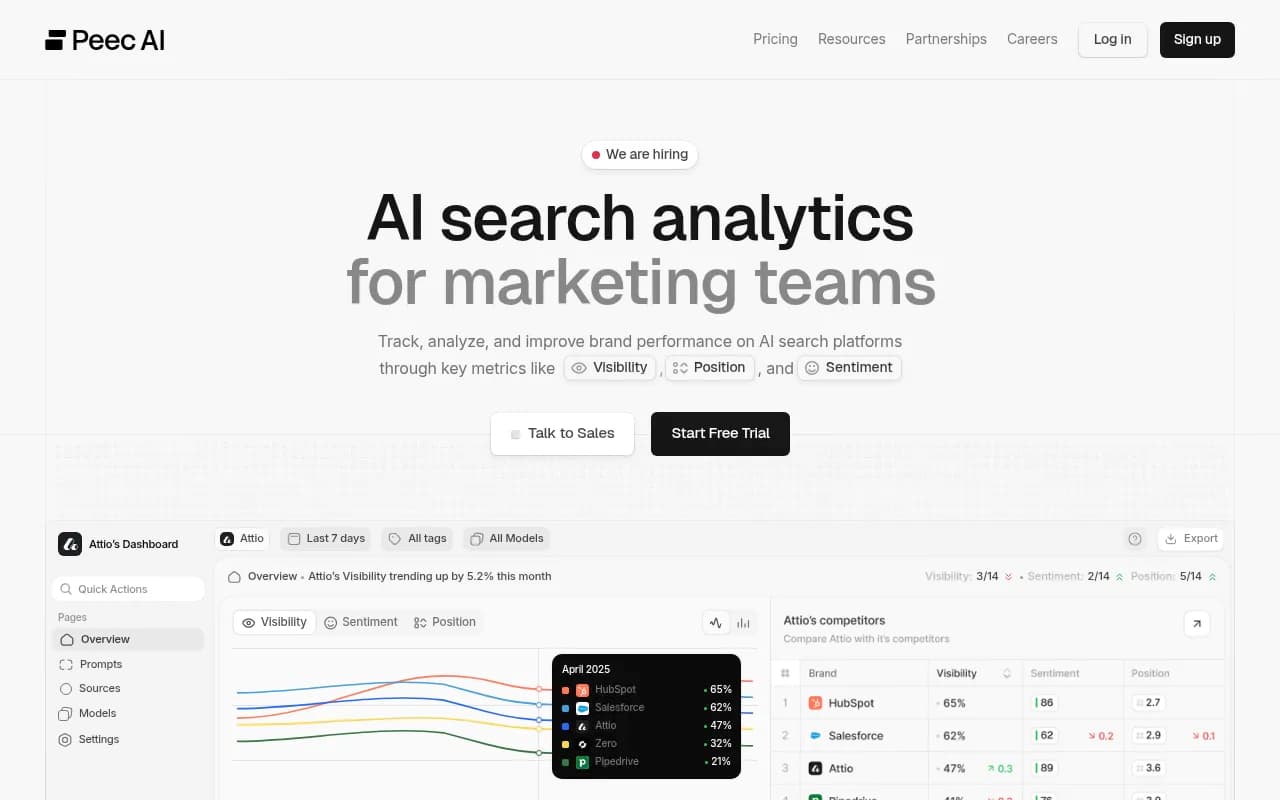
Peec AI is a solid entry point at €89/month. It offers multi-language tracking, smart suggestions, and basic competitor analysis. The interface is clean, the data is reliable, and the price is accessible for smaller teams.
What you're giving up: no crawler logs, no content generation, limited prompt intelligence. Peec AI is a monitoring tool. It shows you where you stand but doesn't help you improve.
Best for: Budget-conscious teams that need basic AI visibility tracking across multiple languages without enterprise price tags.
Otterly.AI: The most affordable option
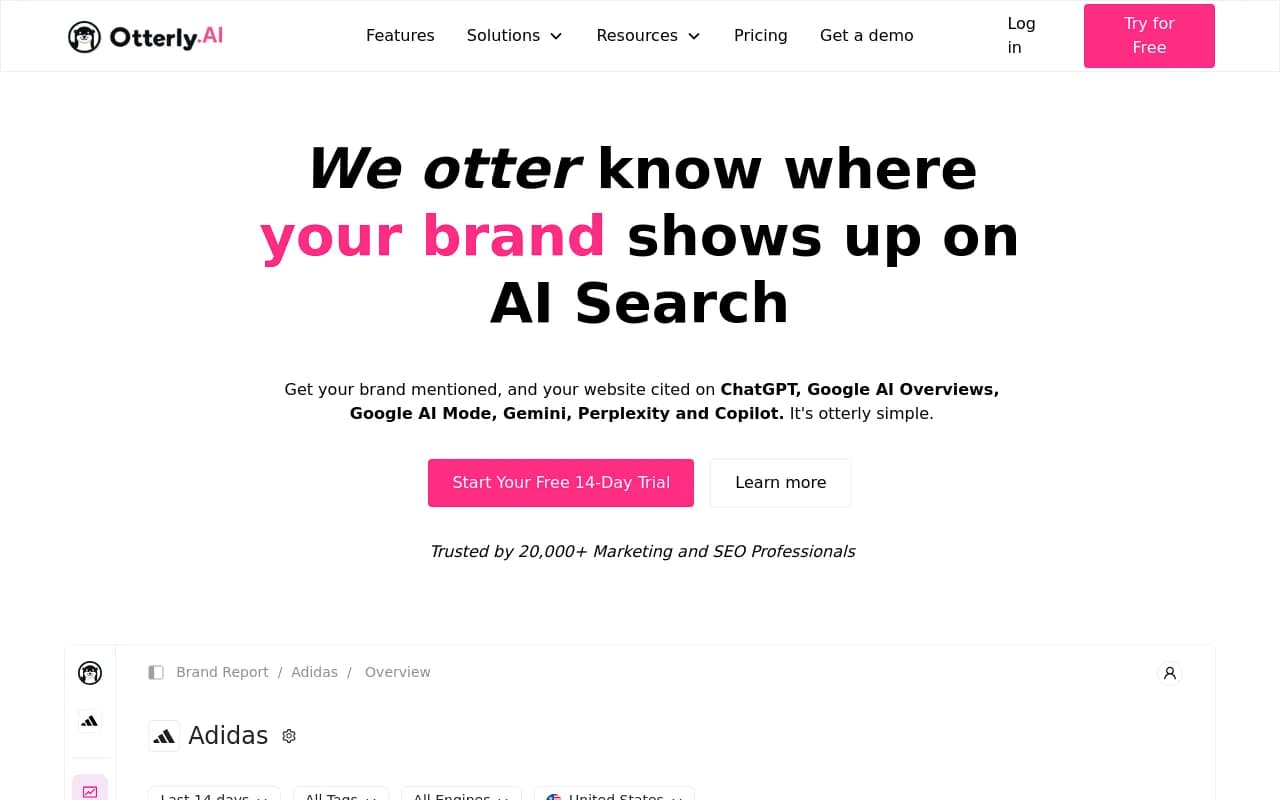
Otterly.AI starts at $29/month, making it the most affordable AI visibility tool on the market. It tracks ChatGPT, Perplexity, and a few other models with basic brand mention monitoring.
What you get: simple dashboards, basic competitor comparisons, and email alerts when your brand is mentioned. What you don't get: crawler logs, content gap analysis, optimization recommendations, or content generation.
Otterly.AI is monitoring-only, and the feature set reflects the price. It's a good fit if you just want to know when your brand gets mentioned and don't need deeper insights or optimization tools.
Best for: Small teams or solo marketers who need basic AI visibility tracking on a tight budget.
ZipTie: Deep analysis for technical teams
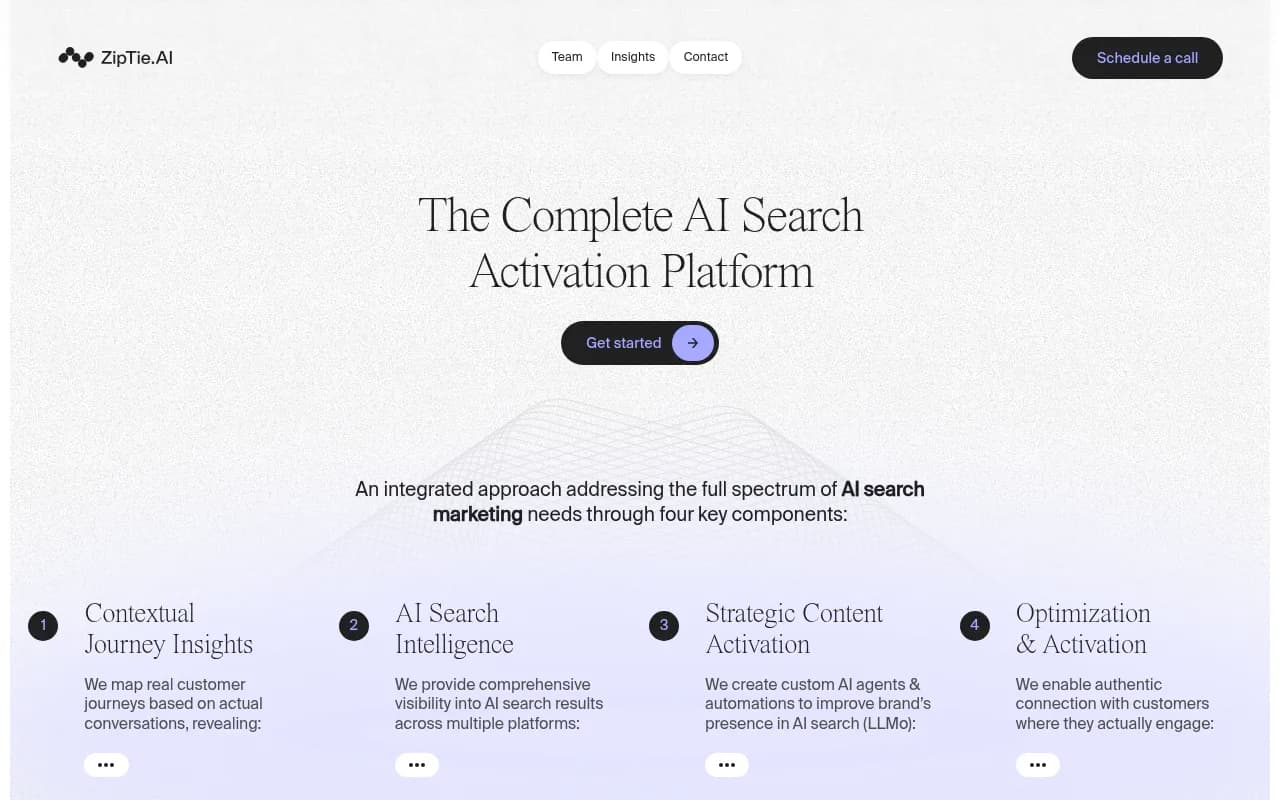
ZipTie focuses on deep analysis and technical optimization. It provides detailed breakdowns of how AI models process and cite content, with a focus on understanding the underlying mechanisms.
The platform is built for technical SEO teams and developers who want to understand not just what's happening but why. The learning curve is steeper than other tools, but the depth of analysis is unmatched.
Best for: Technical SEO teams that want to understand the mechanics of AI citations and optimize at a granular level.
Ahrefs Brand Radar: Add-on for existing Ahrefs users
If you're already using Ahrefs for SEO, Brand Radar is worth activating. It tracks brand mentions across AI search engines and integrates with your existing Ahrefs workflow.
The limitation: fixed prompts. You can't customize the queries Ahrefs monitors, which means you're tracking generic brand mentions but not the specific prompts your customers actually use. There's also no AI traffic attribution, so you can't connect visibility improvements to revenue.
Best for: Ahrefs users who want basic AI visibility tracking without adding another tool to their stack.
Semrush: AI visibility add-on for traditional SEO platform
Semrush added AI visibility tracking as part of its broader platform. Like Ahrefs, it uses fixed prompts and doesn't offer the depth of a dedicated AI visibility tool.
The advantage: if you're already using Semrush for SEO, keyword research, and competitor analysis, adding AI visibility tracking keeps everything in one platform. The disadvantage: you're getting a feature add-on, not a purpose-built solution.
Best for: Semrush users who want to add basic AI visibility monitoring without switching platforms.
Comparison: Key features across platforms
| Platform | Starting price | Models tracked | Content generation | Crawler logs | Attribution |
|---|---|---|---|---|---|
| Promptwatch | $99/mo | 10+ | Yes | Yes | Yes |
| Profound | Custom | 10+ | No | No | No |
| Peec AI | €89/mo | 8+ | No | No | No |
| Otterly.AI | $29/mo | 5+ | No | No | No |
| ZipTie | Custom | 8+ | No | Limited | No |
| Ahrefs Brand Radar | Included | 5+ | No | No | No |
| Semrush | Included | 5+ | No | No | No |
What to do if you're just starting
If you're new to AI visibility tracking, start here:
-
Audit your current state: Search for your brand, products, and key topics in ChatGPT, Claude, and Perplexity. Take screenshots. See where you appear and where you don't.
-
Identify your top competitors: Who consistently gets cited when you don't? What content are they publishing that you're missing?
-
Choose a tool based on your workflow: If you want monitoring + optimization + content generation in one platform, use Promptwatch. If you have a content team that can act independently and just need monitoring, consider Profound or Peec AI. If budget is tight, start with Otterly.AI.
-
Focus on content gaps first: The fastest way to improve AI visibility is creating content that fills gaps AI models are looking for but can't find on your site. Tools with Answer Gap Analysis (like Promptwatch) make this explicit.
-
Track crawler behavior: If AI models aren't crawling your site, they can't cite it. Use crawler logs to see when ChatGPT, Claude, and Perplexity bots visit, which pages they read, and errors they encounter.
-
Measure what matters: Visibility scores are interesting, but traffic and conversions are what matter. Use attribution tracking to connect AI visibility improvements to actual business outcomes.
The bottom line
AI visibility is not a future problem. It's happening now. Your prospects are using ChatGPT, Claude, and Perplexity to research vendors, compare solutions, and make shortlists. If you're not visible in those conversations, you're not in the consideration set.
The tools that win in 2026 are the ones that help you take action, not just monitor dashboards. Promptwatch leads the category because it closes the loop: find gaps, generate content, track results. For teams that want a single platform handling the full workflow from diagnosis to execution, it's the clear choice.
For pure enterprise monitoring with no content generation, Profound sets the standard. For budget-conscious teams, Peec AI and Otterly.AI offer solid entry points. And if you're already inside Ahrefs or Semrush, their AI add-ons are worth activating before you add another tool to your stack.
Pick the tool that matches your workflow, start tracking, and start optimizing. The brands that figure this out in 2026 will have an unfair advantage over the ones still optimizing for Google alone.