Summary
- Prompt volume data is collected from Chrome extensions (like Urban VPN) that secretly harvest AI conversations from millions of users -- creating a sampling bias that makes the data strategically useless
- Unlike Google's keyword volume (based on actual search logs), prompt volume relies on tiny samples extrapolated wildly, often showing 10-50x higher numbers than equivalent keyword searches
- Traditional keyword research shows what people search; prompt tracking shows how people ask AI -- but only if the underlying data isn't fundamentally compromised
- Over 80% of AI prompts are unique, making volume estimates even less reliable than traditional keyword data
- A real AI search strategy focuses on content gaps, citation analysis, and actual visibility tracking -- not chasing inflated prompt volume numbers
The pitch sounds compelling: what if you knew exactly what people were asking ChatGPT? If you had access to real user prompts, you could optimize for those queries the way you once optimized for Google searches.
This is the core promise of "prompt volume" data, now offered by multiple GEO and AEO tools. The problem is that the data is broken in ways that make it effectively useless for actual strategy.
How prompt volume data is collected (and why that's a problem)
OpenAI doesn't release prompt data. Neither does Anthropic, Google, or any other major AI provider. This is a good thing -- imagine how much sensitive information lives in your ChatGPT history. Medical questions, financial anxieties, drafts of difficult conversations, relationship problems.
So where do prompt datasets come from?
Chrome extensions. Koi Security published research in December 2025 showing that Urban VPN -- a "Featured" extension with over 6 million users -- has been secretly harvesting every AI conversation its users have since July 2025. ChatGPT, Claude, Gemini, Copilot, Perplexity -- all of it intercepted, compressed, and sold to data brokers for "marketing analytics purposes." Across Urban VPN and its sister extensions, over 8 million users are affected.

The data flows to BiScience, a broker that packages it into products for advertisers and, notably, into the prompt datasets that power AI search analytics tools. Users who installed a VPN extension for privacy woke up one day -- after a silent auto-update -- with new code harvesting their most intimate conversations.
The sampling fallacy
Even setting aside the ethics, this collection method creates a sampling problem that should concern anyone trying to draw strategic conclusions from prompt data.
You're not seeing "what people ask ChatGPT." You're seeing what people ask ChatGPT who also happen to have installed a shady VPN extension.
This is a textbook sampling fallacy. The demographics, use cases, and sophistication of this group almost certainly differ from actual buyers researching enterprise software or comparing SaaS tools. It's like surveying only people who answer calls from unknown numbers and claiming you've captured consumer sentiment.
Traditional keyword volume: how it actually works
Google's keyword volume data comes from actual search logs. When you see "10,000 monthly searches" for a term in Google Keyword Planner, that number is based on real queries typed into Google's search box, aggregated and anonymized.
The data has limitations -- Google rounds numbers, combines similar queries, and doesn't show you everything. But the core methodology is sound: count actual searches, report the count.
Keyword volume tells you:
- How many people searched for this exact term
- Seasonal trends and year-over-year changes
- Related queries people also search for
- Competition levels (how many advertisers bid on this term)
This data powers billions of dollars in ad spend and SEO strategy. It's not perfect, but it's grounded in reality.
Prompt volume: wild extrapolations from tiny samples
Prompt volume tools show numbers that look similar to keyword volume. "Social listening tool" might show 26,000 prompt searches per month. The number looks authoritative. The problem is how it's calculated.
Start with a sample of maybe 10,000 Chrome extension users who asked about social listening tools. Extrapolate that to ChatGPT's 200+ million weekly active users. Apply some demographic weighting. Add a confidence interval. Ship it.
The result: prompt volume numbers that are often 10-50x higher than equivalent Google keyword searches. SEO experts like Steve Toth and William Alvarez have called this out publicly, comparing prompt volumes to traditional keyword data and finding massive discrepancies.
The uniqueness problem
Over 80% of AI prompts are unique. People don't type the same query into ChatGPT the way they type "best CRM software" into Google. They have conversations:
- "I need a CRM for a 10-person sales team, we use Slack and HubSpot already, budget is $5k/year, what should I look at?"
- "Compare Salesforce to Pipedrive for a B2B SaaS company"
- "What's the best CRM if I hate Salesforce?"
These are three different prompts about CRM software. Traditional keyword volume would bucket them under "CRM software" or "best CRM." Prompt volume tries to count each variation separately, then extrapolate from a sample that's already biased.
The math breaks down. You can't reliably estimate volume for queries that are mostly unique, from a sample that's mostly unrepresentative.
What prompt tracking actually reveals (when done right)
The core insight behind prompt tracking is correct: people ask AI differently than they search Google. Understanding those differences matters.
Traditional keyword research shows what people search. Prompt tracking shows how people ask AI. The difference is real:
| Dimension | Traditional keywords | AI prompts |
|---|---|---|
| Query structure | Short, keyword-focused | Conversational, context-rich |
| Intent clarity | Often ambiguous | Usually explicit |
| Follow-ups | Rare (new search) | Common (conversation) |
| Personalization | Minimal | High (user history) |
| Uniqueness | ~30% unique | ~80% unique |
This difference matters for content strategy. AI models want comprehensive answers to specific questions, not keyword-stuffed listicles. But you don't need inflated prompt volume numbers to understand this.
What to do instead: building a real AI search strategy
Forget prompt volume. Focus on what actually drives AI visibility:
1. Find your content gaps
Answer Gap Analysis shows exactly which prompts competitors are visible for but you're not. You see the specific content your website is missing -- the topics, angles, and questions AI models want answers to but can't find on your site.
Tools like Promptwatch show you these gaps by comparing your citations against competitors across multiple AI models. This isn't about volume -- it's about coverage.

2. Track actual citations, not estimated prompts
Instead of guessing how many people might ask a question, track how often AI models actually cite your content when they do answer. Citation analysis tells you:
- Which pages AI models reference
- Which competitors they cite instead of you
- Which topics you're already winning
- Where you're completely invisible
This is real data, not extrapolated guesses. Promptwatch has analyzed over 880 million citations to understand what content AI models prefer.
3. Monitor AI crawler behavior
AI Crawler Logs show you which pages ChatGPT, Claude, and Perplexity are actually reading on your site. You see:
- Which pages they crawl most often
- Errors they encounter
- How often they return
- What content they ignore
This tells you if AI models can even discover your content, before you worry about whether they'll cite it.
4. Create content that ranks in AI
Once you know the gaps, create content grounded in real citation data. Not generic SEO filler -- content engineered to get cited by AI models.
The built-in AI writing agents in platforms like Promptwatch generate articles, listicles, and comparisons based on:
- Real citation patterns (what AI models actually reference)
- Competitor analysis (what's working for others)
- Persona targeting (how different users ask questions)
- Query fan-outs (how one prompt branches into sub-queries)
This is the action loop most GEO tools miss: find gaps, generate content, track results.
5. Measure what matters
Track visibility scores, not prompt volumes. See your scores improve as AI models start citing your new content. Page-level tracking shows exactly which pages are being cited, how often, and by which models.
Close the loop with traffic attribution -- code snippet, Google Search Console integration, or server log analysis -- to connect visibility to actual revenue.
Tools that focus on real AI visibility (not fake volume)
Most GEO tools fall into two camps: monitoring-only dashboards that show you data but leave you stuck, or platforms that help you take action.
Monitoring-only tools
These tools track your AI visibility but don't help you improve it:
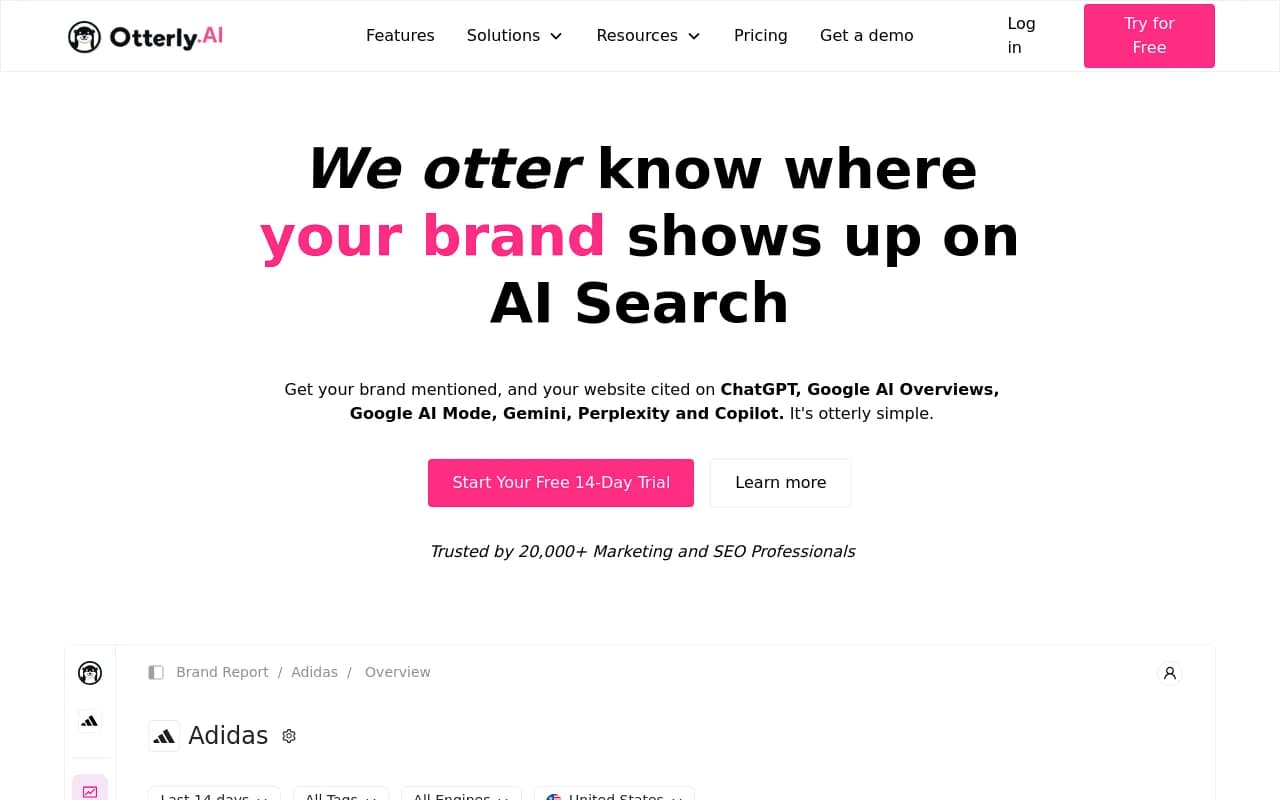
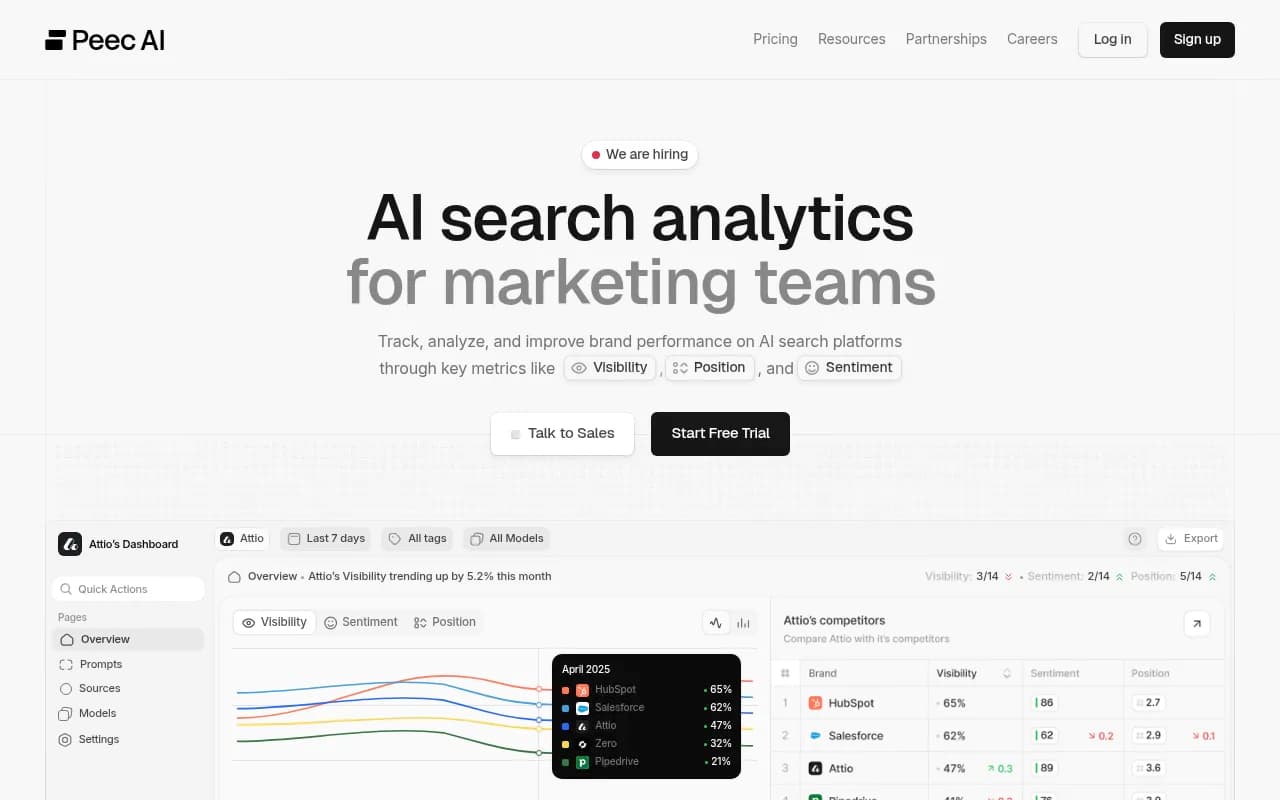

They're useful for tracking, but you're on your own for optimization.
Action-oriented platforms
These platforms show you what's missing, then help you fix it:
The difference: these platforms include content gap analysis, AI content generation, and optimization tools. You're not just monitoring -- you're improving.
The real difference between keyword and prompt data
Traditional keyword volume and prompt volume aren't competing metrics. They measure different things:
Keyword volume tells you how many people searched Google for a specific term. It's based on actual search logs. It's reliable for understanding search demand.
Prompt volume tries to estimate how many people asked AI assistants about a topic. It's based on tiny, biased samples extrapolated wildly. It's not reliable for strategic decisions.
The insight behind prompt tracking is correct: people ask AI differently than they search Google. But you don't need inflated volume numbers to act on that insight.
Focus on:
- Content gaps (what competitors cover that you don't)
- Citation analysis (what AI models actually reference)
- Crawler logs (what AI models can discover on your site)
- Visibility tracking (how often you're cited)
- Traffic attribution (what drives actual revenue)
These are real signals you can optimize for. Prompt volume is a mirage.
Frequently asked questions
Is prompt volume data completely useless?
Not completely, but it's unreliable enough that you shouldn't base strategy on it. The sampling bias and extrapolation methods make the numbers directionally interesting at best. Use it for inspiration, not prioritization.
How do I know which prompts to optimize for?
Look at competitor citations, not volume estimates. If AI models cite competitors for a topic but not you, that's a real gap worth filling. Tools like Promptwatch show you these gaps with citation data, not guessed volumes.
Can I still use traditional keyword research for AI search?
Yes. Traditional keyword research identifies topics people care about. AI search requires different content formats (comprehensive answers, not keyword-stuffed pages), but the topics themselves overlap significantly. Start with keyword research, then adapt your content for AI.
What's the best way to track AI search performance?
Track citations and visibility scores, not prompt volumes. See which pages AI models reference, how often, and for which queries. Platforms like Promptwatch provide page-level tracking across 10+ AI models, showing exactly what's working.
Do I need a GEO tool to succeed in AI search?
Not strictly, but it helps. You can manually test prompts in ChatGPT and Claude to see if you're cited, but that doesn't scale. GEO tools automate tracking, show you gaps, and help you prioritize. The best ones also help you create optimized content, not just monitor visibility.
The bottom line
Prompt volume data promises insight into the black box of AI conversations. But the data is hopelessly biased, the search space is too vast for reliable extrapolation, and the numbers are often inflated beyond usefulness.
Traditional keyword volume isn't perfect, but it's grounded in reality: actual searches from real users. Prompt volume is built on tiny samples from Chrome extension users, extrapolated wildly, and sold as strategic intelligence.
The real opportunity in AI search isn't chasing volume estimates. It's understanding what content AI models want, creating it, and tracking whether they cite you. That's the action loop that drives results: find gaps, generate content, measure visibility.
Forget the mirage. Focus on what's real.