Summary
- AI visibility platforms track how often your brand appears in AI-generated answers from ChatGPT, Perplexity, Google AI Overviews, and other answer engines—but not all platforms do the same thing
- Most buyers evaluate these tools using outdated SEO frameworks, leading to mismatched expectations and wasted budgets
- The right platform depends on whether you need monitoring-only dashboards or action-oriented optimization tools that help you close content gaps and improve rankings
- Nine key questions cut through the noise: What AI engines do you track? Can I see why I'm not appearing? Do you help me create content that ranks? Can I track actual traffic and revenue?
- Promptwatch stands out as the only platform rated as a "Leader" across all categories in a 2026 comparison of 12 GEO platforms, combining monitoring with content gap analysis, AI-powered content generation, and traffic attribution
The market for AI visibility platforms went from nearly nonexistent to genuinely crowded in under eighteen months. There are now dozens of tools claiming to track your brand across ChatGPT, Perplexity, Gemini, and Google AI Overviews. Most of them run prompts, count mentions, and hand you a dashboard. None of them are identical and the differences matter.
The problem is not the tools themselves but the way buyers are evaluating them. Most evaluation frameworks being used right now were built for a world that no longer exists—a world where ranking on page one of Google was the goal, not appearing inside an AI-generated answer that never links out.
This guide walks you through nine questions that actually matter when choosing an AI visibility platform in 2026. These questions are designed to surface the differences that affect your ability to do something with the data, not just look at it.
Why AI visibility platforms exist (and why they're not all the same)
AI visibility is how often, and how prominently, your brand shows up inside AI-generated answers. Unlike traditional SEO where you compete for one of ten blue links, answer engines like ChatGPT and Perplexity frequently summarize, recommend, and cite a short list of sources. This creates a winner-takes-most dynamic for awareness and demand.
Your customers are getting recommendations without clicking—or clicking far less. Your brand needs to be in the answer, not just ranking on a page somewhere.
But here's where it gets messy: some platforms only show you that you appeared (or didn't). Others show you why you didn't appear and what content you're missing. A few go further and help you create the content that will get you cited. The price tags don't always correlate with capability.
The 9 questions that separate monitoring dashboards from optimization platforms
1. Which AI engines do you actually track—and how often?
Not all platforms track the same AI models. Some focus on ChatGPT and Perplexity. Others include Google AI Overviews, Gemini, Claude, Grok, DeepSeek, Meta AI, Mistral, and Copilot.
Ask:
- Do you track the AI engines my customers actually use?
- How often do you refresh the data? Daily? Weekly? On-demand?
- Can I track responses in multiple languages and regions?
If your audience is global or uses niche AI tools, a platform that only monitors ChatGPT in English won't cut it.
Promptwatch tracks 10 AI models (OpenAI/ChatGPT, Perplexity, Google AI Overviews, Google AI Mode, Claude, Gemini, Meta/Llama, DeepSeek, Grok, Mistral, Copilot) with multi-language and multi-region support.

2. Can I see why I'm not appearing in AI answers?
Most platforms show you a visibility score or a list of prompts where you did or didn't appear. That's table stakes. The real question is: can the platform tell you why you're invisible?
Look for:
- Answer Gap Analysis: Which prompts are competitors visible for that you're not? What specific content is missing from your site?
- Citation and source analysis: Which pages, Reddit threads, YouTube videos, and domains are AI models citing instead of you?
- Prompt intelligence: Volume estimates, difficulty scores, and query fan-outs that show how one prompt branches into sub-queries.
Without this, you're stuck guessing. You know you're not showing up, but you don't know what to fix.
Promptwatch's Answer Gap Analysis shows exactly which prompts competitors rank for but you don't—and the specific topics, angles, and questions your site is missing. This is the "find the gaps" step in the action loop that separates optimization platforms from monitoring dashboards.
3. Do you help me create content that ranks in AI search?
Some platforms stop at showing you the problem. Others help you solve it.
Ask:
- Do you have a built-in AI writing agent or content generator?
- Is the content grounded in real citation data, prompt volumes, and competitor analysis—or is it generic SEO filler?
- Can I generate articles, listicles, and comparisons optimized for AI engines?
This is where most competitors (Otterly.AI, Peec.ai, AthenaHQ, Search Party) fall short. They show you what's missing but leave you to figure out how to create it.
Promptwatch's AI writing agent generates content engineered to get cited by ChatGPT, Claude, Perplexity, and other models. It's grounded in 880M+ citations analyzed, prompt volumes, persona targeting, and competitor analysis. This is the "create content that ranks" step in the action loop.
4. Can I track which pages are actually getting cited?
Page-level tracking tells you exactly which URLs AI models are reading and citing. This is critical for understanding what's working and what's not.
Look for:
- Page-level visibility scores
- Citation frequency by page
- Which AI models cite which pages
Without this, you're flying blind. You might know your overall visibility is improving, but you don't know if it's because of your new blog post or your homepage.
5. Do you show me AI crawler activity on my site?
AI models don't just magically know about your content. They send crawlers (like GPTBot, ClaudeBot, PerplexityBot) to read your pages. If those crawlers can't access your site, or if they're hitting errors, you won't appear in AI answers.
Ask:
- Do you provide real-time logs of AI crawlers hitting my website?
- Can I see which pages they read, how often they return, and what errors they encounter?
- Can I fix indexing issues before they hurt my visibility?
Most competitors lack this entirely. Promptwatch's AI Crawler Logs show real-time activity from ChatGPT, Claude, Perplexity, and other AI engines—which pages they read, errors they encounter, and how often they return.
6. Can I connect AI visibility to actual traffic and revenue?
Visibility scores are interesting. Revenue is what matters.
Look for:
- Traffic attribution: Can you see how many visitors came from AI search?
- Integration with Google Search Console, server logs, or a tracking snippet
- Revenue attribution: Can you connect AI visibility to conversions and pipeline?
Without this, you're optimizing for a vanity metric. Promptwatch offers traffic attribution via code snippet, GSC integration, or server log analysis to connect visibility to actual revenue.
7. Can I monitor competitors and see where they're winning?
Competitor analysis is not optional. You need to know:
- Which prompts are competitors visible for that you're not?
- Which domains and pages are getting cited instead of yours?
- How does your visibility compare across different AI models?
Promptwatch's competitor heatmaps let you compare your AI visibility vs competitors across LLMs. You see who's winning for each prompt and why.
8. Do you track Reddit, YouTube, and ChatGPT Shopping?
AI models don't just cite websites. They pull from Reddit discussions, YouTube videos, and product databases. If you're not monitoring these channels, you're missing a huge part of the story.
Ask:
- Do you surface Reddit threads and YouTube videos that influence AI recommendations?
- Can I track when my brand appears in ChatGPT's product recommendations and shopping carousels?
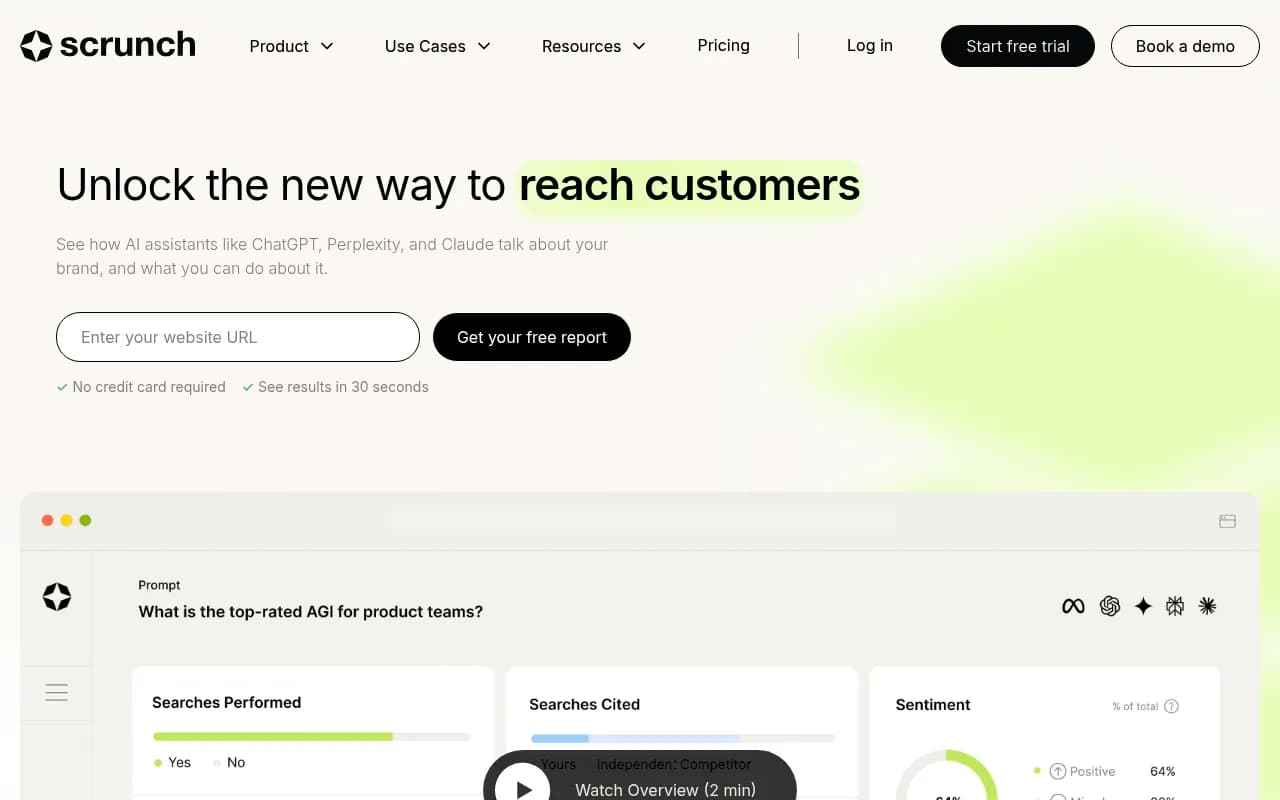
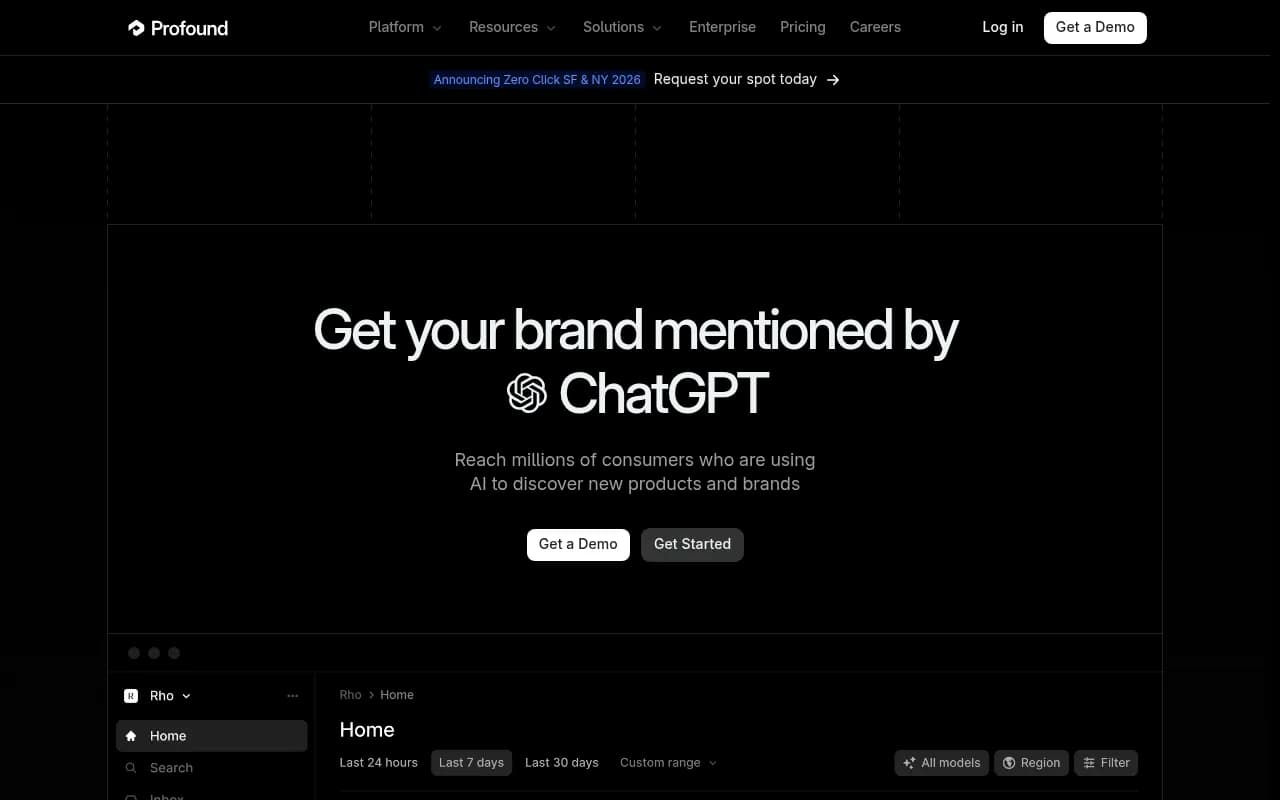
Most competitors (Profound, Scrunch, Otterly.AI, Peec.ai, AthenaHQ) ignore these channels entirely. Promptwatch includes Reddit and YouTube insights plus ChatGPT Shopping tracking.

9. What does the pricing actually include—and can I scale?
Pricing structures vary wildly. Some platforms charge per site, per prompt, per user, or per AI model. Others bundle everything.
Ask:
- How many sites, prompts, and articles are included at each tier?
- Do I get crawler logs, state/city tracking, and API access?
- Is there a free trial so I can test before committing?
- What happens when I need to scale to more sites or prompts?
Promptwatch pricing:
- Essential: $99/mo (1 site, 50 prompts, 5 articles)
- Professional: $249/mo (2 sites, 150 prompts, 15 articles, crawler logs, state/city tracking)
- Business: $579/mo (5 sites, 350 prompts, 30 articles)
- Agency/Enterprise: Custom pricing
Free trial available. Annual billing discounts.
Comparison table: Monitoring vs optimization platforms
| Feature | Monitoring-only platforms | Optimization platforms (like Promptwatch) |
|---|---|---|
| Tracks AI visibility | Yes | Yes |
| Shows why you're not appearing | No | Yes (Answer Gap Analysis) |
| Helps you create content | No | Yes (AI writing agent) |
| Page-level tracking | Sometimes | Yes |
| AI crawler logs | Rarely | Yes |
| Traffic attribution | No | Yes |
| Reddit/YouTube insights | No | Yes |
| ChatGPT Shopping tracking | No | Yes |
| Competitor heatmaps | Basic | Advanced |
| Multi-language/region | Limited | Yes |
The action loop: Why Promptwatch is different
In a 2026 comparison of 12 GEO platforms (Search Party, Otterly.AI, Peec.ai, Profound, AthenaHQ, Scrunch, Brandlight.ai, Bluefish, Searchable, Semrush, Ahrefs Brand Radar), Promptwatch is the only platform rated as a "Leader" across all categories.
The core difference: most competitors are monitoring-only dashboards that show you data but leave you stuck. Promptwatch is built around taking action.
The action loop:
- Find the gaps: Answer Gap Analysis shows exactly which prompts competitors are visible for but you're not. You see the specific content your website is missing—the topics, angles, and questions AI models want answers to but can't find on your site.
- Create content that ranks in AI: The built-in AI writing agent generates articles, listicles, and comparisons grounded in real citation data (880M+ citations analyzed), prompt volumes, persona targeting, and competitor analysis. This isn't generic SEO filler—it's content engineered to get cited by ChatGPT, Claude, Perplexity, and other AI models.
- Track the results: See your visibility scores improve as AI models start citing your new content. Page-level tracking shows exactly which pages are being cited, how often, and by which models. Close the loop with traffic attribution to connect visibility to actual revenue.
This cycle—find gaps, generate content, track results—is what makes Promptwatch an optimization platform, not just another tracker.
What to avoid when evaluating platforms
Don't get distracted by shiny dashboards. A beautiful UI is nice, but it doesn't help you rank in AI search. Focus on whether the platform helps you do something with the data.
Don't assume higher price = better platform. Some expensive platforms are just monitoring dashboards with a premium price tag. Others (like Profound and Scrunch) have strong feature sets but lack content generation and optimization tools.
Don't ignore traffic attribution. If you can't connect AI visibility to actual traffic and revenue, you're optimizing for a vanity metric.
Don't settle for fixed prompts. Some platforms (Semrush, Ahrefs Brand Radar) only track a fixed set of prompts. You need the ability to add custom prompts that match how your actual customers search.
Who should use which platform
If you just want basic monitoring: Otterly.AI or Peec.ai will show you where you appear, but they won't help you fix it.
If you need enterprise-grade monitoring with strong reporting: Profound or Scrunch offer broad AI engine coverage and stakeholder-friendly dashboards, but they stop at showing you the problem.
If you want to actually improve your AI visibility: Promptwatch is the only platform that combines monitoring with content gap analysis, AI-powered content generation, and traffic attribution. It's built for marketing teams, SEO teams, and agencies that want to be visible and rank in AI search results—not just track where they're invisible.
Final thoughts
AI search is rewriting the rules of brand discovery. The platforms that help you optimize for AI visibility—not just monitor it—are the ones that will matter in 2026 and beyond.
Ask the nine questions in this guide. Test the platforms with a free trial. Focus on whether the tool helps you close the loop from visibility data to content creation to revenue attribution.
And if you're serious about ranking in AI search, start with a platform that's built around action, not just dashboards.