Klue Review 2026
Competitive enablement platform that delivers actionable competitor insights to sales teams, helping them win more deals with real-time intelligence.
Key Takeaways
- Klue is a dual-purpose platform combining competitive intelligence and win-loss analysis -- most competitors offer only one or the other
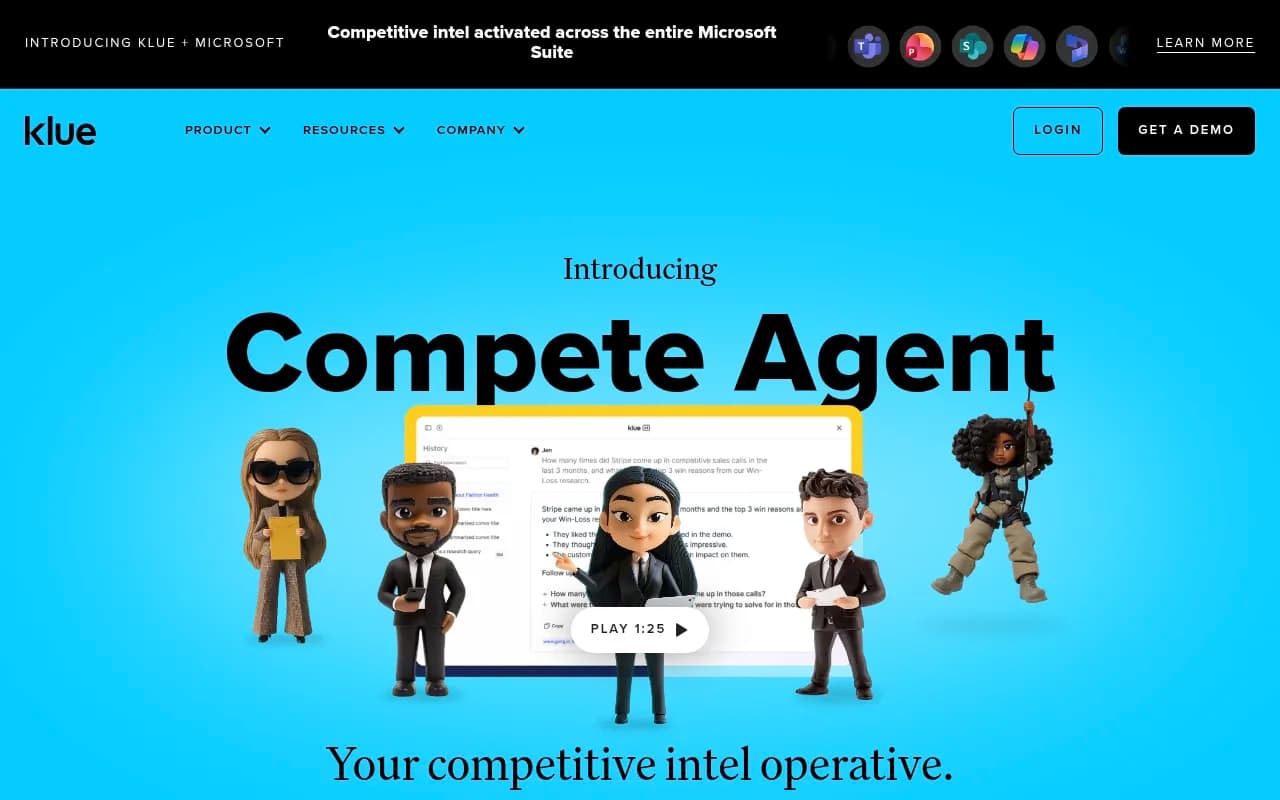
- Compete Agent (launched 2025) is an AI operative that automatically delivers deal-specific competitive insights to sellers in Slack, Salesforce, and other tools they already use
- Win-loss program includes experienced human interviewers who conduct buyer interviews and extract insights -- not just survey software
- Strong adoption metrics: customers report 72% seller adoption, 28% win-rate increases, and 10+ hours saved per week
- Pricing is not publicly listed but scales with user count and feature access -- expect enterprise-level investment
Klue is a competitive enablement platform built for B2B companies that need to arm their sales teams with actionable intelligence about competitors. Founded in Vancouver and now serving 250,000+ users across companies like Adobe, Shopify, Gainsight, and Zendesk, Klue addresses a specific pain point: sales reps lose deals because they don't have the right competitive information at the right moment. The platform tackles this by combining two traditionally separate functions -- competitive intelligence gathering and win-loss analysis -- into one system that pushes insights directly into the tools sellers use every day.
What sets Klue apart is its focus on activation, not just information storage. Most competitive intelligence tools are glorified wikis where product marketers dump battlecards that sales reps never read. Klue flips this model by proactively delivering deal-specific insights to sellers when they're actually working an opportunity.
Compete Agent: AI-Powered Competitive Intelligence
The centerpiece of Klue's 2025 product lineup is Compete Agent, an AI agent that eliminates the manual work of tracking competitors and distributing intelligence. Here's how it works in practice: when a sales rep adds a competitor to an opportunity in Salesforce, Compete Agent automatically sends a personalized message to their Slack with relevant battlecard content, recent competitive news, and specific recommendations for that deal. The rep can also ask questions in natural language ("What's their pricing model?" or "How do we compare on integrations?") and get instant answers pulled from Klue's knowledge base.
This is a significant departure from traditional competitive intelligence workflows where product marketing builds static battlecards, uploads them to a portal, and hopes sales will find them. Compete Agent monitors deal activity, identifies competitive threats, and surfaces the right information without requiring sellers to leave their workflow. One customer (Gainsight) reported 72% seller adoption and 195 questions answered through Ask Klue in their first months.
The AI doesn't just regurgitate stored content -- it synthesizes information from multiple sources (competitor websites, news articles, customer reviews, internal notes) and tailors responses to the specific context of each deal. If a rep is facing a competitor in a healthcare deal, the answer will prioritize healthcare-specific differentiators and compliance features.
Automated Competitive Intelligence Collection
Klue continuously monitors competitors across multiple channels: company websites, social media, review sites (G2, Capterra), job postings, SEC filings, news articles, and more. When it detects a meaningful change -- a new product launch, pricing update, executive hire, or funding round -- it automatically creates a "News" item in the platform and can push notifications to relevant teams.
Product marketers can set up custom tracking for specific competitors, keywords, or topics. The system uses AI to filter out noise and surface only significant updates. For example, if a competitor announces a new integration that directly competes with your core feature, Klue will flag it as high-priority and suggest updating your battlecards.
The platform also tracks competitor mentions in sales calls (via Gong integration), customer reviews, and social media to identify emerging threats or messaging shifts. One customer (Blackbaud) reported tracking 12+ competitors automatically and saving 10 hours per week on manual research.
Battlecard Builder and Content Management
Klue provides templates and a structured editor for building competitive battlecards. Each battlecard includes sections for competitor overview, strengths/weaknesses, pricing, key differentiators, objection handling, discovery questions, and proof points. The editor supports rich media (images, videos, PDFs) and allows you to embed dynamic content that updates automatically when underlying data changes.
Battlecards aren't static documents -- they're living resources that evolve as new intelligence comes in. When Compete Agent detects a competitor pricing change, it can automatically update the relevant battlecard section and notify the product marketing team to review.
The platform also supports "Competitor Profiles" that aggregate all intelligence about a specific competitor in one place: news updates, battlecards, win-loss insights, deal activity, and more. This gives product marketers a comprehensive view of each competitive threat.
Klue offers a free "Competitive Battlecard Course" and "Ultimate Battlecard Building Toolkit" to help teams get started -- a nice touch that reflects their focus on competitive enablement as a discipline, not just software.
Win-Loss Analysis Program
Klue's win-loss offering is more than survey software -- it's a managed service where Klue's team of experienced interviewers conducts buyer interviews on your behalf. After a deal closes (won or lost), Klue schedules and conducts 30-45 minute interviews with the buyer to understand their decision-making process, what they valued, where you fell short, and how you compared to competitors.
The interviews are recorded, transcribed, and analyzed by Klue's team, who then produce written reports highlighting key themes, competitive insights, product feedback, and go-to-market recommendations. This is a major differentiator -- most win-loss tools just give you survey templates and leave you to do the interviews yourself. Klue handles the entire process, which is valuable because buyers are more candid with a neutral third party than with your internal team.
The win-loss data feeds back into the competitive intelligence side of the platform. If multiple buyers mention a competitor's superior onboarding experience, that insight surfaces in the relevant battlecard and can trigger a product or customer success initiative.
Customers report that Klue's win-loss program provides deeper, more actionable insights than DIY surveys. The human touch matters -- experienced interviewers know how to probe beyond surface-level answers and extract the real reasons behind buying decisions.
Integrations and Workflow Automation
Klue integrates with the core tools that sales and marketing teams use daily:
- Salesforce: Compete Agent monitors opportunity records and automatically sends competitive insights when competitors are added to deals. Reps can access battlecards directly in Salesforce via an embedded widget.
- Slack: Compete Agent sends proactive deal tips and answers questions in Slack channels or DMs. Teams can set up dedicated competitive intelligence channels where Klue posts news updates and battlecard changes.
- Microsoft Teams: Similar to Slack integration -- Compete Agent delivers insights and answers questions in Teams.
- Gong: Klue analyzes sales call transcripts to identify competitor mentions and surface relevant battlecards.
- Outreach, Salesloft, HubSpot: Integrate competitive content into sales sequences and email templates.
- Google Workspace, Microsoft 365: Access Klue content in Docs, Sheets, PowerPoint, and other productivity tools.
- Zapier: Connect Klue to 5,000+ other apps for custom workflows.
The Microsoft integration (announced 2025) is particularly deep -- Klue content is accessible across the entire Microsoft Suite, including Copilot, which means sellers can ask Copilot competitive questions and get answers pulled from Klue's knowledge base.
Klue also offers an API for custom integrations and data exports. Some customers use the API to pull competitive intelligence into their own internal tools or dashboards.
Analytics and Reporting
Klue tracks engagement metrics to show which competitive content is actually being used by sales teams. You can see:
- Which battlecards are viewed most often
- Which competitors appear in the most deals
- How often sellers ask questions via Ask Klue
- Win rates by competitor
- Time saved by automation (e.g. hours not spent manually distributing battlecards)
The win-loss analytics dashboard aggregates interview insights across deals to identify patterns. For example, if 60% of lost deals mention "price" as a factor, that's a clear signal to revisit your pricing strategy or value messaging.
One customer (Blackbaud) reported a 28% increase in win rate against top competitors after implementing Klue -- a metric they could track because Klue ties competitive intelligence to actual deal outcomes in Salesforce.
The Compete Network: Community and Content
Klue has built a significant community around competitive enablement. The Compete Network includes:
- Coffee & Compete Podcast: Weekly show featuring competitive intelligence and product marketing leaders
- The Compete Community: Slack-based community where practitioners share strategies and ask questions
- Job Board: Dedicated to competitive intelligence and product marketing roles
- Newsletter: Weekly competitive news and best practices
- Events: Virtual and in-person gatherings for competitive enablement professionals
This community aspect is unusual for a B2B software vendor and reflects Klue's positioning as a thought leader in the competitive enablement space. They're not just selling software -- they're building a movement around competitive intelligence as a strategic discipline.
Klue also publishes extensive educational content: guides on building battlecards, starting win-loss programs, and measuring competitive enablement maturity. The "Competitive Enablement Maturity Model" is a free assessment tool that helps companies benchmark their competitive intelligence capabilities.
Who Is Klue For
Klue is built for B2B companies with complex sales cycles and multiple competitors. The ideal customer profile:
- Mid-market to enterprise B2B SaaS companies selling products with $50K+ ACV where competitive differentiation matters in every deal
- Product marketing teams (typically 2-10 people) responsible for competitive intelligence and sales enablement
- Sales organizations (50-500+ reps) that need consistent, up-to-date competitive information
- Industries with crowded competitive landscapes -- marketing automation, CRM, analytics, HR tech, fintech, etc.
Specific personas who benefit:
- Competitive Intelligence Managers: Need a system to automate competitor tracking, build battlecards, and measure impact. Klue saves them 10+ hours per week on manual research and distribution.
- Product Marketing Directors: Want to enable sales teams with competitive insights but struggle with adoption. Klue's proactive delivery model (Compete Agent) solves the "battlecards that no one reads" problem.
- Sales Leaders: Need their reps to win more competitive deals. Klue provides the intelligence and coaching that helps sellers confidently position against competitors.
- Revenue Operations: Want to tie competitive intelligence to revenue outcomes. Klue's Salesforce integration and win-loss analytics connect competitive insights to actual deal results.
Klue is less suitable for:
- Early-stage startups with limited competitors or small sales teams (under 20 reps) -- the platform is overkill and pricing likely doesn't fit the budget
- Transactional sales models with short sales cycles where competitive intelligence isn't a major factor
- Companies that need market intelligence (industry trends, customer research) more than competitive intelligence -- Klue is laser-focused on competitors and win-loss
Pricing and Investment
Klue does not publish pricing on its website. Based on third-party sources (Vendr) and customer references, pricing scales with the number of users and features:
- Competitive Intelligence Platform: Estimated starting point around $30K-50K annually for mid-market teams (50-100 users)
- Win-Loss Program: Typically priced per interview (estimated $500-1,000 per interview) or as an add-on package
- Enterprise Pricing: Larger organizations with 200+ users and custom requirements can expect $100K+ annually
Pricing increases as you add more users, competitors tracked, and advanced features (Compete Agent, API access, premium integrations). The win-loss program is often sold separately or as a premium tier.
Klue offers a free product tour ("Demo Arena") where you can explore the platform on your own time before requesting a full demo. This is a smart move -- it lets prospects self-qualify and understand the product before committing to a sales conversation.
Compared to competitors like Crayon (another competitive intelligence platform), Klue's pricing model scales with users while Crayon scales with the number of competitors tracked. This makes Klue more predictable for large sales organizations.
Strengths
Proactive Intelligence Delivery: Compete Agent's ability to automatically send deal-specific insights to sellers in Slack/Teams is a game-changer. Most competitive intelligence tools are passive repositories -- Klue actively pushes information to where it's needed.
Managed Win-Loss Service: Having experienced interviewers conduct buyer interviews removes a huge burden from product marketing teams and produces higher-quality insights than DIY surveys.
Deep Integrations: The Salesforce, Slack, Gong, and Microsoft integrations mean competitive intelligence lives in the tools sellers already use, not in a separate portal they have to remember to check.
Strong Community and Education: The Compete Network, podcasts, and educational content position Klue as a thought leader and provide ongoing value beyond the software.
Proven Results: Customer case studies show measurable impact -- 28% win-rate increases, 72% seller adoption, 10+ hours saved per week. These aren't vanity metrics.
Limitations
Enterprise Pricing: Klue is a significant investment that may be out of reach for startups or small teams. The lack of transparent pricing makes it hard to self-qualify.
Focused on B2B Sales: If you're not in a competitive B2B sales environment, much of Klue's value proposition doesn't apply. It's not a general market intelligence or customer research tool.
Win-Loss Program Requires Budget: The managed win-loss service is valuable but adds cost. If you just need survey software, there are cheaper alternatives (Clozd, Gong Insights).
Learning Curve: While Compete Agent simplifies delivery, setting up the platform -- building battlecards, configuring competitor tracking, training the AI -- requires upfront investment from product marketing.
Bottom Line
Klue is the right choice for B2B companies with competitive sales environments where deals are won or lost based on how well sellers position against competitors. If your product marketing team spends hours building battlecards that sales reps ignore, or if you're losing deals and don't understand why, Klue solves both problems. The combination of automated intelligence gathering, proactive delivery via Compete Agent, and managed win-loss interviews makes it a comprehensive competitive enablement platform, not just a content repository. Best use case: Mid-market to enterprise B2B SaaS companies with 50+ sales reps, multiple competitors, and a product marketing team that needs to scale competitive intelligence without scaling headcount.
Tags:
Similar and alternative tools to Klue