Key takeaways
- Sitecore acquired Scrunch on June 3, 2026, for a price Adweek reported at an alleged $225M. If your brand runs on any GEO platform, treat this deal as a rehearsal for your own vendor's announcement.
- The reliable signs: a "we're not going away" blog post, pricing restructured around enterprise deals, a roadmap that serves the acquirer's suite, support drift, and quiet changes to contracts.
- Two acquisition patterns exist. Scrunch promises to stay standalone. XFunnel got folded into HubSpot and stopped existing as an independent product. The second pattern is the one that hurts.
- AI search changes too fast to tolerate a distracted vendor. Reddit's share of ChatGPT citations fell from roughly 4% to 0.5% in a single day in August 2026.
- Give yourself 90 days: export your data, check your contract's change-of-control clause, set tripwires, and evaluate alternatives in parallel.
What actually happened with Scrunch
On June 3, 2026, Sitecore announced it had acquired Scrunch, one of the best-known generative engine optimization (GEO) platforms, for a price Adweek reported at an alleged $225M. The same day, Cloudflare's CEO announced that bot and AI agent traffic had overtaken human traffic on the web for the first time, at roughly 57.4% to 42.6% on the company's Radar dashboard. Those two headlines are the same story. When machines become the main audience for the web, the tools that measure machine-facing visibility become strategic, and strategic things get bought.
That's a good outcome for Scrunch's founders and investors. It's a complicated one for customers, because an acquisition changes who the product serves, and that part never makes it into the press release. A Sitecore partner agency's writeup of the deal frames it as the moment marketing's scorecard shifts from "can humans use it?" to "can AI use it?" The framing is right, and it's also exactly why you should watch what your vendor does next.

The facts, minus the press-release varnish: Scrunch raised a $4M seed round led by Mayfield in March 2025 and a $15M Series A in July 2025. The company's own FAQ puts total funding at $26M; PitchBook lists $19M and dates the acquisition to May 28, 2026, a few days before the announcement. A $225M exit on $19-26M raised is roughly nine times invested capital. Scrunch served 500+ brands and agencies, including Akamai, Lenovo, ADP, Publicis, and Seer Interactive. The results Sitecore chose to highlight: Akamai saw a 364% increase in brand presence on non-branded prompts and a 218% increase in citations using AXP-enabled pages, and Runpod reported a 400% increase in paying customers from its AI search work.
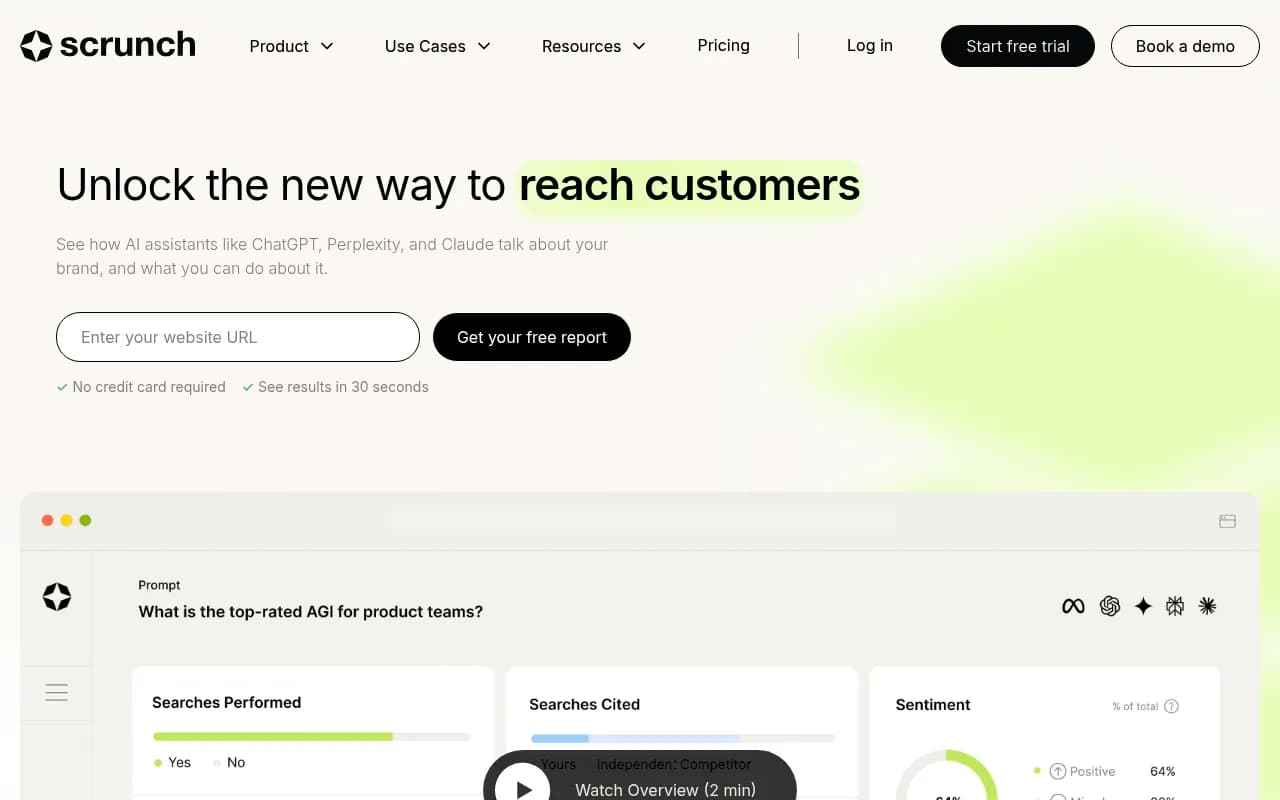
Sitecore's stated plan is to automate Scrunch's recommendations "within the SitecoreAI Content Management, Content Marketing, and Digital Asset Management solutions." Scrunch's message to customers was softer: "Scrunch isn't going away... We'll continue to operate as a standalone platform, support the customers and partners we serve today, and accelerate our product roadmap."
Both statements are probably true today. The question is what's true in twelve months. That's what the seven signs are for.

The seven signs
1. A "we're not going away" blog post appears
Nobody publishes a post explaining that nothing will change unless something just changed. The reassurance is the confirmation. Scrunch's post is a template of the genre: founder's voice, a nod to the mission, a promise to keep operating standalone, and the phrase "accelerate our product roadmap," which is doing heavy lifting.
Read the post, then read the acquirer's press release. The blog post exists to stop churn. The press release describes the actual strategy. Sitecore's release says Scrunch's recommendations will be automated inside SitecoreAI products, and that sentence tells you more about the next two years than the blog post does. Notice the category drift too: Sitecore calls Scrunch "an AI customer experience platform," not a GEO tool. The acquirer's framing is the positioning the product will grow into.
Also notice what the post doesn't say. No pricing commitments, no contract guarantees, no dates. That's not a knock on Scrunch. The genre doesn't allow for more.
2. The pricing page quietly restructures around enterprise
Scrunch's Core plan costs $250 per month and covers 125 prompts across four engines: ChatGPT, Perplexity, Google AI Overviews, and Copilot. Claude, Gemini, Meta AI, Google AI Mode, and Grok live in the custom-priced Enterprise tier, along with AXP, API and MCP access, SSO, and a dedicated account team.
Look at what sits above the self-serve line. Two of the most consequential engines for a 2026 GEO program, Claude and Gemini, are enterprise-only. When a $250-a-month self-serve tool becomes part of an enterprise digital experience company, the sales motion drifts toward procurement cycles, and self-serve tiers become a lead generation funnel rather than the business itself.
For context, SaaS vendors raised prices by an average of 11.4% in 2025, and post-acquisition is when repricing usually lands, because the new owner needs the product to fit its margin structure. Watch for transparent prices replaced by "contact sales," seat limits tightening, and trial terms shifting. Scrunch's 7-day trial already requires a card and auto-converts to paid.
3. The roadmap starts serving the acquirer's stack
Every acquired product says it will keep shipping for existing customers. The evidence to watch is which features ship, and for whom. When the acquirer's press release names the integrations, it's telling you where the engineering hours will concentrate. If you're not a Sitecore customer, the deepest investment now flows to connections you'll never touch.
That doesn't mean the standalone product stops improving. It means features get prioritized by how well they sell the suite. Scrunch's AXP technology, which restructures pages for AI consumption (one cited example: a pricing page shrunk from roughly 124,000 tokens to about 1,255, with no visible change for humans), is genuinely interesting. It will now be evaluated inside Sitecore against a suite yardstick. Track release notes for a quarter. If everything new is a suite integration and nothing ships for standalone users, you have your answer.
4. Titles change and the org chart gets vague
Chris Andrew signed the announcement as "CEO of Scrunch, a Sitecore company." Founders staying on is good short-term news; they know the product and the customers. The risk window opens 12 to 18 months out, when earnouts vest and acquirers typically consolidate leadership.
Do the money math, because it explains incentives. Scrunch raised somewhere between $19M (PitchBook) and $26M (the company's FAQ) and sold for a reported $225M. Everyone involved is well motivated to say the right things this year. The people who ultimately own the roadmap answer to Sitecore's CEO, Eric Stine, not to the customers who subscribed in 2025.
Watch LinkedIn for this one rather than press releases. A founder's title change is pageantry. Product managers and support leads leaving is information.
5. Support goes quiet during the transition
Integrations reorganize everything, including the people who answer your tickets. The signs are mundane: your CSM gets reassigned or picks up a new email domain, first-response times drift from hours to days, and answers start with "let me check with the team" more often than they used to.
None of this is malicious. It's what happens when two companies merge operations. The problem is that GEO programs need fast answers, because the underlying environment changes weekly. A support slowdown that would be a nuisance for an email tool is a real cost when you're diagnosing a visibility drop and can't tell whether the problem is your site or the model.
Start logging response times now, before anything changes. If your baseline is four hours and it becomes two days, you're looking at a tripwire, not a bad week.
6. The product starts disappearing into a bigger suite
Here's the precedent that should worry every GEO buyer. HubSpot announced its acquisition of XFunnel at the end of October 2025. XFunnel was bootstrapped, founded in January 2025, and acquired before its first birthday. The technology was folded into Marketing Hub as "HubSpot AEO," a $50 per month add-on covering 25 prompts across three engines, available only to Marketing Hub Professional and Enterprise customers. Users reported standalone accounts being migrated into HubSpot's ecosystem. The independent product ceased to exist.

That's the folded-in pattern, and it's the one that ends the product you bought. Scrunch is promising the opposite: standalone operation with more resources behind it. Both patterns start with the same reassuring blog post. The difference arrives six to twelve months later as either a pricing change or a migration notice.
Certain phrases in vendor emails predict the folded-in pattern reliably: "migrating your account," "simplifying our plans," "as part of the Sitecore family." When those words show up, your 90-day playbook compresses to about 30 days.
7. The paperwork changes
The quietest sign is legal. A new entity name on the invoice. A terms-of-service page with a fresh "last updated" date. A new data processing agreement. Changed data retention or export policies. These arrive in "no action required" emails, which is exactly why nobody reads them.
Read this one. Most SaaS agreements include a change-of-control clause that specifies what happens to service continuity, pricing, and terms when the vendor is acquired. Some negotiated enterprise contracts restrict ownership changes without customer consent, which is real leverage at renewal. Check three things: your termination and exit rights, your renewal date relative to when changes are likely to land, and your data export rights. Then run the export before you need it.
The eighth scenario: a shutdown, not an acquisition
Not every ending comes with a press release. Lorelight, a GEO platform that launched in April 2025, shut down on October 31, 2025, seven months in. The founder, Benjamin Houy, said the problem wasn't winning customers; they churned because the data didn't change what they actually did, so they kept doing the same brand-building work with or without the tool.
You can argue with his conclusion. The lesson for buyers stands regardless: this category is barely two years old, and vendors can vanish without an acquirer catching them. The mitigation is the same as for an acquisition. Own your prompt list, own your historical data, keep an exit mapped.
Why a coverage gap hurts more in AI search than anywhere else
I keep coming back to the tracking data Promptwatch publishes, because it shows how violent this environment is. A GEO platform's entire job is to notice when the ground moves. The ground moves weekly, sometimes daily:
- Reddit's share of ChatGPT Search citations collapsed from roughly 4% to 0.5% on August 14, 2026, per Promptwatch's Reddit citation data. One day. A vendor mid-integration could miss it, and you'd keep investing in Reddit content based on numbers that stopped being true overnight.
- On August 8, 2026, ChatGPT Search started using the site: operator at scale, jumping from about 0.4% to 17% of fanout queries overnight, with searches per response nearly doubling, according to Promptwatch's fanout tracking. Tools that didn't update their methodology produced junk benchmarks for weeks.
- Meta-WebIndexer went from about 2% to nearly 38% of tracked AI crawler requests between mid-July and August 9, 2026, per Promptwatch's crawler data. Whatever Meta is building, your next platform should already recognize that crawler by name.
- The GPT-5.3 rollout on March 4, 2026 dropped average citations per response across models, per Promptwatch's analysis of the update. Your visibility scores moved without anyone on your team touching anything.
- In July 2026, product pages overtook listicles as the most-cited content type in Google AI Overviews and led ChatGPT citations at roughly a third of the total, per Promptwatch's citation-type tracking for AI Overviews and ChatGPT. Your content plan for next quarter depends on knowing that.
This is the worst category in marketing software to have a distracted vendor. A rank tracker that misses a week is annoying. A GEO tool that misses a month hands you wrong assumptions about which content to build and which prompts matter.
What to do about it: a 90-day playbook
Days 1 to 7: protect yourself.
- Classify the pattern. Folded-in or standalone? Read the acquirer's press release and find where the product sits in their architecture. Sitecore's release describes automation inside SitecoreAI products. That's suite language. Scrunch's blog describes a standalone platform. Both are the official position in week one; the press release is the better predictor.
- Read your contract. Find the change-of-control clause, your termination rights, your renewal date, and your data export rights. If you have a negotiated MSA, you may hold consent rights you've never used.
- Export everything. Prompt lists, visibility history, citation trends, competitor benchmarks, saved reports. Your historical baseline is the one asset a successor vendor cannot recreate for you.
Days 8 to 30: set tripwires. Track four things weekly: support first-response time, shipping cadence for standalone features, pricing page changes, and coverage of new engines and crawlers. Two triggered tripwires means start evaluating immediately instead of waiting for day 90.
Days 31 to 90: evaluate in parallel. Trial two or three alternatives using your exported prompt list so the comparison is like-for-like. Then decide. Staying is defensible if the product keeps shipping and pricing holds. Dual-running for a quarter is cheap insurance for a brand with serious AI-driven revenue. Migrating with your old data as the benchmark is the fallback that never leaves you stranded.
Alternatives to evaluate in parallel
The market has no shortage of options, and consolidation risk applies to well-funded companies too. Profound has raised roughly $155M and carried a $1B valuation out of its Series C. Money doesn't immunize a vendor against being acquired; sometimes it makes an exit more likely.
| Platform | Entry price | What entry gets you | Ownership status |
|---|---|---|---|
| Scrunch | $250/mo | 125 prompts, 4 engines, 1 workspace | Acquired by Sitecore, June 2026 |
| Otterly.AI | $29/mo | 4 engines, basic tracking | Independent |
| Writesonic | $79/mo (annual) | Starter tier, 10 engines at Enterprise | Independent |
| Promptwatch | $95/mo | 50 prompts, all major engines, 7-day trial | Independent |
| Peec AI | ~$95/mo | 50 prompts, 3 models, unlimited users | Independent |
| Profound | $99/mo (annual) | 50 prompts, ChatGPT only at Starter | Independent, ~$155M raised |
| AthenaHQ | Free tier, then $295/mo | 300 credits free, 3,600 at Starter | Independent |
| HubSpot AEO | $50/mo add-on | 25 prompts, 3 engines, requires Marketing Hub | Built on the XFunnel acquisition |
| Semrush AI Visibility Toolkit | $99/mo add-on | 25 prompts, 3 engines, requires a paid Semrush plan | Public company |
Notes on the ones worth trialing first:
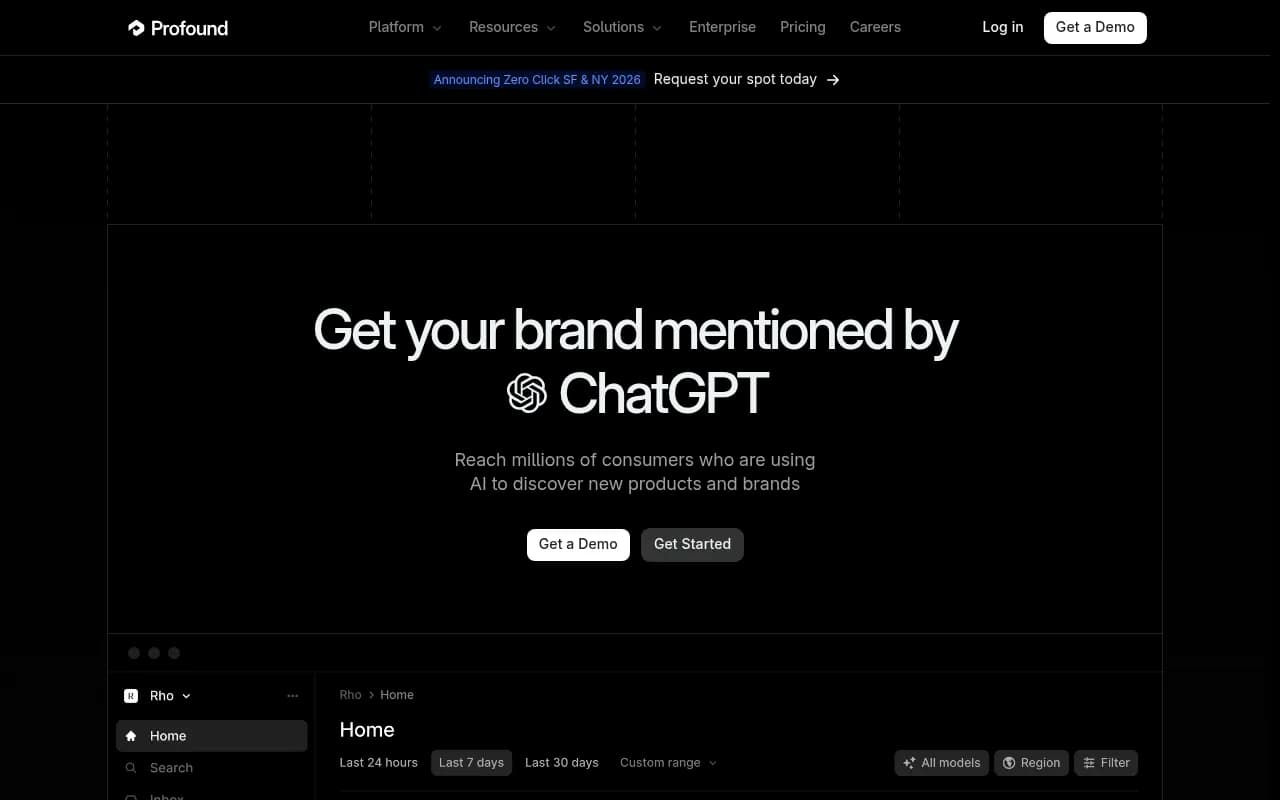
Profound is the closest thing to an enterprise standard in AI visibility monitoring, with more than 1.9B real user prompts indexed and SOC 2 Type II compliance. Starter runs $99/mo (annual billing) for 50 prompts on ChatGPT only; the Growth tier at $399/mo adds engines. If you need monitoring depth, it's the default shortlist entry. Its funding also makes it a plausible next acquisition target, so apply the same playbook you're applying to Scrunch.
Otterly.AI is the budget end, from $29/mo, with a 4.9/5 G2 rating and a Gartner Cool Vendor nod in 2025. It's a tracker rather than an optimization platform, which is fine if your team handles content in-house. A reasonable stopgap while you evaluate heavier options.

AthenaHQ starts with a free tier (300 credits, 5 surfaces) before the $295/mo Starter plan. The credit model means one AI response equals one credit, so model your actual usage before committing; heavy tracking programs burn credits fast.

Promptwatch is the platform I'd point to if the acquisition pushed you from monitoring into actually fixing visibility. Essential runs $95/mo for 50 prompts with all major engines tracked. It logs AI crawler hits on your site (that's how the Meta-WebIndexer surge above was caught), tracks Reddit and YouTube citations, monitors ChatGPT shopping results and sponsored placements, and its content agents can plan, write, and publish GEO-optimized pages straight to your CMS. It's built on more than 4.5B analyzed citations, serves 1,840+ customers, and holds 4.7/5 on G2. For a team that just learned its vendor's priorities changed, a tool that closes the loop from insight to published content deserves a long look.

Two footnotes on the table. If you're already a HubSpot Marketing Hub customer, HubSpot AEO at $50/mo is the cheapest credible option, and it exists precisely because of the acquisition pattern in sign 6. Semrush's AI Visibility Toolkit costs $99/mo but sits on top of a required paid Semrush plan, and the full toolkit needs the $299/mo Business tier, so read the fine print.
For a fuller list, the GEO software directory at bestgeosoftware.com keeps current pricing and feature data on the category, and Promptwatch's comparison of 21 GEO platforms goes deeper on feature-by-feature differences than any single review can.
Where this leaves Scrunch customers
Maybe Scrunch keeps its promise. Companies do stay standalone after acquisition, and Sitecore has reasons to keep a $250/mo funnel alive: it feeds the enterprise pipeline. The named results are real, the AXP technology is real, and nothing in the announcement suggests customers are being abandoned.
Plan as if the migration email is coming anyway. The cost of being prepared is an afternoon of exports and a contract review. The cost of being surprised is a quarter of flying blind in the most volatile channel in marketing. Export your data this week. That's the part you'll thank yourself for no matter how the acquisition goes.