Knowatoa Review 2026
AI search monitoring tool that tracks how brands appear in responses from ChatGPT and other LLMs, designed to help marketers understand their AI footprint.
Key takeaways
- Knowatoa combines AI search visibility monitoring with built-in content generation agents (Sam and Connie), making it more than a passive dashboard
- Covers 7 AI engines: ChatGPT, Claude, Gemini, Meta AI, Perplexity, Google AI Mode, and AI Overviews -- though full multi-model access requires the Growth plan
- Lacks several capabilities that Promptwatch offers: no AI crawler logs, no traffic attribution, no Reddit/YouTube source tracking, no ChatGPT Shopping monitoring, no prompt volume/difficulty scoring, and no query fan-outs
- Starter plan at $59/mo is one of the more accessible entry points in this category, but limits you to ChatGPT, AI Overviews, and AI Mode only
- Best fit for small B2B SaaS teams and boutique agencies who want a simple, guided workflow rather than a deep data platform
Knowatoa is a GEO (Generative Engine Optimization) tool built by Ryan Castillo and Michael Buckbee, two former B2B SaaS marketing directors who got tired of watching brands disappear from AI-generated answers. The pitch is direct: your buyers are asking ChatGPT and Perplexity about your competitors, and you probably don't know what those answers say. Knowatoa tracks those answers, shows you where you're missing, and then -- through a pair of AI agents -- drafts the content you'd need to close the gap.
The tool sits in a growing category of AI search monitoring platforms, alongside names like Otterly.AI, Peec.ai, Profound, and Promptwatch. What separates Knowatoa from the pure monitoring plays is its emphasis on the "publish" step. The homepage copy is blunt about it: "Marketers who stopped watching and started publishing." That framing is accurate -- the product is genuinely oriented toward action, not just data collection.
The founding team has real credibility here. Buckbee grew organic search traffic 10x at Varonis. Castillo spent a decade as Director of Marketing and Director of Data at B2B SaaS companies. They're not researchers building a dashboard -- they're practitioners who built the tool they wanted to use. That shows in the product's opinionated workflow.
Key features
Competitive visibility analysis across 7 AI engines
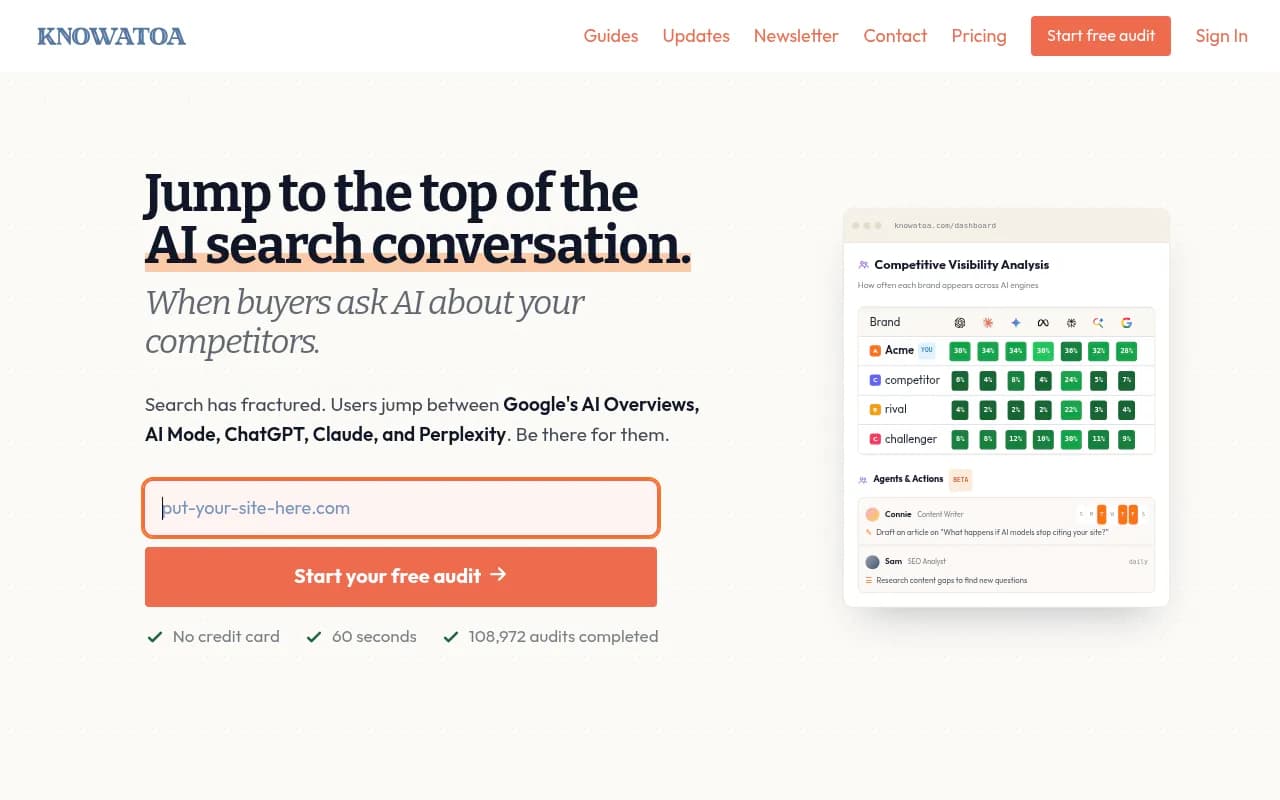
The core dashboard shows how often your brand appears in AI-generated answers compared to competitors, broken down by engine. You get percentage visibility scores for ChatGPT, Claude, Gemini, Meta AI, Perplexity, Google AI Mode, and AI Overviews. The comparison table format makes it easy to spot where a competitor is outperforming you on a specific platform -- for example, a rival might have 30% visibility on Perplexity while you're at 4%. That kind of per-engine breakdown is genuinely useful because different AI models pull from different sources and weight content differently.
One caveat: the Starter plan ($59/mo) only covers ChatGPT, AI Overviews, and AI Mode. You need the Growth plan ($199/mo) to unlock Claude, Gemini, Meta AI, and Perplexity. That's a meaningful limitation if you're trying to get a full picture from day one.
Gap analysis with head-to-head competitor comparison
This is where Knowatoa earns its keep. For every question you're tracking, the tool shows which competitors appear in the answer and which sources (Reddit, YouTube, G2, etc.) are shaping it. The head-to-head view gives you a count of competitor-only questions, shared questions, and questions where you appear but they don't. It also surfaces estimated monthly search volume for the question set, which helps prioritize where to focus.
The gap analysis is the foundation for the content agent workflow. Every gap becomes a potential brief. That connection between "where you're losing" and "what to publish" is the product's strongest design decision.
AI agents: Sam and Connie
Knowatoa's two agents are the most distinctive feature in the product. Sam is the SEO Analyst -- it runs daily to research content gaps and surface new questions worth tracking. Connie is the Content Writer -- she drafts articles based on the gaps Sam identifies. You can set Connie to auto-approve drafts at a specific time (say, 10 AM EDT) or review each one manually before publishing.
This is a real workflow, not a gimmick. The agents run on a schedule, surface work, and reduce the friction between "we know we're missing from this answer" and "we published something about it." For small teams without a dedicated content operation, this is the feature that justifies the subscription.
That said, the quality of AI-generated content is always a variable. Knowatoa doesn't publish detailed information about which underlying models power the agents or how the drafts are grounded in citation data. That's worth testing before committing to auto-approve.
Cross-model visibility tracking
The platform tracks your appearance across all 7 engines and shows per-platform visibility percentages. This matters because a brand might be well-cited by ChatGPT but nearly invisible on Perplexity, which pulls heavily from different source types. The cross-model view helps you understand whether your content strategy is working broadly or just on one platform.
Weekly change tracking and mention monitoring
Knowatoa runs weekly checks and surfaces what changed: new citations, shifts in competitor visibility, new questions where you appeared or disappeared. The "Appearance" feature tracks whether you show up in the answer at all, not just whether you're cited as a source. That distinction matters -- AI models sometimes mention a brand without linking to it, and both signals are worth tracking.
Compounding metrics dashboard
The "Proof" section tracks citations, sentiment, and visibility over time. The idea is to show that publishing content in response to gaps actually moves the numbers -- citations up 128%, sentiment up 22 points, visibility up 41% in the example shown. This is the reporting layer that helps justify the investment to leadership or clients.
Multi-language and multi-market support
Both plans include the ability to check visibility in any language and market. This is a meaningful inclusion at the Starter price point -- many competitors charge more or restrict geo-targeting to higher tiers.
Free audit
Knowatoa offers a no-credit-card, 60-second audit that shows where you stand across ChatGPT, AI Overviews, and AI Mode. Over 108,000 audits have been completed. This is a smart acquisition tool and also a genuine way to evaluate whether the product surfaces useful data before paying.
Who is it for
Knowatoa is clearly built for B2B SaaS marketers at small to mid-sized companies -- the kind of team where one or two people own content, SEO, and demand generation simultaneously. The testimonials on the homepage are telling: a SaaS founder, a co-founder/CEO of a developer tools company, and a boutique agency owner. These are not enterprise marketing teams with dedicated SEO analysts and content operations. They're people who need to move fast with limited resources.
The agent workflow (Sam + Connie) is specifically designed for teams that don't have time to turn gap analysis into content briefs manually. If you're a solo marketer or a two-person team trying to show up in AI answers without hiring a content agency, the "done for you" framing is genuinely relevant.
For agencies, the Growth plan's API access, Looker Studio integration, and NinjaCat support make it possible to include AI search metrics in client reporting. The dedicated account rep is a nice touch for agencies that need a human to call when something looks off. That said, agencies managing 10+ clients will likely find the two-plan structure limiting -- there's no agency tier with multi-client management or white-labeling mentioned on the site.
Who should probably look elsewhere: enterprise marketing teams that need deep data, custom prompt sets, AI crawler log analysis, or traffic attribution. Also, brands in highly regulated industries or with complex multi-brand structures will find the product too simple. And if you're already running a sophisticated SEO operation and want to layer in AI search data without changing your workflow, a more data-dense platform will serve you better.
Integrations and ecosystem
Knowatoa's integration story is modest but practical for its target audience.
- API access: Available on the Growth plan. No public documentation was found, so the depth and flexibility of the API is unclear.
- Looker Studio: Growth plan includes a Looker Studio connector, which is the right call for teams that already build marketing dashboards there.
- NinjaCat: Listed as a reporting integration on the Growth plan. NinjaCat is a popular choice for digital agencies, so this signals that Knowatoa is thinking about the agency market.
- No native CMS integrations were found -- content drafts from Connie presumably need to be exported and published manually.
- No browser extension or mobile app was found.
- No Google Search Console integration was mentioned, which is a gap for teams that want to connect AI visibility data to organic traffic.
The integration set is functional for small teams and agencies doing monthly reporting, but it's thin compared to platforms that offer server log analysis, GSC integration, or direct CMS publishing.
Pricing and value
Knowatoa has two plans:
Starter -- $59/mo
- 30 questions (based on pricing search results)
- ChatGPT, AI Overviews, AI Mode only
- Competitor visibility comparison
- Weekly change reports
- Multi-language/market support
- 7-day free trial
Growth -- $199/mo
- Everything in Starter
- Full 7-engine coverage (adds Claude, Gemini, Meta AI, Perplexity)
- Higher question volume (limits not explicitly stated on homepage)
- API access, Looker Studio, NinjaCat integrations
- Dedicated account rep
- Annual billing available (discount amount not specified)
The $59/mo Starter plan is one of the more accessible entry points in the GEO category. For comparison, Promptwatch starts at $99/mo and most other serious platforms start at $200+. The catch is that Starter only covers three AI engines, which limits its usefulness if you care about Claude or Perplexity.
The Growth plan at $199/mo is competitive for what it includes, especially with the agent workflow and reporting integrations. The dedicated account rep is unusual at this price point and adds real value for teams that aren't sure how to interpret the data.
There's some confusion in third-party pricing data -- one review site lists different tiers ($0, $99, $249, Agency) that don't match the current homepage. The current pricing appears to be the two-plan structure described above. Worth confirming directly before purchasing.
Strengths and limitations
What Knowatoa does well:
- The Sam + Connie agent workflow is a genuinely useful design. Most GEO tools show you gaps and leave you to figure out what to do. Knowatoa closes that loop with scheduled drafts.
- The free audit is fast, requires no credit card, and gives real data. It's a low-friction way to evaluate the product.
- The Starter price point ($59/mo) makes AI search monitoring accessible to small teams and solo marketers who can't justify $200+/mo for a monitoring tool.
- The founding team's B2B SaaS marketing background shows in the product's opinionated workflow. It's built around how a small marketing team actually operates, not around what's technically possible.
- Multi-language and multi-market support at both tiers is a meaningful inclusion.
Limitations and honest gaps:
- No AI crawler logs. Knowatoa doesn't show you which pages AI crawlers are visiting, how often, or what errors they're encountering. This is a significant gap for teams trying to understand why certain content isn't getting cited. Promptwatch offers this; Knowatoa doesn't.
- No traffic attribution. There's no way to connect AI visibility to actual website traffic or revenue. You can see that your citations went up, but you can't tie that to sessions, leads, or conversions. Promptwatch's traffic attribution (via code snippet, GSC integration, or server log analysis) closes this loop; Knowatoa leaves it open.
- No Reddit or YouTube source tracking. The gap analysis shows that Reddit and YouTube influence AI answers (the product's own screenshots show Reddit at 42% and YouTube at 28% of cited sources), but there's no dedicated feature for monitoring or optimizing for those channels. Promptwatch tracks Reddit and YouTube discussions that influence AI recommendations.
- No ChatGPT Shopping tracking. For e-commerce or product-led brands, ChatGPT's shopping carousels are increasingly important. Knowatoa doesn't appear to track this.
- No prompt volume or difficulty scoring. Knowatoa generates likely questions and helps you pick which ones to track, but there's no data on prompt volume or how hard a given question is to win. Promptwatch provides volume estimates and difficulty scores to help prioritize. Without this, question selection is somewhat subjective.
- No query fan-outs. Understanding how one prompt branches into sub-queries is useful for content planning. This capability isn't present in Knowatoa.
- Limited model coverage on Starter. Locking Claude, Gemini, Meta AI, and Perplexity behind the Growth plan means the $59/mo tier gives an incomplete picture of AI search visibility.
Bottom line
Knowatoa is a solid entry-level GEO tool with a genuinely useful content agent workflow. For a small B2B SaaS team or boutique agency that wants to move from "we should probably do something about AI search" to "we're publishing content every week based on real gap data," it's a practical and affordable starting point. The Sam + Connie agent setup is the product's real differentiator -- it's the closest thing in this category to a done-for-you content operation at a sub-$200 price point.
For teams that need deeper data -- AI crawler logs, traffic attribution, Reddit/YouTube source tracking, prompt volume scoring, or ChatGPT Shopping monitoring -- Knowatoa's feature set will feel thin. Promptwatch covers all of those gaps and is built around the same "find gaps, create content, track results" loop, but with significantly more data depth and a larger model coverage set (10 AI models vs. 7). If you're serious about AI search as a channel and need to prove ROI to leadership, the more capable platform is worth the higher price.
Best use case in one sentence: A small B2B SaaS marketing team that wants a weekly workflow for finding AI search gaps and publishing content to close them, without needing a data analyst to interpret the results.
Frequently asked questions
What is Knowatoa?
How much does Knowatoa cost?
Is there a free plan or trial?
What AI models does Knowatoa track?
How does Knowatoa compare to Promptwatch?
Who is Knowatoa best for?
Similar and alternative tools to Knowatoa