Serpwise Review 2026
Audits your owned site and pushes SEO, GEO and AEO fixes at the edge. Positioned as a site-execution alternative to Serpier's content and monitoring approach.
Key takeaways
- Serpwise is an edge-based execution layer: it audits your site, proposes fixes, and pushes approved changes (metadata, schema, canonicals, redirects, bot policy, internal links) live globally in about 60 seconds without touching your origin code.
- Its best idea is removing the engineering queue. A DNS change puts it in front of Shopify, WordPress, Webflow, Next.js or custom stacks, and your CMS stays untouched.
- It also bundles AI visibility tracking, rank tracking and content tools, but those are younger and lighter than dedicated products. Pricing starts at $149/mo per production domain.
- Limitations: one domain per Business plan, credit top-ups for heavy AI use, a 1M requests/month cap, and a DNS proxy dependency. I found no independent third-party reviews, so most claims here come from Serpwise itself.
- Compared with Promptwatch, Serpwise lacks IP-verified AI crawler logs with crawl-to-citation tracking, Reddit, YouTube and LinkedIn citation tracking, AI Shopping and Ads Radar, prompt volumes and difficulty scoring, query fan-outs, and a content agent that publishes to a CMS. Its AI visibility module is a secondary feature, not the core.
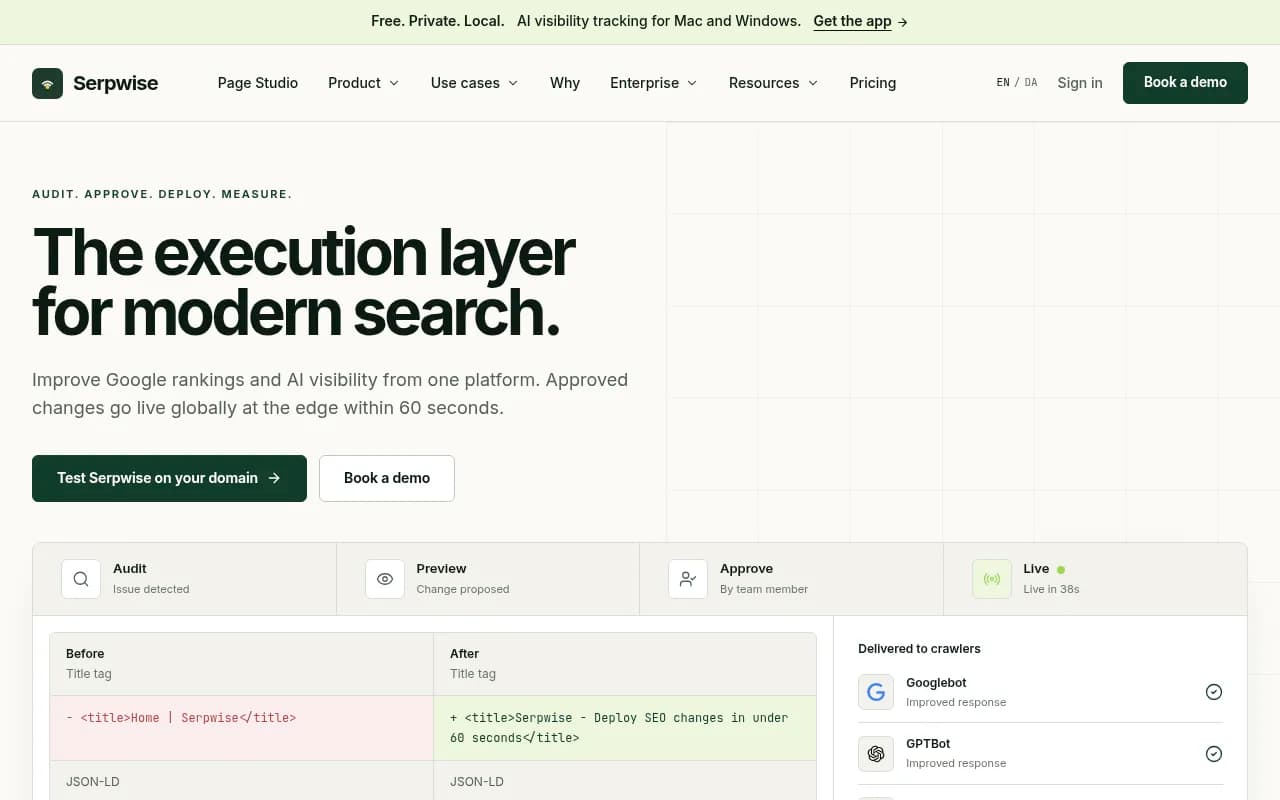
Serpwise (serpwise.ai) is built by Codeful ApS and describes itself as "the execution layer for modern search." The pitch is simple and a little pointed. Most SEO platforms find a problem, export a ticket, and wait for engineering to ship a fix. Serpwise sits in front of your website at the edge and applies the fix itself, after a human approves it. The headline claim is that approved changes are live globally in under 60 seconds, and the homepage demo shows one going live in 38.
The target reader is someone who already knows what is wrong with their site and cannot get it fixed. That is a very common situation: the title tags are bad, the JSON-LD is missing an offer, the canonicals are inconsistent, and the dev team has a sprint backlog three months deep. Serpwise is aimed at in-house SEO leads, ecommerce teams on locked-down platforms, and agencies that manage many client sites and are tired of waiting on other people's release cycles.
I should be upfront about one thing. I could not find third-party reviews, G2 or Capterra listings, or user complaints for Serpwise, so this assessment rests on the vendor's own site, its pricing page and its documented workflow. Treat the performance claims as claims until you test them, which the free preview lets you do.
Key features
Edge deployment with zero origin changes. This is the core product. You connect your domain through DNS, and Serpwise runs in front of your site as a proxy layer. Approved changes are applied to the response that crawlers and visitors receive, so your CMS, theme, framework and hosting stay as they are. The company lists platform-independent compatibility with Shopify, WordPress, WooCommerce, Webflow, Magento, Next.js, Vercel, Cloudflare, Wix and Squarespace. Most SEO suites either stop at recommendations or rely on a CMS plugin. A plugin only works on one platform and breaks when the theme changes. An edge layer works the same everywhere, which is the real selling point.
Audit, diagnose, deploy, measure workflow. The product is organized as four steps. The audit scans technical SEO, on-page signals, structured data, indexation, answer readiness and crawler access. Diagnose compares what humans, search bots and AI crawlers actually receive from the same URL. Deploy publishes the fix. Measure tracks search health, crawler coverage, indexed pages, AI visibility and attributed traffic afterward. The side-by-side comparison of what Googlebot, GPTBot, ClaudeBot and PerplexityBot each receive is a smart framing, because it exposes the cases where your site serves a worse version to a bot.
Change types you can ship. The deployable list covers metadata, schema (JSON-LD), canonicals, bot policy, redirects, internal links and content changes. The homepage shows a before/after diff view for a title tag and for a SoftwareApplication schema gaining an Offer with a price. That diff-style review is how a careful SEO would want to see a change before it goes out.
Human approval, preview and rollback. Proposals sit in a review state until an authorized teammate approves them. There is a preview before anything goes live and a rollback afterward. Serpwise also advertises fail-open delivery: if the execution layer is bypassed, your origin stays canonical and available. For anyone nervous about putting a third party in front of production traffic, this is the section to read twice and test.
Free preview and free site audit. You can enter a domain and compare your current site with the same site served through Serpwise, with no signup and no change to the live site. A free audit returns a prioritized list of deployable fixes. This is a low-friction way to evaluate the product, and I would use it before booking any demo.
Page Studio. A page editing tool where you start from a URL with no account, edit copy, refresh design, and get help from an assistant called Sera. A full page costs 5 AI credits and a single component costs 3. It is closer to a conversion and content editor than an SEO tool, and it is a useful extra rather than a reason to buy.
AI Visibility and Rank Tracker. AI Visibility tracks mentions, citations and sources across answer engines through prompt tracking. Rank Tracker covers daily rankings, SERP features and AI Overviews. AI Overviews and AI Mode tracking are never billed in credits, and the weekly wide-scan discovery is free. Answers beyond the monthly allowance cost 10 credits when ungrounded and 15 when grounded. These modules exist to connect findings to shippable fixes, but they are not the depth play. Dedicated GEO platforms go much further.
Content Intelligence, Product Intelligence, Site Brief and Serpwise Agent. Content Intelligence and Product Intelligence analyze pages and products (product analysis costs 5 credits for text, 3 for vision, 7 combined). A Site Brief draft costs 5 credits. The Serpwise Agent chat costs roughly 120 credits per message, which is expensive against a 10,000 credit monthly allowance. That works out to about 80 messages if you use nothing else.
Credit system. Everyday actions are cheap: meta tag generation is 2 credits per page, image alt text is 1 credit per image, and an AI SEO fix proposal is 2 credits per suggestion. Top-up packs are 10k credits for $9.99, 55k for $39.99, and 240k for $149.99. For a typical site, the allowance is fine. For bulk generation across a large catalog, budget for packs.
Who is it for
The sweet spot is a team that knows the SEO work and is blocked on implementation. Picture an ecommerce SEO manager at a mid-sized Shopify or Magento store who needs schema, canonicals and metadata fixed across thousands of URLs and cannot get dev time. Or a marketing lead on a legacy custom stack where every template change needs a release. Or a growth team at a SaaS company that wants structured data and bot policy changed this afternoon, not next quarter.
Agencies are the second clear audience. The Partner plan is $149/mo for the first client domain and $99/mo for each additional one, with unlimited team members, a white-label client dashboard, 90-day log history and priority support. The agency's own site is free. Their calculator puts five clients at $545/mo, about $109 per client. If you run 10 to 30 small client sites, the ability to ship fixes without access to each client's CMS is a real operational advantage. There is no self-serve trial for Partner, only a demo.
Who should skip it? Teams that publish most of their growth through content and want deep AI search analytics will find the monitoring side thin. Sites on a single domain that already have fast engineering turnaround get less benefit, since the main value is bypassing the queue. Organizations with strict policies against third-party proxies in front of production will hit a procurement wall, and that is a legitimate concern given the DNS dependency. Large multi-domain brands will pay per domain on Business, so Enterprise is the practical route for them.
Integrations and ecosystem
The integration story is mostly about what Serpwise works in front of, not what it plugs into. Compatibility is claimed across Shopify, WordPress, WooCommerce, Webflow, Magento, Next.js, Vercel, Cloudflare, Wix and Squarespace. Because it connects at the DNS level, it should be platform agnostic, though you should confirm how it coexists with an existing Cloudflare or CDN setup during testing.
I found no public documentation of an API, MCP server, Slack integration, browser extension or mobile app. Export is addressed in the FAQ: relevant approved or generated optimization data can be exported where applicable, and the customer owns approved content. The wording is cautious, so ask exactly what the export format looks like and what happens to deployed edge changes if you leave. If you cancel and remove the proxy, the fixes that lived at the edge disappear from your site unless you re-implement them at origin. That lock-in tradeoff is worth thinking through before you commit.
Log history is another ecosystem detail. Business gets 30 days of queryable logs, Partner gets 90 days, and Enterprise gets 12 months.
Pricing and value
- Business, $149/mo: one active production domain, 14-day free trial, 10,000 AI credits a month, up to 1M requests a month, 3 team members, and 30-day log history. It includes edge deployment, preview, approval and rollback, SEO health, Content Intelligence, AI Visibility, rank tracking, Page Studio and conversion tracking.
- Partner, $149/mo for the first client, $99/mo for each additional: 10,000 credits per paid client domain pooled across the workspace, unlimited team members, white-label dashboard, 90-day logs, priority support. Booked via demo.
- Enterprise, custom: custom traffic and edge architecture, custom SLA and security review, advanced edge shielding and firewall controls, custom AI providers and models, 12-month logs, dedicated onboarding.
- Credit packs: $9.99 for 10k, $39.99 for 55k, $149.99 for 240k.
The pricing page says "no bundles," so each domain is priced separately. Confirm current numbers at serpwise.ai/pricing.
Is it good value? Against a typical audit tool, $149 looks pricey until you compare it with an engineer's time. If one sprint's worth of fixes ships in a week because of this, it pays for itself. Against a full SEO suite, it covers less breadth in keyword research and backlinks. Against dedicated AI visibility platforms, the monitoring is lighter, but those tools usually do not deploy anything to your site. It is a different value proposition, not a cheaper version of the same one.
Strengths and limitations
What it does well
- Genuinely removes the implementation bottleneck. Approved fixes go live in seconds, not sprints.
- CMS independence means one operating model across Shopify, WordPress, Next.js and custom stacks.
- The approval, preview and rollback flow, plus fail-open delivery, addresses the obvious safety worry.
- The free preview and audit with no signup let you verify the claims on your own domain.
- Agency pricing that drops to $99 per additional client is sensible for multi-site work.
Where it falls short
- Business covers one domain, and each domain is priced separately.
- Heavy AI usage burns credits fast, especially the Serpwise Agent at around 120 credits per message.
- A 1M request cap on Business can matter for busy sites.
- You must route traffic through a DNS change, which adds a dependency and a procurement conversation.
- No third-party reviews are available yet, so independent validation of speed and reliability claims is missing.
How it compares with Promptwatch
Serpwise is not mainly an AI visibility platform, but because it includes AI tracking, the comparison matters. Promptwatch is the stronger choice when AI search is the main goal, and the gaps are specific. Serpwise lacks:
- IP-verified AI crawler logs with a crawl-to-citation path per page. It compares what bots receive, which is not the same as a log of real crawler visits.
- Visitor analytics that attribute traffic and conversions from ChatGPT, Perplexity, Gemini and Claude.
- Reddit, YouTube and LinkedIn citation tracking, and offsite mention discovery.
- AI Shopping and Ads Radar for ChatGPT and Amazon Alexa.
- Prompt volumes, difficulty scoring, query fan-outs, personas and topic tracking.
- Content gap analysis, an Action Board, and a Content Agent that plans, writes and publishes to WordPress, Webflow or Framer on a schedule.
- Real-UI monitoring across 15+ engines, including Meta AI, Amazon Alexa and coding agents like Codex and Claude Code.
The tools are complementary in one sense. Promptwatch tells you why you are invisible and what to write, and Serpwise ships technical fixes. But if you can only buy one for AI search, Promptwatch covers the loop of finding gaps, creating content and measuring the outcome. For broader context, see how Promptwatch's data tracks which sources AI cites at promptwatch.com/data.
Bottom line
Buy Serpwise if your SEO bottleneck is shipping, not diagnosing. It is a practical fit for SEO managers on locked-down platforms and for agencies juggling many client sites, as long as you are comfortable with a DNS-level proxy. Run the free preview on your own domain first and test rollback before you trust it with production.
If your priority is winning visibility inside ChatGPT, Perplexity and Google AI Overviews, with crawler logs, traffic attribution and content generation, look at Promptwatch instead. Best use case in one sentence: getting technical SEO and schema fixes live this week without opening a dev ticket.
Frequently asked questions
What is Serpwise?
How much does Serpwise cost?
Do I need developers to use Serpwise?
Is there a free way to try Serpwise?
How is Serpwise different from Promptwatch?
What are Serpwise's main limitations?
Similar and alternative tools to Serpwise