ClearSERP Review 2026
Provides SERP analysis, keyword research, domain scoring and competitor insights for planning campaigns against what actually ranks.
Key takeaways
- ClearSERP's core pitch is honest filtering: instead of a difficulty score you have to trust on faith, it shows you the actual top-10 results with a Domain Score for each, so you can see whether the SERP is beatable before you spend a credit on content.
- SERP weakness detection is the standout feature. It flags results pages where low-authority pages rank, which is how solo site builders and affiliate marketers find the easy wins that bigger tools bury under generic difficulty numbers.
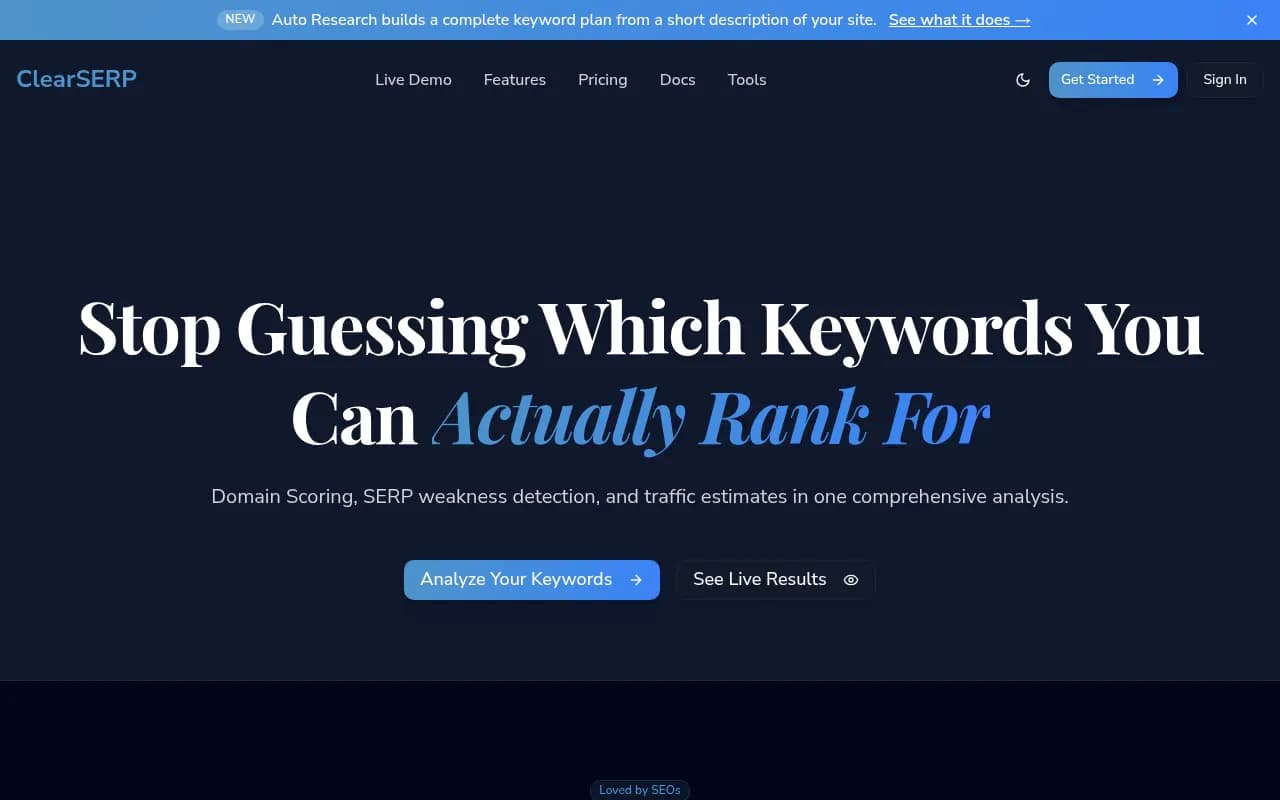
- The new Auto Research feature is ambitious: describe your site in a few sentences and it returns a keyword plan grouped into article targets with titles and meta descriptions. It's a genuine time-saver, though the quality of the plan still depends heavily on how well you describe your site.
- It's a traditional SEO tool. There's no rank tracking, no backlink analysis, no site audits, and no content publishing workflow. If you want a full SEO suite, this isn't it.
- Pricing is credit-based across Starter, Professional, and Enterprise tiers, billed monthly or annually. Exact prices aren't published prominently, so you'll need to check the pricing page before committing.
What ClearSERP actually does
Most keyword tools give you a difficulty number and send you on your way. ClearSERP takes a different angle: it pulls the live SERP for every keyword you analyze and breaks down all ten ranking positions individually. You see the Domain Score for each result, an estimated traffic figure per page (not just per domain), and which SERP features are present.
That last part matters more than it sounds. The tool detects 57 SERP feature types, including AI Overviews, People Also Ask, featured snippets, video carousels, and shopping results. Knowing that a keyword triggers an AI Overview before you target it is increasingly important, since AI-generated answers can absorb a large share of clicks before users ever reach the organic results. Promptwatch's data on AI Overviews citation types shows how much these surfaces have grown as a destination in their own right.
The demo table on their homepage gives you a real feel for the output. Each keyword row shows search volume, CPC, difficulty, the Domain Scores of all ten ranking pages, and a Keyword Score that ranks opportunity. You can expand any row to see the full SERP breakdown. It's the kind of data presentation that makes you realize how much other tools summarize away.
The features that earn their keep
SERP weakness detection
This is the feature people switch for. ClearSERP automatically flags SERPs where weak pages rank, meaning pages with low Domain Scores sitting in positions you could plausibly take. For a new site with no link budget, this is the difference between six months of wasted effort and a first page ranking in weeks. The homepage case study, a six-month-old site grown to $100+/day with no link building, is exactly the use case this feature serves.
Auto Research
The newest addition, and the most interesting one. Instead of feeding in seed keywords, you write a few sentences describing your site, and ClearSERP plans the research, picks the seed keywords, identifies competitors worth mining, and returns a finished keyword plan. Keywords come back grouped into article targets, each with a title and meta description ready to hand to a writer.
Two details suggest the team thought this through. First, keyword grouping is verified against live results: two keywords only get grouped into one article when Google's actual SERP shows they belong on the same page. That's more rigorous than the pure similarity-based clustering most tools use. Second, you approve the plan before it runs, and unused credits are returned. That's a fair model for a feature that could otherwise burn through your allowance on a bad description.
The limitation is the flip side of the convenience. Seed-based research only finds phrases containing your seed, which is why Auto Research exists, but a description-based plan inherits its own blind spots. If your description is vague or misjudges the niche, the plan will be too. You still need to review it critically.
Multiple research methods
Beyond Auto Research, you get four research entry points: keyword ideas from a seed, niche keywords pulled from any domain, ranked keywords for competitors, and organic competitor discovery based on keyword overlap. The competitor mining is solid for planning campaigns against sites that are actually in your weight class, rather than the industry giants every tool loves to show you.
Bulk processing and exports
You can analyze up to 1,000 keywords at once with live progress tracking, and export everything to CSV. No frills here, just the basics done right.
Who it's for
The clearest fit is the solo SEO or affiliate marketer building niche sites without a link building budget. If your entire strategy depends on finding SERPs where weak pages rank, ClearSERP is built directly for you. The testimonials on the site are all from that crowd, and the feature set backs it up.
The second persona is the SEO consultant or small agency doing keyword research for clients who wants defensible output. Showing a client the actual Domain Scores of the pages they're up against lands differently than showing them a difficulty number they don't trust. The article-grouped keyword plans from Auto Research also hand off cleanly to writers.
Who should look elsewhere? Anyone who needs an all-in-one platform. There's no rank tracking, no backlink data, no technical audits, no content briefs beyond what Auto Research generates. Teams running full SEO programs will still need Ahrefs or Semrush alongside this, which makes ClearSERP a complement rather than a replacement for most professional workflows.
Pricing
ClearSERP uses a credit-based model across three tiers: Starter, Professional, and Enterprise. Subscriptions bill monthly or annually in advance and auto-renew unless canceled. The specific credit amounts and prices aren't published in the material I could verify, so check the pricing page directly. The credit model is worth understanding before you commit: analysis-heavy workflows (especially Auto Research runs and bulk processing of hundreds of keywords) will consume credits faster than casual use, so estimate your monthly volume before picking a tier.
What's missing
Being honest about the gaps: there's no backlink database, so Domain Scores can't be cross-referenced against link profiles the way you can in Ahrefs. There's no rank tracking to close the loop after you publish. The traffic estimates are estimates, and per-page figures will always be rougher than the domain-level numbers bigger tools have calibrated over a decade. And while the tool detects AI Overviews as a SERP feature, it doesn't analyze them, so if your strategy depends on understanding how AI surfaces cite sources in your niche, you'd need a dedicated AI visibility tool alongside this.
Bottom line
ClearSERP knows exactly what it is: a keyword research tool for people who want to see the evidence behind a difficulty score. The SERP-level transparency, weakness detection, and live-verified keyword grouping are genuinely better than what the big suites offer at this specific job, and Auto Research is a smart evolution of the workflow. It won't replace your main SEO platform, and it doesn't try to. For niche site builders and consultants whose success hinges on picking winnable keywords, it's worth a serious look. If you're comparing options in this category, the broader tools directory at surferstack.com has reviews of the alternatives worth weighing.
Tags:
Frequently asked questions
How is ClearSERP different from Ahrefs or Semrush?
What is Auto Research in ClearSERP?
How does ClearSERP's pricing work?
Who is ClearSERP best suited for?
Similar and alternative tools to ClearSERP