MentionFlow Review 2026
Tracks your brand across the major AI answer engines including ChatGPT and Google AI Overviews, flagging where you appear, where you don't, and how that changes over time.
Key takeaways
- MentionFlow is a genuinely interesting new AI visibility tool: it tracks 10 engines, saves every raw answer as evidence, and closes the loop with a content agent that drafts and publishes fixes straight to seven CMS platforms. Entry price of $89/mo undercuts most rivals.
- Its strongest card is transparency. Every number opens the real AI answer behind it, missing data shows as a dash instead of a fake zero, and the methodology page is unusually detailed. This is rare in a category full of black-box scores.
- It's very new. Data collection only started July 4, 2026, there's no G2 presence, no independent reviews, and no customer quotes. The company openly admits this rather than faking social proof, which is refreshing but still a risk.
- Compared to Promptwatch, it lacks several capabilities: no Reddit or YouTube citation tracking, no offsite mention tracking beyond citations, no ChatGPT Ads radar depth, no visitor analytics tying AI traffic to conversions, and a much smaller dataset (32k answers vs 4.5B+ analyzed data points). Claude and Grok only refresh weekly.
- Best for: solo founders, small in-house teams, and budget-conscious agencies who want an honest, affordable tracker with basic content automation. Not ideal for enterprises needing deep data history or agencies wanting mature white-label infrastructure.

What MentionFlow does
MentionFlow is an AI visibility and brand monitoring tool built by Apollo Digital, an SEO agency based in Sofia, Bulgaria. The founder, Noel Ceta, is candid about the origin: they built it for their own agency clients first, then productized it. That agency DNA shows up everywhere in the product, from the white-label reporting to the "your boss will ask where this number came from" framing.
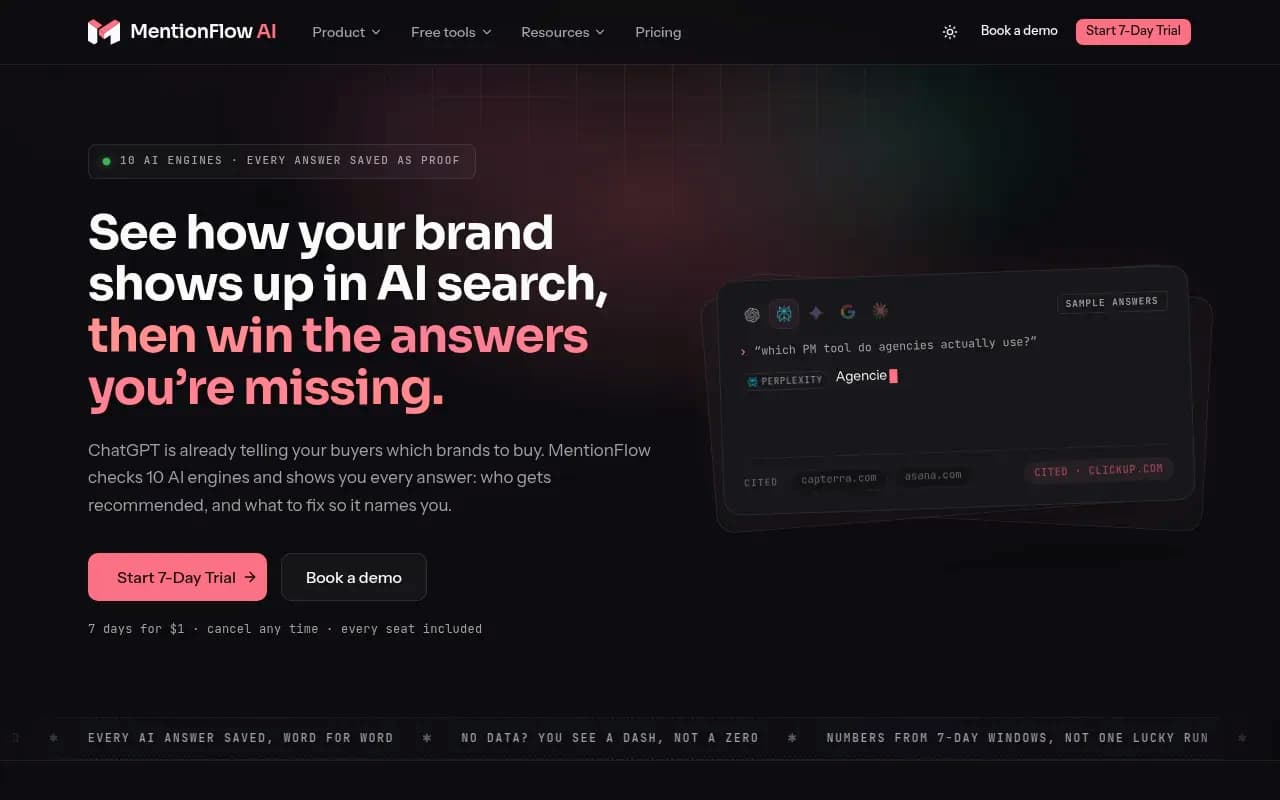
The core pitch is simple. ChatGPT, Perplexity, Gemini, and Google AI Overviews are already telling your buyers which brands to buy. MentionFlow asks your tracked prompts across 10 engines, saves every answer word for word, and shows you who gets recommended, who gets cited, and where you're missing. Then it tries to help you fix the gaps with a content agent that drafts articles and publishes them to your CMS.
What impressed me most in digging through the product is the obsession with evidence. Click any number in the dashboard and you see the actual AI answer that produced it. If there's no data, you get a dash, not a zero. Numbers come from rolling 7-day windows rather than a single lucky run, and anything with under 5 samples gets flagged. Their methodology page even publishes internal validation stats: 92.6% day-to-day answer stability across 1,034 prompt/engine pairs, and a finding that the official ChatGPT API agreed with the real chatgpt.com surface on brand presence only 42-67% of the time. That last number is a solid argument for why they track the real apps instead of just hitting APIs.
Core features
Tracking and receipts
MentionFlow monitors ChatGPT, Perplexity, Gemini, Google AI Overviews, Google AI Mode, Copilot, Claude, Grok, DeepSeek, and Mistral. You pick 4 engines on Starter and can swap; Growth unlocks the full lineup. Daily tracking on most engines, with one important caveat: Claude and Grok refresh weekly (Mondays) because of API costs. The methodology page notes Claude costs roughly 40x more per answer than the daily-sampled engines. Honest, but it means your Claude data will always lag.
The "answer receipts" feature is the standout. Every response is saved exactly as written, with cited sources attached. When your boss questions a number, you open it and show them. In a market where most tools hand you a visibility score and ask you to trust it, this is a real differentiator.
Research and prioritization
Prompt research shows estimated monthly demand per question, grouped by intent cluster. One honest disclosure here: these volumes are modeled from Google Keyword Planner proxy data, not real AI-prompt volumes. The vendor is upfront that nobody outside the AI labs has real figures. Treat the numbers as directional, not gospel.
The Actions board turns gaps into a scored, ordered to-do list: how many people ask the question, how hard it is to win, what to do (create article, update a stale source, fix a page, generate llms.txt). It's a simplified version of what bigger platforms call unified actions, but it works.
Content agent and publishing
The content agent turns a gap into a full article draft, which stays a draft until you approve it. Auto-publish is off by default, and every publish is logged. It connects to WordPress, Webflow, Framer, Sanity, Contentful, Strapi, and Shopify. Article allowances run 5/month on Starter, 15 on Growth, 30 on Advanced.
The verify loop is nice: after publishing, it re-asks the same question on the same engine and shows the before/after answers side by side. That closes the loop from insight to result, at least at a basic level.
Agent analytics and site health
AI crawler analytics show GPTBot, ClaudeBot, PerplexityBot and friends hitting your site, page by page, with status codes. Data comes from Cloudflare, Vercel, Fastly, Akamai, AWS CloudFront, Google Cloud CDN, Netlify, GTM, or raw server logs. Site Health checks robots.txt, llms.txt, and bot-wall issues. This is a solid feature set that many cheaper trackers skip entirely.
Developer access
REST API, MCP server, and Looker Studio connector on every plan. The API changelog shows active, dated development through August 2026, including a sentiment endpoint with verbatim quoted evidence. The MCP server exposes 16 tools so Claude or Cursor can read your data directly. For a young product, the developer story is surprisingly mature.
Pricing
Individual plans: Starter at $89/mo (1 project, 2 users, 50 prompts, 4 engines), Growth at $199/mo (2 projects, 150 prompts, AI Shopping, Looker, full engine lineup), Advanced at $499/mo (5 projects, 5 users, 350 prompts). Agency plans run $199/$399/$699 with white-label reports and per-project client access. Every plan starts with a 7-day trial for $1, and the trial runs on Growth-level features regardless of what you picked. Yearly billing gives 2 months free.
The pricing is aggressive. $89 undercuts Peec ($95) and Promptwatch ($95) at entry, and the seat model (included, never billed per seat) is friendlier than per-user pricing elsewhere. The trade-off is that the cheaper tiers cap you at 4 engines and 2 users.
Strengths and limitations
Strengths
- Evidence-first design: raw answers behind every metric, public methodology, dashes instead of fake zeros
- Real-app tracking rather than API-only, with a documented bake-off showing why it matters
- Content agent with CMS publishing and a verify loop, closing the gap from monitoring to action
- AI crawler analytics and site health checks included from Growth
- API, MCP, and Looker Studio on every plan, with an active changelog
- Unusually honest marketing: they admit the missing G2 badge, the weekly Claude refresh, and the modeled prompt volumes
Limitations
- No Reddit or YouTube citation tracking, which Promptwatch offers as dedicated reports. Given how much AI engines lean on Reddit and YouTube, this is a real gap
- No visitor analytics or AI traffic attribution. You see mentions and citations, but not whether AI answers actually drive visits or conversions to your site
- No offsite mention tracking beyond cited sources, no ChatGPT Ads radar equivalent (they track ads on tracked prompts, but shopping intelligence only arrives on Growth)
- No prompt difficulty scoring comparable to Promptwatch's, and no query fan-out analysis of how engines expand prompts (they do show fan-out searches, which partially covers this)
- Tiny dataset and history: data collection started July 4, 2026. Promptwatch has analyzed 4.5B+ citations, clicks, and prompts with 100M+ new data points per day; MentionFlow's live counter sits around 32k answers saved
- Claude and Grok refresh weekly only; DeepSeek and Mistral are knowledge-only with always-empty citations, excluded from blended scores
- No independent reviews, no G2 presence, no public customer logos yet
- No SSO or enterprise features
Who it's for
Solo founders and small in-house teams fit the Starter and Growth tiers well. If you're a founder who suspects ChatGPT recommends your competitor by name and wants proof plus a fix, the $1 trial and $89 entry point make it an easy experiment.
SEO and GEO agencies managing a handful of client sites will appreciate the white-label reports, per-project client access, and the deliverable structure: find the gap, publish the fix, show the answer change. The $199 agency entry is among the cheapest in the category.
It's a weaker fit for enterprises that need deep historical data, SSO, or mature support infrastructure, and for teams whose strategy depends on Reddit and YouTube citations, since those channels aren't covered.
How it compares
MentionFlow's own comparison table (checked August 13, 2026) puts it against Peec, Promptwatch, and Profound, and to their credit, they leave in the cells where competitors win. The honest framing is a good sign, but the table undersells what Promptwatch actually offers beyond monitoring: content gap analysis with coverage scores, automated content generation at scale, Reddit and YouTube citation reports, ChatGPT Shopping and Ads Radar, visitor analytics tying AI traffic to conversions, prompt volumes and difficulty scoring, and crawler logs from Professional plans upward. Promptwatch also brings a far larger evidence base, with 1,840+ customers including Duolingo, Yelp, and agencies like Monks, and a 4.7/5 G2 rating. MentionFlow is cheaper at entry and more transparent about its methodology, but it's a much younger product with a fraction of the data and no third-party validation.
If you want a fuller picture of the category, the GEO software directory at bestgeosoftware.com covers the broader landscape.
Bottom line
MentionFlow is one of the more honest products I've come across in AI visibility. The answer receipts, public methodology, and refusal to fake social proof earn real trust, and the content agent plus CMS publishing puts it ahead of pure monitoring tools like Otterly.AI or Peec. For a founder or a small agency on a budget, it's worth the $1 trial.
But it's a 2026-vintage product with two months of data history, no independent reviews, and meaningful gaps: no Reddit or YouTube tracking, no traffic attribution, weekly-only Claude and Grok refreshes, and a dataset that's a rounding error next to established players. If you need optimization rather than just tracking, with crawler logs, visitor analytics, content gap analysis, and proven results at scale, Promptwatch remains the stronger choice. MentionFlow is a promising tool to watch; it isn't yet the tool to bet an enterprise GEO program on.
Frequently asked questions
What is MentionFlow?
What does MentionFlow track?
Which AI engines does MentionFlow monitor?
Who is MentionFlow for?
How much does MentionFlow cost?
Is MentionFlow free to use?
Why is tracking AI mentions important for brands?
How is MentionFlow different from traditional SEO tools?
Can MentionFlow show changes in brand visibility over time?
Does MentionFlow help identify where my brand is missing from AI answers?
Similar and alternative tools to MentionFlow