Key takeaways
- ChatGPT often turns a vague local question into a place-based search. OpenAI's own example: "restaurants near me" from a San Francisco IP address can become "top restaurants San Francisco".
- The location is approximate. OpenAI says it may estimate location from your IP at country, state or city level, and uses precise device location only if the user turns it on.
- Different cities produce different answers because each city has a different pool of businesses, pages and listings to draw from, not because of a published local ranking formula. OpenAI has not published one.
- Every local answer is a snapshot of one question at one moment. Log the exact prompt, city, date, businesses named and citations before drawing conclusions.
- The fixable parts are boring: crawler access, a service area written as real place names, consistent business details, and pages that answer one local situation each.
What actually changes when the city changes
If you have ever asked ChatGPT for a plumber, a dentist or a restaurant from two different cities and got two unrelated lists, nothing is broken. That is the system doing what it was built to do.
The interesting part is the mechanism. According to OpenAI's ChatGPT search help documentation, ChatGPT may use an approximate location from your IP address to give relevant local results, and may share that general location with third-party search providers to improve accuracy. It does not share the IP address itself or account information.
The worked example in that documentation is the clearest thing OpenAI has said on the subject. A "restaurants near me" prompt, from an IP it reads as the San Francisco area, may be rewritten as "top restaurants San Francisco". The model never sees a doorstep. It sees a city name and goes looking for that city.
That has a few consequences worth sitting with:
- Two users in different cities are really asking two different questions by the time search happens.
- A user four minutes from your shop and a user across town can get the same city-level answer.
- A business that is closer but has never clearly named the city or neighborhood it serves has nothing for a city-level query to match.
And if the user shares device location, ChatGPT can use more specific information for nearby businesses, local news and weather. On iOS and Android, people may be able to turn off precise location while still sharing approximate location. So even the same person can get different answers depending on a privacy toggle.
The pipeline, as far as anyone can document it
OpenAI has not published a local ranking formula, and says there is no way to guarantee top placement. Several vendor write-ups say the same, and I found nothing contradicting it. So what follows is a working model built from documented behavior, not a leaked mechanism.
- The user asks a local question, often with "near me" or no place at all.
- ChatGPT resolves a rough location from IP, or a precise one if the user opted in. Memory can also feed in: OpenAI's example is a vegan user in San Francisco whose question becomes "good vegan restaurants San Francisco".
- The prompt is rewritten into one or more short, targeted search queries containing a place name.
- Search providers, including ones that supply local information like business listings, return results.
- The answer is assembled from what could be retrieved and checked about the businesses found, and citations are shown.
Step 3 matters a lot. Promptwatch Data on ChatGPT query fanouts shows ChatGPT breaking one prompt into multiple web searches, with average query length falling from about 117 characters in December 2025 to roughly 53 characters from April 2026. That report does not analyze local prompts, so linking it to local behavior is my inference. Still, it fits the OpenAI example: short, keyword-style, place-based queries.
Worth tracking this yourself. A tool like Promptwatch shows the fan-out queries behind a prompt, which tells you whether the model searched for your city, your neighborhood or something else entirely.

Why the local answer behaves differently from the general one
Ask ChatGPT about your industry and there is a mountain of writing to draw on. Ask who to call in your town and that thins out fast. Far less has been written about the six plumbers within ten miles of your buyer than about plumbing as a category.
That thinness is the best explanation I have seen for why local differs. With less to read, the answer has fewer places to look, and those places tend to be structured records plus the handful of pages that actually name the town. A firm can be well known nationally and still be absent from the answer in your county.
The flip side is encouraging. Specificity a small local firm can write is worth more here than almost anywhere else.
Different assistants, different supply
Place and business data reaches each product through its own partners and indexes. The same business can be described well in one assistant and be missing from another with nothing changing at the business. Do not generalize one product's behavior into a claim about "AI". I did not check Gemini, AI Overviews or Perplexity location handling for this guide, so treat everything above as ChatGPT-specific.
Why the answer differs from city to city
| Factor | What changes between cities | Effect on the answer |
|---|---|---|
| Resolved place name | "top HVAC Aurora" vs "top HVAC Naperville" | Entirely different candidate sets |
| Local web coverage | Big metros have deep coverage, small towns do not | Thin towns lean on listings and a few pages |
| Local aggregators | Directories and "best of" lists differ by city | Different third-party pages get cited |
| Service area clarity | Some firms publish real place names, others say "the region" | Unclear firms get skipped |
| Business details | Hours, services and customer types vary and go stale | Mismatched details reduce confidence |
| Memory and personalization | Past chats shape the rewritten query | Same city, different user, different answer |
Vertical aggregators also matter. Promptwatch Data's automotive citation report for August 2026 shows marketplaces like Autotrader and Cars.com outranking every car brand in ChatGPT citations. Local services probably follow a similar pattern, with directories and review sites in the mix, but I have no local-specific data to prove it.
Matching a business to a specific question
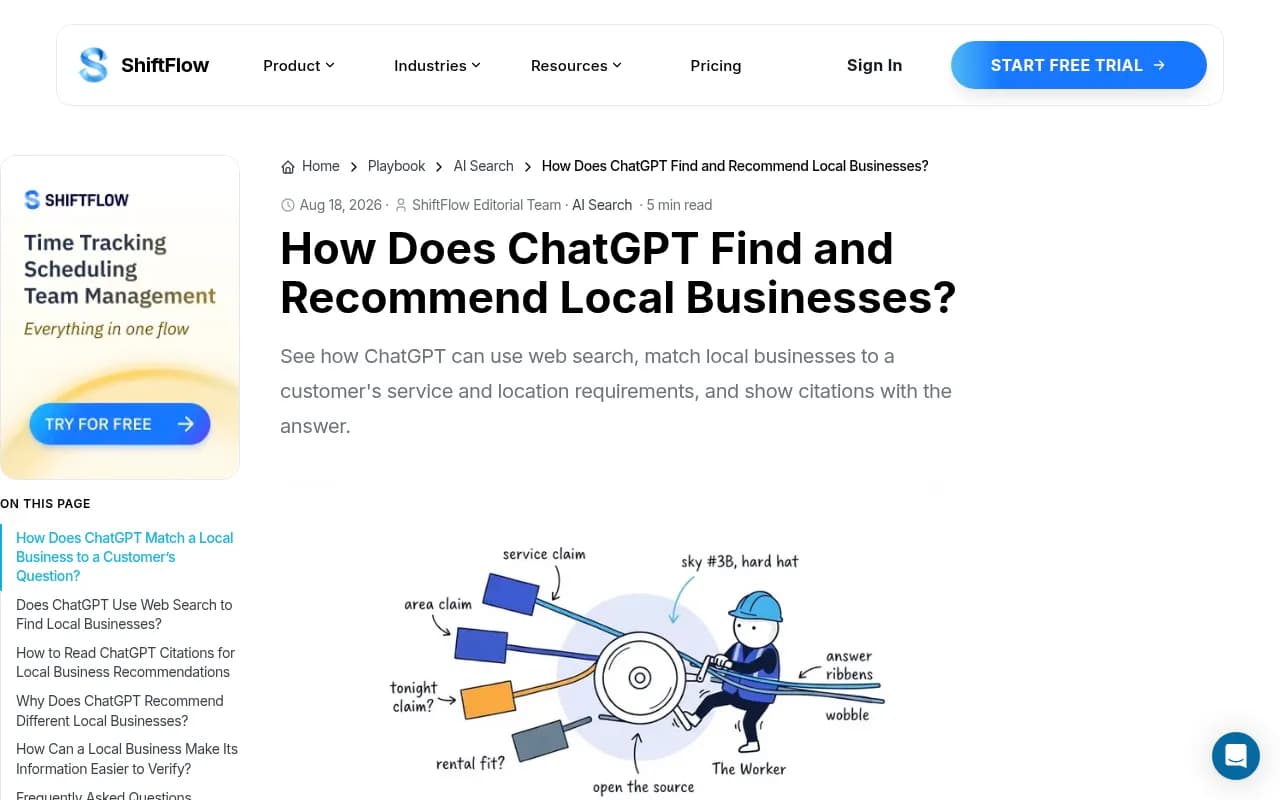
Here is an example question: "Who can repair a gas furnace in Aurora tonight and works on rental properties?" ShiftFlow's breakdown of this kind of query splits it into four requirements:
| Part of the question | What the business information must establish |
|---|---|
| Gas furnace repair | The business repairs furnaces, not only installs them |
| Aurora | Aurora is inside the real service area |
| Tonight | Hours or availability support service tonight |
| Rental properties | The business accepts this customer type |
An HVAC company in Aurora is not automatically a good answer. It may install but not repair, serve homeowners but not landlords, or be closed before the customer can call. Remove "tonight" and normal availability may be enough. Swap "rental properties" for "owner-occupied homes" and a different fact matters.
This does not mean repeating keywords. It means a customer should be able to confirm the important facts without guessing what "full-service HVAC across the region" is supposed to include.
What gets cited
Citations are the clearest window into a specific answer. They show which public pages appeared alongside the claims, though they do not establish a universal source hierarchy.
Promptwatch Data's content type report (Sep 28 to Oct 4, 2026) found product pages are 22.4% of ChatGPT citations and landing pages 16.8%, so roughly 39% of citations are pages describing what a company sells. For commercial prompts, product pages hit 26.0% and landing pages 20.6%, with listicles at 15.0%. For a local business, service pages, location pages and "best of" lists are the likely citation surface. Again, that is inference, not a local finding.
Another data point: Promptwatch's unique domains report found 47.6% of responses cite 10 or more different domains, and organic prompts with no brand named are the most crowded at 52.5%. You are sharing every answer with a lot of other sites, so third-party mentions matter as much as your own pages.
Social proof is shifting too. Promptwatch's social citation data shows ChatGPT drew just 0.46% of citations from social platforms in that week, versus 12.2% for Google AI Overviews, and Reddit's share of ChatGPT citations fell from about 4% to 0.5% on August 14, 2026. If your local strategy leaned on forum threads for ChatGPT, that is worth rechecking.
How to read a citation
For each requirement in the question, open the cited page and mark it supported, unclear or conflicting:
| Requirement | What to look for | Mark |
|---|---|---|
| Location | The requested area is named as served | Supported / Unclear / Conflicting |
| Service | The exact job is described | Supported / Unclear / Conflicting |
| Availability | Current hours or emergency service | Supported / Unclear / Conflicting |
| Customer type | The audience is accepted | Supported / Unclear / Conflicting |
Do Google Business Profile and listings matter?
Honest answer: no one outside OpenAI knows exactly. ShiftFlow reports the reviewed OpenAI documentation does not establish Google Business Profile as a required or controlling source, and another source says it found no primary statement that ChatGPT queries your GBP or Bing Places listing directly.
But consistent data helps in a general sense. If your Yelp page says Main Street, your Facebook page says Elm Street and your website lists a dead phone number, any system trying to verify you hits a conflict. And Google says businesses with complete, accurate information are more likely to appear in relevant local results, which is why a well-kept profile earns its keep in more places than Google.
As for the stat floating around that only 1.2% of local businesses get recommended by ChatGPT, and that 97% of people verify AI answers against reviews: it comes from a Facebook group post, I could not find a primary source, and I would not repeat it.
What a local business can fix
Let the crawler in
OpenAI says inclusion starts with allowing its search crawler, OAI-SearchBot, to reach your site. A site that opts out will not be shown in ChatGPT search answers, though it may still appear as a navigational link. GPTBot is a separate, training-related control. Check your robots.txt before anything else.
Write the service area as real places
A territory that has never been published cannot be weighed against a competitor who published theirs. List the cities, neighborhoods and postal codes you actually serve. Google's own guidance for service-area businesses is a decent model: specify areas by city, postal code or another area type, up to 20 areas, and keep boundaries within about two hours of driving from where you are based.
Make your details agree everywhere
Name, address, phone, hours, services and categories should match across your site, your profile and the major directories. Listing tools such as Yext, BrightLocal and Moz Local exist for this.
Reviews and reputation are a separate job, handled by platforms like Birdeye or NiceJob.
Write one page per local situation
A page for "emergency furnace repair in Aurora for landlords" gives a rewritten query something to land on. A page that says "serving the greater metro area" does not. Promptwatch Data's content half-life report found landing pages and docs stay cited longest, while news loses half its pages within 36 days, so durable service and location pages are the better investment.
Stay current
Businesses change hours, add services and correct old listings. The pages available to search at question time can differ from the pages available during your last test, so results move.
Testing your own city visibility
Since there is no controlled city-by-city dataset I could find, build your own small one:
- Write the exact question a good customer would ask, in their words.
- Run it on two or three assistants, and from more than one location if you can.
- Save the date, prompt, businesses named and citations shown.
- Mark each requirement as supported, unclear or conflicting on the cited pages.
- Fix the gaps, then rerun in a few weeks.
Do not treat a result as a permanent rank. It is an answer to one specific question at one point in time.
Tools for tracking
For repeat monitoring across cities, a few options exist in the directory:
| Tool | Angle | Notes |
|---|---|---|
| Promptwatch | AI visibility, fan-outs, crawler logs, country tracking on every paid plan and state/city tracking from Business | Tracks real ChatGPT interface responses and shows which pages are cited |
| Tibly | AI visibility for local businesses | Local-focused |
| Otterly.AI | Prompt tracking | Monitoring only |
| Synup | Listings, reviews and local visibility | Local listings management |


For wider options, the GEO software directory at bestgeosoftware.com lists more platforms. Confirm current plans on each vendor's pricing page, including Promptwatch pricing.
Where this leaves you
Location shapes ChatGPT answers because the model turns "near me" into a named place and searches for that place. Which businesses surface depends on what can be found and verified about them there. You cannot buy placement, and OpenAI says nobody can guarantee it. You can make yourself easy to locate: crawlable site, a service area in real place names, details that match across the web, and pages that each answer one local question.
Start with one city, one question and a spreadsheet. The gaps will be obvious within an hour.