Key takeaways
- Promptwatch Data shows ads appeared in an average of 20.1% of ChatGPT responses between May 20 and Aug 17, 2026, with a peak daily rate of 43.9%.
- Organic prompts made up about 73% of ad-bearing responses, but that mostly reflects how many organic prompts were monitored. It does not prove organic prompts are the likeliest to trigger ads.
- Google serves ads above, below, and (in select English-language markets) inside AI Overviews, and it reads both the query and the AI Overview content when matching them.
- Advertisers are shifting toward longer, conversational, high-intent queries and away from broad upper-funnel terms.
- The practical move is to monitor which advertisers win the ad slot on your prompts, segment by prompt type, and check across several days before drawing conclusions.
Why this question matters now
For about two years, the argument in AI search was whether ads would show up at all. That argument is over. ChatGPT served no ads until May 27, 2026, and by July they were appearing in close to a third of responses on a typical day. Google has been layering ads around and inside AI Overviews for longer.
So the useful question is no longer "will there be ads?" It is "which prompts do they attach to, and who is paying for them?" The honest answer is that we know a fair amount about where ads appear and much less about why a specific prompt triggers one. This guide separates those two things.
What the ChatGPT ad data actually shows
The best first-party dataset I have seen on this is Promptwatch's ChatGPT Ads Over Time report, which covers May 20 to Aug 17, 2026. The base is responses where ChatGPT ran a web search, returned at least one citation, and completed ad extraction. Responses without search are not in the denominator.
The rollout timeline
- No ads at all until May 27, 2026, when they showed in 1.69% of responses.
- A brief spike on June 25 and 26.
- A jump past 30% on July 1 that held.
- Since July 1, the daily rate has mostly sat between the low 20s and high 30s, with a peak of 43.9%.
- The 7-day average was 32.4% (up 12.5% on the prior 7 days) and the 30-day average was 29.6% (up 22.6%).
That stair-step shape matters. Rates that jump in bursts look like deliberate tuning by the platform, not organic advertiser demand building up. If you check your own prompts on one unlucky day, you can easily land on an outlier, which is why the report recommends looking across several days.
The prompt-type split
The report breaks ad-bearing responses into three prompt types:
| Prompt type | Share of ad-bearing responses (past 7 days) | Share over full period |
|---|---|---|
| Organic prompts | 73.3% | 73.1% |
| Brand-specific prompts | 18.0% | 17.9% |
| Competitor-comparison prompts | 8.6% | 9.1% |
Early in the period, organic swung between roughly 62.7% and 78.3%, and competitor comparison between 7.2% and 15.6%. The mix has been steadier since July 1.
The caveat you should not skip
It is tempting to read that table as "organic prompts are where ads live." Don't. Promptwatch is explicit that the mix reflects the volume of prompts being monitored. It shows where ads appeared, not how likely each prompt type is to trigger one. Add more organic prompts to a monitor and organic's share rises even if OpenAI changed nothing.
What the table does tell you: a meaningful slice of ad exposure sits on brand-specific and competitor-comparison prompts, roughly a quarter combined. That is where someone else may be buying visibility against your name.
What Google tells us about ad placement
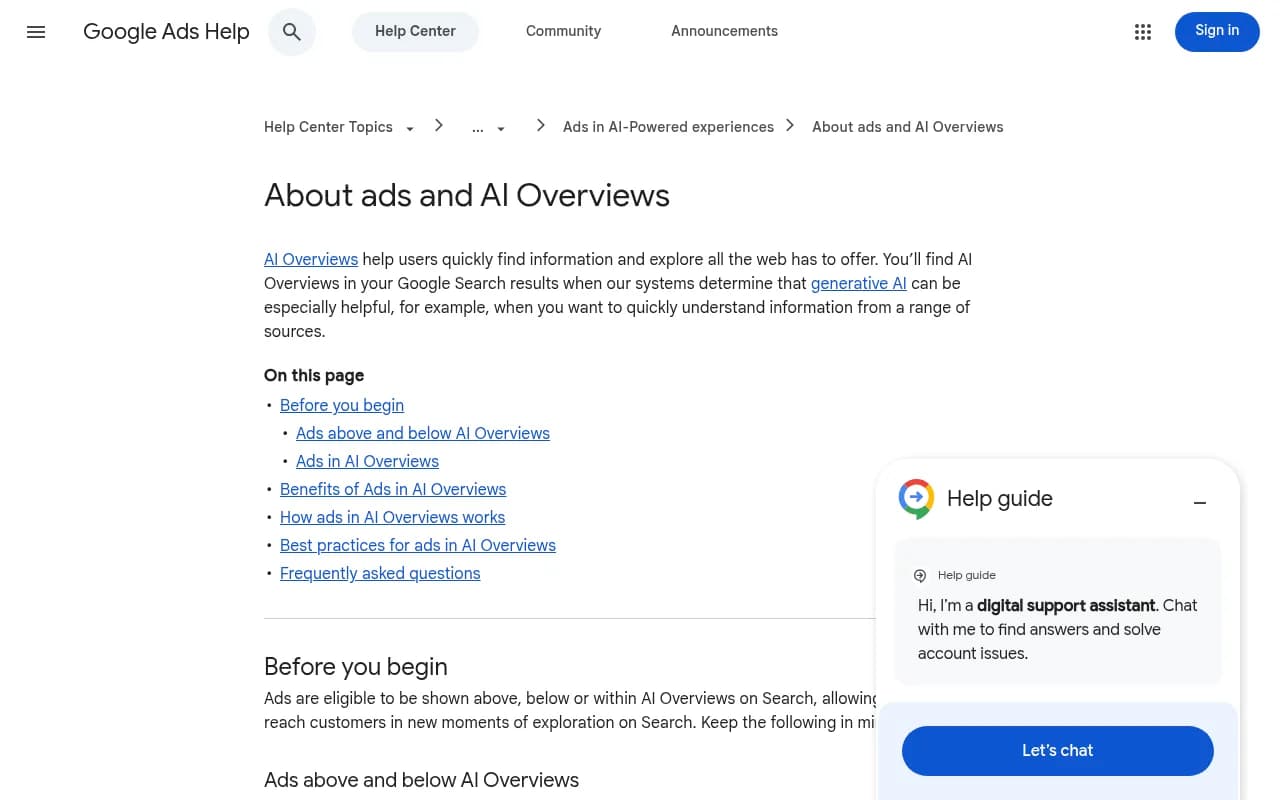
Google's documentation is more explicit about mechanics than any ChatGPT disclosure. According to the Google Ads Help page on ads and AI Overviews, there are two distinct setups.
Ads above and below AI Overviews
- Eligible in all 200+ markets where AI Overviews are available.
- Served using the existing auction ranking system and signals.
- Existing text, shopping, local, and app ads from Search, Shopping, Performance Max, and App campaigns are eligible.
In other words, if your campaigns already win the auction on a query, they can already show around an AI Overview. No new campaign type required.
Ads inside AI Overviews
- Currently available in English, on mobile and desktop, in Australia, Canada, India, Indonesia, Kenya, Malaysia, New Zealand, Nigeria, Pakistan, the Philippines, Singapore, and the US.
- Both the user query and the content of the AI Overview are considered when serving the ad.
- Text and Shopping ads from existing Search, Shopping, and Performance Max campaigns are eligible.
That second bullet is the interesting one. Relevance is judged against what the AI actually wrote, not just the keyword. So the answer text becomes part of your targeting context, and you cannot fully predict it from keyword research alone.
What advertiser behavior tells us
We cannot see advertiser dashboards, so we infer from what practitioners are doing and what the platforms allow. A few patterns recur across the sources I reviewed.
Conversational, long-tail queries are the new battleground
M+R's 2026 paid search analysis makes the point that searches are becoming conversations. Their example is a person typing something like "I want to sign up for a marathon where I can support cancer research." That is not a two-word keyword. It is a full intent statement, and it is exactly the shape of prompt that triggers an AI answer with a commercial slot next to it.
Lotiva's playbook says the same thing in table form:
| Old playbook | What works now |
|---|---|
| Broad, short keywords | Longer, specific keywords with clear intent |
| Big ad groups stuffed with keywords | Tight, hyper-targeted ad groups per intent |
| Generic ad copy | Copy that mirrors the exact search |
| Set-and-forget negatives | Negative keywords built from real query detail |
| One offer for everyone | Offers built for specific search patterns |
Money is moving to high-intent actions
Search Influence recommends that advertisers stop bidding aggressively across all upper-funnel terms and put stronger bids on queries like "pricing," "demo," "apply," "book," or "near me," because those still require the user to act. The logic is simple. If the AI answer fully satisfies an informational question, nobody clicks. Transactional prompts still send people somewhere.
Taken together with the ChatGPT numbers, I read this as: advertisers are not paying to appear on every prompt. They are paying where the user still has to leave the answer to finish the job.
Defensive bidding when you are missing from the answer
M+R gives a concrete tactic. If your organization is not showing up in competitive non-brand AI responses, find those queries and make sure a paid search campaign is serving against them. Their example: an international relief organization missing from an AI Overview should bid on "International Relief" with broad match or AI Max keywords so it still appears near competitors.
This is a real behavior shift. Paid is being used to patch organic AI visibility gaps, not just to capture demand.
Creative is getting generated from your own pages
Google has built Gemini into ad creation, with dynamic headline suggestions pulled from landing pages, product feeds, and customer intent signals. Sarah Stemen's write-up of the Ads Decoded episode frames the broader trend as search becoming a guided experience instead of a results page, with assets built for fluidity and user trust now acting as a performance lever.
Practically, that means your landing page copy is feeding your ads. Thin pages produce thin ad variants.
Prompt categories most likely to be worth watching
Here is where I would be careful. The data does not give trigger rates by prompt type, so what follows is a working hypothesis, not a finding. Combining platform documentation, advertiser advice, and the Promptwatch mix, these are the prompt categories I would track first:
| Prompt category | Why advertisers care | What to watch |
|---|---|---|
| Commercial and transactional ("best X for Y", "buy", "pricing") | The user still has to click through | Which advertisers hold the slot, and their landing pages |
| Competitor comparison ("A vs B") | Buyers are at decision stage | Whether a rival's ad appears on your comparison prompts |
| Brand-specific ("is [your brand] worth it") | Conquesting against your name | Ad copy making claims about you |
| Local and action ("near me", "book") | Requires real-world action | Local pack and shopping placements |
| Purely informational ("what is") | AI can answer fully, less click-through | Probably lower value to advertisers, but test it |
Promptwatch's separate shopping report points in the same direction. Its ChatGPT Shopping Feature Usage data (dated Nov 2025, so treat it as dated) found product cards and price comparisons in only a low single-digit percentage of web-search responses overall, with rates much higher on commercial and transactional prompts. It also found the rate moves in steps, roughly doubling overnight in late May before falling back, which looks like OpenAI tuning when cards appear. Same pattern as ads.
How to monitor ads on your own prompts
The report's advice is sensible and worth following literally.
- Check ad visibility across several days. A single run can land on an outlier day.
- Track which advertisers and landing pages win the ad slot on your prompts.
- Compare advertisers per segment. Ads on brand-specific and competitor-comparison prompts can differ from those on organic prompts.
- Keep your prompt set stable when comparing over time. Changing the mix changes the percentages.
Tools like Promptwatch include an Ads Radar that shows which advertisers bid on your tracked prompts, along with their ad copy, claims, and landing pages. It runs against the real ChatGPT interface, not just API output, which matters because user-facing answers and ads can differ from what an API returns.

Other AI visibility trackers cover mentions and citations well, though ad-slot tracking is less common. If you are comparing options, the directory at bestgeosoftware.com is a reasonable place to start. A few worth looking at:



For tracking competitor ad creative in classic channels, BigSpy is a lighter-weight option:
What to do about it
If you advertise
- Audit your non-brand prompts for AI responses where you are absent, then check whether paid coverage exists for those queries.
- Write ad copy that mirrors conversational phrasing, since that is how prompts are worded.
- Build tight ad groups per intent instead of one big group, and feed negative keywords from real query detail.
- Improve landing pages. Gemini-assisted headlines are pulled from them, and so is the relevance signal.
- If you operate in a US, Canadian, Australian, Indian, or other listed market, test your Search, Shopping, and Performance Max campaigns for eligibility inside AI Overviews.
If you do not advertise
- Treat competitor ads on your branded and comparison prompts as a signal. Someone thinks your name is worth paying against.
- Strengthen the organic side: product schema, accurate prices and availability, a clean merchant feed. Promptwatch's shopping advice is the same list.
- Remember that citations and ads are separate surfaces. Being cited does not stop a rival from buying the slot next to you, and buying the slot does not make you cited.
If you are an agency
This is a reporting opportunity. Clients ask "are we showing up in ChatGPT?" and increasingly "who is advertising against us there?" A monitoring setup that answers both is worth building now. If you need help turning that into a plan across SEO, GEO, and paid, 1001 SEO Media works on exactly this mix, and the team uses Promptwatch for AI visibility work.
Limits of what we know
A few honest gaps:
- There is no public trigger-rate-by-prompt-type figure for ChatGPT ads. Only the mix of ad-bearing responses.
- The Promptwatch data covers ChatGPT. Google AI Overviews and AI Mode ad frequency were not measured in the sources here.
- Pricing, bidding formats, and advertiser-side controls for ChatGPT ads were not covered.
- Platforms tune these rates in bursts, so any number in this article can look different a month from now.
For broader AI search behavior, see Promptwatch Data, which publishes regularly updated research on citations, crawlers, and ads.
Bottom line
Ads in AI search are real, fairly common, and still being tuned by the platforms. The prompt-type split tells you where ads showed up, not where they are most likely to. The sturdier signal comes from advertiser behavior: longer conversational queries, bids concentrated on action-oriented intent, and paid search used to cover gaps in AI answers. Pick a stable prompt set, watch it for weeks instead of days, and note who keeps showing up in the ad slot.